

Learn the Basics. Save a Life.
When someone’s heart stops beating or they stop breathing, every second counts. CPR and basic lifesaving techniques give you the power to respond quickly and effectively—even before emergency help arrives. This guide introduces you to the fundamentals of Cardiopulmonary Resuscitation (CPR) and other essential emergency response actions every beginner should know.
What Is CPR?
Cardiopulmonary Resuscitation (CPR) is a lifesaving procedure performed when the heart stops beating or a person is not breathing. It keeps oxygenated blood flowing to the brain and vital organs until normal heart activity can be restored.
CPR involves two key actions:
- Chest compressions – to manually pump blood through the body.
- Rescue breaths (optional for lay responders) – to provide oxygen to the lungs.
When done correctly, CPR can double or triple a person’s chance of survival.
When to Use CPR
You should begin CPR if a person:
- Is unresponsive and not breathing
- Is only gasping or showing irregular, shallow breathing
- Has no pulse (if trained to check)+
Always call emergency services first (in Kenya: 999, 911, or 112), or ask someone nearby to do so.
Hands-Only CPR for Adults and Teens
If you’re not trained in full CPR or are unsure about giving rescue breaths, hands-only CPR is the recommended approach for adults and teenagers.
Steps:
- Ensure the scene is safe.
- Check for responsiveness by tapping the person and shouting.
- If there’s no response and they are not breathing or only gasping, call for help.
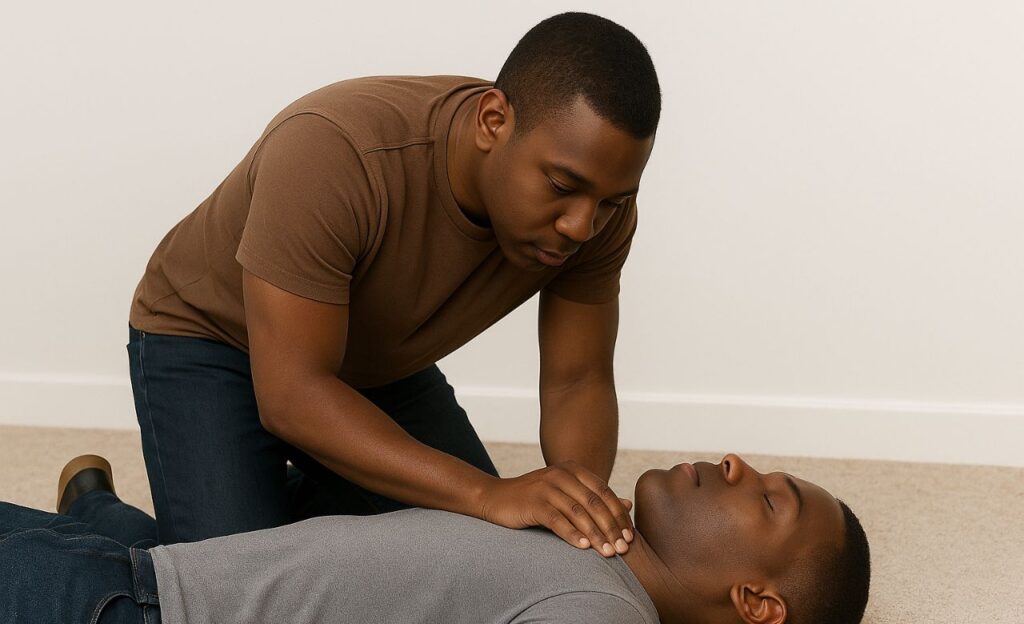
- Begin chest compressions:
- Place the heel of one hand in the center of the chest (on the lower half of the breastbone).
- Place your other hand on top and interlock fingers.
- Keep your elbows straight and shoulders above your hands.
- Push hard and fast—at least 2 inches deep and at a rate of 100–120 compressions per minute.
- Allow the chest to fully recoil between compressions.
- Continue until help arrives or the person starts breathing.
CPR With Rescue Breaths (Full CPR)
If you’re trained and comfortable:
30 compressions + 2 breaths:
- After 30 compressions, tilt the person’s head back slightly to open the airway.
- Pinch the nose, cover their mouth with yours, and give 2 slow breaths, watching the chest rise.
- Resume compressions immediately.
Repeat this cycle: 30 compressions, 2 breaths.
CPR for Children and Infants
Children (1–12 years):
- Use one hand for compressions (two if needed for strength).
- Compress the chest about 2 inches deep.
- Continue with 30 compressions and 2 gentle breaths.
Infants (under 1 year):
- Use two fingers in the center of the chest.
- Compress the chest about 1.5 inches deep.
- Cover both the nose and mouth with your mouth when giving breaths.
- Be very gentle—do not use adult force.
Using an Automated External Defibrillator (AED)
An AED is a portable device that analyzes the heart rhythm and, if needed, delivers a shock to help restart the heart.
Steps:
- Turn on the AED and follow the audio/visual prompts.
- Expose the chest and attach the pads as shown in the diagrams.
- Ensure no one is touching the person when the AED analyzes or delivers a shock.
- Resume CPR immediately after the shock if advised.
AEDs are safe and easy to use, even for untrained bystanders.
Other Lifesaving Techniques to Know
Recovery Position (for breathing but unconscious people):
- Turn the person onto their side with the head tilted slightly back.
- This keeps the airway open and prevents choking.
Choking Rescue:
- For adults and children: Use back blows and abdominal thrusts.
- For infants: Use 5 gentle back slaps followed by 5 chest thrusts.
Controlling Severe Bleeding:
- Apply firm, direct pressure to the wound using a clean cloth or bandage.
- Raise the injured part if possible.
- Do not remove embedded objects; apply pressure around them.
Common Myths About CPR
- “I might do it wrong.” Doing something is better than doing nothing—especially with hands-only CPR.
- “Only professionals should do CPR.” Anyone can perform CPR. It can make all the difference before emergency services arrive.
- “Rescue breaths are always required.” Hands-only CPR is effective for most adult cardiac arrest cases.


Leave a Reply