
Every successful business begins with a single idea—but not every idea becomes a viable product. What separates dreamers from doers is the ability to validate, shape, and develop that idea into something real, useful, and valuable to others. This self-study guide will walk you through the essential steps of turning your business concept into a product that meets real needs, attracts real users, and has potential for growth.
Whether you’re starting from scratch or already have a concept in mind, this guide will help you clarify your direction, test your assumptions, and take practical steps toward launching a real product.
Clarify Your Business Idea
The first step is defining your idea with precision. Ask yourself:
- What specific problem am I solving?
- Who experiences this problem most?
- How does my idea offer a better solution than what currently exists?
A good practice is to craft a value proposition—a single sentence that captures the essence of your idea.
Example:
A mobile app that allows Nairobi residents to order home-cooked meals from local chefs, delivered within 30 minutes.
Be clear, specific, and honest. A focused idea is easier to develop and test.
Conduct Market Research
To ensure your idea has potential, conduct basic but effective market research. You need to understand:
- Your target audience: Who will buy or use your product?
- Market demand: How big is the need or problem?
- Existing solutions: What are your competitors doing well or missing?
Methods to use:
- Online surveys (Google Forms, Typeform)
- Social media polls or group discussions
- Keyword research (Google Trends)
- Reading reviews of similar products
Good research helps you avoid assumptions and design with purpose.
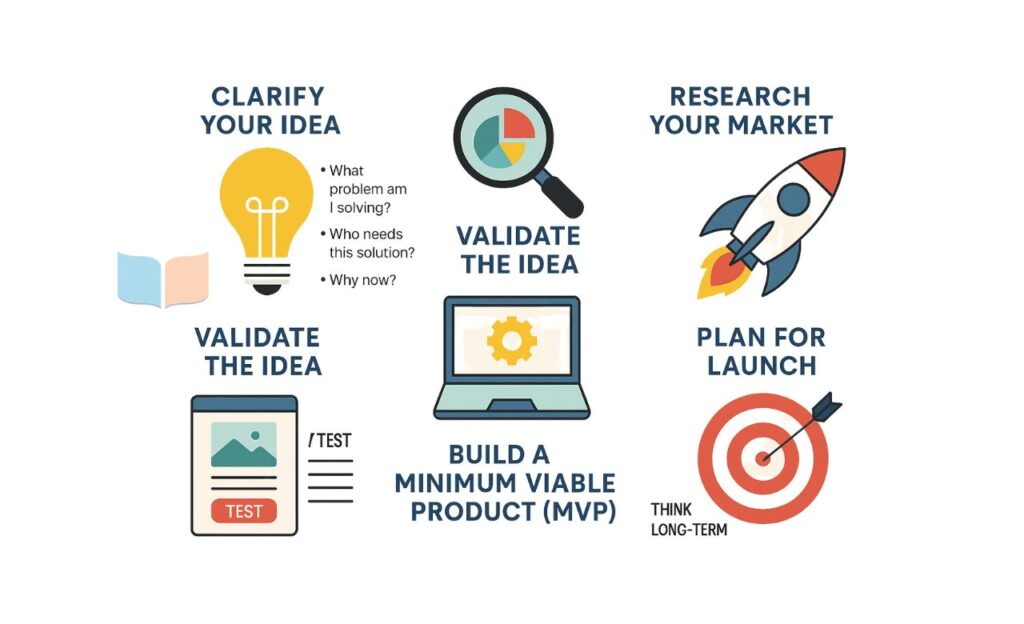
Validate the Idea
Validation is the process of proving that people truly want what you’re offering.
Ways to validate your idea:
- Conduct short interviews with your target users
- Set up a simple landing page explaining your product and collect sign-ups
- Post about your idea on social media or community forums to gauge interest
- Offer a test version of the service manually and measure the response
The goal is to confirm demand before spending time and money on full development.
Build a Minimum Viable Product (MVP)
An MVP is the simplest functional version of your product that solves the main problem for your users.
Key characteristics of an MVP:
- Focuses on just one core feature
- Built quickly with minimal resources
- Meant for testing and learning—not perfection
Examples:
- A service-based business can use WhatsApp or Facebook to coordinate clients
- A tech startup can use a no-code tool like Glide or Bubble
- A retail idea can start with selling via Instagram or Jumia before launching a website
Your MVP is your learning tool—it helps you gather real-world insights fast.
Test, Learn, and Improve
Now that users are interacting with your MVP, observe and ask:
- What do users love or ignore?
- Are they using it as you expected?
- What confuses them?
- What feedback do they keep repeating?
Practical tips:
- Track usage and feedback in a spreadsheet or Notion board
- Don’t be afraid to make changes (pivot) if needed
- Keep your users involved—they are your best advisors
This is where real growth begins—through listening and adjusting.
Prepare for Launch
With a working version and user feedback, you can now plan your full product launch.
Steps for a simple launch:
- Design a clear, attractive landing page or product website
- Create basic branding (logo, colors, name)
- Start building excitement through social media or email
- Offer early access or bonuses to first users
Your goal during launch is to build momentum, gain real users, and keep improving.
Plan for Growth and Sustainability
Beyond the launch, think long-term:
- How will you grow your customer base?
- What will you improve or add next?
- Will you need a team, funding, or better systems?
- How will you stay profitable?
Growth means thinking beyond just today’s users—it means preparing to serve more people, more efficiently, with consistent quality.
Examples:
- Automate manual tasks
- Partner with others for distribution
- Set goals for the next 3, 6, and 12 months
Success is not about speed, but about steady progress guided by purpose.
Final Takeaway
Developing a business idea into a viable product is a journey. It requires clear thinking, real feedback, flexibility, and courage. Start small, test often, and never stop learning. You don’t need to be perfect—you just need to keep moving forward, step by step.


Leave a Reply