
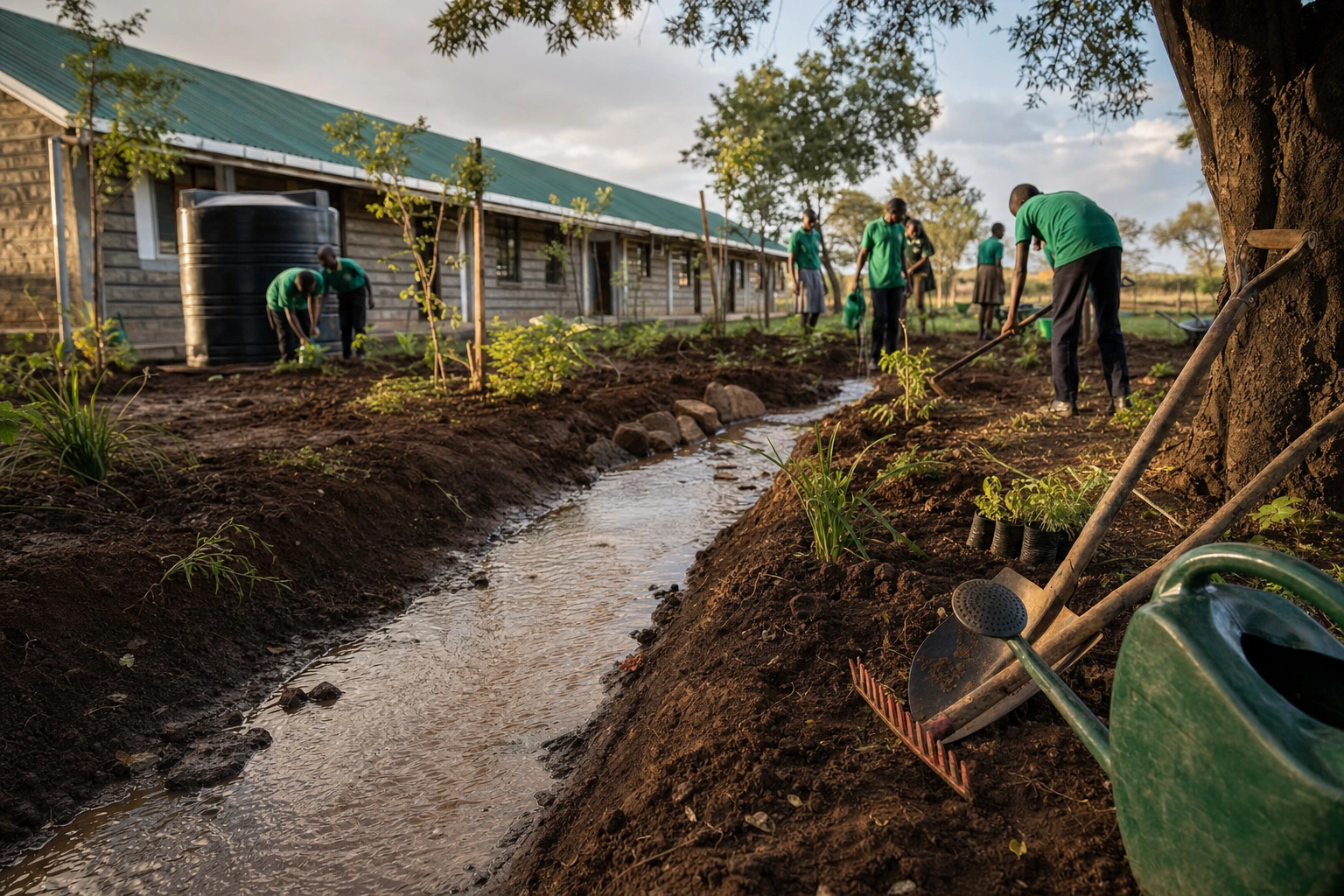
Climate change is often discussed as a problem for governments, scientists and large organisations. Yet young people have a direct stake in the decisions made today because those decisions shape the quality of their future work, health, livelihoods and communities. Youth participation in climate action means more than inviting young people to attend an environmental event. It means giving them meaningful opportunities to understand climate risks, influence decisions and lead practical responses.
Young people are already contributing in many ways: organising clean-up activities, restoring ecosystems, developing climate-smart businesses, conducting research, educating peers and speaking about environmental concerns in public forums. Their participation becomes most effective when it is informed, inclusive and connected to real decision-making. This article explains what meaningful youth participation involves and how learners, professionals, entrepreneurs, schools, communities and institutions can support it.
What Youth Participation in Climate Action Means
Youth participation is the active involvement of young people in identifying environmental problems, developing solutions, putting plans into practice and evaluating results. It includes both individual and collective action. A student may reduce waste in a school, while a youth group may campaign for better public transport or protect a local wetland.
Participation has several levels:
- Learning and awareness: young people build knowledge about climate change, its causes, its effects and possible responses.
- Consultation: young people share views before a project, policy or decision is made.
- Collaboration: young people work alongside adults, institutions or businesses to design and implement solutions.
- Leadership: young people set priorities, manage activities, make decisions and remain accountable for results.
- Advocacy and accountability: young people ask decision-makers to explain their choices and improve environmental performance.
These levels are not identical. Asking young people to submit opinions is useful, but it is not the same as giving them influence over a project. Meaningful participation requires clarity about what young people can decide, what support they will receive and how their contributions will affect the outcome.
Why Youth Participation Matters
Young people bring important perspectives to climate action because they experience schools, workplaces, digital spaces and communities in ways that may differ from older decision-makers. They can identify practical barriers that are easily overlooked. For example, young commuters may understand why a proposed transport arrangement is difficult to use, while young farmers may notice changing rainfall patterns and market pressures affecting local livelihoods.
Youth participation can also strengthen communication. Young people often share information through peer networks, community groups and digital platforms. When they understand climate issues accurately, they can translate technical ideas into language that is relevant to friends, families and customers. This does not mean assuming that every young person is automatically an environmental expert. Effective participation still requires training, reliable information and access to knowledgeable mentors.
Climate action also needs creativity and experimentation. Young entrepreneurs may see opportunities in solar services, repair businesses, sustainable agriculture, recycling, water efficiency or low-waste products. These activities can support both environmental goals and livelihoods when they are designed around genuine customer needs and responsible business practices.
Finally, involving young people strengthens fairness between generations. Decisions about energy, land use, urban development and natural resources can create long-term consequences. Young people should therefore be able to contribute to discussions about choices that will affect their lives, rather than being treated only as future leaders.
Understanding Climate Action
Climate action includes two broad areas: mitigation and adaptation. Understanding the difference helps young people choose realistic projects.
Mitigation involves reducing greenhouse gas emissions or increasing the removal of carbon dioxide from the atmosphere. Examples include improving energy efficiency, using renewable energy, reducing unnecessary travel, protecting forests and reducing waste that could otherwise generate emissions.
Adaptation involves adjusting to actual or expected climate impacts. Examples include water-saving farming methods, improving drainage, protecting homes from flooding, planting suitable trees, developing heat-management plans and using climate information to make better decisions.
Some activities support both areas. Restoring a degraded landscape can help store carbon while reducing erosion and improving water retention. A school tree-planting programme, however, should not be judged only by the number of seedlings planted. The choice of species, location, maintenance, survival and effects on local biodiversity all matter.
Practical Ways Young People Can Participate
Build climate literacy
Climate literacy means being able to understand climate information, assess claims and connect global processes with local experiences. Young people can begin by learning key concepts such as emissions, resilience, adaptation, mitigation, biodiversity, renewable energy and sustainable consumption.
Good learning involves comparing sources rather than accepting every dramatic claim online. A learner can ask: Who produced this information? Is the evidence explained? Does the claim distinguish between weather and climate? Is it consistent with reliable scientific and public information? This habit is valuable for professionals and entrepreneurs as well as students because poor information can lead to ineffective or harmful decisions.
Improve practices at school, work or home
Climate action often begins with observing how resources are used. A group might examine electricity consumption, water leaks, food waste, transport patterns or the disposal of electronic equipment. The group can then identify one manageable improvement, establish a baseline and track progress.
For example, a workplace youth committee could map which lights and appliances are regularly left on after working hours. It could recommend simple operating procedures, check whether equipment is being used efficiently and report the results to management. The purpose is not to blame individuals but to improve systems and make responsible choices easier.
Join or create community projects
Community projects are strongest when they respond to a clearly defined local need. Possible activities include restoring a stream, maintaining a community garden, reducing plastic waste, improving public awareness of flood risks or supporting household energy efficiency.
Before starting, young organisers should speak with residents and relevant local groups. They need to understand land ownership, safety concerns, seasonal conditions and the views of people who may be affected. A project designed without local knowledge may duplicate existing work or create conflict. Listening is therefore part of climate action, not a delay before the “real” work begins.
Take part in public decision-making
Youth participation can include attending public forums, submitting written views, joining school or community committees, engaging elected representatives and contributing to consultations on development plans. Effective advocacy is specific. Instead of saying only that leaders should “save the environment”, young advocates might request safer walking routes near a school, stronger protection for a wetland or clearer waste collection arrangements.
Useful advocacy explains the problem, identifies who has responsibility, presents evidence and proposes a realistic action. It also recognises different interests. A campaign about cleaner transport, for instance, should consider passengers, workers, operators, people with disabilities and residents living near busy roads.
Develop climate-related enterprises
Climate entrepreneurship involves creating products or services that address environmental challenges while operating as viable enterprises. Examples may include solar installation and maintenance, efficient irrigation services, repair and refurbishment, sustainable packaging, compost production, recycling collection or climate information services for farmers.
A responsible climate enterprise should test more than its environmental message. It should examine customer demand, affordability, supply chains, safety, quality and the full life cycle of its product. A product described as “green” is not automatically sustainable if it is difficult to repair, depends on unsafe materials or creates waste at the end of its use.
Making Participation Meaningful and Inclusive
Not all young people have the same opportunities to participate. Differences in income, gender, disability, location, education, language, internet access and family responsibilities can affect who is heard. A programme that relies only on online meetings may exclude young people with limited connectivity. A meeting held at an inconvenient time may prevent participation by young workers or caregivers.
Inclusive participation requires practical design choices. Organisers can use accessible venues, provide information in appropriate languages, offer transport support where possible, schedule activities carefully and create different ways to contribute. Some people may speak confidently in a public meeting; others may prefer written submissions, small-group discussions or practical fieldwork.
Inclusion also means avoiding tokenism. A young person should not be invited merely to appear in a photograph or to give a symbolic speech while adults make every important decision. Organisers should explain the purpose of participation, provide relevant information in advance, record recommendations and report back on which suggestions were accepted, adapted or rejected and why.
Young people also need protection from unreasonable expectations. Participation should not depend on unpaid labour that only wealthier individuals can afford to provide. Volunteers need clear roles, safe working conditions, supervision where necessary and recognition of their time and contribution. When young people handle funds, data or public communications, they should receive appropriate guidance and accountability procedures.
From an Idea to a Climate Project
A simple planning process can turn concern into organised action:
- Define the problem: Describe the environmental issue in specific, observable terms. “Too much waste” is less useful than “food and packaging waste from the school canteen is mixed together and collected without sorting”.
- Understand the causes: Speak with affected people and gather basic information. Look at behaviour, infrastructure, costs, policies and incentives rather than assuming there is only one cause.
- Set a realistic objective: Decide what the project will change, for whom and within what period. A focused objective is easier to manage than a promise to solve climate change.
- Choose actions and responsibilities: List tasks, resources, partners, risks and deadlines. Make sure roles are shared and that no single person carries all the work.
- Measure useful results: Select indicators linked to the objective. These may include participation levels, the amount of material recovered, trees surviving after a defined period or the number of households adopting a practice.
- Learn and adjust: Review what worked, what did not and what affected the result. Adaptation is also a principle for project management: plans should respond to evidence and changing conditions.
Consider a youth group concerned about erosion near a settlement. It might begin by mapping affected areas and speaking with residents. Rather than planting trees everywhere, the group could work with knowledgeable partners to identify suitable vegetation, improve ground cover and protect drainage channels. It would then monitor whether the intervention reduces visible erosion and whether maintenance responsibilities are clear.
The Role of Adults, Institutions and Employers
Youth participation cannot succeed if responsibility is placed entirely on young people. Adults and institutions control many of the resources, permissions and decisions that determine whether ideas can be implemented.
Schools can connect climate learning with practical projects, science, agriculture, business and civic education. Businesses can offer mentoring, internships, equipment access and opportunities for young innovators to test services responsibly. Community organisations can provide local knowledge and help build trust. Public institutions can create transparent channels for youth input and explain how proposals are considered.
Adults should guide without taking over. This involves asking questions, clarifying risks and sharing expertise while allowing young people to make appropriate decisions. It also means being honest about constraints. If a proposal cannot be funded or approved, explaining the reason is more respectful than making a promise that will not be kept.
Common Challenges and Better Responses
Climate fatigue can arise when the problem appears too large. Breaking the issue into a specific local objective helps participants see what can be influenced. Conflict within a group can be managed through agreed roles, decision rules and regular reviews. Limited funding may require starting with a low-cost pilot, partnering with an existing organisation or demonstrating results before seeking additional support.
Greenwashing is another risk, particularly in business and communications. Young advocates should distinguish between a measurable improvement and a vague environmental claim. They can ask what has changed, how it is measured and whether unintended effects have been considered.
Unequal participation should be addressed early rather than after a project has been designed. Organisers can review who attends, who speaks, who performs unpaid tasks and who benefits from the outcome. This makes inclusion a practical management responsibility rather than a general statement of values.
Applying This in Practice
Use the following questions when planning or evaluating a youth climate initiative:
- What specific climate or environmental problem are we addressing?
- Which young people are most affected, and who is currently missing from the discussion?
- What evidence do we have about the causes and possible solutions?
- What decisions can young participants genuinely influence?
- What skills, permissions, funding and partnerships are needed?
- How will we protect participants and avoid creating unfair burdens?
- What result will we measure, and when will we review the project?
For an individual learner, the process might begin with a small audit of energy, water, waste or transport in a familiar setting. For an entrepreneur, it might involve interviewing potential customers before investing in a climate-related product. For a professional, it could mean creating a structured channel for younger employees to contribute to sustainability decisions. In each case, the essential movement is from awareness to evidence, from evidence to action and from action to learning.
Key Takeaways
- Youth participation means giving young people meaningful influence, not simply inviting them to attend events.
- Climate action includes both mitigation, which reduces emissions, and adaptation, which responds to climate impacts.
- Effective projects begin with a specific local problem, reliable information and a realistic objective.
- Inclusive participation requires attention to access, language, disability, income, time and decision-making power.
- Climate-related enterprises should test environmental benefits alongside customer needs, affordability, safety and life-cycle effects.
- Adults and institutions should provide resources, protection, mentoring and honest feedback while allowing young people to lead appropriate decisions.
No comments yet.