
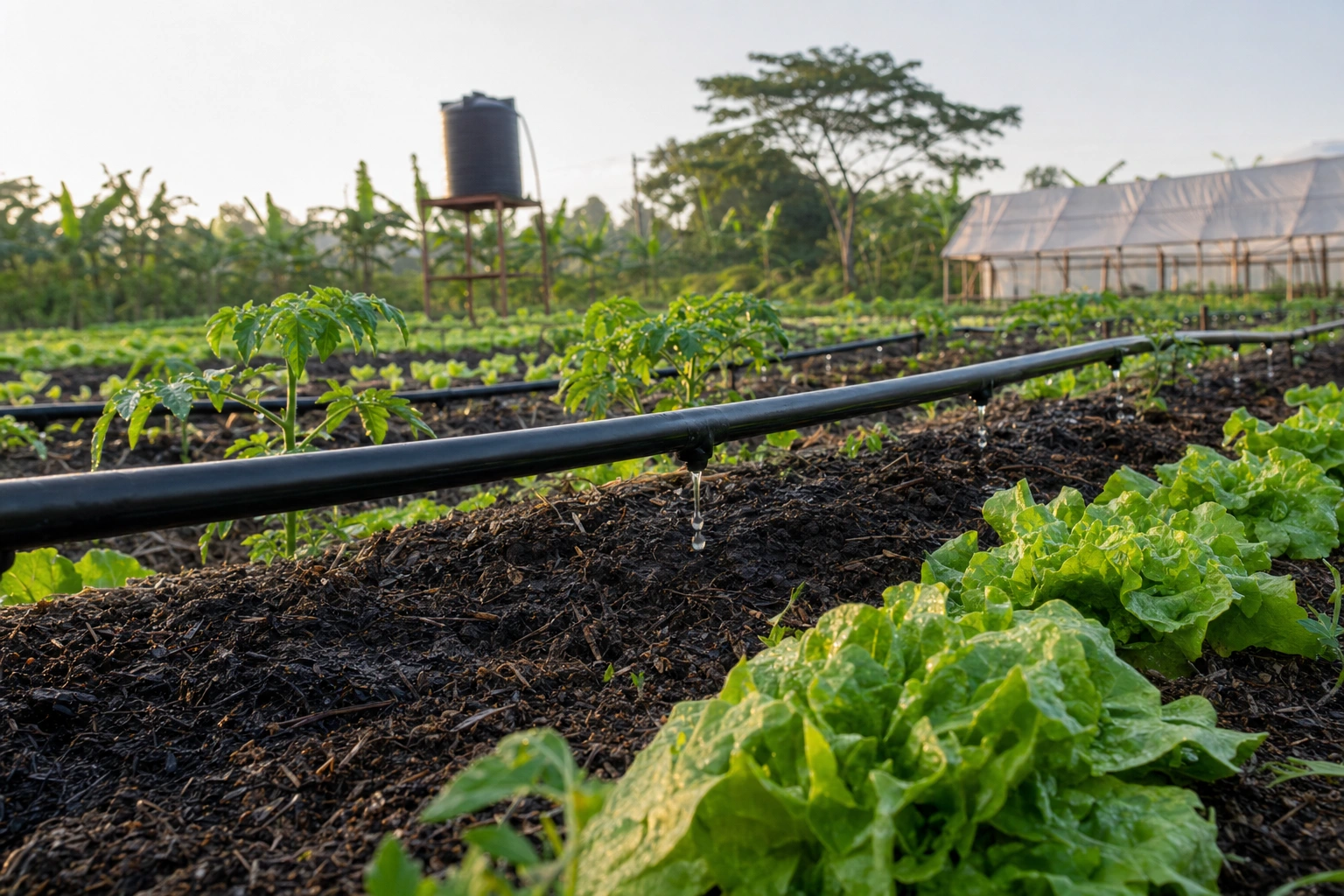
Water management in horticultural production is the planned use, movement and protection of water so that crops receive enough moisture at the right time, in the right quantity and with minimal waste. It involves much more than installing an irrigation system. A successful approach links crop requirements, soil characteristics, weather, water quality, irrigation equipment and farm records.
For vegetable growers, fruit producers, nursery operators and greenhouse businesses, good water management can influence germination, plant growth, yield, produce quality and the spread of some diseases. It is also increasingly important where rainfall is irregular, water sources are limited or production takes place throughout the year. The aim is not simply to apply more water, but to make every application useful to the crop and safe for the soil and environment.
Why water management matters in horticulture
Horticultural crops often have relatively shallow or concentrated root systems, especially during establishment. This means that a short period of water shortage can affect young plants quickly. At the same time, excessive watering can remove nutrients from the root zone, reduce oxygen around roots, encourage root diseases and increase production costs.
Water stress does not affect all crops in the same way. Leafy vegetables may lose quality rapidly when they wilt, while fruiting crops may experience poor flowering, flower drop or misshapen fruit when moisture is inconsistent. In crops such as tomatoes, peppers and cucurbits, alternating very dry and very wet conditions can contribute to cracking, uneven growth and nutrient-uptake problems.
Efficient water management therefore supports several objectives:
- Maintaining adequate moisture in the active root zone.
- Reducing evaporation, runoff, leakage and unnecessary deep drainage.
- Protecting soil structure and preventing waterlogging or erosion.
- Applying fertiliser and crop-protection products safely where irrigation is used for delivery.
- Improving consistency of yield and produce quality.
- Reducing the amount of labour, energy and money required to pump and distribute water.
Understand crop water requirements
A crop’s water requirement is influenced by its growth stage, crop type, plant spacing, temperature, wind, humidity, sunlight and the amount of water held by the soil. A seedling with a small root system needs frequent, carefully controlled applications. A mature crop may use more water overall but may be able to draw moisture from a larger volume of soil.
It is useful to distinguish between crop water use and irrigation requirement. Crop water use is the water lost through evaporation from the soil and transpiration through plant leaves. Irrigation requirement is the additional water that must be supplied after considering rainfall, soil moisture already available and losses from the irrigation system.
Weather-based planning often uses the idea of evapotranspiration, commonly shortened to ET. Evapotranspiration combines evaporation and plant transpiration. When the weather is hot, sunny, dry or windy, water use generally rises. When conditions are cool, cloudy or humid, it generally falls. Producers do not need advanced instruments to apply this principle: irrigation should be reviewed more frequently during hot, dry or windy periods and reduced when the soil remains adequately moist after rainfall.
Crop stage also matters. Water is especially important during germination, transplant establishment, flowering, fruit development and periods when the harvested part is enlarging. However, more water is not always better. Near harvest, some crops may require careful control to protect quality, reduce disease risk or prevent excessive vegetative growth.
Assess the water source before designing a system
Before purchasing pumps, pipes or drip lines, assess the water source. Identify whether water comes from a borehole, river, dam, pond, roof catchment, municipal supply or another source. Record how much water is available, when it is available and whether the supply changes during the dry season.
Two practical measurements are particularly important:
- Flow rate: the volume of water delivered over a specified period, such as litres per minute.
- Storage capacity: the amount of water held in a tank, reservoir or pond for use when the source is not operating or demand is high.
A system that delivers water more slowly than the farm requires may need zoning, storage or a different pump arrangement. A pump that is too powerful for the pipes and emitters can create excessive pressure, leaks and uneven application. Water should also be tested where possible. Important characteristics include salinity, acidity or alkalinity, suspended solids, iron, harmful contaminants and, when water contacts harvested produce, microbiological safety.
Water quality problems can appear gradually. Salts may accumulate in the root zone, blocked filters may reduce flow and unsuitable pH may affect nutrient availability. If a water test identifies a concern, seek advice from a qualified agricultural or water professional before choosing treatment or changing fertiliser practices.
Choose an irrigation method that fits the crop and farm
No irrigation method is best for every situation. The correct choice depends on crop spacing, soil, topography, water availability, labour, energy costs and the value of the crop.
Drip irrigation
Drip systems apply water slowly near the plant root zone through emitters or perforated lines. They can reduce wetting of paths and foliage and are particularly useful for vegetables grown in rows, orchards, nurseries and protected cultivation. Drip irrigation requires filtration, pressure control and regular inspection because small emitters can block easily.
Lines should be laid out so that water reaches the intended root zone rather than being placed too far from young plants. As roots develop, the wetting pattern may change. Producers should check the soil beneath several emitters instead of assuming that every part of the field is receiving the same amount.
Sprinkler irrigation
Sprinklers distribute water over a wider area and can be useful for seedbeds, leafy vegetables, lawns, some nurseries and crops with close spacing. They are also useful for establishing plants when a broad, gentle application is required. However, wind can distort the pattern, and wet foliage may increase the risk of some diseases. Sprinklers should be selected and operated to apply water evenly without creating runoff.
Furrow or basin irrigation
Surface methods such as furrows and basins can be affordable where land is suitably level and water is available in sufficient quantity. Their performance depends heavily on field preparation, slope, soil infiltration and the skill of the operator. Poorly managed surface irrigation may cause waterlogging at one end of a plot and shortage at the other. Dividing long beds, improving land levelling and controlling the inflow can improve uniformity.
Hand watering
Watering cans, hoses and small pumps may be appropriate for nurseries, kitchen gardens and small plots. Their main limitation is inconsistency. Operators should avoid applying a small amount every day merely out of habit. Instead, inspect the growing medium or soil and use a measured volume where possible. Hand watering should be gentle enough not to expose roots or wash soil away.
Schedule irrigation using evidence
A fixed calendar can be a useful starting point, but it should not replace observation. Irrigating every day at the same time may waste water after rain and still fail to meet demand during a heatwave. A better schedule combines crop stage, weather, soil condition and system output.
Simple soil-moisture checks can be effective. Push a finger or small tool into the soil, inspect the soil at different depths and compare areas near and away from emitters. Soil that looks wet at the surface may be dry lower down, while heavy soil can appear moist long after the root zone has become poorly aerated. Moisture meters or tensiometers can provide more consistent information when correctly installed and interpreted.
Use several monitoring points because one location rarely represents the whole field. Check high and low parts of the plot, different soil types and areas with different plant growth. Record the date, irrigation duration, rainfall, observations and crop response. Over time, these records help the producer identify patterns and adjust irrigation before plants show severe stress.
When deciding how long to irrigate, consider both the application rate and the depth of wetting. A short application may wet only the surface, encouraging shallow roots. A very long application may move water below the root zone. The target is a suitably moist active root zone with limited runoff and deep drainage. After changing the duration, inspect the soil profile to see whether the result matches the intention.
Manage the soil as part of the water system
Soil is the storage medium between irrigation events. Sandy soils usually drain quickly and may require smaller, more frequent applications. Clay soils can hold more water but may accept water slowly and become waterlogged if irrigated too rapidly. Loam soils often provide a useful balance, although actual performance depends on structure, organic matter and compaction.
Adding suitable organic matter, retaining crop residues where practical, reducing unnecessary cultivation and protecting the soil surface can improve infiltration and water retention. Mulch can reduce direct evaporation and moderate soil temperature. Organic or synthetic mulch should be managed carefully so that it does not harbour pests, contaminate produce or obstruct inspection of drip lines.
Compaction is another water-management problem. A compacted layer can prevent water from entering the root zone or create temporary waterlogging above it. Avoid working wet soils when this would damage their structure, and use beds, paths or traffic routes that limit repeated wheel movement across cropped areas.
Use fertigation carefully
Fertigation is the application of dissolved fertiliser through an irrigation system. It can place nutrients close to active roots and allow applications to be divided into smaller doses. However, it requires careful planning. Fertilisers must be compatible with the water and with one another, fully dissolved and applied at an appropriate concentration.
Before fertigation, check the irrigation system for leaks, confirm that filters and pressure are functioning and calculate the quantity of fertiliser required. After the fertiliser has entered the system, clean water may be needed to move remaining solution through the lines. The duration should be controlled so that fertiliser does not remain concentrated in a small section or move unnecessarily below the root zone.
Never assume that clear water is safe for every fertigation product. Some combinations can form precipitates that block emitters. When uncertain, test compatibility on a small scale and obtain technical guidance. Keep fertiliser out of natural water bodies and follow applicable safety instructions.
Prevent losses and protect water resources
Inspect the entire system regularly, not just the pump. Look for leaking joints, damaged pipes, blocked emitters, broken sprinklers, loose connections and pressure changes. Compare water delivery at the beginning and end of lines. Uneven plant growth may indicate an irrigation problem rather than a seed or fertiliser problem.
Reduce evaporation by irrigating during periods that limit avoidable losses, while still considering crop-disease risk, labour and electricity availability. Avoid irrigation during strong winds when using sprinklers. Maintain storage structures to reduce seepage, contamination and algae problems. Keep animals, fuel, chemicals and waste away from water sources and storage areas.
Where rainfall is available, harvesting roof runoff or collecting water in a properly designed storage structure can supplement irrigation. The water should be managed according to its quality and intended use. Water that contacts harvested produce requires particular attention to hygiene and contamination risks. Water conservation should never compromise worker safety, crop safety or the quality of food supplied to consumers.
Applying This in Practice
A practical farm water-management plan can be developed in stages:
- Map the production area: mark plots, crop types, soil differences, slopes, water points, storage tanks and irrigation zones.
- List crop priorities: identify crops and growth stages that are most sensitive to water shortage, such as newly transplanted seedlings or fruiting plants.
- Measure the system: record source flow, storage volume, pump capacity, operating pressure and the output from representative emitters or sprinklers.
- Check the soil: examine moisture at several depths and locations before and after irrigation.
- Set an initial schedule: base the timing and duration on crop stage, soil type, recent weather and the depth of the active root zone.
- Review crop and system performance: inspect plant growth, wilting, runoff, pooling, blocked outlets and differences between sections.
- Keep records and adjust: note rainfall, irrigation time, repairs, fertiliser applications and crop responses. Change one factor at a time where possible so that the effect can be understood.
For example, a Kenyan vegetable grower using drip irrigation might divide a field into zones according to soil type and crop age. A newly transplanted section could receive shorter, more frequent applications, while an established crop on heavier soil might need less frequent irrigation with careful checks for waterlogging. If the far end of the plot grows poorly, the grower should inspect pressure, filtration and emitter output before automatically increasing the irrigation time for the entire field.
Key Takeaways
- Water management means matching irrigation to crop needs, soil conditions, weather and system capacity.
- Measure water-source flow, storage and quality before designing or expanding an irrigation system.
- Use soil checks and crop observations alongside weather information instead of relying only on a fixed calendar.
- Choose irrigation methods according to crop spacing, soil, terrain, labour, energy and water availability.
- Maintain filters, pipes, emitters and sprinklers because uneven delivery can reduce yield even when total water use is high.
- Manage soil structure, mulch and organic matter to improve infiltration and reduce avoidable water loss.
- Keep practical records so that irrigation schedules can be tested, improved and adapted to changing conditions.
No comments yet.