
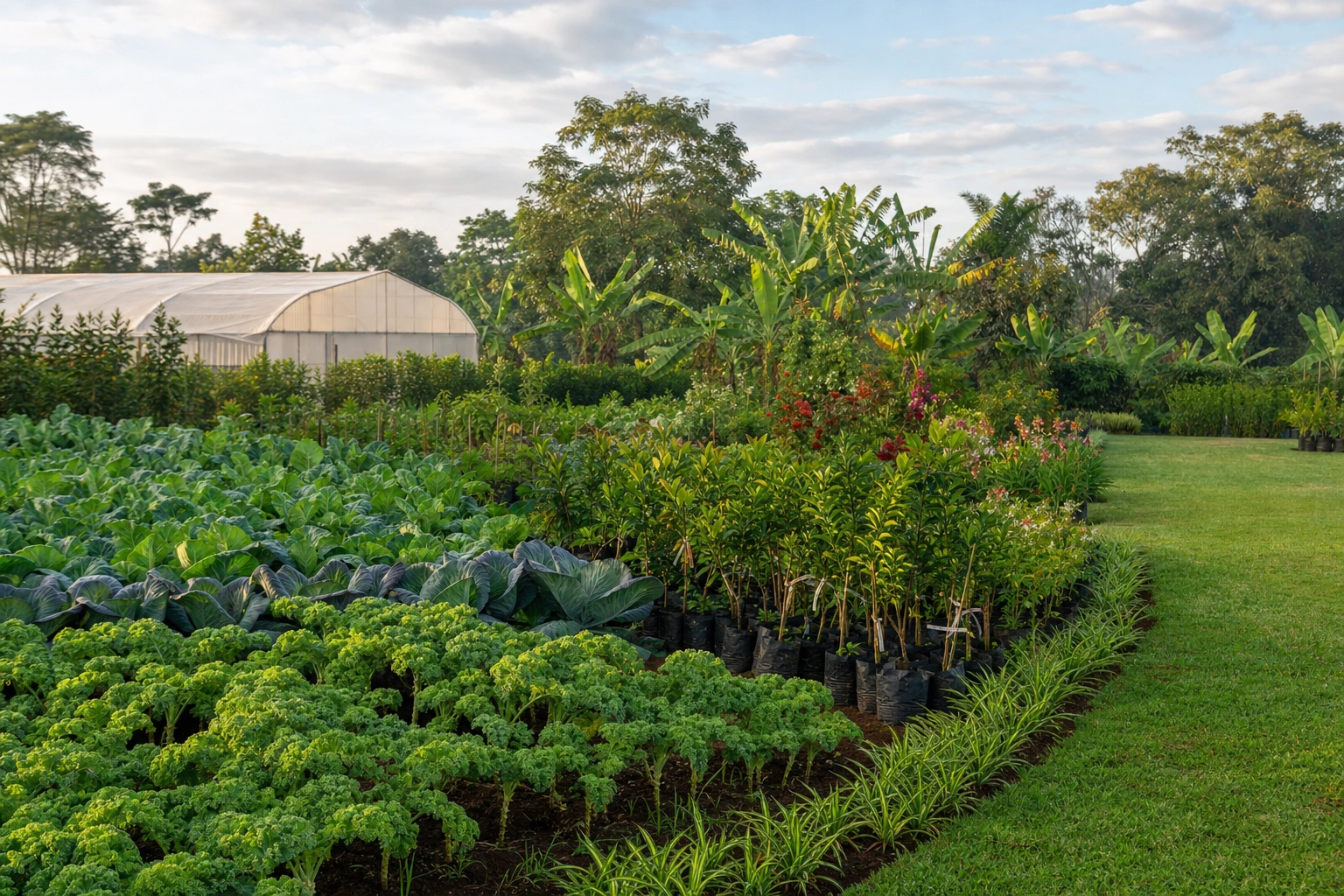
Horticulture is the specialised cultivation, management and use of plants, especially fruits, vegetables, flowers, ornamental plants, trees and turf. It combines plant science with practical skills in soil management, irrigation, propagation, pest control, harvesting, marketing and design. Unlike broad-acre crop production, horticulture often focuses on crops that require closer attention and may have high value per unit of land.
The field is wide enough to support farmers, nursery operators, landscape designers, researchers, extension officers, florists, food businesses and environmental professionals. A smallholder growing tomatoes for a local market, a Kenyan enterprise producing roses for export, and a grounds manager maintaining a public park are all working within horticulture, although they may belong to different branches.
How horticulture is organised
The main branches are usually classified according to the type of plant being grown or the purpose of the production system. The most commonly recognised branches are olericulture, pomology, floriculture and landscape horticulture. Other important specialisations include arboriculture, turf management, nursery production, plant propagation and post-harvest handling.
These divisions are useful for learning and professional practice, but they are not completely separate. For example, a fruit farmer may operate a nursery to produce grafted seedlings, use protected cultivation to raise young plants, and apply post-harvest technology to extend the shelf life of the crop. Understanding the branches helps a learner identify the main production goals while recognising that horticultural businesses often combine several areas.
1. Olericulture: the production of vegetables
Olericulture is the branch of horticulture concerned with the production, handling and marketing of vegetables. It includes leafy vegetables, roots, tubers, bulbs, stems, immature fruits, legumes and other edible plant parts. Common examples include kale, spinach, cabbage, onions, carrots, beetroot, peas, beans, courgettes, cucumbers, peppers and tomatoes.
Vegetable production requires careful timing because many vegetables have relatively short growing cycles and can lose quality quickly after harvest. Farmers must choose varieties suited to the local climate and market, prepare the soil, manage water and nutrients, control weeds and pests, and harvest at the correct stage. A tomato intended for a nearby market may be harvested at a different stage from one that must travel a long distance.
Key features of olericulture
- Intensive management: Vegetables often need regular irrigation, weeding, feeding, scouting and harvesting.
- Short production cycles: Many crops can be planted and harvested within one season, allowing several production cycles where conditions permit.
- Quality sensitivity: Freshness, colour, size, cleanliness, texture and freedom from damage influence market value.
- Strong market connection: Production decisions should be based on demand, prices, transport, storage and the requirements of buyers.
For example, a grower near Nairobi may supply restaurants with herbs and salad vegetables, while a rural farmer may produce cabbages, onions or indigenous vegetables for local traders. In both cases, a production plan should consider water availability, likely harvest dates, post-harvest losses and the risk of planting more than the market can absorb.
2. Pomology: the production of fruits and nuts
Pomology is the branch of horticulture dealing with fruit and nut crops. It covers the selection of varieties, orchard establishment, propagation, planting, pruning, pollination, pest management, harvesting, grading and storage. Examples include mangoes, avocados, citrus, bananas, passion fruit, apples, grapes, strawberries, macadamia nuts and tree nuts.
Fruit production usually involves longer-term planning than vegetable production. An orchard may occupy land for many years, so choices about rootstock, variety, spacing, drainage and water supply have lasting consequences. Farmers must also understand whether a crop needs cross-pollination, how it responds to pruning, and when it is likely to reach commercial maturity.
Important decisions in pomology
- Site selection: Soil depth, drainage, temperature, rainfall, wind exposure and access to markets all affect orchard performance.
- Variety and rootstock: These influence fruit quality, tree size, disease tolerance, maturity period and adaptation to local conditions.
- Canopy management: Pruning and training help control tree shape, improve light penetration and make spraying and harvesting more manageable.
- Pollination: Some fruit crops need compatible varieties or active pollinators for reliable fruit set.
- Harvest maturity: Fruit may need to be picked when mature but still firm enough to withstand handling and transport.
Consider an avocado enterprise. Its success depends on more than planting seedlings. The operator must obtain healthy planting material, establish suitable spacing, maintain soil moisture without waterlogging, monitor pests and diseases, harvest carefully and meet buyer requirements. Good pomology therefore connects biological knowledge with business planning and post-harvest discipline.
3. Floriculture: flowers and ornamental plants
Floriculture focuses on the cultivation and use of flowers and ornamental plants. It includes cut flowers, flowering pot plants, bedding plants, foliage plants and plants used for decoration. Roses, carnations, chrysanthemums, lilies, orchids, gerberas and a wide range of nursery ornamentals fall within this branch.
Floriculture has several distinct markets. Cut flowers are grown for bouquets, events, retailers and sometimes export. Pot plants are sold as indoor or outdoor decorations. Bedding plants are used to create seasonal displays, while ornamental shrubs and climbers may be sold to homes, offices, hotels and landscape contractors.
Appearance is central to floriculture. Flower colour, stem length, form, uniformity, vase life and freedom from blemishes can determine value. Production may therefore involve protected structures such as greenhouses, shade houses or screen houses. These structures can help manage temperature, humidity, rain, light and pests, but they also require investment, ventilation and careful environmental control.
Kenya has a well-known commercial cut-flower industry, particularly in areas where altitude, temperatures and access to infrastructure support production. However, floriculture is not limited to large export farms. Small nurseries can supply ornamental plants to households, schools, offices, hotels and local landscaping projects. A successful operator must understand both plant care and customer preferences, including packaging, timing and presentation.
4. Landscape horticulture: plants in designed spaces
Landscape horticulture applies horticultural knowledge to the planning, establishment and maintenance of attractive, functional and sustainable outdoor spaces. These may include home gardens, public parks, hotel grounds, school compounds, office landscapes, roadside plantings and recreational areas.
This branch is broader than simply planting flowers. It involves selecting plants that suit the site, arranging them for visual and practical effect, preparing the soil, installing irrigation where needed, managing lawns, pruning shrubs and trees, replacing failed plants and maintaining a healthy appearance over time.
What landscape horticulture considers
- Purpose: A school garden, a hotel entrance and a public park have different needs for safety, shade, access and appearance.
- Site conditions: Light, wind, soil, drainage, available water and foot traffic influence plant selection.
- Design: Colour, height, texture, spacing, seasonal interest and movement through the space should work together.
- Maintenance: A design is only successful if the owner can afford and organise watering, mowing, pruning, weeding and replacement.
- Environmental performance: Suitable plants can provide shade, reduce exposed soil, support biodiversity and improve the experience of a place.
For instance, a landscape contractor working on a commercial compound might combine shade trees, low-maintenance shrubs, ground covers and turf. The contractor should avoid choosing plants merely because they look attractive in a nursery. Their mature size, root behaviour, water requirements and safety around buildings must also be considered.
5. Arboriculture: the care of trees
Arboriculture is the specialised management of individual trees and woody plants, particularly in urban and amenity settings. It includes tree selection, planting, formative pruning, structural assessment, risk management, pest and disease care, removal of dangerous branches and, where necessary, safe tree removal.
Arboriculture differs from forestry, which generally concerns the management of forests or tree stands for ecological, conservation or commercial purposes. An arborist may instead care for a single roadside tree, a group of trees in a school compound or mature trees near buildings and power infrastructure.
Good arboricultural practice begins before planting. The selected species should match the available space, soil and intended function. A large tree planted beneath power lines or too close to a foundation may create avoidable problems later. Young trees also benefit from correct staking, watering and formative training, while mature trees require careful pruning rather than indiscriminate cutting.
6. Turfgrass management
Turf management deals with grasses grown as a closely maintained surface. Turf is used for sports fields, golf courses, parks, institutional grounds, home lawns and recreational spaces. The work includes species selection, establishment, mowing, irrigation, fertilisation, aeration, weed control, pest management and repair of worn areas.
A turf manager must balance appearance, durability and available resources. A sports field needs a surface that can tolerate repeated use and drain effectively. A household lawn may prioritise low maintenance and visual appeal. The right grass depends on climate, sunlight, soil, traffic and water availability. Mowing too closely, watering poorly or applying nutrients without understanding the soil can weaken the turf and encourage weeds or disease.
7. Nursery management and plant propagation
Nursery management and plant propagation support nearly every other branch of horticulture. Nurseries raise plants from seed, cuttings, grafts, divisions, tissue culture or other propagation methods until they are ready for sale or field planting.
Propagation is not simply a way to produce more plants. It is a way to preserve desirable characteristics, multiply selected varieties and produce uniform planting material. Sexual propagation through seed can create variation, while asexual methods such as cuttings, grafting and division generally help retain the features of the parent plant. The appropriate method depends on the species and the purpose of production.
A well-managed nursery needs clean containers, suitable growing media, reliable water, good drainage, shade or protection where necessary, accurate labelling and regular inspection. Weak or diseased planting material can cause losses long after it leaves the nursery, so quality control is essential. For fruit trees, grafted seedlings may be preferred because they combine a selected fruiting variety with a rootstock suited to particular conditions.
8. Post-harvest horticulture
Post-harvest horticulture focuses on maintaining the quality of produce after it is harvested. It includes maturity assessment, careful picking, sorting, grading, cleaning where appropriate, packaging, cooling, storage and transport. Although post-harvest work is sometimes taught as a supporting area rather than a primary branch, it is vital to the profitability of horticultural enterprises.
Fresh produce continues to respire after harvest. Heat, bruising, moisture loss, poor ventilation and contamination can reduce quality. Handling requirements differ by crop: leafy vegetables may wilt rapidly, delicate berries bruise easily, while some fruits require time to ripen after harvest. A producer who grows an excellent crop but handles it carelessly can lose much of its value before it reaches the buyer.
Practical improvements may include harvesting during cooler periods, using clean containers, avoiding overfilling sacks, keeping produce out of direct sun, separating damaged items and planning transport before picking begins. Post-harvest decisions should be part of the production plan, not an afterthought.
How the branches work together
Modern horticultural businesses frequently combine several branches. A fruit nursery may propagate grafted mango and avocado plants, an orchard may grow cover plants between trees, and a packing facility may grade and store the harvested fruit. A landscaping company may buy ornamental plants from nurseries, install turf and manage trees through an arboricultural service.
The branches also share core principles. These include choosing adapted plant material, understanding the growing environment, managing water and nutrients responsibly, monitoring pests rather than reacting blindly, keeping accurate records and matching production to a real market. The best branch for a learner or entrepreneur depends on available land, water, skills, capital, labour, market access and personal interests.
Applying This in Practice
- Identify the main product or service. Decide whether the enterprise will focus on vegetables, fruit, flowers, ornamental plants, trees, turf or a combination.
- Study the site. Record soil condition, drainage, sunlight, temperature, water supply, access and nearby risks such as flooding or strong winds.
- Investigate the customer. Speak with households, traders, restaurants, schools, landscapers or other buyers before making a large investment.
- Select suitable plant material. Use reliable varieties and healthy seedlings, and confirm their expected maturity, quality and management needs.
- Plan the full production chain. Include land preparation, inputs, labour, irrigation, pest monitoring, harvesting, packaging, transport and waste management.
- Keep records and review results. Note planting dates, quantities, costs, harvest volumes, losses, buyer feedback and prices so that future decisions are based on evidence.
Key Takeaways
- Olericulture covers the production and marketing of vegetables, while pomology focuses on fruits and nuts.
- Floriculture produces flowers and ornamental plants, with appearance, uniformity and handling quality especially important.
- Landscape horticulture designs and maintains useful, attractive and sustainable planted spaces.
- Arboriculture specialises in the care and safety of individual trees, while turf management maintains grass surfaces.
- Nursery management and propagation provide healthy, suitable planting material for many horticultural enterprises.
- Post-harvest handling protects quality and profitability after crops leave the field.
- A sound horticultural enterprise links plant knowledge with site assessment, market research, records and careful planning.
No comments yet.