
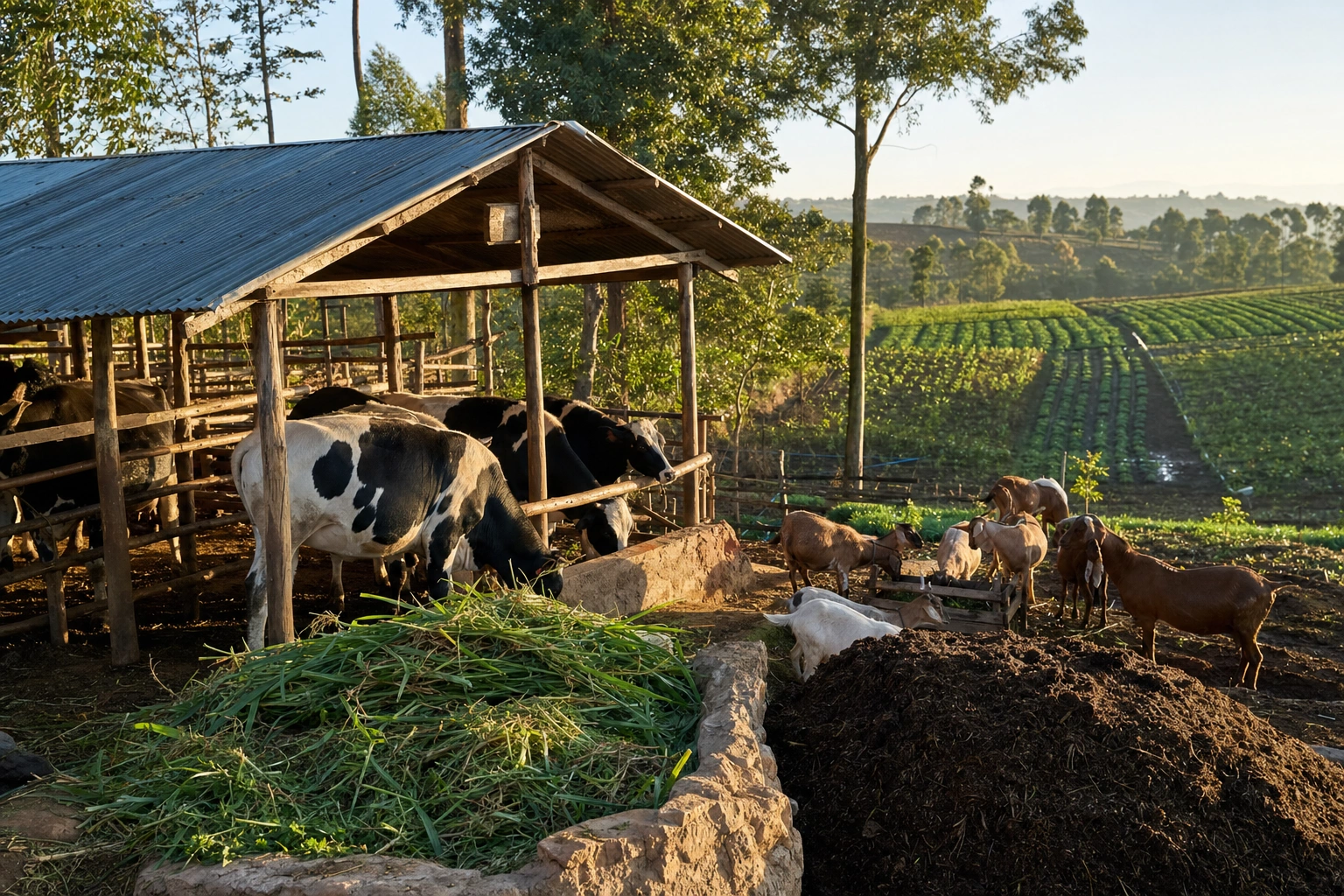
Livestock are an important part of agriculture because they provide food, income, employment, manure, transport and financial security. Cattle, goats, sheep, poultry, pigs, camels, rabbits and bees each support farming households in different ways. Their value is not limited to the products sold at a market; livestock also connect crop production, household nutrition and rural enterprise.
However, keeping animals is not automatically profitable or sustainable. Livestock require suitable feed, clean water, housing, disease prevention, labour and access to reliable markets. Understanding their wider role helps farmers, entrepreneurs and policymakers make better decisions about which animals to keep, how many to maintain and how to combine livestock with other agricultural activities.
Livestock as a Source of Food
The most familiar role of livestock is the production of nutritious food. Cattle, goats, sheep, pigs and poultry provide meat, while dairy animals provide milk. Chickens and other birds produce eggs, and bees produce honey. These products can be consumed at home or sold to generate income.
Livestock foods can contribute protein, energy, fats and important micronutrients to a balanced diet. Milk, for example, can be consumed fresh or processed into products such as yoghurt, fermented milk, butter and cheese. Eggs are relatively easy for many smallholders to produce and can provide both household food and a regular source of cash. Goats and sheep may be particularly useful where land, feed or water resources are limited, although their suitability depends on local conditions.
Food production must be considered alongside animal health and food safety. Farmers need to observe withdrawal periods after veterinary treatment, maintain hygienic milking and slaughter practices, store products correctly and use approved channels where these are available. Producing more food is beneficial only when the food is safe and reaches consumers in good condition.
Livestock as a Source of Income
Livestock can turn farm resources into several streams of income. A dairy farmer may sell milk each day, while a poultry keeper may sell eggs regularly and market birds in batches. Other farmers earn from breeding stock, young animals, hides and skins, wool, honey, manure or processed products.
This variety can help a household manage cash flow. Crop income may arrive mainly at harvest, but milk, eggs or small animals can provide more frequent revenue. A farmer may also sell an animal to pay school fees, meet a medical expense, purchase seed or respond to an emergency. Livestock therefore often function as a form of household financial reserve.
Nevertheless, an animal should not be treated as automatic savings. Its value can fall because of disease, poor body condition, drought, weak demand or high transport costs. The farmer must calculate the full cost of production, including feed, labour, veterinary care, housing, breeding and losses. An enterprise that appears busy may still be unprofitable if these costs are ignored.
Employment and Enterprise Development
Livestock support employment both on and beyond the farm. Farmers need workers to feed, clean, milk, herd and monitor animals. The wider value chain creates opportunities for veterinary professionals, animal health providers, feed suppliers, transporters, traders, abattoirs, milk processors, equipment makers and retailers.
Livestock enterprises can also be developed at different scales. A household may begin with a small flock of layers, a few goats, rabbits or beehives. As skills and capital improve, the owner may invest in better housing, breeding, feed production, cold storage or processing. For example, a dairy enterprise may expand from selling raw milk to producing yoghurt, provided the operator can meet the necessary hygiene, packaging and regulatory requirements.
Entrepreneurs should distinguish between production and value addition. Producing more animals does not always create more profit. Better records, improved quality, dependable delivery and careful processing may create greater value than simply increasing herd size.
Livestock and Crop Production Work Together
Livestock and crops can complement each other in an integrated farming system. Crop residues such as maize stover, cereal straw or vegetable trimmings may provide feed when they are safe and nutritionally suitable. In return, livestock manure can be applied to fields to add organic matter and plant nutrients.
This relationship can reduce waste and make better use of farm resources. A farmer growing maize and keeping cattle, for instance, may use part of the crop residue as feed and return collected manure to the soil. A poultry farmer may use properly managed poultry manure as an input for crop production or composting. The exact benefits depend on the quality of the material, the application rate and the condition of the soil.
Manure should be managed carefully. Fresh manure can contain pathogens, weed seeds and excess nutrients. Composting, appropriate storage and correct application help reduce risks. It should not be placed where it can run directly into rivers, wells or other water sources. Good manure management protects public health and prevents nutrient pollution.
Contribution to Soil Fertility
Well-managed livestock manure can improve soil structure, water-holding capacity and biological activity. These effects are particularly useful in soils with low organic matter. Manure also supplies nutrients, although its nutrient content varies according to the animal species, feed, bedding, storage method and degree of decomposition.
Farmers should avoid assuming that manure can replace every fertiliser requirement. Soil testing, where accessible, helps identify nutrient needs and prevents unnecessary application. Combining organic materials with other soil fertility practices may be more effective than relying on one input alone. The aim is to maintain productive soil over time rather than to apply large amounts of manure without a plan.
Livestock for Transport and Farm Work
In some farming systems, animals provide draught power and transport. Oxen, donkeys, horses, camels and other working animals may help with ploughing, pulling carts or moving goods and water. This can reduce dependence on machinery where fuel, spare parts or equipment are expensive or unavailable.
The usefulness of working animals depends on their strength, training, feed, health and the tasks required. Overworking animals, denying them water or using unsuitable equipment can reduce productivity and cause suffering. Proper harnesses, rest periods, shade, veterinary care and adequate nutrition are essential parts of responsible use.
Mechanisation and animal power are not always opposing choices. Some farmers use a combination of tractors, small machinery and working animals depending on the land, season, cost and task. The appropriate choice is the one that performs the work safely and economically within the farmer's circumstances.
Livestock and Household Resilience
Livestock may help households cope with uncertain conditions. A farmer can sell an animal when a crop fails, prices change or an unexpected expense arises. Herds and flocks can also provide a way to preserve wealth in areas where access to formal financial services is limited.
Resilience is not the same as keeping as many animals as possible. During drought, a large herd can become a burden if pasture and water are insufficient. Overstocking may damage grazing land, lower animal condition and increase mortality. Planning for difficult seasons is therefore important. Measures may include conserving fodder, storing water where feasible, selecting animals suited to local conditions, maintaining a manageable herd size and arranging early sales before animals lose significant value.
In pastoral and agro-pastoral areas of Kenya and other parts of Africa, mobility, communal grazing arrangements and livestock markets can be central to livelihoods. These systems have their own knowledge and management practices, but they remain exposed to drought, disease, conflict, market disruption and restricted access to grazing. Support for animal health, water management and fair market access can strengthen, rather than replace, local decision-making.
Livestock Diversity and the Choice of Species
Different animals fit different environments and business goals. Cattle may suit a farmer with adequate land, water and a market for milk or beef. Goats often appeal to smallholders because they can browse a variety of plants, but they still require nutrition, shelter and disease control. Poultry can produce income in a relatively small space, yet intensive systems may have high feed, housing and health-management costs.
Pigs can grow quickly under suitable conditions, but they require reliable feed, biosecurity and an appropriate market. Rabbits may be suitable for some small-scale enterprises, while bees can produce honey without occupying the same land area as grazing animals. Camels may be well adapted to dry environments, although their management and marketing needs differ from those of cattle.
The right choice should be based on a practical assessment rather than fashion. Consider available land, feed, water, labour, start-up capital, technical skills, local demand, climate, disease risks and the time required before sales begin. A farmer should also consider whether the enterprise competes with household food needs or uses resources needed for crops.
Responsible Livestock Management
Good management protects productivity, profitability and animal welfare. Core practices include providing adequate feed and clean water, maintaining dry and ventilated housing, observing animals frequently, keeping records and seeking professional advice when illness is suspected.
Prevention is usually better than waiting for a disease outbreak. Farmers should follow locally appropriate vaccination and parasite-control guidance, quarantine newly purchased animals when advised, limit unnecessary contact between herds and keep housing and equipment clean. They should not use medicines casually or sell products during a required withdrawal period.
Animal welfare also matters economically. Animals that are chronically hungry, injured, stressed or exposed to extreme weather are less likely to grow, reproduce or produce quality products. Humane handling, suitable stocking density and prompt treatment of illness are both ethical responsibilities and sound management practices.
Environmental Responsibilities and Risks
Livestock can support soil fertility and rural livelihoods, but they can also create environmental pressure. Overgrazing may reduce vegetation and expose soil to erosion. Poorly managed manure can pollute water. Livestock production also requires land, feed and water, and ruminant animals produce methane as part of digestion.
Responsible farming focuses on using resources efficiently and preventing avoidable harm. Practical actions may include rotational or controlled grazing where appropriate, protecting water points, planting or conserving fodder, reducing feed waste, improving animal health and using manure carefully. Keeping healthier animals that produce more from available resources can improve efficiency, but no single measure works in every location.
Environmental decisions should reflect local conditions. A dryland pastoral system, a small dairy farm near a town and a commercial poultry unit have different challenges. Farmers need to assess their own land, climate, feed sources and markets rather than copy a production model without adaptation.
Applying This in Practice
Before starting or expanding a livestock enterprise, work through the following steps:
- Define the purpose. Decide whether the main goal is household food, daily income, breeding stock, manure, transport, asset storage or a combination of these.
- Assess resources. List available land, water, feed, labour, housing, capital and technical support. Identify which resources are scarce before choosing a species.
- Study the market. Find out who will buy the product, when demand is strongest, what quality is expected and how the product will be transported or stored.
- Prepare a health plan. Identify reliable animal health support, vaccination needs, parasite risks, quarantine procedures and emergency contacts.
- Calculate costs and returns. Include purchase costs, feed, housing, labour, treatment, transport, losses and marketing. Compare expected income with the full cost, not just the purchase price.
- Start at a manageable scale. A smaller enterprise allows the farmer to learn about feeding, disease control, records and customers before committing more capital.
- Keep records and review them. Track births, deaths, treatments, feed purchases, production, sales and expenses. Use the records to identify what is profitable and what needs to change.
For a Kenyan smallholder, this may mean comparing a dairy cow with poultry or goats according to available fodder, water, family labour and nearby buyers. For an urban entrepreneur, it may mean checking zoning, waste management, biosecurity and reliable feed supply before keeping poultry or rabbits. In every case, the central question is the same: can the enterprise produce useful outputs without exhausting the resources on which it depends?
Key Takeaways
- Livestock provide food, income, employment, manure, transport and financial security.
- Profit depends on full costs, reliable markets, animal health and careful record-keeping.
- Crop and livestock activities can complement each other through feed use and manure management.
- Choose species according to available land, water, feed, labour, skills and local demand.
- Healthy, well-treated animals are more productive and support better farm outcomes.
- Manage grazing, manure, water and feed responsibly to reduce environmental risks.
No comments yet.