
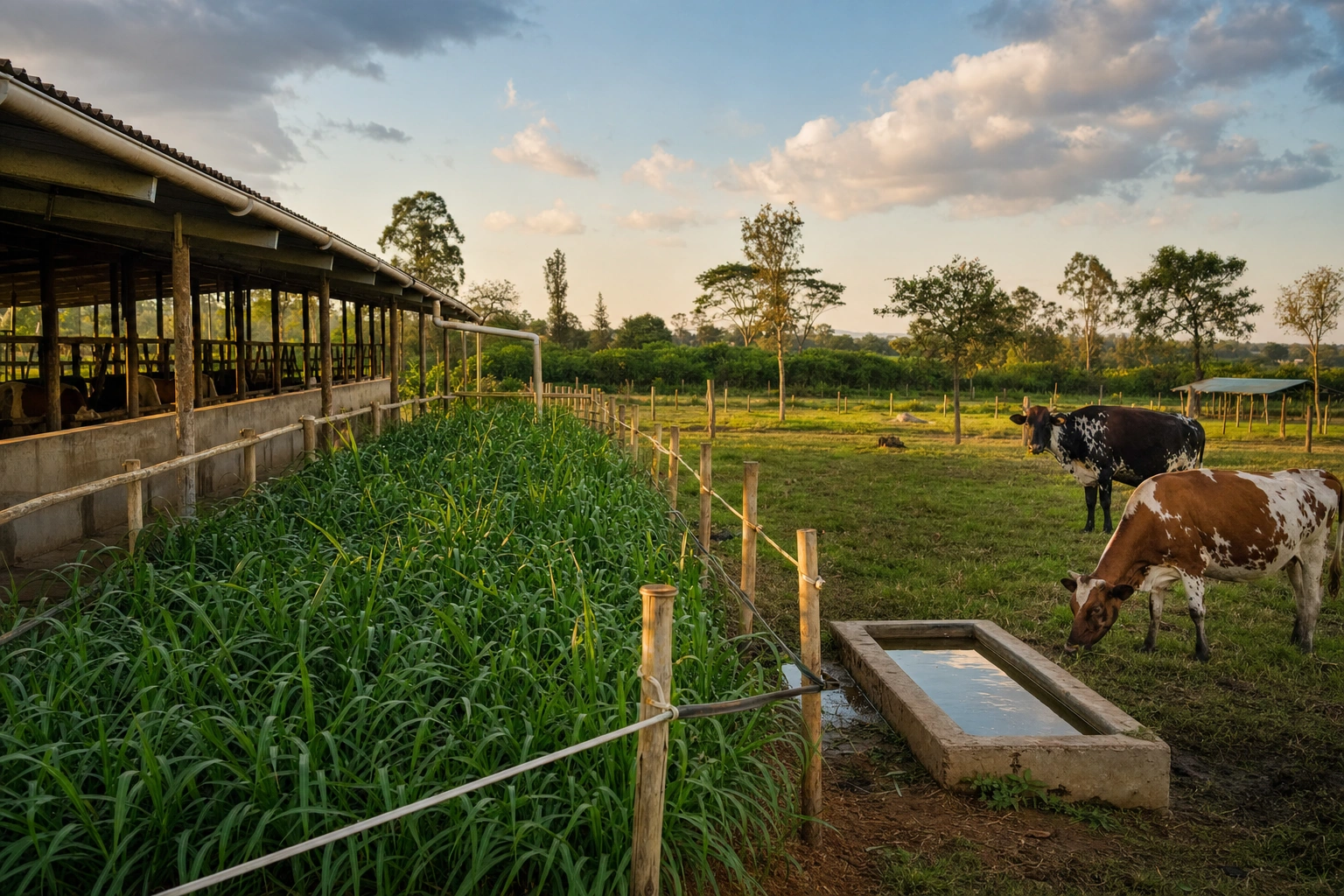
Livestock production systems describe the organised ways farmers raise animals for meat, milk, eggs, fibre, hides, breeding stock or other products. A system includes more than the type of animal kept: it covers the source of feed and water, the amount of land used, housing, labour, capital, breeding practices, health care and the relationship between livestock and crops.
Understanding these systems helps a farmer choose an approach that matches available land, climate, labour, capital, markets and personal objectives. A smallholder near Nairobi may use zero grazing for dairy cows, while a pastoralist in northern Kenya may move cattle, goats or camels in search of pasture and water. Neither system is automatically best; each is suited to particular conditions.
How Livestock Production Systems Are Classified
Livestock systems can be classified in several ways. The most common classification considers the level of external inputs and the degree of control over the animals.
- Extensive systems: animals depend mainly on natural pasture and browse over a large area, with relatively low purchased inputs.
- Intensive systems: animals are kept in a controlled area and receive carefully managed feed, housing and health care.
- Semi-intensive systems: combine grazing or outdoor access with supplementary feeding and more regular management.
Another useful classification looks at the main activity of the farm. For example, a farm may be pastoral, ranch-based, mixed crop-livestock, dairy-oriented or poultry-intensive. In practice, many farms combine features from more than one category.
1. Pastoral and Nomadic Livestock Production
Pastoral production is based mainly on livestock grazing natural vegetation. Pastoralists often keep cattle, sheep, goats, camels or donkeys, depending on the environment. In dry and semi-arid areas, animals convert grass, shrubs and other vegetation that people cannot eat into useful products such as milk, meat, hides and income.
In a nomadic system, households move regularly with their herds, often following seasonal availability of water and pasture. In a transhumant system, herders move animals between recognised dry-season and wet-season grazing areas. Movement may be short-distance or extensive, depending on climate, land access and local traditions.
Strengths
- It makes productive use of land that may be unsuitable for crop farming.
- Moving animals can reduce pressure on a single grazing area.
- Livestock provide food, savings, transport and a source of income.
- The system often requires less purchased feed than intensive production.
Limitations
- Drought can reduce pasture and water, causing loss of body condition or animal deaths.
- Access to grazing routes may be restricted by farms, settlements, infrastructure or conflict.
- Veterinary treatment, markets and education services may be difficult to reach.
- Uncontrolled grazing can lead to pasture degradation where stocking levels exceed carrying capacity.
Good pastoral management involves protecting dry-season grazing areas, planning access to water, controlling animal diseases and matching herd size to available resources. Herders may also improve resilience by keeping species suited to local conditions, storing fodder where possible and selling selected animals before a severe feed shortage.
2. Ranching Systems
Ranching is a large-scale form of livestock production in which animals are managed on an extensive area of land. It is commonly associated with beef cattle, but ranches may also keep sheep, goats or wildlife alongside livestock. Unlike nomadic pastoralism, ranching usually operates from a more permanent base with defined ownership or management boundaries.
Ranchers may divide land into grazing paddocks and move animals according to pasture growth. This is known as rotational grazing. When animals are removed from a paddock before the pasture is severely damaged, plants have time to recover. Ranches may also provide mineral supplements, water points, fencing, breeding programmes and disease control.
Strengths
- Large areas can support production where cropping is difficult.
- Permanent infrastructure can improve water supply, record keeping and animal health.
- Planned grazing can protect vegetation and reduce soil erosion.
- Specialised breeding can improve growth, fertility or adaptation to local conditions.
Limitations
- Large land requirements can create pressure where land is scarce.
- Fencing, water infrastructure, vehicles and breeding stock may require substantial capital.
- Long distances can make supervision and marketing expensive.
- Poorly managed ranches can still suffer from overgrazing, especially during drought.
A ranch is not automatically sustainable simply because it is extensive. Sustainability depends on stocking rate, grazing plans, water management, pasture recovery and the protection of soil and vegetation. A useful management question is whether the number of animals is appropriate for the land's long-term carrying capacity.
3. Mixed Crop-Livestock Farming
Mixed crop-livestock farming combines crop production and animal keeping on the same farm or within the same household livelihood. It is one of the most common systems among smallholder farmers. A farmer may grow maize, beans, sorghum, wheat, vegetables or fodder while keeping cattle, goats, sheep, pigs or poultry.
The key feature is the exchange of resources between the crop and livestock enterprises. Crop residues such as maize stover may feed animals after harvesting. Livestock manure can improve soil fertility when properly collected, composted and applied to fields. Animals may also provide draught power or income for purchasing seed, fertiliser and school supplies.
Strengths
- Farmers can diversify income and food sources.
- Manure and crop residues reduce waste and support nutrient recycling.
- Livestock can provide cash when crop prices are low or harvests are delayed.
- Several enterprises can spread risk across seasons.
Limitations
- Crop residues may be insufficient or of poor nutritional quality during the dry season.
- Animals may damage crops if grazing is not controlled.
- Managing several enterprises requires planning, labour and record keeping.
- Competition may arise between selling crop residues and feeding them to animals.
Farmers can improve this system by planting fodder crops, treating or chopping crop residues, making hay or silage, and storing feed before the dry season. They should also decide how much residue must remain on the soil to protect it and maintain organic matter.
4. Intensive Livestock Production
Intensive production keeps animals in a controlled environment and aims to obtain high output from limited land. Animals may be housed in sheds, pens, cages or specialised units. Feed is supplied by the farmer, and production depends heavily on purchased inputs, careful supervision, disease prevention and reliable markets.
Examples include commercial poultry units, pig farms, feedlots and high-producing dairy units. A poultry farmer may manage temperature, ventilation, lighting, feed formulation, vaccination and egg collection. A dairy farmer may provide balanced rations, clean water, milking hygiene and regular health checks.
Strengths
- High production can be achieved from a relatively small area.
- Feeding, breeding, health checks and records can be closely controlled.
- Animals can be located near markets, processing facilities and transport.
- Specialisation may improve efficiency when management is strong.
Limitations
- Feed, housing, energy, medication and equipment can be expensive.
- Diseases may spread quickly when animals are crowded or biosecurity is weak.
- Waste must be managed to avoid odour, water pollution and health risks.
- Profitability can change rapidly when feed prices rise or market prices fall.
Intensive farming requires strong biosecurity. This includes controlling visitors, cleaning equipment, quarantining new or sick animals, disposing of dead stock safely and following an appropriate vaccination and veterinary plan. Good ventilation, enough space and clean water are equally important for welfare and productivity.
5. Semi-Intensive Production
Semi-intensive production combines features of extensive and intensive systems. Animals may graze during part of the day and receive supplementary feed in a shed or enclosure. They may have access to pasture, but the farmer also provides fodder, crop residues, concentrates, minerals or cut-and-carry feed.
This system is common among small and medium-sized dairy farmers. For example, a farmer may allow cattle to graze for several hours, then provide chopped napier grass, hay and a concentrate ration in a simple housing unit. Goats and sheep may browse outdoors but receive extra feed during pregnancy or the dry season.
Strengths
- It requires less land than a fully extensive system.
- Supplementary feeding can improve growth, milk production and reproduction.
- Farmers have greater control over animals than in open grazing systems.
- It can be adapted gradually as a household acquires more feed or infrastructure.
Limitations
- Feed shortages can still reduce production if fodder is not planned.
- Labour requirements may be high, especially for cutting and carrying grass.
- Housing, water and manure management need regular attention.
- Purchased concentrates can reduce profit if they are used inefficiently.
The success of a semi-intensive system depends on balancing feed quality with production goals. Giving a high-producing cow more concentrate will not solve every problem if the animal lacks adequate roughage, clean water, minerals or a healthy digestive system.
6. Zero-Grazing and Stall-Fed Systems
Zero-grazing is a highly controlled system in which animals do not normally graze freely. Instead, farmers bring cut fodder to the animals in a stall or housing unit. It is widely used where land is limited, particularly for dairy cattle near towns and cities.
A zero-grazing unit may include a resting area, feeding trough, water point, drainage, manure collection space and a store for fodder. Farmers may grow fodder on small plots, use crop residues and purchase supplements. Because animals remain close to the home, the farmer can observe feeding, illness, heat signs and calving more easily.
Advantages
- Small land parcels can support livestock production.
- Manure can be collected for crops, compost or biogas where suitable facilities exist.
- Animals are easier to monitor and protect from theft or uncontrolled grazing.
- Feed quantities can be measured more accurately.
Risks and management needs
- Cutting, transporting and storing fodder requires substantial labour.
- Poor drainage or dirty housing can increase disease and foot problems.
- Inadequate space, heat or ventilation can harm animal welfare.
- Production can fall quickly when fodder crops fail or purchased feed becomes costly.
Before adopting zero-grazing, a farmer should calculate whether enough fodder can be produced or purchased throughout the year. The plan should include water availability, labour, veterinary services, manure disposal and a market for milk or other products.
Choosing a Suitable Production System
The best system depends on the interaction of several factors rather than on fashion or imitation. A practical decision begins with the following questions:
- What resources are available? Assess land size, pasture, water, labour, buildings, capital and access to feed.
- What is the local climate? Consider rainfall reliability, drought risk, heat, cold and seasonal feed shortages.
- Which market will be served? Identify demand, prices, transport, buyers, collection points and quality requirements.
- Which animals fit the environment? Choose breeds or crosses for adaptation, productivity, disease tolerance and feed availability rather than production potential alone.
- What level of management is realistic? A technically impressive system will fail if the farmer cannot provide daily feeding, hygiene, records and health care.
- How will risks be controlled? Prepare for disease, drought, theft, price changes, feed shortages and animal losses.
For instance, a farmer with limited land, reliable water, a nearby milk market and access to fodder may consider zero-grazing or semi-intensive dairy production. A household in a dry rangeland with access to communal grazing may be better suited to pastoral production, supported by strategic herd management and drought planning. A farm with enough land for crops and animals may benefit from a mixed system that recycles nutrients.
Applying This in Practice
Before investing, prepare a simple enterprise plan. List the number and type of animals, expected feed sources, housing requirements, labour needs, health costs, likely production and selling price. Include both cash expenses and household labour. This helps reveal whether a system is profitable or merely busy.
Start at a manageable scale and keep records of feed, disease treatments, births, deaths, growth, milk yield, eggs, sales and expenses. Review the records regularly. If animals are consuming expensive feed but production is low, investigate health, breed, ration balance, water, heat stress and management before expanding the herd.
Environmental care should also be part of the plan. Prevent animals from contaminating water sources, protect soil from erosion, maintain pasture cover, store manure safely and avoid keeping more animals than the available land and feed can support. Productive livestock farming is a combination of suitable animals, adequate nutrition, healthy surroundings, careful records and dependable markets.
Key Takeaways
- Livestock production systems differ in land use, feed sources, housing, labour, capital and management control.
- Pastoralism and ranching rely mainly on natural grazing, but pastoralists move more frequently while ranches usually operate from permanent bases.
- Mixed crop-livestock farming links crops and animals through manure, crop residues, income diversification and shared labour.
- Intensive systems can produce high output from limited land but require strong feeding, hygiene, biosecurity and waste management.
- Semi-intensive and zero-grazing systems provide greater control but depend on reliable fodder, water, labour and housing.
- The most suitable system is the one that matches local resources, climate, markets, animal adaptation and the farmer's management capacity.
No comments yet.