
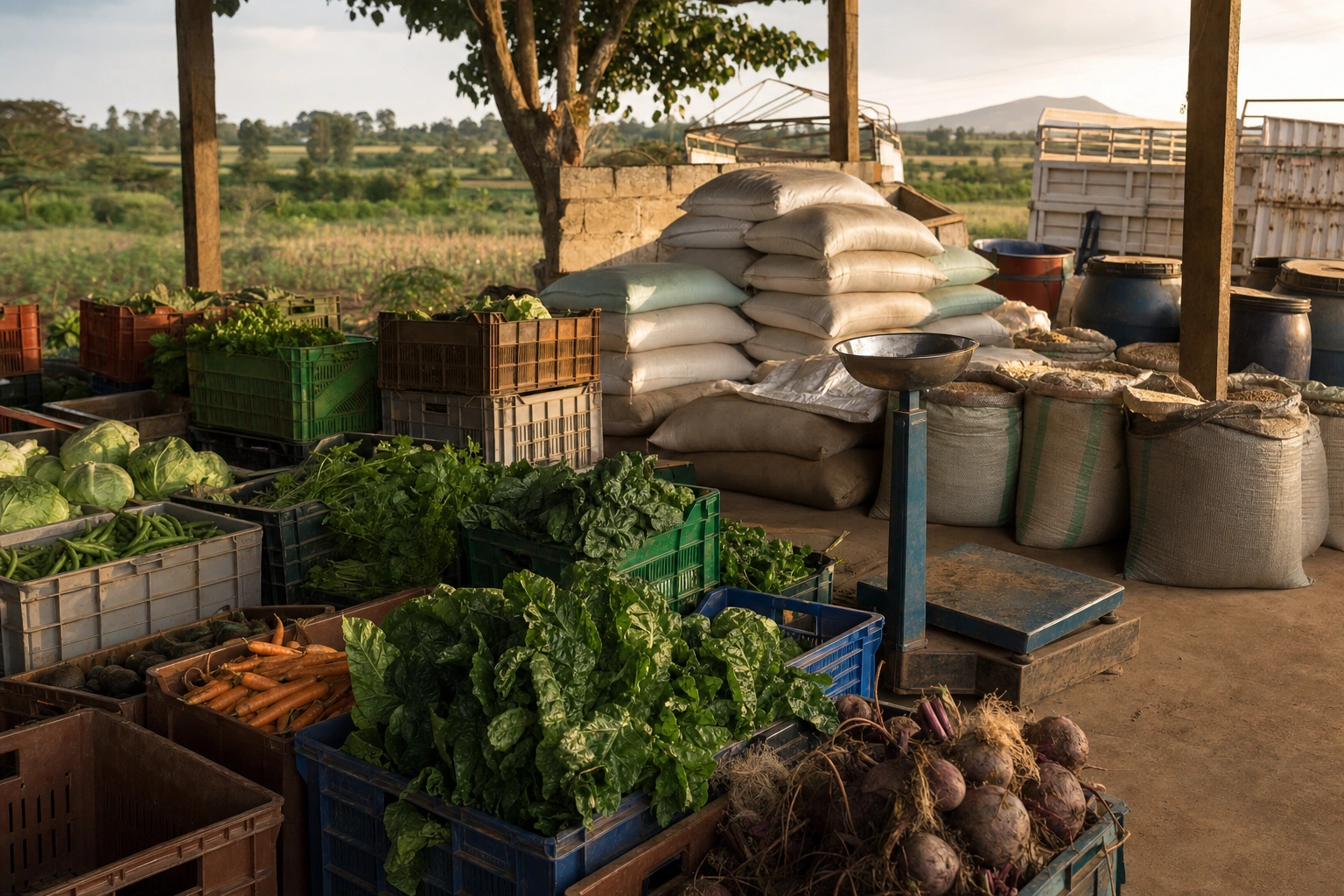
Farmers are central participants in agricultural markets because they produce the crops, livestock and other products that move through local, national and international value chains. However, their role is broader than simply growing or raising products. Farmers make decisions about what to produce, when to sell, how to meet quality requirements and whether to work individually or collectively.
Understanding this role helps farmers, entrepreneurs, policymakers, financial service providers and consumers see how agricultural markets function. It also shows why production decisions must be connected to market information, customer needs, costs, risk and opportunities for value addition.
What Are Agricultural Markets?
An agricultural market is a system in which farm products, services, information and money are exchanged. It includes much more than a physical marketplace. A market may involve a farmer selling vegetables to a local trader, a cooperative supplying grain to a miller, or a processor buying milk from organised producers.
Agricultural markets include several connected activities:
- Input supply: seeds, fertiliser, animal feed, equipment, veterinary products and other resources reach farmers.
- Production: farmers grow crops, keep livestock, fish, manage forests or produce other agricultural goods.
- Aggregation: products from different farms are collected, sorted and combined.
- Processing: raw products are transformed into goods such as flour, yoghurt, cooking oil or packaged fruit.
- Distribution and marketing: products are transported and sold to wholesalers, retailers, institutions, exporters and consumers.
- Consumption: households, businesses and institutions purchase and use the final products.
Farmers are usually positioned at the production end of this system, but their decisions affect every later stage. A farmer who delivers clean, properly graded produce can make processing and retailing easier. A farmer who changes production in response to consumer demand can create opportunities for new products and businesses.
Farmers as Producers and Suppliers
The most visible role of farmers is producing agricultural goods. They decide how to use land, labour, water, capital, technology and knowledge to create products for household use or sale. These decisions influence the volume, timing and quality of supply in the market.
Production is not simply a matter of producing as much as possible. A market may have strong demand for a product, but farmers must also consider whether they can produce it profitably. For example, a vegetable grower may identify demand from hotels or schools but still need to assess water availability, transport costs, labour requirements, expected prices and the risk of spoilage.
Farmers also influence supply through timing. When many producers harvest the same product at once, the market may experience a temporary increase in supply. Prices can then fall, especially when the product is perishable and storage options are limited. Planning production dates, choosing suitable varieties and finding buyers before harvest can help farmers manage this challenge.
Farmers as Responders to Market Signals
Prices, customer preferences, weather conditions, input costs and buyer requirements all provide market signals. Farmers use these signals to decide what to produce and how to sell it. A market signal does not guarantee profit, but it provides information for decision-making.
Suppose demand for fresh herbs is increasing among urban restaurants. A farmer may consider entering that market, but should investigate the opportunity carefully. Important questions include:
- How much do buyers need, and how regularly do they purchase?
- What quality, packaging and delivery standards do they require?
- What are the production and transport costs?
- How many competing suppliers are already present?
- What happens if demand falls or the product cannot be delivered on time?
This process illustrates the difference between a market opportunity and a profitable business opportunity. Farmers who collect information before changing production are more likely to match supply with realistic demand.
Market signals can come from buyers, farmer organisations, extension officers, digital platforms, market visits, radio programmes, price records and direct observation. Reliable decision-making usually requires comparing several sources rather than depending on a single rumour or one unusually high price.
Farmers as Contributors to Quality and Standards
Quality begins on the farm. Buyers often assess agricultural products according to freshness, size, appearance, moisture content, cleanliness, safety, variety, maturity and consistency. The exact requirements differ by product and buyer.
Farmers influence quality through seed or breed selection, land preparation, animal care, harvesting methods, hygiene, sorting and storage. For instance, rough handling can damage fruits and vegetables, while poor drying can reduce the quality of grain. In dairy production, cleanliness and appropriate handling affect whether milk is acceptable to a buyer.
Quality is important because it affects more than the price received for one delivery. Consistent quality can help a farmer build trust with a buyer and secure repeat business. Inconsistent quality may lead to rejection, lower prices, extra sorting costs or the loss of a market relationship.
Farmers should therefore understand buyer specifications before production or delivery. A written agreement, product checklist or simple quality record can help clarify expectations. Where formal certification or regulatory requirements apply, farmers need to understand those requirements and obtain appropriate guidance rather than assuming that all markets use the same standards.
Farmers as Participants in Value Addition
Value addition means changing a raw agricultural product in a way that improves its usefulness, shelf life, convenience, quality or market appeal. Although processing companies often perform major value-adding activities, farmers can also participate.
Examples include cleaning and grading grain, drying fruit, packaging vegetables, chilling milk, milling cereals, making yoghurt, producing animal feed or selling eggs in organised quantities. These activities may increase revenue, but they also introduce costs, equipment needs, skills, quality controls and business risks.
The right question is not whether value addition always produces a higher price. It is whether the additional income is greater than the cost and risk of carrying out the activity. A farmer or farmer group should calculate expenses such as packaging, energy, labour, transport, equipment maintenance, storage, licensing where applicable and product losses.
Value addition can also improve market access. A smallholder who cannot supply a large buyer with raw produce every day may be able to participate through a group that grades, aggregates and packages products according to the buyer's requirements.
Farmers as Aggregators and Collective Marketers
Individual farmers often produce quantities that are too small to attract large buyers or justify direct transport to distant markets. Collective action can help address this limitation. Farmers may work through cooperatives, producer groups, associations or informal marketing arrangements.
Aggregation involves collecting products from several producers and presenting them as a larger, more consistent supply. It can reduce duplicated transport, improve bargaining power and make it easier to meet volume requirements. For example, farmers in a Kenyan horticultural area may coordinate harvesting and collection so that a buyer receives the required quantity within an agreed period.
Collective marketing succeeds only when the group has clear rules. Members need to understand how products are graded, how prices are communicated, how costs are shared, when payments are made and how disputes are handled. Transparent records are essential. Without trust and accountability, a group may have the appearance of collective strength but still experience delays, side-selling or conflict.
Collective action does not remove the need for market research. A group can negotiate more effectively only when it understands its costs, quality, available volumes and alternative buyers.
Farmers and Price Formation
Farmers influence prices through the volume and quality of products they bring to market, although they do not always control prices. Prices are also affected by consumer demand, competing suppliers, imports and exports, transport costs, weather, storage capacity, processing demand and broader economic conditions.
In a competitive market, a farmer who has accurate cost information can make better selling decisions. The farmer can estimate the minimum price needed to cover production and marketing costs, while also considering the value of labour and the use of land and equipment. This is more useful than judging a sale only by the money received.
Farmers may improve their position by comparing buyers, selling at different times where storage is safe and affordable, improving quality, reducing avoidable losses or entering supply agreements. However, storage and delayed selling also carry risks. Products may deteriorate, prices may fall or the farmer may need cash immediately. Every strategy involves a trade-off.
Farmers as Managers of Agricultural Risk
Agriculture is exposed to risks that can affect both production and marketing. These include drought, floods, pests, diseases, price changes, transport problems, theft, input shortages and buyer default. Farmers cannot eliminate all risks, but they can identify and manage them.
Common risk-management approaches include diversifying crops or enterprises, using water-saving practices, maintaining production records, choosing suitable planting dates, following recommended animal-health practices, building relationships with more than one buyer and avoiding unnecessary concentration in a single product.
Contracts may provide clearer expectations about quantity, quality, price or delivery, but farmers should understand the terms before agreeing. They should ask what happens if production is lower than expected, quality requirements change or payment is delayed. Professional advice may be useful for complex agreements.
Financial planning is also part of risk management. A farmer should separate sales revenue from profit and keep track of variable and fixed costs. This helps reveal whether an enterprise is genuinely viable and whether borrowing is affordable.
Farmers as Sources of Market Information
Farmers are not only users of information; they also generate it. Their records can show changes in yields, input costs, disease patterns, customer preferences, rejection rates and seasonal prices. When shared responsibly through a group or business relationship, this information can improve decisions across the value chain.
Simple records are often enough to begin. A farmer can record the date, product, quantity, buyer, price, transport cost, rejected quantity and payment status for each sale. Over time, these records may reveal which buyers are reliable, which products are most profitable and where losses occur.
Market information should be interpreted carefully. A high price in one market may not result in better income if transport, market fees, spoilage and unsold stock are substantial. The relevant comparison is usually the net return after necessary costs.
Farmers and Sustainable Market Development
Farmers help shape the long-term health of agricultural markets through the way they manage soil, water, animals, biodiversity and waste. Sustainable practices can protect the productive foundation on which future income depends.
Examples include maintaining soil cover, managing water carefully, reducing unnecessary chemical use, protecting livestock health, using organic resources responsibly and reducing post-harvest losses. The most suitable practices depend on the farming system, local conditions and available knowledge.
Sustainability also has a business dimension. A buyer may require reliable supply, traceability or responsible production practices. Even where there is no immediate price premium, resource-efficient production can reduce costs or protect the farm from avoidable losses. Farmers should evaluate claims about sustainability using clear requirements and realistic financial calculations.
Applying This in Practice
A farmer or farmer group seeking to strengthen its market position can use the following process:
- Identify the target customer. Decide whether the intended buyer is a household, trader, processor, institution, retailer or exporter.
- Learn the buyer's requirements. Confirm the expected quantity, quality, packaging, delivery schedule, payment terms and documentation.
- Calculate the full cost. Include inputs, labour, equipment, finance, storage, transport, packaging and expected losses.
- Assess production capacity. Estimate realistic output rather than promising the best possible harvest.
- Choose a marketing arrangement. Compare individual selling, collective marketing, direct supply, contract arrangements and local trading.
- Plan for risk. Identify what could go wrong and decide how to respond to delays, poor weather, rejected products or price changes.
- Keep records and review results. Compare planned and actual costs, volumes, prices, quality and payments after each marketing cycle.
For entrepreneurs and professionals working with farmers, the same process encourages more practical support. Useful services may include reliable market information, aggregation, transport coordination, storage, quality training, transparent payment systems, financial planning and appropriate technology. Effective support should reflect farmers' production realities rather than focusing only on the needs of downstream buyers.
Key Takeaways
- Farmers influence agricultural markets through the volume, timing, quality and reliability of their supply.
- Production decisions should be based on evidence about customer demand, costs, risks and buyer requirements.
- Quality management begins on the farm and affects prices, rejection rates and long-term buyer relationships.
- Aggregation and collective marketing can improve market access, but they require clear rules, records and accountability.
- Profit depends on net returns after production and marketing costs, not simply on the selling price.
- Farm records help farmers identify profitable enterprises, reliable buyers and avoidable losses.
- Value addition and sustainable practices should be adopted after assessing their costs, skills, risks and market benefits.
No comments yet.