
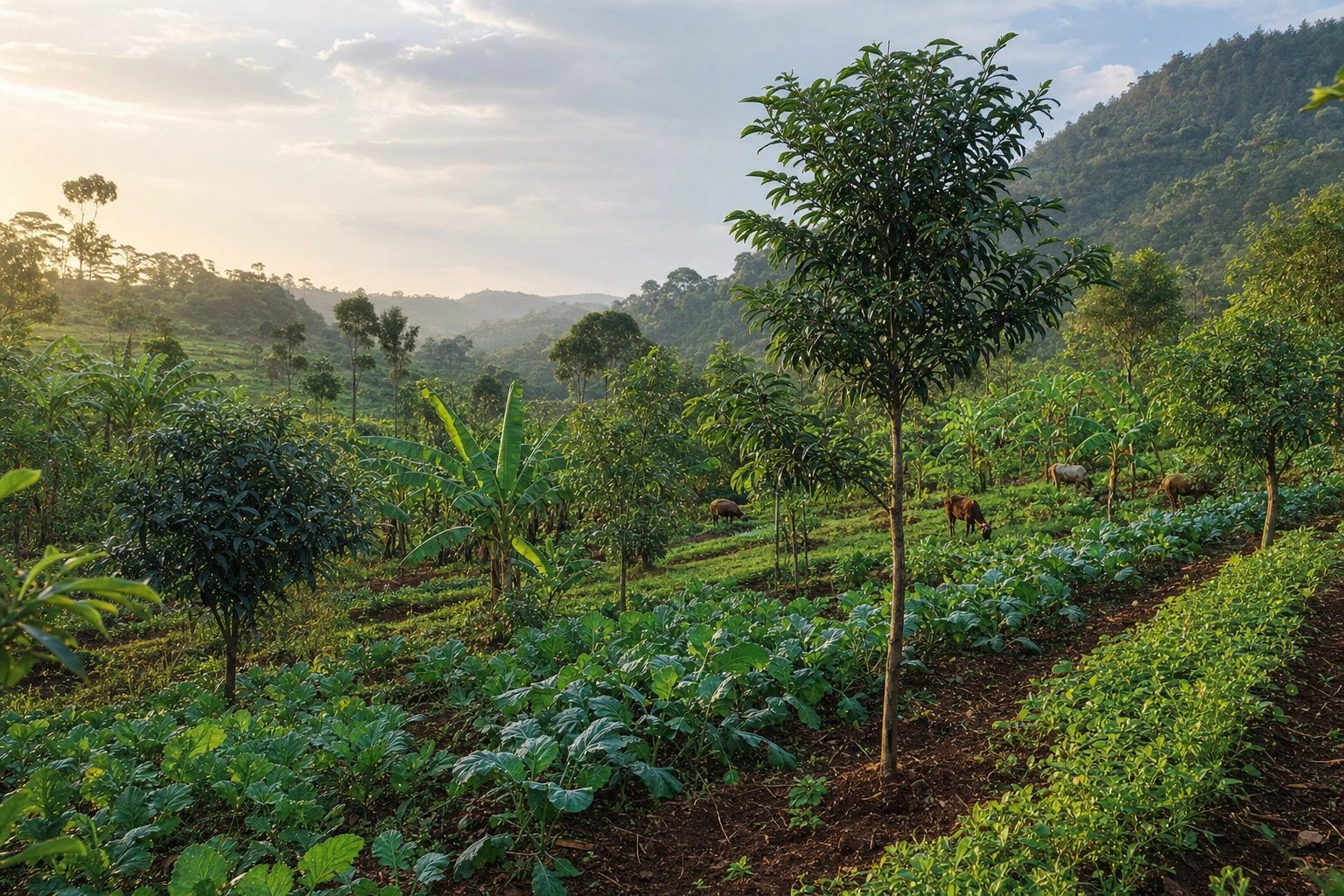
Climate change is making farming more difficult to predict. Many farmers are dealing with longer dry periods, intense rainfall, rising temperatures, new pest pressures and changing planting seasons. These stresses can damage crops, reduce livestock productivity and weaken household incomes, especially where farms depend heavily on one harvest.
Agroforestry offers one practical way to make agricultural systems more resilient. It involves deliberately integrating trees and shrubs with crops, livestock or both. Instead of treating trees as separate from farming, agroforestry uses them as part of the production system. The right trees, placed in the right locations and managed carefully, can protect soil, improve farm resources, diversify income and create more options when weather conditions change.
What Climate Resilience Means in Agriculture
Climate resilience is the capacity of a farm, household or agricultural value chain to prepare for climate-related stress, withstand disruption, recover from losses and adapt to changing conditions. Resilience does not mean that a farm will never experience drought, floods or crop failure. Rather, it means the farm has more ways to reduce damage and continue functioning.
For example, a farm growing only one rain-fed crop may be highly exposed if the rains arrive late. A diversified agroforestry farm might still lose part of that crop, but it may have fodder trees, fruit, fuelwood, honey, livestock products or timber that provide food or income at different times. The trees do not remove risk, but they can spread it across seasons and activities.
It is useful to distinguish resilience from climate mitigation. Mitigation focuses on reducing greenhouse gas emissions or increasing carbon storage. Resilience focuses on coping with the impacts that are already occurring or expected. Agroforestry can support both goals, but its value to a particular farmer should first be assessed through practical needs such as soil protection, fodder availability, shade, water management and income security.
How Agroforestry Builds Climate Resilience
1. Protecting soil from erosion
Heavy rainfall can wash away topsoil, particularly on sloping land or fields with little ground cover. Tree canopies intercept some rainfall, while leaf litter and ground vegetation reduce the force of raindrops hitting the soil. Roots help bind soil particles, and hedgerows or strips of trees can slow the movement of water across a field.
These functions are especially useful on hillsides and in areas where intense storms occur. A farmer may establish contour hedges, grass-and-tree strips or carefully positioned trees along waterways. Such measures should be designed so that they slow runoff without creating new waterlogging or concentrating water in unsafe locations.
2. Improving water infiltration and moisture retention
Healthy soil is better able to absorb and store rainfall. Organic matter from leaves, roots and pruned material can contribute to soil structure when managed appropriately. Tree roots also create channels through the soil, although their effects vary according to species, soil type and root distribution.
When water enters the soil rather than running rapidly over the surface, crops may have access to moisture for longer after rainfall. Mulching with suitable plant material, maintaining ground cover and reducing unnecessary soil disturbance can strengthen this benefit. However, trees also use water. In dry environments, poorly chosen or overly dense tree plantings may compete with crops, so water availability and spacing must be considered carefully.
3. Moderating heat and wind
High temperatures can reduce crop growth, increase evaporation and place stress on livestock. Trees can provide shade and alter wind speed, creating more favourable microclimates for people, animals and crops. Windbreaks can protect young plants and reduce wind erosion, while scattered trees may provide shade in pasture or around livestock handling areas.
Shade is not automatically beneficial for every crop. Some crops require strong sunlight, and dense canopies can reduce yields if they block too much light. The objective is to create an appropriate balance through species selection, spacing and pruning. For instance, widely spaced trees in a field may provide useful shade and organic matter without creating the same level of competition as a closed canopy.
4. Diversifying food and income
One of the strongest resilience benefits of agroforestry is diversification. Trees can supply fruits, nuts, fodder, fuelwood, poles, medicines, resins or timber, depending on the species and local market. They may also support beekeeping or provide materials for farm infrastructure.
Diversification matters because climate shocks rarely affect every farm product in exactly the same way. A dry spell may reduce a seasonal crop but leave a deep-rooted fruit tree, a fodder source or a livestock enterprise partly productive. Different products can also mature at different times, helping households manage gaps between harvests.
Income diversification must be planned realistically. A valuable tree product is only useful if the farmer can harvest, store, process and sell it at a reasonable cost. Before planting commercial trees, farmers should consider market access, transport, quality requirements, processing facilities and the time required before the first sale.
5. Supporting livestock during difficult seasons
In mixed farming systems, fodder trees and shrubs can supplement grasses and crop residues. Some species provide leafy material during periods when pasture quality declines. Trees can also offer shade and shelter, which may improve livestock comfort during hot or windy weather.
Fodder should be selected and managed carefully. Farmers need to understand which parts of a plant are suitable, how much can be fed and whether the material requires drying, mixing or other preparation. Some plants can be harmful in excessive quantities or under particular conditions. Advice from a qualified extension officer, animal health professional or locally trusted agricultural specialist is important when introducing unfamiliar fodder species.
6. Supporting pollinators and natural pest control
Well-planned tree diversity can provide habitat and food for pollinators and other beneficial organisms. Flowering trees, shrubs and undisturbed areas may help create a more varied farm environment. Birds and predatory insects can sometimes contribute to natural pest regulation.
This does not mean that agroforestry eliminates pests. Trees can also harbour pests, compete with crops or make monitoring more difficult if they are unmanaged. Resilience therefore depends on diversity combined with regular observation, sanitation, appropriate pruning and integrated pest management rather than on planting trees alone.
Common Agroforestry Designs
Agroforestry is not one fixed technique. The design should match the farm's climate, soil, slope, labour supply, enterprise goals and land-tenure situation.
- Alley systems: Rows of trees or shrubs are planted between crop alleys. Prunings may be used as mulch or, where appropriate, as a source of organic material. Spacing and pruning are essential to limit competition.
- Scattered trees in cropland: Selected trees are retained or planted across fields. This can provide shade, soil benefits, fodder or products while allowing crops to continue growing between trees.
- Agrosilvopastoral systems: Trees, crops and livestock are managed together. Crop residues may feed animals, manure can return nutrients to the soil, and trees can provide fodder or shade.
- Silvopastoral systems: Trees and pasture are combined for livestock production. The arrangement needs sufficient open space for grazing and careful management to prevent overgrazing around young trees.
- Home gardens: A mixture of fruit trees, vegetables, herbs, shrubs and sometimes livestock is grown close to the household. These systems can support dietary diversity and make efficient use of small areas.
- Riparian and boundary planting: Vegetation is established along streams, field boundaries or vulnerable edges. Planting must respect water access, neighbouring land and the need to keep waterways clear.
In parts of East Africa, farmers may combine food crops with fruit trees, fodder species, nitrogen-fixing trees or useful indigenous species. In higher-potential areas, trees such as Grevillea robusta are sometimes integrated with crops, while in drier regions farmers may retain drought-tolerant trees suited to local conditions. These examples are not universal recommendations: performance depends on altitude, rainfall, soils, local management and available planting material.
Designing an Agroforestry System Step by Step
Step 1: Identify the main climate risk
Start with the problem rather than with a preferred tree species. Is the farm losing soil during storms, suffering from wind, lacking dry-season fodder, facing heat stress, or depending too heavily on one income source? A system designed for erosion control may look different from one designed mainly for fruit production.
Step 2: Map the farm
Observe slopes, drainage paths, water points, existing trees, buildings, roads, power lines and neighbouring fields. Note where crops perform poorly and where runoff concentrates. A simple hand-drawn map can reveal suitable places for boundaries, windbreaks, contour planting or livestock shade.
Step 3: Choose species for several criteria
Consider climate suitability, root and canopy behaviour, mature size, products, labour needs, disease risks, livestock safety and market demand. Prefer reliable local or regionally adapted planting material. A tree that grows quickly but consumes too much water, spreads aggressively or has no useful market may create more problems than benefits.
Step 4: Plan spacing and timing
Spacing should reflect the mature size of the trees, the associated crops and the desired level of shade. Planting too densely can increase competition and management costs. Establishing trees at the start of a suitable rainy period can improve survival, but farmers should also plan for watering, mulching and protection during the early stages.
Step 5: Protect young trees
Seedlings may be damaged by livestock, weeds, fire, drought or cultivation equipment. Practical protection can include guards, live fencing, mulching, selective weeding and community agreements about grazing. The most sophisticated design will fail if young trees are not protected through their vulnerable establishment period.
Step 6: Manage the system continuously
Agroforestry requires management, not just planting. Prune branches that interfere with crops, remove diseased material, manage competing vegetation and thin trees where necessary. Use prunings appropriately and monitor whether the system is improving or reducing crop performance. Farmers should be willing to adjust the design as trees mature.
Trade-Offs and Risks to Manage
Agroforestry can produce benefits, but trees are not automatically beneficial in every location. Roots may compete with crops for water and nutrients. Canopies may create excessive shade. Fallen branches can interfere with machinery, and trees may complicate ploughing or harvesting. Some species can spread beyond intended areas or become difficult to remove.
There are also financial and time-related trade-offs. Many tree products take years to generate significant returns, while establishment requires labour and sometimes fencing or seedlings. Farmers should avoid planting an area so extensively that they lose essential food production or cash flow. A phased approach, beginning with a small trial, can reveal how a species behaves before it is introduced widely.
Land rights are another important consideration. If farmers do not have secure access to land, they may be reluctant to invest in long-term trees. In communal or rented settings, clear agreements about ownership, harvesting and responsibilities can reduce conflict. Tree planting should also respect neighbours' access, boundaries and water sources.
Measuring Whether the Farm Is Becoming More Resilient
Farmers can track practical indicators rather than relying only on the number of trees planted. Useful questions include:
- Does the soil remain in place after heavy rainfall?
- Does the field retain moisture for longer between rains?
- Are livestock able to access adequate fodder or shade during difficult periods?
- Has the household gained additional food or income sources?
- Are crop yields improving, declining or remaining stable under variable weather?
- What labour, water and maintenance costs are required?
- Are pests, diseases or invasive growth becoming more difficult to manage?
Keeping simple seasonal records can support better decisions. Compare areas with and without trees where possible, while recognising that soil, slope and management may differ. Resilience should be judged over time because young trees may initially compete with crops before later providing shade, mulch, products or structural benefits.
Applying This in Practice
Imagine a smallholder farm on a sloping site that loses topsoil during intense rainfall and faces a shortage of livestock fodder near the end of the dry season. The farmer could begin by identifying the main runoff routes and establishing suitable contour vegetation, while protecting the planting from grazing animals. Fodder trees could be placed where they will not shade the main crop excessively, and pruned material could be managed as mulch or feed according to its suitability.
The farmer could then retain productive existing trees, add a modest number of fruit trees near the household and maintain ground cover between planting areas. Instead of planting the entire farm at once, the farmer might test the arrangement on one section for two seasons. Records of crop growth, fodder availability, labour, tree survival and erosion would help determine whether to expand, change spacing or replace unsuitable species.
For an entrepreneur or agricultural adviser, the same logic applies at a larger scale. Begin with a climate-risk assessment, involve the people who manage the land daily, check the market and service requirements, and design for maintenance as well as establishment. A resilient system is one that farmers can afford, manage and adapt—not simply one that looks diverse on paper.
Key Takeaways
- Agroforestry builds resilience by combining trees with crops, livestock or both, giving farms more ecological and economic options.
- Trees can reduce erosion, moderate heat and wind, improve soil conditions and support water management when correctly selected and placed.
- Diversified tree products can reduce dependence on a single harvest, but markets, processing, labour and time to maturity must be assessed.
- Species, spacing and pruning should be chosen according to local climate, soils, water availability, farm enterprises and management capacity.
- Young trees need protection from livestock, weeds, drought and fire; successful agroforestry depends on long-term management.
- Start with a manageable trial, monitor practical results and adapt the design as trees and climate conditions change.
No comments yet.