
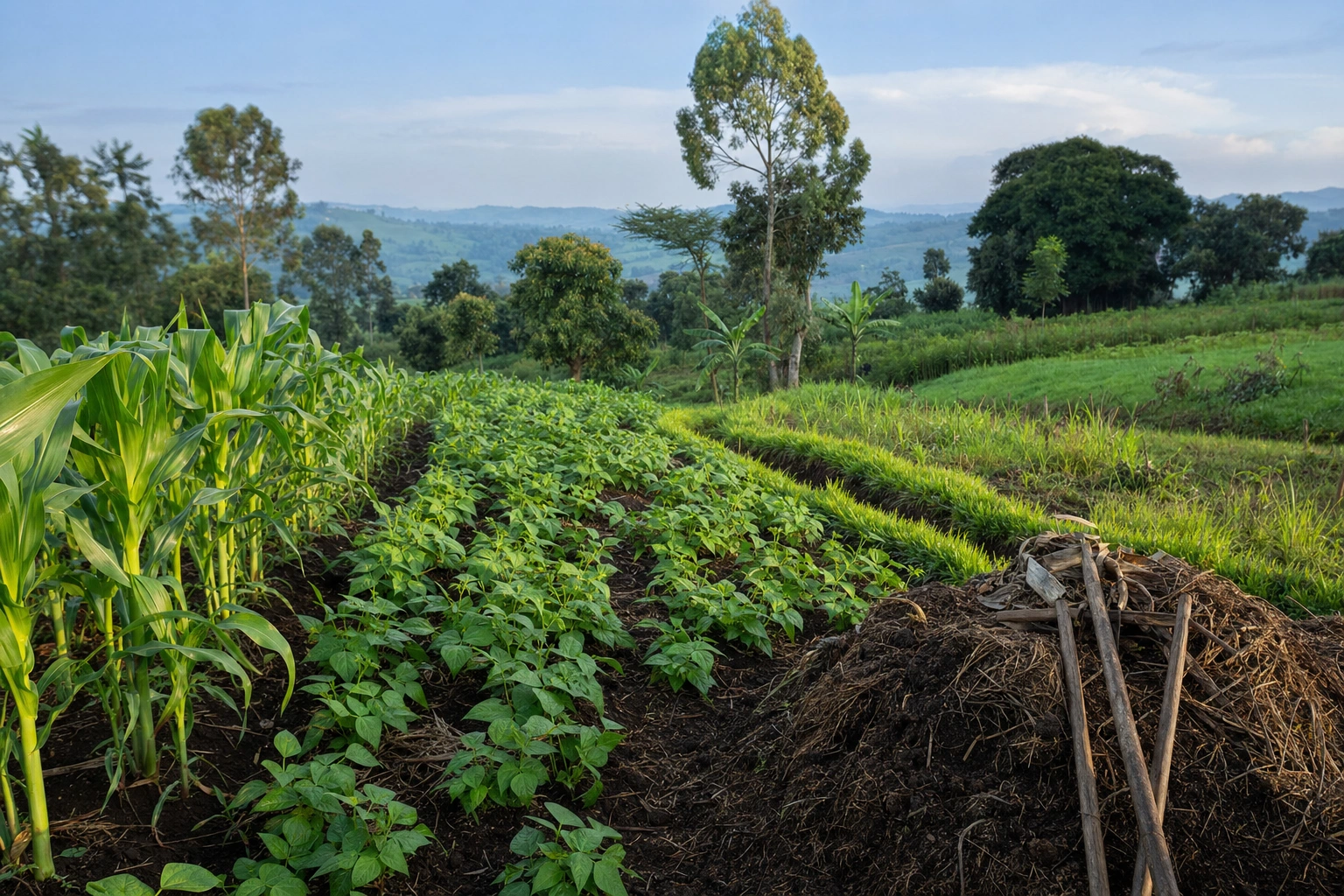
A farm can produce a good harvest this season while its soil is quietly becoming less productive. Heavy cultivation, erosion, nutrient removal, declining organic matter and poor water management may not cause immediate failure, but their effects accumulate. Over time, crops may need more fertiliser, rainfall may become more difficult to use, and yields may become less reliable.
Long-term soil productivity means maintaining or improving the soil’s capacity to support healthy crops, livestock forage and beneficial biological activity over many seasons. It is not simply about producing the highest yield today. It is about making sure the land remains fertile, structurally stable, biologically active and capable of recovering from drought, heavy rain and continuous production.
What long-term soil productivity means
Soil productivity is the ability of soil to provide the physical support, nutrients, air, water and biological conditions that plants need to grow. A productive soil holds enough water without remaining waterlogged, allows roots to penetrate, supplies nutrients in usable forms and supports organisms that help cycle nutrients and break down organic material.
The word long-term is essential. A farmer may increase production temporarily by applying a large amount of a single fertiliser, cultivating more frequently or expanding into fragile land. However, if the practice damages soil structure, increases erosion or removes nutrients faster than they are replaced, it is not sustainable. Long-term productivity considers the balance between what the soil gives and what the farming system returns.
This is related to, but not exactly the same as, soil fertility. Soil fertility mainly concerns the availability of essential plant nutrients. Soil productivity is broader: it includes fertility, structure, water movement, biological health, depth, drainage and the soil’s ability to support profitable production under real farm conditions.
Why soil productivity matters to farmers and communities
Reliable yields and income
Healthy soil helps crops make better use of rainfall and applied nutrients. This can improve yield stability, especially when weather conditions are uneven. For a smallholder farmer growing maize, beans or vegetables in Kenya, more reliable production can make it easier to plan household food supplies, school expenses and market sales. For a commercial farm, stable soil performance reduces the risk that one poor season will cause severe financial losses.
Lower production risk
Soils with good structure and adequate organic matter often absorb and store more water than compacted or severely degraded soils. During heavy rain, they may allow more water to infiltrate rather than running across the surface and carrying soil away. During dry periods, the stored moisture can support crops for longer. No soil can eliminate drought risk, but good soil management can reduce the severity of water stress.
Efficient use of inputs
Fertiliser, manure, irrigation water, seed and labour all have costs. When soil conditions are poor, some inputs may be lost through erosion, leaching, runoff or inefficient uptake. Improving soil structure and matching nutrients to crop needs can help farmers obtain more value from each input. This does not mean that fertiliser is unnecessary. It means that fertiliser works best as part of a wider soil-management plan.
Protection of the wider environment
Soil erosion can carry sediment and nutrients into rivers, dams and wetlands. Excess nutrients may contribute to water-quality problems, while the loss of topsoil reduces the productive depth of farmland. Maintaining soil cover and managing water flow therefore protects both the farm and surrounding ecosystems. Soil also stores carbon in organic matter, although the amount and permanence of storage depend on local conditions and management.
The main threats to long-term soil productivity
Erosion
Water erosion occurs when rainfall detaches and transports soil particles. It is more likely when land is bare, slopes are cultivated up and down, or rainfall flows rapidly across compacted ground. Wind erosion can also remove fine, nutrient-rich particles from exposed soil. The most valuable topsoil is often lost first, leaving behind shallower and less fertile ground.
Declining organic matter
Organic matter includes decomposed plant and animal material and other carbon-rich substances in the soil. It contributes to aggregation, water-holding capacity, nutrient cycling and biological activity. Repeatedly removing crop residues, burning vegetation, applying little organic material and cultivating intensively can reduce organic matter over time.
Compaction
Compaction occurs when soil particles are pressed together, reducing the spaces through which air and water move. It can result from heavy machinery, repeated traffic, working wet soil or concentrated livestock activity. Compacted layers may restrict root growth, slow infiltration and create conditions where water either pools at the surface or runs off.
Nutrient depletion and imbalance
Crops remove nutrients from the field when grain, vegetables, fodder or other products are harvested. If those nutrients are not replaced in suitable amounts, fertility declines. A different problem occurs when one nutrient is applied repeatedly while others remain deficient, or when applications exceed crop needs. Soil testing and careful nutrient planning help distinguish deficiency from imbalance.
Acidity, salinity and poor water management
Some soils become more acidic through natural processes or repeated management practices. Others accumulate salts where evaporation is high and drainage is inadequate. Irrigation can support productivity, but poorly managed irrigation may cause waterlogging or salinity. These problems are not solved by adding more fertiliser; they require diagnosis and appropriate water, drainage or soil-management measures.
How sustainable practices protect soil
Keep soil covered
Living crops, cover crops, crop residues and well-managed vegetation protect the soil surface from the direct force of rainfall and wind. Cover also reduces evaporation and moderates soil temperature. Examples include leaving suitable residues after harvest, growing cover crops between main crops, using mulch around vegetables and establishing grass or legume cover where appropriate.
Cover must be managed carefully. Some residues may harbour pests or diseases, interfere with planting or compete for limited water in dry areas. The right choice depends on the crop, climate, soil type and available equipment.
Reduce unnecessary disturbance
Conservation or reduced tillage limits the physical disturbance of soil. It can help preserve soil aggregates, protect soil organisms and reduce erosion. However, reduced tillage is not a single recipe. Results depend on residue management, weed control, rainfall, machinery and crop rotation. A farmer should assess whether the system controls weeds and maintains yields rather than adopting a label without adapting it to local conditions.
Rotate and diversify crops
Growing the same crop repeatedly can encourage particular pests and diseases and may remove similar nutrients year after year. Rotating cereals with legumes, oilseeds, roots or forage crops can spread production risks and improve nutrient cycling. Legumes such as beans, cowpeas or groundnuts can contribute nitrogen to the farming system through biological processes, although their benefits depend on healthy plants, suitable soil conditions and what happens to the crop residues.
Diversity can also include intercropping, agroforestry or integrating crops with livestock. For example, trees may provide shade, fodder, fuelwood or additional products, while carefully managed livestock can convert some farm resources into manure. Each arrangement requires attention to competition for water, light and nutrients.
Manage nutrients based on evidence
Good nutrient management begins with identifying what the crop needs and what the soil can supply. Soil testing, field observation, crop history and local agronomic advice can guide decisions. Farmers should consider the nutrient content of manure and compost, the timing of applications, placement near roots and the expected yield.
A useful principle is to apply the right source, at the right rate, at the right time and in the right place. Splitting nitrogen applications, for instance, may reduce losses where conditions make a single large application inefficient. Organic inputs can improve soil condition, while mineral fertilisers can supply nutrients in concentrated and predictable forms. Many farms benefit from combining both rather than treating them as competing choices.
Control water movement
Water management should slow, spread and safely direct rainfall. Practices may include planting across the slope where suitable, contour farming, grass strips, terraces, tied ridges, infiltration trenches and protected waterways. The correct intervention depends on slope, soil, rainfall intensity and farm layout. Structures should be designed and maintained properly; a poorly placed channel can concentrate water and worsen erosion.
On irrigated land, scheduling should consider crop demand, soil moisture and drainage. Applying more water than the soil can hold wastes water and may move nutrients below the root zone. Where water is scarce, mulching, drip systems or other efficient methods may improve the amount of water reaching crops, but equipment alone cannot compensate for poor soil structure or inadequate maintenance.
Soil biology: the living part of productivity
Soil contains bacteria, fungi, earthworms, insects and other organisms. These organisms decompose residues, form channels, contribute to aggregation and participate in nutrient cycling. Their activity is influenced by moisture, temperature, organic material, chemical conditions and disturbance.
Supporting soil biology does not mean assuming that every organism is beneficial or that a single biological product will solve soil problems. It means creating conditions in which a diverse soil community can function: keeping appropriate cover, returning organic material, reducing unnecessary disturbance and avoiding misuse of chemicals. Farmers should follow product labels and seek qualified advice before applying biological amendments or pesticides.
Measuring whether soil is improving
Improvement should be monitored rather than assumed. Laboratory soil tests can provide information about pH, organic matter, nutrients and other properties. Testing should be repeated using comparable sampling methods so that changes can be interpreted sensibly.
Simple field observations are also valuable. Farmers can record:
- How quickly water enters the soil after rain or irrigation.
- Whether water ponds or runs off in particular areas.
- Root depth and visible root health.
- The presence of earthworms and decomposing residues.
- Changes in soil colour, smell, crumb structure and ease of cultivation.
- Yield stability, crop vigour and the amount of fertiliser required.
These observations are not a substitute for laboratory analysis, but they can reveal patterns between testing periods. Keeping farm records makes it easier to compare fields, identify weak areas and evaluate whether a new practice is helping.
Applying This in Practice
A practical soil-productivity plan can begin with a clear assessment rather than a costly intervention.
- Map the farm. Mark slopes, eroded patches, compacted areas, wet spots, different soil types and fields with consistently low yields.
- Set a baseline. Record recent crops, yields, fertiliser and manure use, residue management, irrigation and visible soil conditions. Take representative soil samples where testing is available.
- Identify the main limitation. A field may be limited primarily by erosion, low nutrients, acidity, compaction, poor drainage or lack of soil cover. Treating the wrong problem wastes resources.
- Choose manageable actions. Start with practices that fit the farm’s labour, equipment, climate and cash flow. These might include retaining residues, planting a cover crop, adding compost, changing traffic routes or establishing a grass strip.
- Combine practices where they reinforce one another. Soil cover is more effective when paired with erosion control and suitable rotations. Nutrient applications are more efficient when supported by good water management and healthy roots.
- Review results over several seasons. Soil changes are often gradual. Compare yields, input costs, erosion, water behaviour and soil-test results rather than judging a practice after one unusual season.
For example, a maize-and-bean farmer on a sloping field might begin by leaving suitable residues, planting along the contour and rotating the next season with a different crop. The farmer could then test soil nutrient status, apply manure or fertiliser according to crop needs, and monitor runoff after heavy rain. This sequence addresses immediate protection while building better information for future decisions.
Key Takeaways
- Long-term soil productivity includes fertility, structure, water movement, biological activity and the soil’s ability to support crops over many seasons.
- Protecting soil from erosion, compaction and loss of organic matter reduces production risk and improves the value of farm inputs.
- Soil cover, suitable rotations, reduced disturbance, balanced nutrients and careful water management work best as part of an integrated system.
- Soil testing should be combined with field observations and farm records to identify the actual limitation before choosing a treatment.
- Sustainable practices must be adapted to local soil, climate, crops, labour, equipment and available finances.
- Progress is usually measured over several seasons through yield stability, input efficiency, soil condition and water behaviour.
No comments yet.