
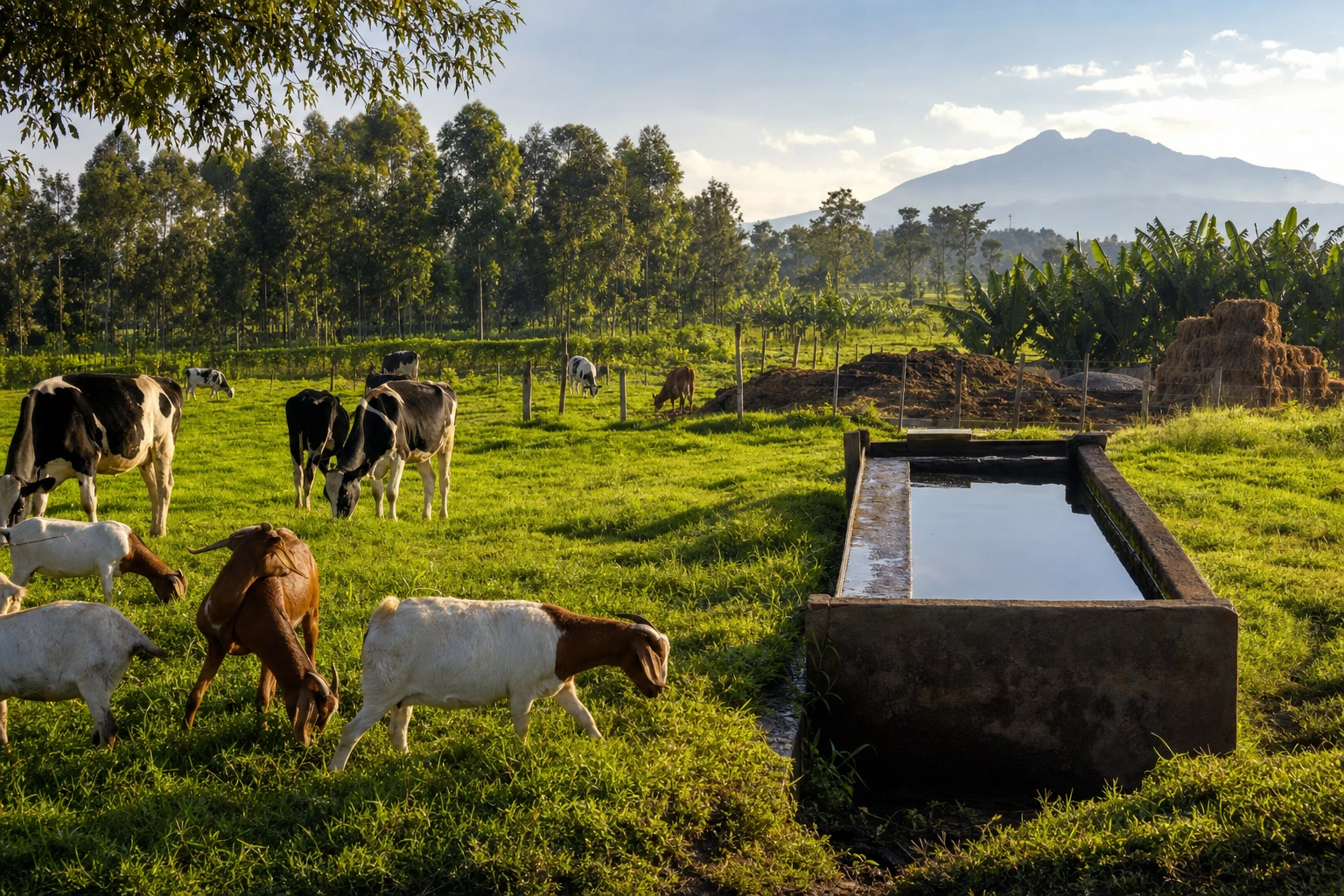
Sustainable livestock production is the practice of raising animals in ways that meet present food and income needs without damaging the natural resources, animal welfare systems or communities that future production depends on. It applies to cattle, goats, sheep, poultry, pigs, camels and other livestock kept for meat, milk, eggs, fibre, manure or breeding.
A sustainable livestock enterprise is not simply one that produces more animals or sells more products. It must also remain economically viable, protect soil and water, use resources efficiently, manage animal health responsibly and adapt to changing weather and market conditions. These principles are relevant to a smallholder keeping several goats, a pastoralist household, a dairy cooperative and a commercial ranch.
What Sustainable Livestock Production Means
Sustainability in livestock farming involves balancing three connected dimensions:
- Environmental sustainability: protecting soil, water, vegetation, biodiversity and air quality while reducing avoidable pollution and resource waste.
- Economic sustainability: ensuring that the enterprise generates reliable returns, controls costs, manages risks and can continue operating over time.
- Social and ethical sustainability: supporting safe livelihoods, responsible labour practices, food security, community relationships and humane treatment of animals.
These dimensions influence one another. For example, overgrazing may reduce vegetation and expose soil to erosion. The resulting decline in feed can lower animal performance, increase purchased-feed costs and reduce household income. Similarly, poor animal welfare may increase disease, mortality and treatment expenses. Sustainable management therefore requires the farmer to consider the whole production system rather than a single output.
Principle 1: Match Livestock to the Farm Environment
The most suitable animal is not necessarily the largest or most productive breed. It is the animal that can perform reliably under the farm’s climate, available feed, water supply, housing, labour and market conditions.
Indigenous and locally adapted breeds often have valuable traits such as tolerance to heat, ability to use local vegetation, resistance to some local challenges and lower maintenance requirements. Improved or crossbred animals may offer higher milk, meat or egg production, but they can also require better nutrition, housing, disease control and management. A crossbred dairy cow, for instance, may be profitable where quality feed and veterinary support are available, but risky where dry-season feed shortages are severe.
Before acquiring animals, assess the production environment. Consider rainfall patterns, temperature, drought risk, disease prevalence, grazing land, water access, available labour and buyer preferences. Choose animals whose needs the farm can meet consistently, not only during a good season.
Principle 2: Plan Feed and Protect Grazing Resources
Feed is often the largest recurring cost in livestock production, and it strongly affects growth, fertility, milk yield, disease resistance and welfare. Sustainable feeding begins with using available resources efficiently while maintaining their quality for future seasons.
Good practice includes combining appropriate pasture, crop residues, fodder crops, conserved forage and carefully selected supplements. Crop residues such as maize stover can provide useful roughage, but their nutritional value may be limited unless they are supplemented or treated appropriately. Leguminous fodder, including suitable beans, lucerne or other locally adapted forage species, can improve the protein supply when managed correctly.
Farmers should calculate the approximate feed demand of their animals across the year. This exposes likely shortages before they become emergencies. Fodder conservation through hay, silage or other suitable methods can help bridge dry periods. Feed should be stored under conditions that minimise moisture, mould, contamination and pest damage.
On grazing farms, planned grazing is essential. Rotating animals between paddocks or grazing areas allows vegetation to recover and reduces repeated pressure on preferred plants. Rest periods should reflect rainfall, pasture growth and local conditions rather than following a rigid calendar. Overstocking is a major sustainability risk because it can cause pasture degradation, soil compaction and livestock weight loss. The number of animals should be aligned with the land’s carrying capacity, especially during drought.
Principle 3: Manage Water Responsibly
Animals need clean, reliable water for drinking, digestion, temperature regulation, milk production and general health. Water requirements vary according to species, body size, feed, pregnancy, lactation and weather. A practical water plan should identify the source, seasonal reliability, quality, storage capacity and distance animals must travel.
Water points should be kept clean and designed to reduce mud, faecal contamination and unnecessary spillage. Leaking troughs waste water and can create breeding grounds for pests or muddy areas that increase disease risk. Where possible, protect water sources from direct trampling and contamination by animals. Farmers should also understand which local water sources may contain excessive salinity, chemical contamination or other hazards.
Efficient water management benefits both the farm and the surrounding community. Rainwater harvesting, storage tanks and carefully maintained pipes may improve resilience, provided the system is appropriate to local rainfall and financially realistic. Water-saving measures should never compromise animal welfare or access to adequate drinking water.
Principle 4: Prioritise Animal Health and Welfare
Healthy animals are generally more productive, require fewer treatments and make better use of feed. Prevention is usually more sustainable than responding to repeated disease outbreaks. A herd or flock health plan may include vaccination where recommended by a qualified animal-health professional, parasite control, quarantine for newly purchased animals, clean housing and regular observation.
Farmers should monitor appetite, movement, body condition, breathing, manure, coat or feather condition, milk changes and unusual behaviour. Early detection can prevent a small problem from becoming a major loss. Records of illness, treatments, vaccination and deaths help identify recurring problems and improve future decisions.
Animal welfare means providing animals with adequate feed and water, suitable shelter, reasonable comfort, protection from avoidable pain and disease, and the ability to express normal behaviour where practical. Housing should provide ventilation, shade or protection from cold, dry resting areas and enough space to reduce injuries and stress. Handling should be calm and appropriate to the species. Unnecessary beating, overcrowding and prolonged restraint are both welfare concerns and management failures.
Responsible medicine use is also important. Treatments should be guided by professional advice and product instructions. Farmers should observe withdrawal periods for milk, meat and eggs, and avoid using leftover or inappropriate medicines. This protects consumers and helps reduce the risk of antimicrobial resistance.
Principle 5: Improve Breeding and Genetic Management
Breeding decisions should support the farm’s long-term objectives rather than pursuing production records alone. Useful traits may include fertility, disease tolerance, growth, milk composition, mothering ability, feed efficiency, body size and adaptation to heat or local conditions.
Keep basic records of identification, birth dates, parentage where known, mating, births, production, illness and culling. These records make it easier to retain productive animals and avoid repeatedly breeding from animals with poor fertility, chronic disease or unsuitable temperament. Planned mating can also reduce inbreeding and improve herd consistency.
Farmers should consider the full cost of high-producing genetics. An animal that produces heavily for a short period but suffers frequent illness or fails to reproduce may be less sustainable than a moderately productive animal that remains healthy and fertile for several seasons.
Principle 6: Use Manure and Waste as Resources
Livestock manure contains nutrients that can improve soil fertility when handled properly. Composting manure and bedding can produce a more stable soil amendment, reduce odour and lower the risk of nutrient loss. Applying manure to fields at suitable rates and times helps crops benefit from its nutrients without overloading soil or water systems.
Waste should not be allowed to flow directly into rivers, wells or drainage channels. Poorly managed manure can contaminate water and increase disease risks. Constructing a simple collection area, maintaining drainage and separating clean rainwater from dirty runoff can make a substantial difference.
Other by-products may also have value. Crop residues can become feed or bedding, while some organic waste may be suitable for biogas systems where the technology, water supply and management skills are available. Such systems should be planned carefully rather than adopted solely because they appear environmentally attractive.
Principle 7: Protect Soil, Vegetation and Biodiversity
Livestock farms depend on healthy soil and vegetation. On mixed farms, integrating crops with livestock can create useful connections: animals provide manure, crops provide residues, and fodder can be grown alongside food or cash crops. However, these links must be managed carefully. Removing all crop residues from fields may reduce soil cover and organic matter, while leaving too little fodder for animals creates another problem.
Practices such as maintaining ground cover, planting suitable fodder trees or grasses, controlling erosion, protecting riverbanks and avoiding unnecessary clearing can strengthen the farm ecosystem. Trees may provide shade, fodder, fuel or wind protection, but species should be selected for local conditions and managed so that they do not compete excessively with crops or water resources.
Biodiversity supports resilience. Maintaining varied vegetation and protecting useful habitats can support pollinators, natural pest predators and soil organisms. Farmers should avoid practices that destroy habitats or cause avoidable pollution, while recognising that livestock management must still address invasive plants and disease risks appropriately.
Principle 8: Reduce Climate and Business Risks
Climate variability affects feed availability, water supply, disease patterns and market conditions. A sustainable enterprise plans for both ordinary seasonal changes and severe events such as prolonged drought, floods or extreme heat.
Risk-reduction measures may include keeping drought-tolerant or locally adapted animals, conserving fodder early, maintaining emergency water storage, improving shade, diversifying income and setting practical destocking rules. Selling some animals before a severe feed shortage may protect the remaining herd and reduce losses, although decisions should reflect household needs, market conditions and available alternatives.
Business sustainability also requires simple financial management. Track purchases, feed costs, veterinary expenses, labour, transport, breeding costs and sales. Calculate whether an animal or enterprise is genuinely profitable after these costs. In Kenya, for example, a dairy farmer supplying a cooperative should examine not only the price per litre but also the cost of feed, rejected milk, transport, loan repayments and periods of low production.
Market planning matters. Reliable buyers, quality requirements, seasonal price changes and access to storage or processing can influence which livestock enterprise is sensible. Diversifying products, such as selling breeding stock, manure, eggs or processed milk where permitted and safe, may reduce dependence on one income stream, but diversification should not exceed the farmer’s management capacity.
Applying This in Practice
A farmer can begin with a simple whole-farm assessment rather than changing everything at once:
- Describe the current system: list animal numbers, breeds, production goals, feed sources, water points, housing, labour and regular buyers.
- Identify the main constraint: determine whether the greatest problem is feed shortage, disease, poor breeding, water, labour, markets or high operating costs.
- Measure what is possible: record animal weights or body condition, milk or egg output, mortality, treatment costs, feed purchases and sales.
- Choose one or two improvements: examples include conserving fodder, repairing a water trough, separating sick animals, improving manure storage or keeping breeding records.
- Review the results: compare costs, animal health, production and labour requirements after an appropriate period.
- Scale carefully: expand only when the farm can reliably provide feed, water, housing, health care and markets for additional animals.
Sustainability is therefore a process of continuous adjustment. A small farm may make progress by reducing preventable deaths and improving fodder storage, while a larger ranch may focus on stocking rates, pasture monitoring and water infrastructure. The best action depends on the production system, but every decision should ask whether it protects future productivity as well as present returns.
Key Takeaways
- Choose livestock breeds and numbers that match the farm’s climate, feed, water, labour and market capacity.
- Plan feed across the whole year, conserve forage and prevent overgrazing.
- Provide clean water, suitable housing, preventive health care and humane handling.
- Use breeding records and select for health, fertility, adaptation and useful production traits.
- Manage manure, runoff and crop residues to protect soil and water while recovering useful nutrients.
- Track costs, production and sales so that environmental improvements also support a viable business.
No comments yet.