
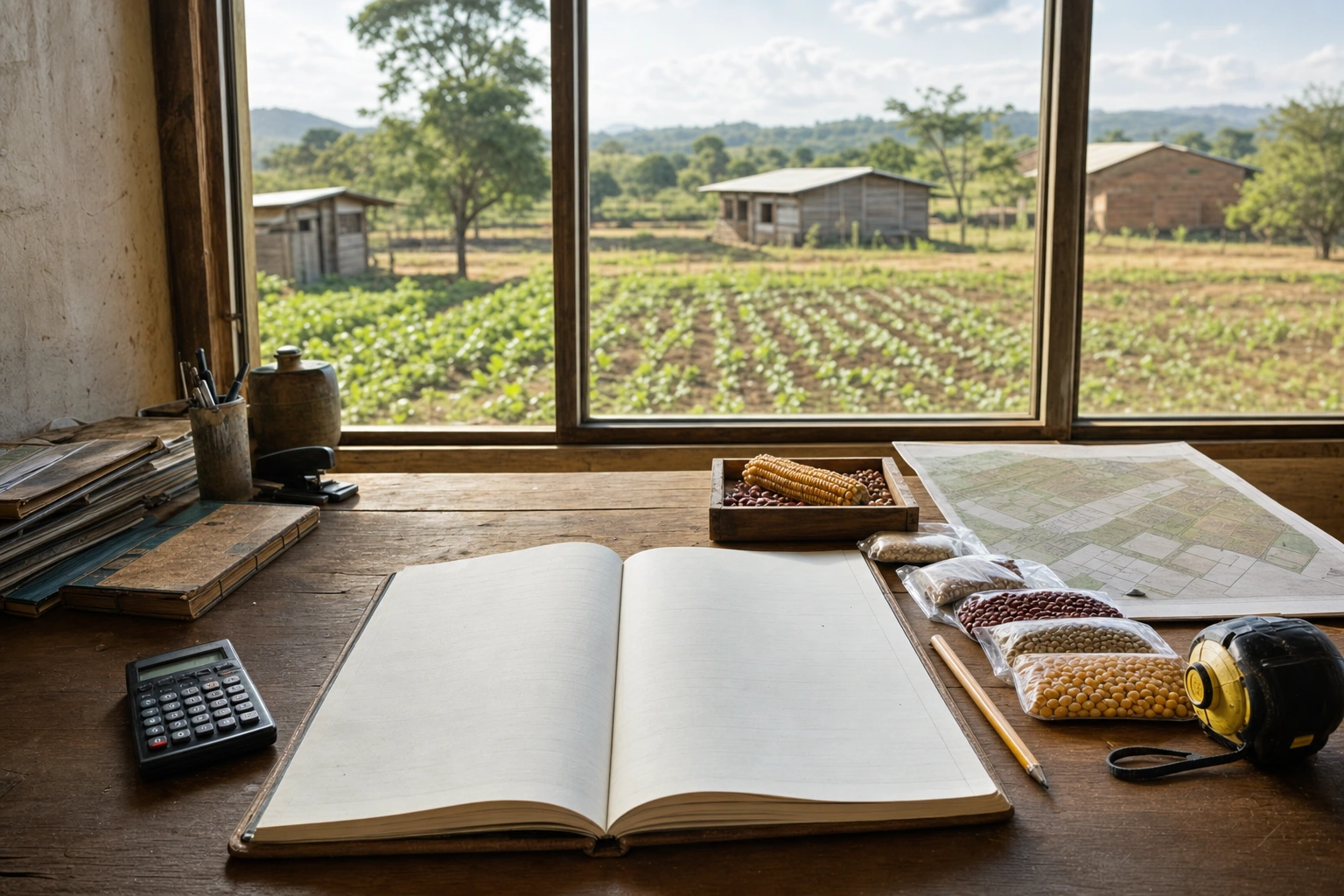
Farm management involves making decisions about land, labour, equipment, livestock, crops, inputs and money. Because these resources are limited, a farmer must decide not only what to produce, but also how much to produce, when to spend and whether an activity is likely to generate a worthwhile return. A farm budget provides a structured way to answer these questions before money and effort are committed.
A budget is not a promise that every result will occur exactly as planned. Weather, market prices, pests, disease, transport costs and other risks can change the outcome. Instead, a farm budget is a planning and control tool. It helps the farmer compare options, identify financial pressure early and adjust decisions using evidence rather than guesswork.
What Is a Farm Budget?
A farm budget is a financial plan that estimates the income, costs and likely returns associated with a farm, enterprise or proposed change. It translates physical activities—such as planting one hectare of maize, keeping dairy cows or purchasing irrigation equipment—into financial terms.
A basic budget normally includes:
- Expected output: the quantity of crops, milk, eggs, livestock or other products to be sold.
- Expected prices: the estimated selling price for each product.
- Variable costs: costs that change with the level of production, such as seed, feed, fertiliser, hired labour, fuel, packaging and veterinary services.
- Fixed costs: costs that do not change greatly in the short term, such as land rent, insurance, equipment depreciation and some administrative expenses.
- Timing of transactions: when money will be spent and when income is expected to arrive.
- Estimated return: the amount left after relevant costs have been deducted.
For example, a farmer considering tomato production may estimate the expected harvest, selling price, seedlings, fertiliser, pest control, labour, irrigation, transport and market fees. The budget can then show whether the enterprise appears financially attractive and how much working capital is required before the first sale.
Why Farm Budgets Matter
1. They support better planning
Farming decisions are often made months before income is received. A crop budget allows a farmer to plan input purchases, labour requirements, planting dates, harvesting arrangements and marketing activities in advance. This reduces the likelihood of buying inputs too late, underestimating labour needs or producing without a clear market plan.
Planning is especially important where several enterprises compete for the same resources. A mixed farm may use land for maize, beans, vegetables, fodder or grazing. A budget helps the farmer assess which combination fits the available land, labour, water and capital.
2. They measure expected profitability
Sales revenue alone does not show whether an enterprise is profitable. An activity may generate substantial income while also consuming large amounts of feed, labour, transport and borrowed money. A budget brings these items together so the farmer can estimate the return after costs.
One useful calculation is:
Gross margin = Total enterprise revenue ? Total variable costs
Gross margin is particularly useful for comparing enterprises in the short term. If land, buildings and equipment are already available, the enterprise with the stronger gross margin may make a greater contribution towards fixed costs and household income. However, gross margin is not the same as final farm profit because it does not normally subtract all fixed costs.
3. They improve cash-flow management
A farm can be profitable on paper and still experience a cash shortage. This happens when expenses occur months before sales, or when customers buy on credit. A cash-flow budget records the timing of cash inflows and outflows, usually by week or month.
For example, a poultry farmer may need to buy feed regularly, pay workers each month and meet electricity costs before selling mature birds. A cash-flow plan can show the amount of money needed during the production period and whether income from another enterprise, savings or external finance will cover the gap.
This distinction is important:
- Profitability asks whether total income is greater than total economic costs over a period.
- Liquidity asks whether the farm has enough cash available to pay bills when they fall due.
4. They help allocate scarce resources
Land, water, labour and capital have alternative uses. Choosing one enterprise may mean giving up another opportunity. Farm budgets make these trade-offs more visible.
Suppose a farmer has limited irrigation water and is considering vegetables or fodder. A budget can compare expected revenue, variable costs, labour demands, production risks and the timing of income for each option. The decision should not be based only on the highest possible sale value. It should also consider whether the enterprise fits the farmer's resources and management capacity.
5. They support borrowing and investment decisions
Lenders and investors usually need evidence that a proposed activity can generate enough income to meet its costs and repay finance. A clear budget helps explain the purpose of a loan, the expected cash-flow pattern and the risks involved.
Budgets also help farmers assess investments such as a water tank, greenhouse, dairy shed, cold-storage unit, tractor or solar pump. The question is not simply whether the equipment is useful. The farmer should estimate its purchase cost, maintenance, operating savings, additional income and likely payback period.
Main Types of Farm Budgets
Enterprise budget
An enterprise budget covers one specific activity, such as maize, coffee, dairy, poultry, beekeeping or fish farming. It lists the expected output, price, revenue and costs for that enterprise.
Enterprise budgets are useful when starting a new activity or comparing different production methods. For example, a farmer can compare open-field vegetables with protected production, or local poultry with improved breeds. The estimates should reflect the farm's actual conditions rather than relying uncritically on a general example.
Partial budget
A partial budget examines the financial effect of a proposed change. It includes only the income and costs that will change because of the decision.
A partial budget normally considers four categories:
- Additional income created by the change.
- Costs that will decrease because of the change.
- Additional costs caused by the change.
- Income that will be lost because of the change.
For instance, a dairy farmer may consider replacing some purchased feed with fodder grown on the farm. The analysis should include the reduction in feed purchases, the extra seed and labour costs, any change in milk output and the value of land or labour redirected from another use. A partial budget is often more practical than rebuilding the entire farm budget for every small decision.
Whole-farm budget
A whole-farm budget combines all major farm enterprises and household-relevant farm activities. It provides an overall view of expected revenue, operating costs, fixed costs, debt obligations and available resources.
This type of budget can reveal problems that are hidden within individual enterprise budgets. For example, each enterprise may appear profitable, but the combined plan may require more labour or cash than the farm can provide during the same month.
Cash-flow budget
A cash-flow budget focuses on the timing of actual receipts and payments. It may be prepared monthly, quarterly or weekly, depending on the farm's needs.
It should include opening cash, expected cash received, expected payments and closing cash. The farmer can then identify periods when cash may be insufficient and plan early—for example, by adjusting planting schedules, negotiating payment terms, reducing non-essential spending or arranging suitable finance.
Capital or investment budget
A capital budget evaluates long-term investments. It considers the initial cost, expected useful life, operating expenses, maintenance, possible income or savings and the timing of returns.
Capital decisions should also account for flexibility and risk. A cheaper machine may have higher maintenance needs, while a larger asset may remain underused. The best choice is not always the one with the greatest capacity; it is the one that fits the farm's expected workload and financial ability.
How to Prepare a Farm Budget
Step 1: Define the decision and planning period
Begin with a clear question. Are you planning the next crop season, comparing two enterprises, deciding whether to expand livestock, or assessing a new piece of equipment? Define the period covered, such as one production cycle or one financial year.
Step 2: Describe the production plan
Record the area to be cultivated, number of animals, expected production method, input quantities, labour requirements and likely harvest or sales dates. Physical assumptions should come before financial calculations.
Step 3: Estimate output and prices carefully
Use realistic production estimates based on the farm's history, local conditions, reliable records and advice from qualified agricultural professionals where appropriate. Avoid using the highest possible yield and price together. Consider different selling periods, quality grades, rejected produce, post-harvest losses and market access.
Step 4: List all relevant costs
Separate variable and fixed costs. Include costs that are easy to overlook, such as transport, market charges, packaging, repairs, water, fuel, hired services, interest, storage and hired labour. If family labour is used, recording its estimated value can improve the quality of comparisons, even when no cash payment is made.
Also distinguish between cash costs and non-cash costs. Depreciation, for example, may not require a payment during the current month, but it represents the gradual use of an asset and matters when assessing long-term sustainability.
Step 5: Calculate returns and resource needs
Calculate total revenue, total variable costs, gross margin and, where appropriate, net farm income after fixed costs. Record the amount of cash required before sales begin and identify the months with the greatest financial pressure.
Useful measures may include:
- Gross margin per unit: gross margin per acre, hectare, animal, crate or kilogram.
- Break-even price: the selling price needed to cover specified costs at an expected output level.
- Break-even output: the quantity that must be sold to cover specified costs at an expected price.
- Return on investment: the estimated gain compared with the money committed, used carefully and with clearly stated assumptions.
Step 6: Test alternative scenarios
Budgeting with one set of assumptions can create false confidence. Prepare at least a realistic case and less favourable cases. Ask what happens if the selling price falls, yield is lower, feed prices rise, transport becomes more expensive or harvest is delayed.
Sensitivity analysis is especially useful for identifying the assumptions that matter most. If a small change in price makes an enterprise unprofitable, the farmer may need a stronger marketing arrangement, a lower-cost production method or a different enterprise.
Step 7: Review the budget during production
A budget should be compared with actual results as the season progresses. Record purchases, labour, production volumes, sales and unexpected costs. When actual figures differ from estimates, investigate the reason rather than simply changing the final total.
A variance may result from poor input control, a change in market conditions, a weather event, an inaccurate estimate or a deliberate management decision. Understanding the cause improves the next budget.
Common Mistakes in Farm Budgeting
One frequent mistake is underestimating small costs. Individual expenses may appear insignificant, but many small items can reduce the final return. Another mistake is treating family labour or owned land as free. Even where no cash changes hands, these resources have value and could be used elsewhere.
Farmers may also confuse revenue with profit, ignore cash-flow timing or assume that an average market price will always be available. Using borrowed figures without adjusting them to local input prices, farm size, soil, climate and management ability can produce misleading results.
A further problem is failing to update the budget. Input prices, labour rates, disease risks and market conditions change. A budget prepared at the beginning of the year should be reviewed when important assumptions change.
Applying This in Practice
Choose one enterprise and create a simple budget using a notebook, spreadsheet or suitable farm-recording application. Start with the physical plan: area, animals, expected output and production dates. Then list every expected income and cost, separating cash expenses from non-cash costs.
- Write down the purpose of the enterprise and the period covered.
- Estimate output using realistic, farm-specific assumptions.
- Record expected prices and identify possible buyers or markets.
- List variable costs, fixed costs and the timing of each payment.
- Calculate revenue, gross margin and the minimum cash needed before sales.
- Prepare a less favourable scenario and identify how you would respond.
- Compare actual figures with the budget at regular intervals and record the reasons for major differences.
For a small farm in Kenya, this might involve budgeting maize and beans separately, then preparing a whole-farm cash-flow plan that includes school-fee obligations, livestock sales and seasonal input purchases. The purpose is not to turn every decision into a complicated accounting exercise. It is to make important assumptions visible and to help the farmer act before a financial problem becomes urgent.
Key Takeaways
- A farm budget links production plans with expected income, costs, resource needs and cash timing.
- Profitability and liquidity are different: a profitable enterprise can still face a temporary cash shortage.
- Enterprise, partial, whole-farm, cash-flow and capital budgets answer different management questions.
- Include overlooked items such as family labour, transport, repairs, storage, interest and depreciation where relevant.
- Use realistic assumptions and test what happens when yields, prices or costs change.
- Compare actual results with the budget regularly and investigate the reasons for important variances.
No comments yet.