
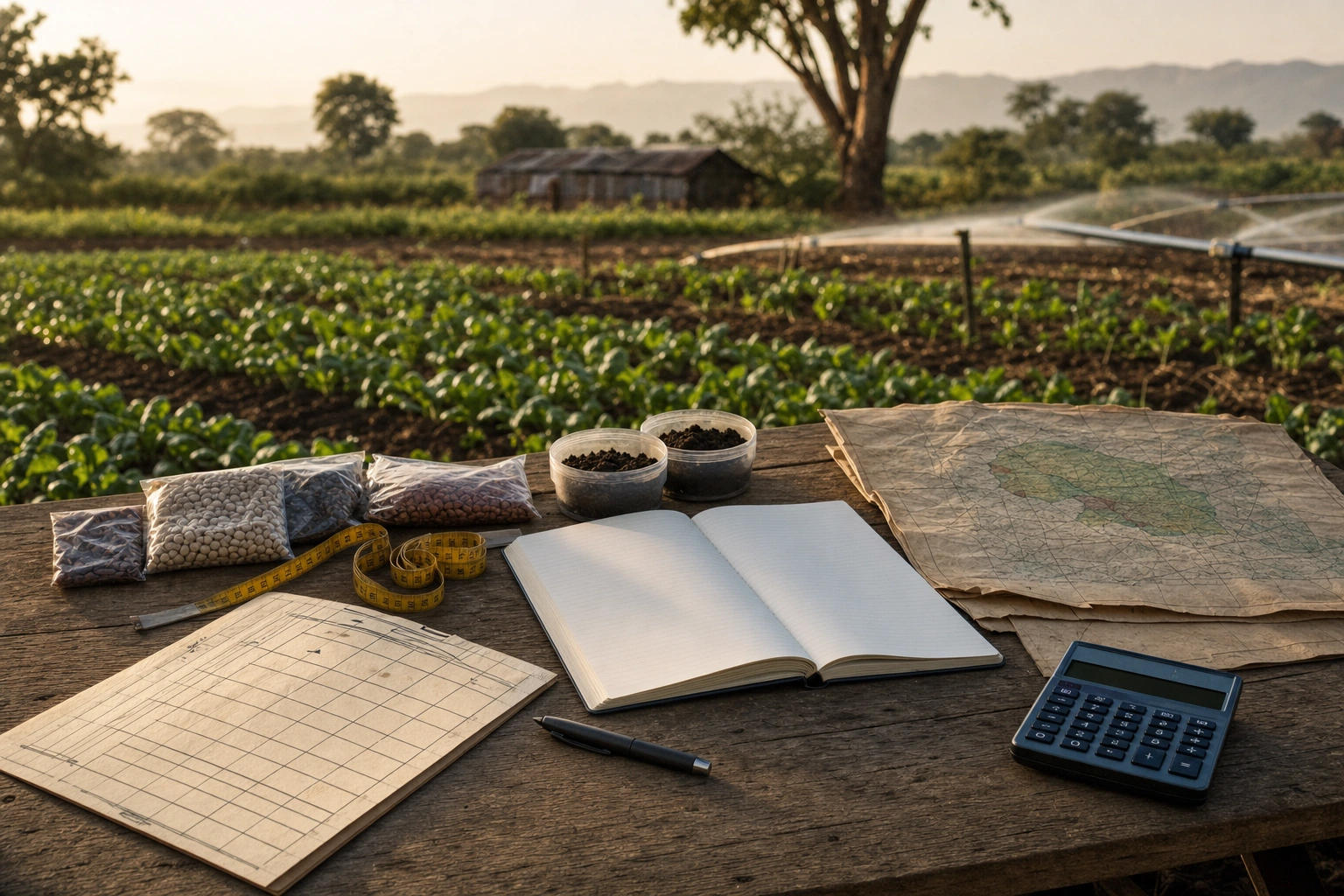
Farm planning is the process of deciding what a farm will produce, how it will produce it, which resources it will use and how results will be measured. It connects day-to-day activities—such as buying seed, preparing land, feeding livestock or arranging transport—to wider business objectives.
Whether you manage a smallholder plot in Kenya, a commercial horticultural unit, a livestock enterprise or an urban farm, planning reduces avoidable surprises. It cannot control rainfall, prices, pests or disease, but it helps you prepare for them and make better choices when conditions change.
What Farm Planning Involves
A farm is both a biological system and a business. Crops and animals respond to weather, soil, nutrition and management, while the enterprise must also cover costs, meet customer needs and generate a worthwhile return. Farm planning brings these dimensions together.
A complete plan normally considers:
- Objectives: what the farm owner wants to achieve, such as supplying food, earning income, creating employment or building an asset.
- Resources: available land, water, labour, equipment, finance, skills, buildings and records.
- Production: crops, livestock or other enterprises, including varieties, breeds, quantities and production methods.
- Timing: when land preparation, planting, breeding, harvesting, purchasing and selling will take place.
- Markets: who will buy the output, what quality they expect and how products will reach them.
- Finance: expected costs, income, cash-flow requirements and possible returns.
- Risk: events that could disrupt production or reduce income, together with practical responses.
Planning is not a document that is written once and forgotten. A useful plan is a working tool. It should be reviewed when rainfall changes, input prices rise, a buyer changes requirements or an enterprise performs differently from expectations.
Why Farm Planning Matters
1. It clarifies goals and priorities
Without clear goals, a farmer may add enterprises because they seem attractive rather than because they fit the farm. For example, a household may want regular cash income, food for home consumption and school-fee money. Those objectives could lead to a combination of staple crops, vegetables, poultry or dairy—but only if the available labour, capital and market access support the combination.
Planning requires the owner to distinguish between objectives. Is the main priority maximum profit, reliable household food, reduced risk, employment for family members or long-term soil improvement? These aims can support one another, but they may also compete. A crop with the highest possible return may require more capital and carry greater market risk than a less profitable but more reliable enterprise.
2. It improves the use of limited resources
Most farms have constraints. Land may be limited, water may be seasonal, machinery may be shared and skilled labour may be unavailable at busy times. A plan reveals where resources will be needed and whether several activities will compete for them.
Consider a farm that grows beans, keeps dairy cattle and plants vegetables for a nearby market. Planting, harvesting and animal care may require labour at overlapping times. By mapping activities on a calendar, the farmer can identify the pressure period early and arrange family labour, temporary workers, equipment hire or changes to the production schedule.
Planning also helps avoid underused assets. A water pump, storage room or chaff cutter may create more value when its use is coordinated across enterprises. Similarly, farm waste can sometimes be planned as an input: crop residues may support livestock feeding or composting, provided this does not damage soil cover or spread disease.
3. It supports better financial decisions
A production idea is not automatically a profitable enterprise. Farm planning separates the expected income from the costs required to achieve it. These costs may include seed, fertiliser, animal feed, veterinary services, labour, transport, packaging, irrigation, repairs, land preparation, storage and finance.
Prepare a simple enterprise budget for each major activity. Estimate:
- the quantity expected to be produced;
- the realistic price or range of prices;
- variable costs that increase with production;
- fixed or shared costs, such as equipment, buildings or administration;
- when money will be spent; and
- when income is likely to be received.
The timing of cash matters as much as the total return. A farmer may expect income after harvest but need money several months earlier for seed, fertiliser, labour and transport. A cash-flow plan highlights this gap and helps the farmer consider savings, staged purchasing, credit, contract arrangements or a smaller production scale.
Use cautious assumptions. It is safer to plan with a reasonable selling price and a conservative yield than to base decisions on the best possible outcome. Comparing a favourable, expected and difficult scenario can show whether the enterprise remains manageable when conditions are less favourable.
4. It improves production timing
Many agricultural activities depend on timing. Planting too early or too late can affect establishment; delayed vaccination can expose livestock to preventable disease; harvesting at the wrong maturity may reduce quality; and missing a buyer’s delivery window can weaken a market relationship.
A farm calendar converts intentions into scheduled actions. For crops, it may include soil testing where appropriate, land preparation, seed selection, planting, weeding, scouting, fertilisation, irrigation, harvesting, grading, storage and marketing. For livestock, it may include breeding, feeding changes, vaccination, treatment, weighing, housing maintenance, purchasing and sales.
Timing should be based on local conditions rather than copied blindly from another farm. Rainfall patterns, soil type, altitude, water access, variety, breed and market requirements all influence the best schedule. Local extension guidance and reliable buyer information can strengthen the plan.
5. It helps manage risk
A farm plan should ask, “What could go wrong, how serious would it be and what can we do before it happens?” Common risks include drought, flooding, pests, disease, theft, fire, equipment failure, input shortages, labour problems, price changes and buyer default.
Risk management begins with prevention. Measures may include using suitable varieties, maintaining soil cover, improving drainage, keeping livestock housing clean, following biosecurity procedures, storing inputs safely and maintaining equipment before peak demand. Diversifying enterprises can spread risk, but diversification should be deliberate. Too many unrelated activities can create management problems and weaken the farm’s focus.
Contingency planning is equally important. A crop farmer may identify an alternative water source, a different buyer or a lower-cost input option. A livestock farmer may plan how to respond to feed shortages, illness or a sudden need for veterinary care. The plan should state which warning signs require action and who is responsible for making the decision.
6. It strengthens market readiness
Production should begin with a realistic understanding of the market, not only with the question, “What can I grow?” Buyers may require particular quantities, grades, sizes, delivery dates, packaging or production practices. A plan helps match production to those requirements.
Market research can involve speaking with several potential buyers, checking seasonal demand, comparing transport costs and identifying how prices change across grades or selling periods. Farmers should also examine payment terms. A buyer offering a higher price may create greater cash-flow pressure if payment is delayed or if the farmer must meet expensive delivery conditions.
For example, a vegetable producer supplying shops or institutions needs to plan harvesting frequency, sorting, packaging and reliable transport. Producing more than the buyer can absorb may lead to waste. A smaller, consistent supply with dependable quality can be more practical than an ambitious volume that the farm cannot manage.
How to Prepare a Practical Farm Plan
Step 1: Assess the current farm
Begin with facts. Record the size and location of fields, soil and water conditions, existing buildings, equipment, livestock, labour availability, debts, available capital and previous production results. Note which activities performed well and which created losses or excessive work.
Separate resources that are owned from those that must be hired or purchased. Also identify constraints that cannot be ignored, such as limited irrigation, poor road access or a shortage of storage. A realistic plan starts from the farm’s actual capacity.
Step 2: Set specific objectives
Turn general ambitions into measurable targets. “Improve the farm” is difficult to manage, while “produce enough eggs to supply two regular customers each week” or “reduce feed waste through measured feeding and records” gives direction.
Set a small number of priorities for the planning period. Each objective should have a time frame and a way to judge progress. If several household members or business partners are involved, discuss the objectives together so that responsibilities and expectations are clear.
Step 3: Choose enterprises that fit
Compare possible enterprises against the farm’s resources, skills, market access, labour demands, risks and financial requirements. Ask whether an enterprise fits the land and climate, whether inputs are accessible, whether the farm can maintain the necessary quality and whether there is a credible route to market.
Do not judge an enterprise by gross sales alone. Estimate the costs and the management time involved. Also consider interactions between enterprises. Crop residues may support livestock, while livestock manure may contribute to soil fertility when handled safely. These links can improve resource use, but they should be included in the plan rather than assumed.
Step 4: Build a production calendar
Place every major task on a calendar. Use weekly or monthly columns, depending on the enterprise. Include preparation, purchasing, production, monitoring, harvesting, sales, maintenance and record review.
Mark tasks that are time-sensitive and tasks that depend on another activity. For instance, planting may depend on land preparation and suitable moisture; selling milk may depend on consistent hygiene, cooling and collection arrangements. Add buffer time where weather or transport could cause delays.
Step 5: Prepare budgets and a cash-flow plan
List expected income and costs for each enterprise. Record the assumptions behind the estimates, such as expected yield, selling price, feed requirement or hired labour rate. Then create a monthly cash-flow view showing when payments and receipts are likely to occur.
Keep business and household money separate where possible. This makes it easier to see whether the enterprise is supporting itself and reduces confusion when reviewing results. If farm resources are shared with household activities, record a reasonable estimate of their use rather than treating them as free.
Step 6: Assign responsibilities and records
A plan fails when nobody knows who is responsible for the next action. Assign duties for purchasing, field checks, livestock care, sales, cash handling and record keeping. A simple notebook, spreadsheet or mobile record can track dates, quantities, expenses, sales, mortality, treatments, labour and unusual events.
Records are useful only when they are accurate and reviewed. Write entries close to the time of the activity. Keep receipts and note whether a cost belongs to a particular enterprise or is shared. Over time, these records reveal patterns that memory may miss.
Reviewing and Improving the Plan
Review the plan at planned intervals rather than waiting until the end of the year. A short weekly check can focus on urgent tasks, while a monthly review can compare actual spending, production and sales with the plan. At the end of a production cycle, examine both financial and operational results.
Ask:
- Which activities were completed on time, and which were delayed?
- Did actual yields, mortality, prices and costs match the estimates?
- Which inputs or tasks consumed more resources than expected?
- What caused losses, waste or missed sales?
- Which customers were reliable and which requirements were difficult to meet?
- What should be continued, changed, reduced or stopped in the next cycle?
Use the answers to update assumptions. If a crop repeatedly requires expensive pest control, investigate prevention, variety choice, rotation or whether it is suitable for the farm. If a livestock enterprise produces sales but leaves little cash after feed and health costs, reassess its scale and management before expanding.
Applying This in Practice
Suppose a farmer near Nakuru wants to combine vegetables with poultry. The first step is not to purchase birds or seed. The farmer would assess water availability, available labour, housing, feed access, nearby buyers, transport and starting capital. The plan might then identify vegetables that fit the water supply and a poultry scale that can be managed without compromising hygiene or feed quality.
The farmer could prepare separate budgets, map labour peaks, schedule input purchases and identify alternative buyers. Weekly records would track vegetable harvests, rejected produce, poultry feed, egg production, mortality, sales and cash expenses. At the review stage, the farmer could compare the two enterprises and determine whether they support the household’s objectives.
The same reasoning applies to larger farms. A commercial manager may use more formal budgets, field maps and digital records, but the essential questions remain the same: what is the objective, what resources are available, what could disrupt the plan, when will work and cash be required, and what evidence will guide the next decision?
Key Takeaways
- Farm planning links production decisions with resources, markets, finances, timing and risk.
- Set specific objectives before choosing crops, livestock or other enterprises.
- Use production calendars to identify labour pressures and time-sensitive activities.
- Prepare enterprise budgets and cash-flow plans using cautious, realistic assumptions.
- Assess market requirements, payment terms and transport before expanding production.
- Keep accurate records and review actual results so the next plan improves.
No comments yet.