
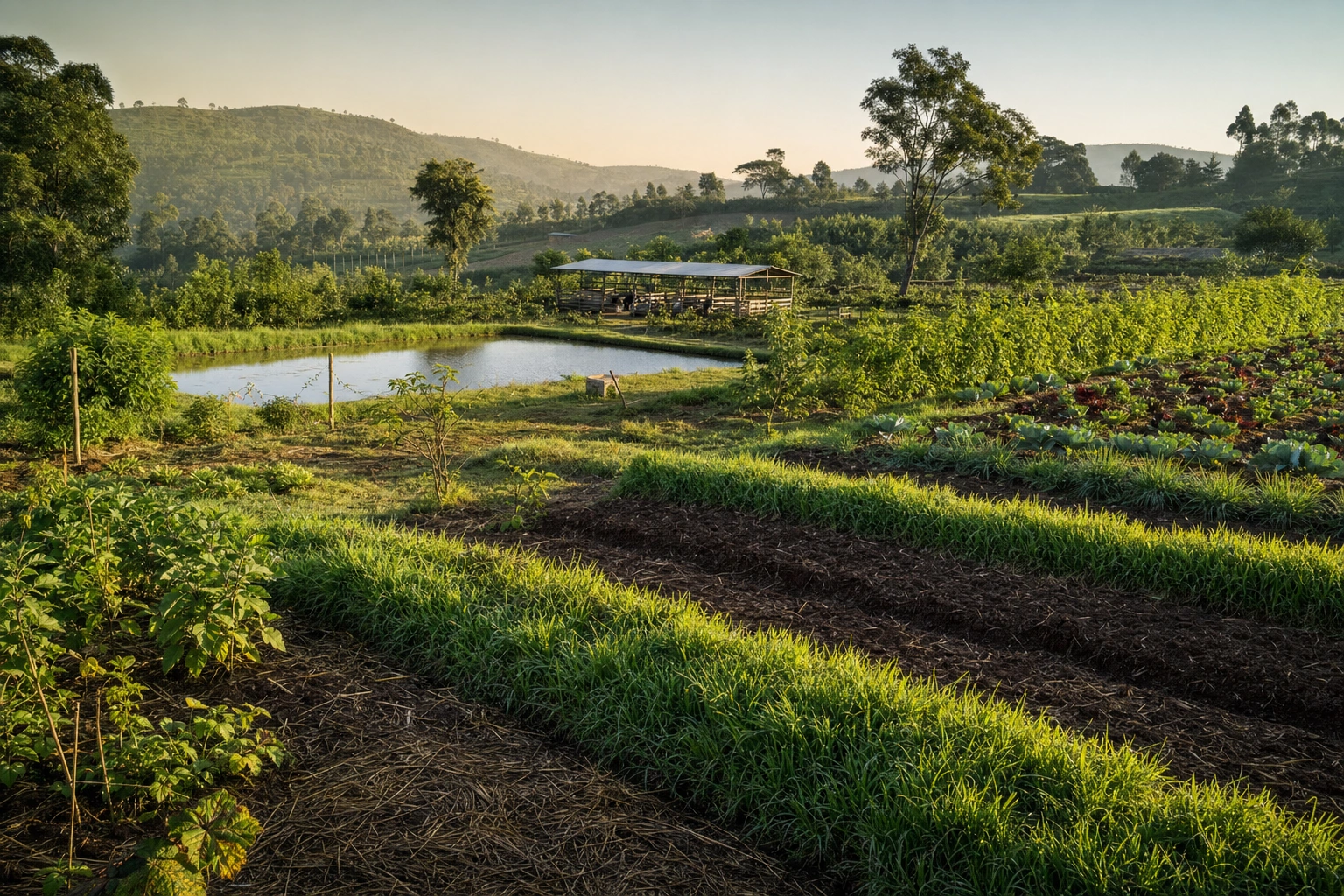
Sustainable farm management is the practice of running a farm in a way that remains productive, profitable and environmentally responsible over time. It requires more than choosing environmentally friendly techniques. A sustainable manager must balance soil health, water availability, biodiversity, animal welfare, labour conditions, market demand and financial performance.
This balance matters to commercial farms, family farms, cooperatives, horticultural enterprises and smallholder producers alike. A farm that earns money today but loses its topsoil, exhausts its water supply or depends on unsafe working conditions may not remain viable. Sustainable management therefore treats the farm as a connected system, where decisions in one area affect many others.
What Sustainable Farm Management Means
Conventional farm decisions often focus on immediate output: how many bags of maize, crates of tomatoes or litres of milk can be produced in the next season. Sustainable management asks a broader set of questions:
- Will the soil remain fertile and structurally healthy after repeated cultivation?
- Can the farm continue producing if rainfall becomes less reliable?
- Is water being used efficiently and protected from contamination?
- Are crops, livestock and natural ecosystems supporting one another?
- Does the enterprise generate enough income to cover costs and reward labour?
- Are workers, family members and animals treated safely and responsibly?
The aim is not to eliminate all inputs or pursue one fixed production method. Rather, it is to use resources wisely, reduce avoidable harm, manage risk and improve the farm's long-term capacity to produce.
The Three Dimensions of Sustainability
A useful way to understand sustainability is through three connected dimensions: environmental, economic and social sustainability. A farm is strongest when all three are considered together.
Environmental sustainability
Environmental sustainability protects the natural resources on which farming depends. These include soil, water, air, pollinators, beneficial insects, vegetation and genetic diversity. Practices such as crop rotation, erosion control, integrated pest management and responsible manure handling help maintain these resources.
Economic sustainability
Economic sustainability means that the farm can meet its costs, manage financial risks and generate a dependable return. A farm may use excellent conservation practices but still struggle if it does not know its production costs, has no market plan or borrows beyond its repayment capacity.
Profit is not opposed to sustainability. In many cases, profitability gives the farmer the resources to invest in soil improvement, water infrastructure, good equipment and safer working conditions. The important question is whether profits are created without undermining the farm's future productive capacity.
Social sustainability
Social sustainability concerns people. It includes safe working conditions, fair treatment, skills development, inclusion in decision-making and respect for the surrounding community. On family farms, it also includes succession planning and ensuring that younger members can see a realistic future in agriculture.
Principle 1: Plan the Farm as a Whole System
Good management begins with understanding how the farm operates as a system. Map the main fields, water sources, buildings, roads, grazing areas, drainage routes and environmentally sensitive areas. Record the crops or livestock enterprise in each area, along with major inputs, outputs, costs and risks.
This assessment can reveal relationships that are easy to miss. For example, crop residues may feed livestock, while livestock manure can improve soil fertility. A tree belt may reduce wind damage, provide fodder or fruit, and create habitat for beneficial organisms. A poorly located road, however, may concentrate runoff and create serious erosion.
Farm planning should include short-, medium- and long-term objectives. A short-term goal might be to reduce fertiliser waste in the next season. A medium-term goal could be to improve soil organic matter or establish a reliable water-storage system. A long-term goal might involve diversifying income, transferring the farm to a new generation or restoring degraded land.
Principle 2: Protect and Improve Soil Health
Soil is more than a medium that holds plant roots. It is a living system containing minerals, organic matter, air, water and many organisms. Healthy soil absorbs and stores water more effectively, supports root growth and is less vulnerable to erosion.
Practical soil-management measures include:
- Keeping soil covered: Use crop residues, cover crops, mulch or living vegetation to protect the surface from intense rainfall, wind and excessive heat.
- Reducing unnecessary disturbance: Avoid repeated or poorly timed tillage, particularly when soil is wet and vulnerable to compaction.
- Rotating crops: Alternate crops with different nutrient needs and root structures. Including legumes can support nitrogen management, although their benefits depend on the crop, soil and management conditions.
- Adding organic materials carefully: Well-managed compost, crop residues and suitable manure can improve soil structure and nutrient cycling.
- Controlling erosion: Use contour farming, grass strips, terraces, agroforestry or other suitable measures on sloping land.
Soil testing can help identify nutrient deficiencies and avoid applying inputs simply by habit. The most useful approach is to combine test results with field observations, such as crop colour, drainage, compaction, weed patterns and yield differences.
Principle 3: Manage Water Efficiently and Safely
Water management involves both conservation and protection. Efficient irrigation does not mean applying the smallest possible volume regardless of crop needs. It means delivering the right amount at the right time while limiting evaporation, runoff, leakage and deep drainage.
Farmers can improve water use by repairing leaking pipes, maintaining pumps, using suitable irrigation schedules, mulching soil and matching irrigation to crop growth stages. Drip or other targeted systems may reduce losses in some enterprises, but their value depends on correct design, maintenance, water quality and affordability.
Rainwater should be treated as a resource to manage rather than simply a hazard. Vegetative ground cover, terraces, infiltration structures and well-planned drainage can slow water movement and increase infiltration. However, water-harvesting structures must be designed for local soil, slope and rainfall conditions to avoid creating new erosion or safety problems.
Water quality also matters. Store chemicals securely and away from wells, springs and streams. Manage livestock access to sensitive water points, and prevent untreated manure or wastewater from entering waterways. A farm's water plan should identify its most important sources, users, risks and backup options.
Principle 4: Use Integrated Crop and Pest Management
Sustainable crop protection does not depend on one method. Integrated pest management combines prevention, monitoring and carefully selected control measures. The first step is to understand the pest, disease or weed problem rather than treating every insect or symptom as an emergency.
Prevention may include using healthy planting material, selecting suitable varieties, rotating crops, removing diseased residues and maintaining field hygiene. Regular scouting helps the farmer identify whether a problem is increasing, which part of the field is affected and whether intervention is justified.
Where control is necessary, use the least harmful effective option first. These options may include physical removal, traps, biological controls, cultural practices or targeted chemical treatment. Pesticides should be selected and applied according to the product label and relevant professional guidance, with appropriate protective equipment, storage and disposal procedures.
Overuse of pesticides can increase costs, harm beneficial organisms and contribute to resistance. A sustainable manager records what was applied, when, where, at what rate and with what result. This information supports better decisions in the following season.
Principle 5: Strengthen Biodiversity and Farm Ecology
Biodiversity supports many farm functions. Pollinators can improve fruit and seed production, while natural predators may help regulate pests. Trees and hedges can provide wind protection, shade, fodder, fuel or additional products. Diverse production can also reduce dependence on a single crop or market.
Useful actions include maintaining native vegetation where appropriate, protecting wetlands and stream buffers, planting flowering species, retaining selected trees and avoiding unnecessary clearing. The correct design depends on the farm's location and enterprise. For example, a horticultural farm may benefit from carefully placed flowering habitat, while a mixed farm may gain from combining fodder trees, pasture and crop production.
Diversity should also exist within the business. Growing several crops, keeping complementary livestock or developing more than one market can spread risk. Diversification should be planned carefully, because adding an enterprise without sufficient skills, labour or market access can create financial pressure rather than resilience.
Principle 6: Integrate Crops and Livestock Responsibly
When managed well, crop and livestock enterprises can support each other. Crop residues may provide feed, livestock manure may contribute nutrients, and pasture rotations can help manage land use. Integration must nevertheless be based on realistic nutrient and feed calculations.
Applying too much manure can cause nutrient losses and water pollution, while allowing livestock to graze continuously can damage vegetation and expose soil. Keep records of livestock numbers, grazing areas, feed sources and manure application. Use rotational or controlled grazing where appropriate, and provide animals with adequate feed, clean water, shelter and veterinary attention.
Animal welfare is both an ethical responsibility and a management concern. Injuries, poor nutrition and untreated disease can reduce productivity and increase costs. Preventive health planning, good handling facilities and prompt attention to illness support more responsible and efficient production.
Principle 7: Improve Energy and Input Efficiency
Inputs include seed, fertiliser, feed, fuel, electricity, machinery, packaging and labour. Sustainable management seeks to reduce waste, not necessarily to minimise every input. Applying too little fertiliser, for example, may reduce yields and encourage further land clearing, while applying too much wastes money and increases environmental risk.
Begin by identifying the farm's largest costs and losses. Maintain machinery, plan field operations to reduce unnecessary travel, store feed and inputs correctly, and purchase materials according to a realistic production plan. Where feasible, renewable energy options such as solar-powered water pumping may be considered, but the decision should include installation, maintenance, reliability and replacement costs.
Input efficiency improves when records are accurate. Compare the amount of seed, fertiliser, water, feed and labour used with the output achieved. This makes it easier to distinguish a genuinely productive investment from an expense that has become routine.
Principle 8: Build Climate and Financial Resilience
Climate resilience means preparing for changing or unpredictable conditions rather than relying on one expected season. Measures may include drought-tolerant or locally suitable varieties, water storage, improved soil cover, shade, drainage, staggered planting and diversified enterprises. No single measure eliminates risk, so resilience usually comes from combining several moderate improvements.
Financial resilience is equally important. Prepare enterprise budgets that separate fixed costs, variable costs, expected income and cash-flow timing. Calculate the approximate cost of producing a unit of output, such as a kilogram, crate or litre. Keep an emergency reserve where possible, avoid taking on debt without a repayment plan, and assess buyers before expanding production.
Market sustainability involves more than finding the highest price. Consider reliability of buyers, quality requirements, transport costs, post-harvest losses, payment terms and the cost of meeting certification or traceability requirements. A farmer supplying an urban market in Nairobi, for example, may need to compare the benefits of higher prices with transport, packaging, rejected produce and delayed payment.
Principle 9: Measure, Review and Adapt
Sustainable management is a continuous process. A farm plan should be reviewed using a small set of meaningful indicators. Possible measures include yield per unit of land, gross margin by enterprise, water used per unit of output, soil-test results, livestock health records, erosion observations, input costs and post-harvest losses.
Do not collect data that will never be used. Choose information that can guide a decision. If tomato production is profitable but losses after harvest are high, the next improvement may involve harvesting, grading, crates or market coordination rather than increasing fertiliser. If a field has declining yields despite higher inputs, investigate soil structure, disease, waterlogging, acidity or compaction.
Compare results with the farm's own previous performance as well as with realistic targets. Weather changes and market conditions can affect results, so one poor season should be examined in context. The purpose of measurement is learning, not blaming.
Applying This in Practice
A practical starting point is to create a one-page sustainability action plan for the next production cycle.
- Describe the current farm: List the main enterprises, available land, water sources, equipment, labour and markets.
- Identify the largest risks: Select two or three pressing issues, such as erosion, unreliable water, high feed costs, pesticide misuse or weak market access.
- Choose measurable actions: For example, establish a grass strip on an erosion-prone boundary, repair irrigation leaks or record all input applications.
- Estimate costs and benefits: Include materials, labour, maintenance and the time required. Consider benefits that may appear over more than one season.
- Assign responsibility: Decide who will carry out each task and when it will be checked.
- Review the results: At the end of the season, record what worked, what failed and what should change.
Farmers do not need to change everything at once. Prioritise actions that address a serious risk, are affordable, and create benefits across more than one area. For instance, improving ground cover may reduce erosion, conserve moisture and support soil organisms at the same time.
Key Takeaways
- Manage the farm as an interconnected system, not as a collection of separate activities.
- Protect soil with cover, suitable rotations, organic matter and erosion-control measures.
- Use water efficiently, protect its quality and plan for periods of shortage or excess rainfall.
- Base pest control on prevention, monitoring and the least harmful effective option.
- Combine environmental care with accurate costing, reliable markets and realistic financial planning.
- Measure a few useful indicators, review results regularly and adapt the farm plan.
No comments yet.