
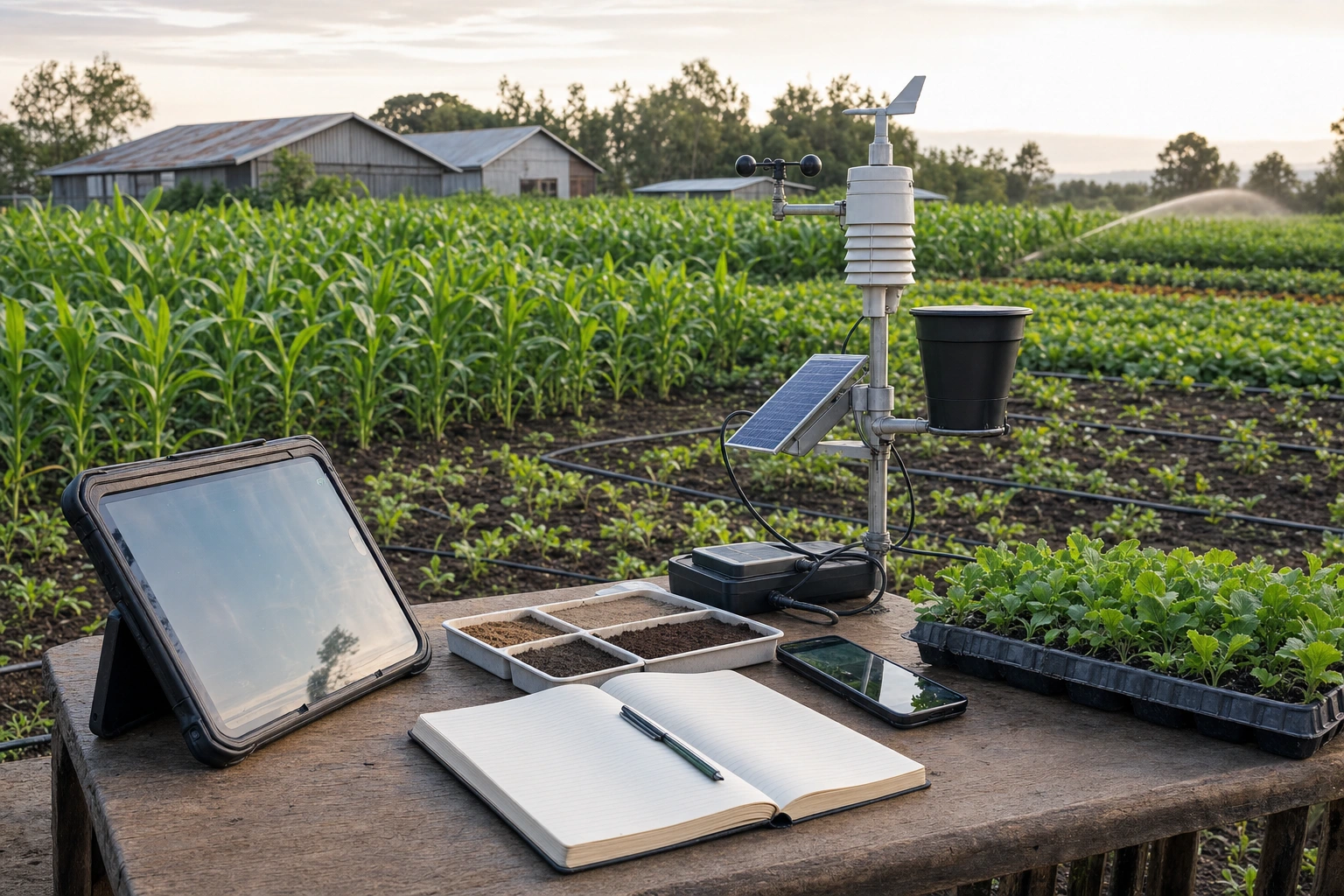
Farm management involves much more than planting crops or keeping livestock. It requires a series of connected decisions: what to produce, when to act, how to use land and labour, how to control costs, and how to respond to changing weather, markets and farm conditions. Technology supports these decisions by making information easier to collect, analyse and use.
A farmer does not need an expensive automated farm to benefit from technology. A mobile phone used to record expenses, a digital weather service checked before spraying, or a spreadsheet used to compare yields can all improve management. The most useful technology is not necessarily the most advanced; it is the tool that solves a real farm problem and can be used consistently.
What Technology Adds to Farm Management
Traditional farm knowledge remains valuable, particularly because it is built from local experience. Technology does not replace that knowledge. Instead, it can help farmers test assumptions, identify patterns and make decisions with better evidence.
For example, a farmer may know that a particular field usually dries quickly. A moisture meter or a simple record of rainfall and irrigation can show exactly when the soil begins to lose enough moisture to affect the crop. This information can support more precise watering rather than relying only on a fixed schedule.
Technology can strengthen farm management in five broad ways:
- Planning: digital calendars, budgets and farm records help organise activities and resources.
- Monitoring: sensors, photographs, satellite images and field inspections help reveal changes in crops, soil, animals or equipment.
- Decision-making: data analysis helps compare options and identify problems earlier.
- Coordination: mobile communication and shared records help farm owners, workers, suppliers and buyers stay informed.
- Evaluation: digital records make it easier to measure results and improve the next production cycle.
Digital Record-Keeping and Farm Planning
Good records are the foundation of effective farm management. Without them, a farmer may remember major expenses or events but miss smaller costs that affect profitability. Digital record-keeping can make information more complete, searchable and easier to compare.
Records may include land preparation, seed or breeding stock purchases, fertiliser, animal feed, labour, fuel, veterinary treatment, irrigation, transport, sales and losses. A smallholder may keep these records in a mobile application, a spreadsheet or even a structured notes system on a phone. A larger enterprise may use farm-management software that connects production, inventory, finance and sales.
The important principle is consistency. Each entry should include a date, the activity, the quantity, the cost and the field, herd, flock or enterprise involved. For instance, recording “fertiliser bought” is less useful than recording the product, quantity, price, field and date of application.
These records support practical questions:
- Which crop or livestock enterprise produces the strongest return?
- Which field requires unusually high labour or input costs?
- How much feed is being used per group of animals?
- Are sales covering production and transport costs?
- What should be purchased before the next season begins?
A farm budget can also be built from these records. Expected income is compared with expected costs, while cash-flow planning shows when money will be needed. This is especially important where income arrives at harvest but expenses occur throughout the season.
Weather and Climate Information
Weather affects planting, spraying, irrigation, harvesting, animal comfort and disease risk. Digital weather services can provide forecasts, rainfall information and alerts that help farmers adjust the timing of farm activities.
Suppose a grower plans to apply a crop-protection product. A forecast indicating likely rain soon after application may lead the farmer to delay the task, provided that the product label and local guidance support such a decision. Similarly, a forecast of dry conditions may encourage earlier irrigation, mulching or prioritisation of the most vulnerable fields.
Weather information should be treated as decision support, not certainty. Forecasts can be wrong, and conditions can vary significantly over short distances. Farmers can improve their use of forecasts by comparing them with observations from the farm, such as soil moisture, wind conditions, cloud cover and recent rainfall.
In parts of Kenya and other African countries where rainfall is highly variable, combining local experience with reliable digital weather information can support choices about planting dates, drought-tolerant varieties, water storage and harvest timing. The value lies in connecting the forecast to a specific action rather than simply checking it out of interest.
Soil, Water and Precision Management
Technology can help farmers use soil and water more efficiently. Soil testing, moisture sensors, GPS-enabled mapping and irrigation controls are examples of tools that provide more detailed information about field conditions.
Soil tests can identify characteristics such as acidity, nutrient levels and organic matter. These results can guide soil amendments and fertiliser decisions, although they should be interpreted with appropriate agricultural advice. Applying more fertiliser is not automatically better. The right input depends on the crop, soil condition, expected yield, timing and application method.
Moisture sensors measure water conditions at particular locations and depths. They can help indicate whether irrigation is needed and whether water is reaching the root zone. Even without sensors, a farmer can use a simple digital log of irrigation dates, rainfall and crop response to improve watering decisions.
GPS and digital mapping can divide a farm into management zones. A large field may contain areas with different soil types, drainage or fertility. Treating every part in exactly the same way can waste inputs or leave some areas under-managed. Mapping allows the farmer to record activities by zone and compare their performance.
Precision agriculture may involve advanced equipment, but its underlying idea is simple: apply the right input, in the right place, at the right time and in the right amount. Small farms can apply this principle through targeted scouting, separate field records and careful observation, even when they do not own specialised machinery.
Monitoring Crops, Livestock and Equipment
Frequent monitoring helps managers find problems before they become expensive. Mobile phones make it possible to photograph crop symptoms, record field observations and share information with an agronomist or farm supervisor. Images are useful when they include the affected area, a wider view of the field and the date of observation.
Satellite and drone imagery can also reveal differences in crop growth, bare patches, water stress or damage. These tools do not always identify the exact cause of a problem. A weak patch may result from pests, poor drainage, nutrient deficiency, planting errors or animal damage. Field inspection is still needed before taking action.
In livestock enterprises, digital tools may be used to record identification, births, weight changes, breeding, vaccinations, treatments and mortality. Some systems use electronic tags or weighing equipment to make monitoring more regular. The benefit is not merely storing information; it is noticing changes that may require attention, such as reduced growth or repeated health problems in a particular group.
Equipment management can also benefit from technology. A record of fuel use, servicing, repairs and operating hours helps prevent avoidable breakdowns. Maintenance reminders reduce the risk of ignoring filters, lubricants, tyres, irrigation pumps or other components until they fail during a critical farm operation.
Farm Communication and Coordination
Farm work often involves several people working at different locations. Mobile calls, messaging services and shared digital records can improve coordination between owners, managers, workers, suppliers, extension advisers and buyers.
A manager might send a daily task list, confirm that a field has been planted, share a photograph of a suspected pest problem or update a buyer about the expected harvest date. Digital communication can reduce delays, but messages should be clear. Important instructions should include the task, location, responsible person, timing and any safety requirement.
Technology is also useful for coordinating machinery and labour. A shared calendar can show when land preparation, transport, harvesting equipment or casual labour is required. This reduces clashes and makes it easier to identify idle resources.
However, communication tools should not create confusion. Farm teams need agreed channels and rules for urgent issues, record changes and approval of purchases. A message in a group chat should not automatically be treated as a complete financial or operational record unless the farm has a process for confirming it.
Markets, Finance and Supply Chains
Digital platforms can connect farmers with market information, buyers, financial services and suppliers. A farmer may use a mobile service to compare prices, receive payment, order inputs or communicate with a cooperative. These tools can reduce the time and cost involved in finding information, although users should check fees, terms and the reliability of the provider.
Digital sales records help a farm understand more than the price received. They can show the quantity sold, buyer, transport cost, packaging cost, payment date and rejected produce. A higher selling price may not produce a better result if it comes with much higher transport or handling expenses.
Traceability is another important use of technology. Records can show where a product was grown or reared, which inputs were used and when it was harvested or handled. This may support quality control and customer confidence, especially for farms supplying processors, institutions or organised markets.
Digital finance can improve convenience, but financial security matters. Farmers should protect personal identification numbers and passwords, verify payment requests and retain records of transactions. Technology should make financial management clearer, not encourage borrowing or spending without a realistic repayment plan.
Using Data Without Losing Practical Judgement
Data is useful only when it is accurate enough, relevant and connected to a decision. Collecting large amounts of information without reviewing it creates work rather than value.
A practical data process has four stages:
- Define the decision: identify what must be improved, such as irrigation timing, feed costs or harvest losses.
- Collect relevant information: record only the measurements and observations needed to understand that issue.
- Check the information: look for missing entries, unusual readings or incorrect units.
- Act and review: make a controlled change, observe the result and record what happened.
For example, a poultry farmer concerned about high feed costs could record the amount of feed issued, flock size, mortality, growth or egg production, and sales. After comparing this information over time, the farmer may identify wastage, poor storage, disease or inefficient purchasing as possible causes. The data does not make the decision automatically; it helps direct attention to the right questions.
Challenges and Responsible Technology Use
Technology has limitations. Devices may be expensive, require maintenance or depend on reliable electricity, connectivity and technical support. A tool may also be designed for large commercial farms and be unsuitable for a small enterprise with different crops, labour systems or cash-flow conditions.
Farmers should consider the total cost of ownership, including subscriptions, repairs, training, data charges and replacement. It is sensible to test a tool on one enterprise or field before adopting it across the whole farm. The trial should have a clear purpose and measures of success, such as reduced water use, fewer missed tasks or better survival of livestock.
Data security and ownership deserve attention as well. Farmers should understand who can access their records, whether information can be exported and what happens if a service closes. Backups should be kept in a separate location or system. Where workers’ personal information is recorded, it should be handled responsibly and shared only for legitimate farm purposes.
Digital tools should complement, not eliminate, human observation. A sensor reading can be faulty, an image can be misinterpreted and a forecast can change. Good management combines technology with field checks, local knowledge, professional advice and careful judgement.
Applying This in Practice
A farm manager starting a technology programme can use a gradual approach:
- Choose one management problem. Examples include missing expense records, irregular irrigation, delayed disease detection or poor coordination of labour.
- Describe the current process. Note who performs the task, what information is available and where errors or delays occur.
- Select the simplest suitable tool. This might be a spreadsheet, mobile form, weather service, sensor or farm-management application.
- Set a routine. Decide when data will be entered, who will check it and how decisions will be recorded.
- Train the users. Demonstrate the tool using real farm activities and explain what to do when the device or network fails.
- Review the results. Compare the new process with the previous one and keep the tool only if it produces a useful improvement.
For instance, a mixed farm could begin with a digital input and sales register. After one production cycle, the manager could add field-level yield records and a weather log. If those records reveal that irrigation is the main source of avoidable cost, the farm could then test moisture monitoring in the most affected area. This staged approach limits risk and makes each technology investment answer a clear management question.
Key Takeaways
- Technology improves farm management by making planning, monitoring, coordination and evaluation more organised.
- Consistent records of activities, costs, quantities and results are more valuable than complicated tools used irregularly.
- Weather services, soil information and moisture monitoring can support better timing and more efficient use of water and inputs.
- Images, maps and digital livestock records help farmers detect changes, but field inspection and professional judgement remain important.
- Digital market and finance tools can improve coordination while requiring careful attention to fees, security and payment records.
- Start with one clearly defined farm problem, test a suitable tool and review whether it produces a practical improvement.
No comments yet.