
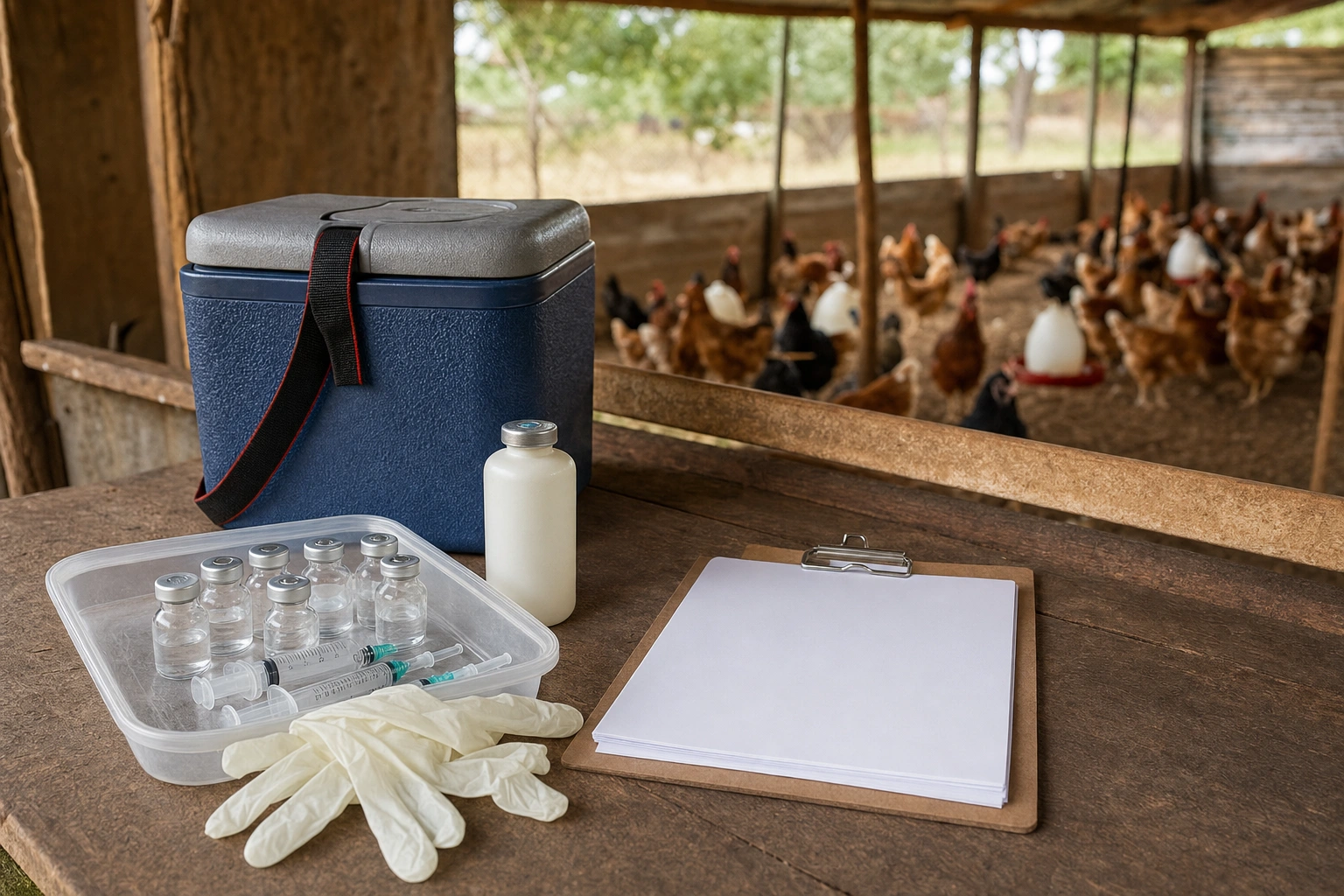
Vaccination is one of the most important tools for preventing infectious disease in poultry, but it is not a substitute for good husbandry. A vaccine works within a wider protection system that includes biosecurity, clean water, suitable nutrition, adequate ventilation, appropriate stocking density and early disease observation. When any of these areas is neglected, vaccinated birds may still become ill.
The principles of poultry vaccination apply whether a farmer keeps a small flock of indigenous chickens, runs a broiler enterprise or manages a commercial layer unit. The exact vaccine programme should be developed with a qualified veterinarian or animal-health professional, because disease risks, approved products and recommended timings differ between countries, production systems and regions. The principles below help a farmer understand why vaccination programmes are designed in particular ways and how to carry them out more reliably.
What Poultry Vaccination Is Designed to Do
A vaccine exposes a bird's immune system to a safe form or component of a disease-causing organism. This prepares the immune system to respond more effectively if the bird later encounters the actual disease. Depending on the vaccine and the disease, vaccination may prevent clinical illness, reduce deaths, lower the amount of organism shed by infected birds or improve flock performance.
Vaccination does not create an invisible wall around a flock. A vaccinated bird can sometimes become infected, particularly where disease pressure is high or the immune response is weak. The practical aim is to reduce the impact of important diseases to a level the flock and farm can manage.
Vaccines are generally preventive, not curative. Giving a vaccine to a bird that is already seriously ill will not normally cure that illness. Vaccinating a flock during an active outbreak may also have limited value and should be considered only with professional guidance. The first priority during suspected disease is to isolate affected birds where practical, reduce movement, seek veterinary advice and follow any applicable animal-health reporting requirements.
Principle 1: Start with the Flock's Risk
A useful vaccination programme begins with a disease-risk assessment rather than a standard list copied from another farm. Consider the following questions:
- Which diseases have occurred on the farm or in nearby poultry holdings?
- Are birds kept for meat, eggs, breeding or household consumption?
- Will new birds be introduced, and do they come from a known health programme?
- Are birds housed, free-ranging or mixed with other poultry species?
- Are wild birds, rodents, visitors, traders, equipment or vehicles likely to carry infection?
- What vaccines are legally available, suitable for the birds and supplied through a reliable channel?
Common poultry diseases considered in vaccination programmes include Newcastle disease, infectious bronchitis, infectious bursal disease, fowl pox and Marek's disease. The list is not universal. A disease that is a major concern in one county or production system may be less important elsewhere, while another local disease may deserve greater attention. Farmers should avoid buying vaccines simply because another producer uses them.
Broilers, layers and breeding birds also have different priorities. Broilers are kept for a relatively short period, so their programme must provide protection during the most vulnerable stages without unnecessary handling. Layers and breeders remain on the farm for much longer and may need a broader programme, including preparation for the laying period. Breeding flocks may also be vaccinated to support antibodies passed to chicks through the egg.
Principle 2: Match the Vaccine to the Disease and the Bird
Vaccines differ in their biological design, strength, route of administration, storage requirements and expected response. A live vaccine contains a weakened organism, while an inactivated vaccine contains organisms or components that have been killed or rendered unable to reproduce. Some products combine several disease antigens.
Live vaccines can produce a rapid local or general immune response, but they require careful handling and correct administration. Inactivated vaccines are often given by injection and may require an adjuvant to strengthen the immune response. They are commonly used where longer-lasting or more uniform protection is needed, particularly in older birds, layers or breeding stock.
Product labels matter. The label or accompanying instructions should be checked for the target species, age or production stage, dose, route, storage temperature, expiry date, withdrawal information where relevant, mixing instructions and any restrictions on use. A vaccine intended for one species or route should not be assumed to be suitable for another.
Combination vaccines can reduce the number of handling events, but combining products independently is unsafe unless the manufacturer specifically permits it. Different live vaccines may interfere with one another, and mixing products can damage their effectiveness or create unexpected reactions.
Principle 3: Time Vaccination Around Maternal Immunity
Chicks may receive antibodies from a vaccinated breeder hen through the egg. These maternal antibodies can protect young chicks for a period, but they can also interfere with some vaccines by neutralising the vaccine before the chick develops its own strong response.
This creates a timing challenge. Vaccinating too early may produce a weak response because maternal antibodies are still high. Vaccinating too late may leave chicks unprotected when they encounter infection. The correct timing depends on the disease, vaccine, breeder programme, level of maternal antibodies, farm exposure and the product instructions.
For this reason, there is no single universal vaccination calendar for every poultry farm. A programme used for commercial chicks from a well-managed hatchery may not be suitable for chicks hatched by a smallholder's hens. Veterinary laboratories can sometimes test antibody levels where this is necessary, but many farms rely on the known history of the parent flock, the vaccine manufacturer's guidance and local veterinary experience.
Booster doses may be needed because immunity can decline, because the initial dose was given when the bird was too young, or because the production period is long. A booster is not automatically evidence that the first vaccine failed; it is often part of the planned process of maintaining protection.
Principle 4: Protect Vaccine Potency through the Cold Chain
Many poultry vaccines are sensitive to heat, sunlight and unsuitable storage. A product can look normal and still have lost effectiveness after poor handling. Maintaining the cold chain means keeping the vaccine within the temperature range specified by the manufacturer from distribution to use.
Farmers should obtain vaccines from a reliable supplier, check the expiry date and keep them in an appropriate refrigerator or validated cold box. Vaccines should not be stored in the freezer unless the product instructions specifically allow it. Freezing can damage some formulations, while placing products against the coldest part of a domestic refrigerator may also be risky.
During transport, use clean ice packs or a suitable vaccine carrier without allowing vials to sit directly against frozen packs if that could freeze them. Keep vaccines away from direct sunlight. Do not use a vial if its seal is damaged, its appearance is abnormal, its label is unreadable or its storage history is uncertain.
Many reconstituted live vaccines have a short useful life. Mix only the quantity that can be administered promptly, using the correct diluent and clean equipment. Dispose of unused mixed vaccine according to professional or local guidance rather than storing it for the next day.
Principle 5: Use the Correct Administration Method
The route of administration affects whether a vaccine works. Common methods include drinking water, eye drop, spray, injection and application to a feather follicle. The correct method is stated on the product instructions and should not be changed casually.
Drinking-water vaccination
Water vaccination can be practical for large groups, but every bird must receive a sufficient dose. Before vaccination, the flock may need access to water to be managed in accordance with the product guidance so that birds drink promptly. Use clean containers and avoid disinfectants, chlorine or other substances that could inactivate a live vaccine. The volume must be adequate for the flock to consume within the recommended period, but not so large that the vaccine becomes diluted or remains available for too long.
Water lines should be clean and free from biofilm where possible. Farmers should not assume that a coloured drinker or a partly blocked line provides equal access to every bird. Smaller or weaker birds may receive less than the intended dose.
Eye-drop and spray methods
Eye-drop vaccination can provide a controlled dose to each bird and is often useful for smaller groups, although it requires careful handling. Spray vaccination may be efficient for a large flock, but droplet size, equipment cleanliness, ventilation and application technique matter. Poor spray technique can result in uneven coverage or excessive irritation.
Injection
Injected vaccines require correct site, dose, needle size and hygiene. Reusing dirty needles can spread infection between birds. Rough handling, incorrect injection sites or poor restraint can cause injury and reduce the value of the programme. Inactivated vaccines may cause temporary swelling at the injection site, but severe or unusual reactions should be investigated by an animal-health professional.
Principle 6: Prepare the Flock and the People
Vaccination is more successful when birds are in reasonable health. Avoid treating vaccination as a way to compensate for poor feed, dehydration, extreme heat, severe parasite burdens or overcrowding. If a flock is already stressed or showing signs of disease, seek professional advice before proceeding.
Plan the work before opening the vaccine. Count birds, assemble clean equipment, check the dose and route, organise helpers and decide how treated birds will be identified or separated. Vaccinating at a cooler part of the day can reduce handling stress, especially in hot climates, but the product instructions and farm conditions should guide the timing.
Vaccinators should wash their hands and use clean equipment. Anyone handling poultry should also follow the farm's biosecurity rules, including dedicated footwear or clothing where appropriate. Work with the youngest or healthiest groups before older or sick groups when the farm layout allows it, reducing the chance of carrying infection between flocks.
Principle 7: Combine Vaccination with Biosecurity
Vaccination and biosecurity perform different jobs. Vaccination improves the bird's ability to resist disease, while biosecurity reduces the chance and quantity of disease entering the flock. Neither should be treated as a replacement for the other.
Basic measures include quarantining new birds before mixing them with an established flock, limiting visitors, cleaning and disinfecting equipment, controlling rodents, protecting feed and water from contamination, removing dead birds promptly and avoiding unnecessary contact with other poultry. Where possible, keep birds of different ages separate because older birds may carry organisms that affect younger birds.
In smallholder systems, complete separation may be difficult. Even then, practical improvements—such as dedicated drinkers, a simple quarantine pen, controlled buying of replacement birds and regular cleaning—can reduce risk. Farmers should also avoid moving crates, workers or equipment from a sick flock to a healthy flock without cleaning and disinfection.
Principle 8: Observe and Record the Results
A vaccination programme should be monitored rather than assumed to be successful. Observe birds after vaccination for expected short-term reactions described by the manufacturer, while watching for severe illness, unusual deaths, breathing difficulty, marked depression or a sharp drop in feed and water intake.
Records should include the date, flock identification, bird age, vaccine name, batch or lot number, expiry date, dose, route, number of birds vaccinated, person responsible and any observed reaction. Also record disease signs, mortality, egg production, growth or feed performance where these measures are relevant.
Good records help distinguish several possible problems: the wrong vaccine may have been selected, the cold chain may have failed, some birds may have missed the dose, the vaccine may have been administered incorrectly, or the flock may be facing a different disease. If illness occurs after vaccination, do not automatically conclude that the vaccine caused it. The timing, clinical signs, management conditions and diagnostic evidence should be reviewed with a veterinarian.
Applying This in Practice
- Assess the risk. Review local disease history, the flock's purpose, housing system and likely sources of infection.
- Seek an appropriate programme. Discuss the plan with a veterinarian or qualified animal-health professional and use products approved for the birds and the local setting.
- Check the product. Confirm the target disease, bird type, dose, route, expiry date, storage requirements and any manufacturer warnings.
- Prepare the flock and equipment. Vaccinate healthy birds where possible, organise clean tools and ensure that every bird can receive the intended dose.
- Maintain potency. Keep the vaccine within the required temperature range, protect it from sunlight and use reconstituted products promptly.
- Record and review. Document what was done, monitor the flock and investigate unexpected disease or performance changes rather than repeating vaccines without diagnosis.
For a small poultry keeper in Kenya, this might mean discussing Newcastle disease risk with a local animal-health provider before the rainy season, confirming how a village flock should receive the chosen product and arranging a practical way to reach every bird. For a commercial layer farm, it may involve coordinating hatchery vaccination, pullet boosters, staff training, cold-chain checks and regular review of production and health records. The scale differs, but the principles remain the same.
Key Takeaways
- Build a vaccination programme around local disease risk, flock purpose and production system rather than copying another farm's calendar.
- Use only the correct product, dose and administration route, following the manufacturer's instructions and professional veterinary guidance.
- Protect vaccine potency by maintaining the cold chain, avoiding sunlight and using mixed live vaccines promptly.
- Time vaccination carefully because maternal antibodies, bird age, health and production stage affect the immune response.
- Vaccinate as part of a wider biosecurity plan that includes quarantine, hygiene, pest control and separation of age groups.
- Keep detailed records and investigate unexpected illness instead of assuming that vaccination alone has failed or caused the problem.
No comments yet.