
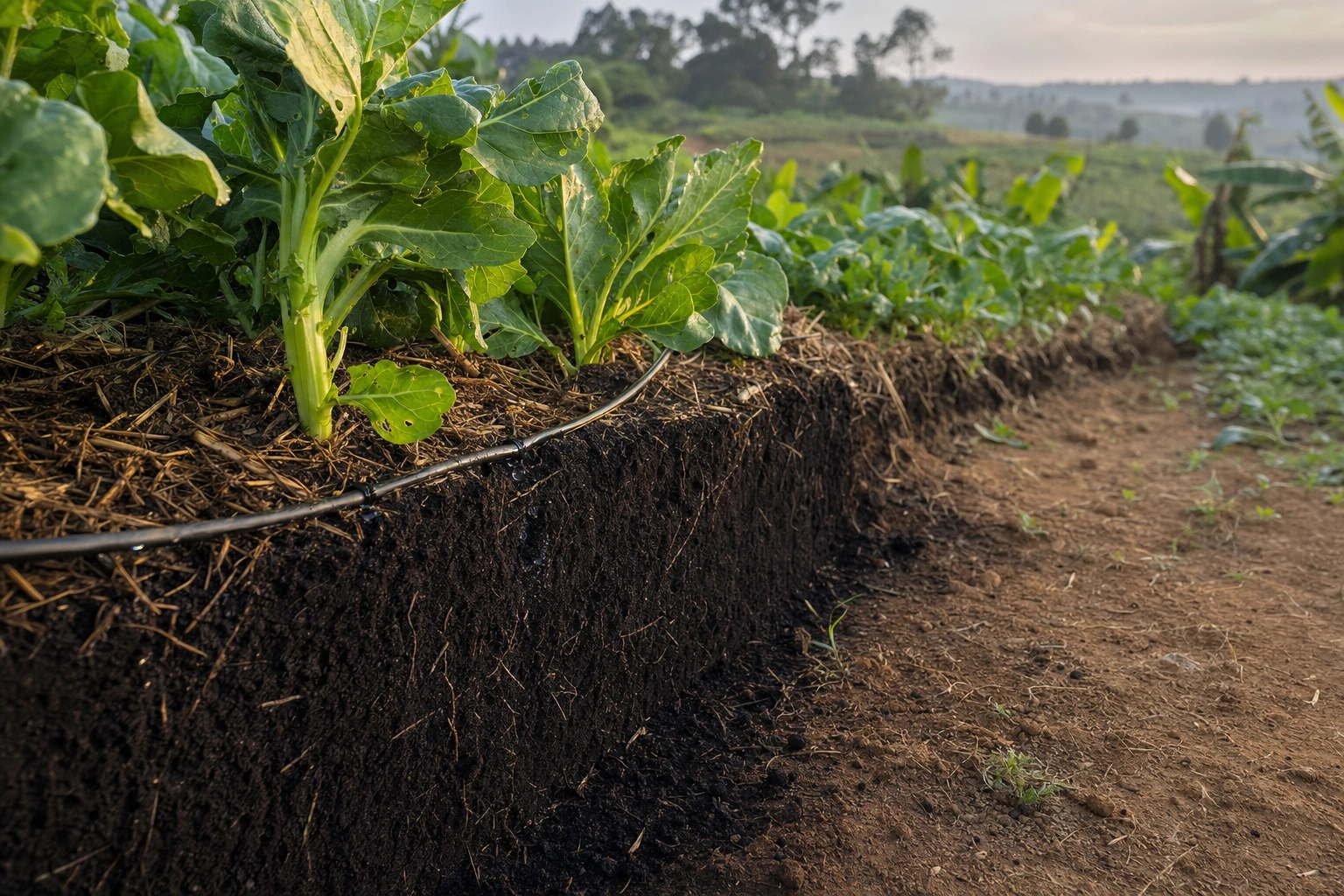
Soil moisture is the amount of water held in the spaces between and around soil particles. It is one of the most important factors controlling crop growth because plants need water for germination, nutrient transport, photosynthesis, cooling and the maintenance of firm stems and leaves. However, more water is not always better. A soil that remains saturated can deprive roots of oxygen, encourage disease and cause nutrients to move away from the root zone.
Effective soil and water management therefore involves keeping moisture within a useful range: enough for roots to access, but not so much that the soil becomes waterlogged. Understanding this balance helps farmers, gardeners, landscapers and agricultural professionals make better decisions about planting, irrigation, drainage, mulching and soil improvement.
Why Soil Moisture Matters
Water is a working part of the soil–plant system rather than simply a reserve stored underground. When roots absorb water, they also take up dissolved nutrients. Water then moves through the plant and is released through the leaves in a process called transpiration. This movement supports plant cooling and helps maintain the flow of nutrients.
Soil moisture also affects the physical condition of the soil. Moist soil can support seed swelling and root penetration, while extremely dry soil may become hard, compacted or difficult to cultivate. In contrast, saturated soil contains little air because water has filled the spaces that would normally hold oxygen. Roots need oxygen for respiration, so prolonged saturation can weaken or kill them.
For a business growing vegetables for a local market, poor moisture management can lead to uneven germination, small produce, blossom-end problems in some crops, wilting and inconsistent harvests. For a smallholder farmer in Kenya or elsewhere in Africa, reliable moisture management can help reduce the risk of crop failure during irregular rainfall. In both cases, the aim is not simply to use more water, but to use the right amount at the right time.
How Soil Holds Water
Soil texture has a major influence on water storage and movement. Soil texture refers to the relative amounts of sand, silt and clay.
- Sandy soils: These have large pores that allow water to drain quickly. They are often easy to work but may require more frequent watering because they hold less water near the root zone.
- Clay soils: These have very small pores and can hold substantial amounts of water. However, some of that water is held so tightly that plants cannot easily use it. Clay soils may also drain slowly and become waterlogged.
- Loamy soils: These contain a useful balance of particle sizes and often provide good water storage, drainage and root growth when well managed.
Soil structure is equally important. Structure describes how soil particles join into aggregates. Well-aggregated soil contains a mixture of large and small pores. Large pores support drainage and air movement, while smaller pores hold water that roots can access. Organic matter, living roots, earthworms and careful cultivation can help maintain this structure.
Important Soil Moisture Levels
Saturation
Soil is saturated when nearly all pore spaces are filled with water. This may occur after heavy rain or excessive irrigation. Some crops tolerate short periods of saturation, but many suffer if their roots remain in waterlogged conditions. Signs can include yellowing leaves, slow growth, root decay and a sour smell in poorly drained soil.
Field capacity
Field capacity is the approximate amount of water remaining in soil after excess water has drained away under gravity. It is not a perfectly fixed value in every field, but it is a useful management concept. Soil near field capacity generally contains considerable water while still retaining air in some pore spaces.
Available water
Available water is the portion of soil moisture that plants can take up without excessive difficulty. It is commonly considered the water between field capacity and the permanent wilting point. The amount varies with soil texture, organic matter, root depth and crop type.
Permanent wilting point
At the permanent wilting point, soil is so dry that a plant cannot recover its normal firmness even if placed in a humid environment. Crops may show severe wilting, leaf curling, leaf drop or halted growth before this point is reached. Irrigation should normally be planned before moisture becomes critically low.
These levels help explain why a watering schedule based only on the calendar can be unreliable. A field may need water sooner after a hot, windy period, while cool, cloudy weather may reduce water loss. Soil type and crop development also change the requirement.
What Causes Soil Moisture to Change?
Rainfall and irrigation add water to the soil, but several processes remove or redistribute it.
- Evaporation: Water moves from the soil surface into the atmosphere, especially when the surface is bare, hot or exposed to wind.
- Transpiration: Plants lose water through small openings in their leaves. Evaporation and transpiration together are called evapotranspiration.
- Run-off: Water flows across the surface instead of entering the soil. This is common on compacted, sloping or heavily crusted ground.
- Deep drainage: Water moves below the main root zone. Deep drainage may be useful for some trees, but excessive drainage can waste water and carry mobile nutrients away.
- Capillary movement: Water can move through small soil pores, sometimes upwards from wetter layers and sometimes sideways. The direction and speed depend on soil texture and moisture differences.
Plant growth stage matters. Newly planted seeds need moisture near the surface for germination. Established crops may need water deeper in the root zone. A mature crop with a large leaf area may lose water more rapidly than a small seedling, although the seedling may have a smaller root system and less access to stored moisture.
How to Assess Soil Moisture
Good irrigation decisions begin with observation. No single method is perfect for every farm, so it is useful to combine simple field checks with records or instruments where possible.
Feel and appearance method
Take soil from several points and from the depth where most roots are growing. Avoid sampling only the surface, since the surface can look dry while deeper soil remains moist. Squeeze the soil gently and observe whether it forms a ball, feels cool, or releases water. Sandy soil may feel dry even when it contains useful moisture, while clay soil may retain a ball shape over a wider range of conditions.
Compare different areas of the field, particularly near irrigation lines, on slopes and where crops look different. This method is inexpensive, but it becomes more reliable with practice and consistent sampling.
Plant observation
Look for midday wilting, dull or bluish leaves, leaf rolling, slow growth and premature leaf drop. Plant symptoms should not be interpreted alone because pests, diseases, heat, nutrient deficiencies and root damage can produce similar signs. If plants wilt during the hottest part of the day but recover by evening, moisture stress may be developing, although other causes remain possible.
Measuring instruments
Soil moisture meters, tensiometers and other sensors can provide more consistent information. A sensor should be installed at a representative location and at an appropriate root depth. One sensor placed beside a leaking irrigation pipe cannot represent the whole field. Larger or variable fields may need several monitoring points.
Record readings alongside rainfall, irrigation amounts, crop stage and weather conditions. The value of monitoring comes from identifying patterns, not from treating one reading as an absolute instruction. Instruments also need correct installation, maintenance and calibration according to the manufacturer’s guidance.
Managing Soil Moisture Through Irrigation
Irrigation should deliver water to the active root zone without creating unnecessary run-off or deep drainage. The best timing depends on soil type, crop, weather, root depth and the irrigation system.
- Inspect the field: Check soil moisture in more than one location and examine crop condition.
- Estimate the root zone: Young vegetables may have shallow roots, while established fruit trees can draw water from a deeper area. Watering depth should match the crop’s effective roots.
- Choose an appropriate application rate: Apply water slowly enough for the soil to absorb it. If water begins to run off, pause or reduce the flow.
- Check after irrigation: Confirm how deeply water has penetrated. A wet surface does not necessarily mean that the full root zone has been supplied.
- Adjust using records: Note how long the soil remains suitably moist and revise the next irrigation accordingly.
Drip irrigation can place water close to crop roots and reduce wetting of unused spaces, but it still requires proper design and maintenance. Blocked emitters, uneven pressure and misplaced lines can create dry areas within an apparently irrigated field. Sprinklers may provide more uniform surface coverage but can lose water to wind and evaporation. Furrow irrigation can be effective when land is well graded and carefully managed, yet it may produce run-off or uneven distribution on sloping ground.
Ways to Conserve Soil Moisture
Mulching
Organic mulch such as crop residue, grass clippings that are free from unwanted chemicals, composted material or leaves can reduce evaporation and moderate soil temperature. Mulch should not be piled tightly against plant stems because that can encourage rotting or provide shelter for pests. In dry regions, mulch is especially valuable when combined with good weed control.
Adding organic matter
Compost, well-decomposed manure and retained plant residues can improve aggregation and increase the soil’s ability to store water. Organic matter does not make every soil behave in exactly the same way, and it must be properly decomposed before application. Fresh manure can damage plants, create unpleasant conditions and introduce unwanted seeds or contaminants.
Reducing soil disturbance
Repeated intensive cultivation can break down aggregates and leave soil exposed to erosion. Practices such as minimum tillage, maintaining ground cover and avoiding traffic on wet soil can protect structure. The most suitable approach depends on crop, equipment, weeds and local conditions.
Controlling weeds
Weeds compete with crops for water, particularly during establishment. Removing them early can conserve moisture, but bare soil should not automatically be the goal. A planned cover crop, residue layer or living ground cover may protect the soil between main crops where it is appropriate.
Improving drainage where necessary
Moisture conservation does not mean retaining all water. On heavy soils or low-lying sites, drainage channels, raised beds, surface shaping or other measures may be needed to protect roots from prolonged saturation. Drainage should be planned carefully so that it does not cause erosion or transfer polluted water to nearby streams.
Soil Moisture and Nutrient Management
Moisture influences how nutrients move through soil and how roots absorb them. When soil is too dry, nutrient movement towards roots slows and biological activity may decline. When water drains excessively, soluble nutrients may move below the root zone. Waterlogged conditions can also change the chemical and biological environment around roots.
Applying fertiliser to severely dry soil can be ineffective or harmful, especially if salts become concentrated near seeds or roots. Farmers should follow the needs of the crop and the recommendations appropriate for their soil and production system. Splitting nutrient applications can sometimes reduce losses, but the correct approach depends on the fertiliser, crop and local conditions.
Applying This in Practice
Consider a small vegetable plot supplying a market in a semi-arid area. The grower first divides the plot into sections because one part is sandy and another contains heavier soil. Soil is checked at root depth every few days, and rainfall and irrigation are recorded. The sandy section receives smaller, more frequent applications, while the heavier section is irrigated more slowly and less often to prevent waterlogging.
Compost is incorporated before planting, the soil is covered with a suitable mulch, and irrigation lines are checked for blocked outlets. The grower also observes crop growth but does not wait for severe wilting before watering. After each irrigation, a small sample is taken to confirm whether water has reached the active roots. These actions create a simple feedback system: observe, apply, check and adjust.
For a larger farm, the same principle can be supported by weather information, flow meters, soil sensors and irrigation audits. Technology is most useful when it answers a clear management question, such as whether water is reaching the required depth or whether one section is receiving more water than another. Expensive equipment cannot compensate for blocked pipes, poor field layout or infrequent observation.
Key Takeaways
- Manage soil moisture within a useful range: avoid both severe dryness and prolonged waterlogging.
- Consider soil texture, structure, crop stage, root depth and weather before deciding when to irrigate.
- Check moisture below the surface and in several field locations rather than relying on appearance alone.
- Use mulch, organic matter, ground cover and careful cultivation to reduce moisture loss and protect soil structure.
- Apply irrigation slowly enough for water to enter the soil, then check how deeply it has penetrated.
- Keep records of rainfall, irrigation, soil observations and crop response so that future decisions improve.
No comments yet.