
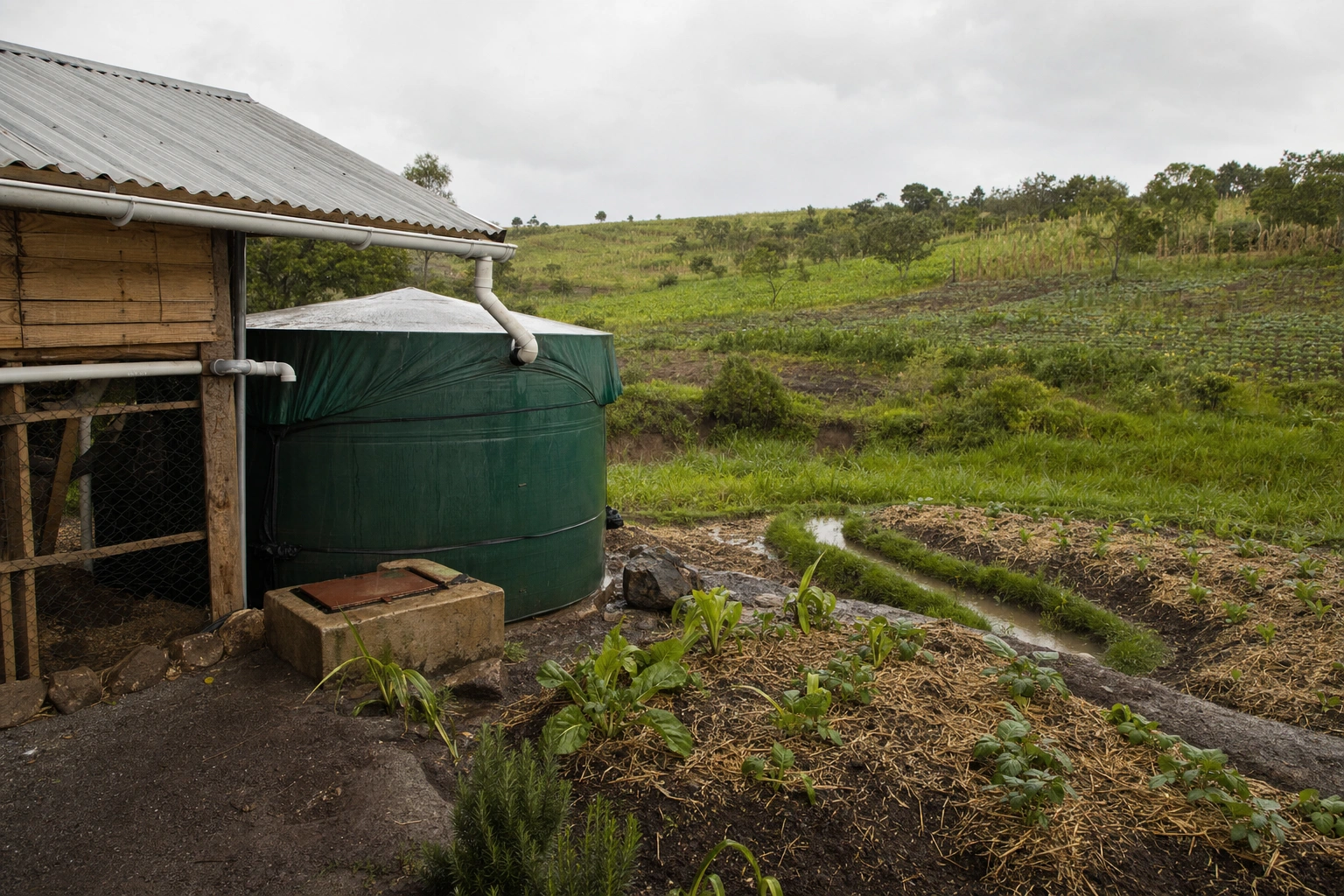
Rainwater harvesting is the planned collection, storage and use of rain that would otherwise run off roofs, compacted ground or farm surfaces. For agriculture, it is more than a way to obtain extra water. When combined with good soil management, it can reduce erosion, improve soil moisture, support crops during dry spells and make better use of short or irregular rainy seasons.
The most effective systems match the source of water, the intended use, the available budget and the local landscape. A small kitchen garden may need roof water stored in tanks, while a larger farm may benefit from contour bunds, swales, farm ponds or infiltration trenches. Understanding these options helps farmers, land managers and entrepreneurs choose a system that is practical rather than simply installing storage without a plan.
Why Rainwater Matters in Agriculture
Rainfall is often unevenly distributed. A farm may receive substantial rain during a few intense storms and then experience several days or weeks without useful rainfall. If the soil is bare, compacted or sloping, much of the water can flow away rapidly. The result is a damaging combination: flooding and erosion during heavy rain, followed by moisture stress when the weather becomes dry.
Rainwater harvesting changes how this water moves through the farm. Some water can be collected for later use, while another portion can be slowed down and encouraged to enter the soil. This supports several agricultural objectives:
- Improved water availability: Stored water can support seedling establishment, vegetable production, livestock needs and limited supplementary irrigation.
- Reduced runoff and erosion: Barriers, channels and covered soil reduce the speed and force of flowing water.
- Better soil moisture: Infiltration structures allow water to enter the root zone instead of leaving the field immediately.
- Greater production flexibility: Farmers can plan planting, transplanting or high-value crop production with a more reliable reserve.
- Lower pressure on other sources: Harvested rain can reduce dependence on distant water points, shallow wells or piped supplies where these are limited.
Rainwater is not automatically safe for every use. Water collected from a clean roof may be suitable for irrigation after appropriate screening and treatment, but water quality can be affected by dust, bird droppings, roofing materials, chemicals and poorly maintained storage. Drinking water and food-washing uses require stricter treatment and safety controls than most field irrigation.
Main Types of Agricultural Rainwater Harvesting
Rooftop collection
Rooftop harvesting directs water from a building into gutters, downpipes and a storage tank. It is often suitable for homes, schools, livestock shelters, greenhouses, packhouses and farm stores. Because roofs provide a defined collection surface, this method can produce relatively clean water and makes it easier to estimate the amount collected.
Stored roof water is useful for nurseries, kitchen gardens, drip irrigation, livestock watering and cleaning farm equipment. A screen can keep leaves and larger debris out of the system, while a first-flush device diverts the initial runoff from a rainfall event. This first water often carries accumulated dust and droppings from the roof.
Surface runoff harvesting
Surface runoff harvesting captures water flowing over open land, paths, compounds or gently sloping fields. It may involve graded channels, diversion drains, stone lines, earth bunds, terraces or small collection basins. The aim is not always to store water in a tank. Often, the aim is to slow the water and spread it across the land so that more of it infiltrates.
On a sloping farm, contour bunds or terraces should generally follow the shape of the land rather than directing water straight downhill. Correct layout reduces flow speed and limits the formation of deep erosion channels. Poorly designed channels can concentrate water and cause more damage, so significant earthworks should be planned with local technical guidance.
In-field water harvesting
In-field techniques hold rainfall close to where crops grow. Examples include planting basins, tied ridges, zai pits, contour furrows and small semicircular bunds. These structures create temporary storage depressions where water can infiltrate near the plant roots.
Such methods can be valuable in dryland farming, especially where constructing a large pond or buying a tank is not affordable. They require suitable spacing, regular maintenance and adaptation to soil type, slope and crop arrangement. Heavy clay soils may absorb water slowly, while sandy soils may require methods that reduce rapid drainage beyond the root zone.
Farm ponds and lined reservoirs
A farm pond or reservoir stores runoff for later use. It may support irrigation, livestock or other non-potable farm activities. Site selection is critical. A pond should not be placed where contaminated runoff enters it, where an embankment could threaten buildings, or where seepage and evaporation would make storage ineffective.
Some ponds are unlined and depend on soil conditions to limit seepage; others use compacted clay or a suitable liner. A lined reservoir may reduce seepage but has construction and maintenance costs. The design should account for overflow, sediment entry, fencing, animal access and safe inspection of embankments.
How to Estimate the Water You Can Collect
A simple planning estimate for rooftop harvesting is:
Harvestable water in litres = roof area in square metres × rainfall in millimetres × runoff coefficient
One millimetre of rain falling on one square metre produces approximately one litre of water before losses. The runoff coefficient allows for water that is lost through splashing, evaporation, gutter leakage and imperfect collection. The actual coefficient depends on the roof material, slope, condition and system design, so it is best treated as a planning estimate rather than a guarantee.
For example, a roof measuring 80 square metres receives 25 millimetres of rain. Before allowing for losses, the potential volume is about 2,000 litres. If the system does not capture all runoff, the usable amount will be lower. The farmer should also consider whether the tank is large enough, whether the water will be used before the next rainfall event and how much water the crops actually require.
For field runoff, estimates are more difficult because water movement depends on slope, soil texture, ground cover, rainfall intensity, compaction and the size of the catchment. A small trial structure can provide useful local evidence. Observe where water collects, how quickly it infiltrates, whether sediment accumulates and whether overflow causes erosion before expanding the system.
Protecting Soil While Harvesting Water
Water harvesting works best when paired with practices that improve the soil's ability to receive and retain water. Bare soil is exposed to raindrop impact, which can break soil aggregates and seal the surface. Once the surface crusts, more water runs off instead of infiltrating.
Useful supporting practices include:
- Mulching: Crop residues, grass or other suitable organic materials cover the soil, reduce evaporation and soften the impact of rainfall.
- Cover crops: Living plant cover protects the surface and can add organic matter when managed appropriately.
- Reduced disturbance: Avoiding unnecessary cultivation helps maintain soil structure, although the best approach depends on the crop and local conditions.
- Organic matter management: Well-managed compost and plant residues can improve soil structure and water-holding capacity over time.
- Contour farming: Rows and barriers laid across the slope slow runoff and encourage infiltration.
- Vegetative strips: Grass or other suitable vegetation can trap sediment and reduce the speed of water moving downslope.
These measures also protect the storage system. If soil is continually washed into a pond, tank inlet or infiltration basin, sediment will reduce its capacity and increase maintenance requirements. Keeping the catchment covered is therefore both a soil-management decision and a water-harvesting decision.
Using Harvested Water Efficiently
Stored water should be allocated according to priority and crop value. A farmer might reserve part of a tank for seedling establishment, apply water directly to the root zone through drip lines, and use mulch to reduce the frequency of irrigation. Watering in the cooler parts of the day can reduce avoidable losses, although the exact schedule should follow crop needs, local weather and disease-management considerations.
Drip irrigation can deliver water close to plant roots, but it is not automatically maintenance-free. Filters may be needed, emitters can clog and pipes should be checked for leaks. Simple watering cans or low-cost hose systems may be more suitable for a small garden if they are used carefully.
Not every crop should receive the same amount of water. Newly planted seedlings are vulnerable to drying, while established crops may have deeper roots. High-value vegetables may justify controlled irrigation, whereas broad-acre crops may require a different approach. A basic farm water budget should list the expected storage volume, priority uses, estimated crop demand, livestock needs and the reserve required for an extended dry period.
Water Quality, Safety and Maintenance
A reliable system depends on routine care. Before the rainy season, inspect roofs, gutters, downpipes, tanks, dams and diversion structures. Remove leaves and sediment, repair cracks and leaks, secure tank covers and confirm that overflow routes will not erode nearby soil.
The first flush of roof runoff should normally be diverted away from the main tank, particularly after a long dry period. Screens can reduce the entry of insects, leaves and larger debris. Tanks should remain covered to limit contamination, algae growth and mosquito breeding. Water intended for livestock should be checked for contamination risks, especially where runoff may pass through areas containing animal waste, fuel, pesticides or other chemicals.
Do not assume that clear water is safe to drink. If harvested water is intended for human consumption, it requires an appropriate treatment and testing approach suited to the local risk. Irrigation water also deserves attention: contaminated water can affect produce safety, workers and soil health. Farmers should avoid allowing chemical storage areas, waste pits or heavily polluted runoff to drain into a collection system.
Common Problems and How to Address Them
Storage is too small
A tank may fill quickly during a storm and then become empty before the next useful rainfall. Review the roof area, rainfall pattern, tank size and planned uses. Adding a second tank, reducing low-priority uses or improving irrigation efficiency may be more practical than simply increasing crop area.
Runoff causes erosion
Water directed through a narrow outlet can cut channels in unprotected soil. Use stable spillways, vegetated outlets, stone checks or other suitable erosion-control measures. Never assume that an earth bank will safely contain exceptional flows without a planned overflow route.
Sediment fills structures
Sediment usually indicates that water is arriving too quickly or that the catchment lacks ground cover. Stabilise the source with mulch, vegetation, contour measures or small sediment traps. Remove accumulated sediment before it reduces the capacity of a pond or basin.
Water is contaminated
Trace the source rather than treating the symptom alone. Examine the roof, catchment, storage cover, nearby latrines, livestock areas and chemical stores. Separate clean roof water from dirty surface runoff where possible, and use suitable treatment for the intended purpose.
Structures are poorly located
Consider soil type, slope, access, overflow, distance from fields and the safety of people and animals. A structure that is convenient to build but difficult to empty, inspect or protect may become a long-term liability.
Applying This in Practice
- Map the farm: Mark roofs, slopes, drainage paths, existing water points, crop areas, livestock areas and places where erosion occurs.
- Identify the main need: Decide whether the priority is nursery water, household gardens, livestock, supplementary irrigation, erosion control or groundwater recharge.
- Select the collection method: Use roof storage where a clean, defined catchment exists; use infiltration or contour structures where slowing runoff is the priority; consider a pond only where the site and safety conditions are suitable.
- Estimate supply and demand: Use roof area and rainfall records for an initial estimate, then compare the result with crop and livestock needs.
- Build soil protection into the design: Include mulch, cover crops, grass strips, contour measures and safe overflow routes rather than treating storage as a separate project.
- Start with a manageable section: Test the design on a garden, nursery or small field area and record performance through one or more rainy periods.
- Inspect and improve: Keep notes on tank levels, blocked gutters, erosion, sediment, crop response and water use. Use these observations to adjust the system.
In Kenya and other parts of Africa, farmers may combine household roof tanks with farm-level soil and water conservation measures. A tank can supply seedlings while grass strips and planting basins keep rainfall in the field. In a different setting, a greenhouse roof may feed a storage tank for high-value vegetables, while a lined pond supports supplementary irrigation. The appropriate solution is determined by local rainfall, soils, land size, labour, finance and the reliability of available materials.
Key Takeaways
- Rainwater harvesting supports agriculture by storing water, slowing runoff and improving soil moisture.
- Choose between roof collection, surface runoff structures, in-field harvesting and ponds according to the farm's water need and landscape.
- Estimate rooftop supply using roof area, rainfall and a realistic allowance for collection losses.
- Combine harvesting with mulch, ground cover, contour measures and organic matter management to improve infiltration and reduce erosion.
- Use harvested water carefully through prioritised irrigation, root-zone application and regular leak checks.
- Protect water quality with first-flush diversion, screens, covered storage and separation from polluted runoff.
- Inspect systems regularly and test small installations before expanding them across the farm.
No comments yet.