
Invasive species are plants, animals, fungi or other organisms that people have moved—intentionally or accidentally—outside their natural range, where they establish, spread and cause harm. Not every introduced species becomes invasive. The important distinction is whether a non-native organism creates significant ecological, economic or social problems in its new environment.
The effects of invasive species are often wider than the loss of one native plant or animal. An invader may change habitats, compete for water and food, introduce diseases, disrupt farming or fishing, and alter the relationships that allow an ecosystem to function. Understanding these effects helps communities, businesses and environmental managers choose proportionate responses, from prevention and monitoring to control and habitat restoration.
What Makes a Species Invasive?
A species normally lives within a particular geographical range, where predators, diseases, competitors and environmental conditions limit its population. When people move it to a new location, some of those natural controls may be absent. If the species can survive, reproduce and spread, it may become established.
Invasive species often have characteristics that support rapid expansion. They may reproduce in large numbers, mature quickly, tolerate different conditions or use resources that native species cannot. Some can spread through seeds, fragments, eggs, spores or underground roots. Human activities can then carry them further through roads, boats, livestock movement, trade, tourism and the transport of soil or water.
However, “non-native” and “invasive” are not interchangeable terms. A crop grown outside its original range may be valuable without becoming invasive, while a species that appears harmless in one location may cause serious problems in another. Risk depends on the species, the receiving ecosystem, the climate, the available resources and the pathways that allow further spread.
How Invasive Species Affect Biodiversity
Competition for essential resources
The most direct effect is competition. An invasive plant may grow faster than native vegetation and take a larger share of sunlight, water, nutrients and space. An invasive animal may consume food needed by native species or occupy nesting sites, burrows and breeding grounds.
Competition can be especially damaging when native species already face pressure from drought, habitat loss, pollution or overharvesting. Even if an invader does not eliminate a native species immediately, it may reduce its growth, reproduction or ability to recover after disturbance.
Predation and direct consumption
Some introduced animals become predators in ecosystems where native species have little experience of avoiding them. Island species are often particularly vulnerable because they may have evolved without certain predators. Introduced predators can consume eggs, young animals or adults, causing rapid population decline.
Other invaders affect biodiversity by feeding on plants, seeds, insects or aquatic organisms. The impact may spread through the food web. If an invasive fish consumes native fish or their food, birds, mammals and people who depend on those fish may also be affected.
Introducing diseases and parasites
Invasive species can carry pathogens, parasites or diseases to which native species have limited resistance. The introduced organism may also become a new host or vector, allowing a disease to persist and spread. Disease effects can be difficult to detect at first because weakened animals may disappear gradually rather than die in large, visible numbers.
People and domesticated animals can also be affected. For example, an introduced organism that carries a crop disease may reduce harvests, while an invasive mosquito or other vector may create additional public-health concerns. These risks are one reason the movement of plants, animals and agricultural materials requires careful inspection and management.
Hybridisation and genetic change
Closely related introduced and native species may breed with one another. This hybridisation can reduce the genetic distinctiveness of a rare native species or alter traits that are adapted to local conditions. In some cases, repeated cross-breeding may make it difficult to identify or conserve the original native population.
Genetic effects do not always produce immediate population loss, but they can weaken a species’ long-term resilience. A population with less local adaptation may be less able to cope with changing rainfall, temperature, disease or habitat conditions.
Changing Habitats and Ecosystem Processes
Invasive species can transform the physical structure of an ecosystem. Dense aquatic plants may cover the surface of a lake or river, blocking sunlight and making movement difficult. Thick terrestrial vegetation can change the amount of light reaching the soil, alter fire behaviour and prevent native seedlings from growing.
Some invasive plants change soil chemistry or nutrient cycles. Others use unusually large amounts of water, which can reduce water availability for native vegetation, livestock or nearby communities. Invasive animals may disturb soil, remove vegetation, erode riverbanks or create conditions that favour further invasion.
These changes can produce a feedback loop. Once an invader alters the habitat, native species may struggle even more, while the new conditions favour the invasive species. For instance, disturbance caused by construction, overgrazing or frequent fires may leave bare ground where an invasive plant can establish. Its growth can then create more fuel, shade or soil disturbance, increasing the likelihood of further spread.
Examples from Kenya and Other African Contexts
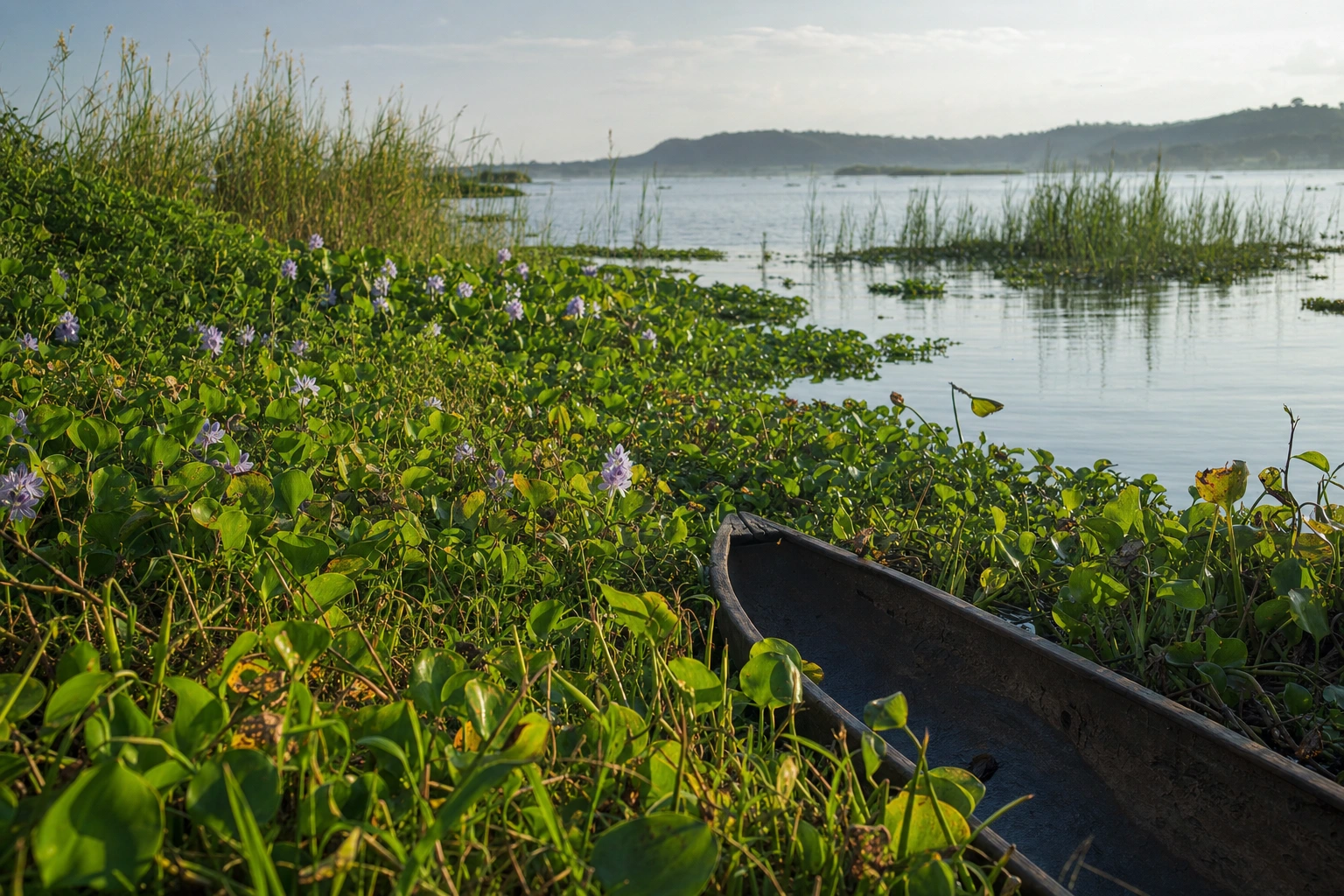
Water hyacinth provides a useful example of how an invasive species can affect an aquatic ecosystem and human livelihoods. It forms floating mats that can interfere with fishing, boat movement and access to water. Dense growth can also reduce light penetration and restrict the exchange of gases at the water surface, changing conditions for aquatic organisms. Its presence in parts of the Lake Victoria basin has demonstrated how an environmental issue can also become a transport, fisheries and local-economy issue.
Prosopis juliflora, commonly known as mesquite, illustrates a different pattern. It has been used in some dryland areas for purposes such as fuelwood, fencing and shade, but where it spreads aggressively it can form dense thickets, occupy grazing land and make access difficult. Its effects may include competition with native vegetation, reduced pasture availability and increased labour for clearing. The lesson is not that every use of an introduced species is harmful; it is that benefits and invasion risks must be assessed together, especially in vulnerable landscapes.
Across Africa, invasive plants, insects, freshwater organisms and pathogens can affect protected areas, rangelands, farms and urban spaces. The consequences differ by location. A species may be manageable in a controlled garden yet become a serious problem when it reaches wetlands, forests or river systems. Local observation is therefore essential when identifying priorities.
Economic and Social Effects
The ecological damage caused by invasive species often creates direct financial costs. Farmers may spend more on weeding, herbicides, labour or replacement seed. Fishers may lose time and income when aquatic weeds block landing sites or reduce access to fishing grounds. Water utilities may need additional maintenance when invasive plants obstruct treatment or intake infrastructure.
Invasive species can also reduce the quality and value of land. Dense thickets may restrict grazing or increase the cost of restoring a field. In forests and conservation areas, managers may have to redirect funds from habitat protection, tourism facilities or community projects towards surveillance and control.
Social effects are not distributed equally. Small-scale farmers, pastoralists, fishers and households that depend directly on local natural resources may have fewer alternatives when an invasion reduces access to food, fuel, water or income. Control measures can also create conflict if they restrict land use or remove a species that some residents rely on. Effective management should therefore consider local livelihoods, safety and participation rather than treating the issue as purely technical.
Why Invasive Species Are Difficult to Manage
Invasions are easier and cheaper to prevent than to reverse, but prevention requires attention before harm becomes obvious. Once a species has spread across several counties, watersheds or countries, removing every individual may be unrealistic. Seeds can remain in soil, fragments can move downstream and animals can recolonise cleared areas.
Control can also have unintended consequences. A chemical treatment may harm non-target organisms or contaminate water if used carelessly. Mechanical clearing may disturb soil and create open space for another invasive species. Introducing a biological control organism requires careful assessment because the control agent itself could create new problems.
For these reasons, managers usually combine several approaches. Physical removal, targeted treatment, grazing management, restoration of native vegetation and restrictions on movement may work better together than any single method. The appropriate choice depends on the species, the site, the stage of invasion and the available resources.
Prevention, Early Detection and Control
1. Reduce risky pathways
Prevention begins by identifying how a species could arrive and spread. Useful measures include inspecting imported plants and animals, cleaning boats and equipment, using uncontaminated soil and seed, and avoiding the release of unwanted pets or ornamental plants into the wild. Businesses involved in horticulture, aquaculture, transport and agriculture have an important role because their activities can move organisms across long distances.
2. Monitor vulnerable areas
Regular monitoring is valuable around ports, lakes, rivers, roads, farms, nurseries, protected areas and construction sites. Early signs may include an unfamiliar plant appearing in a wetland, unusual animal sightings or a sudden change in vegetation density. Photographs, location details and dates can help environmental officers identify a possible new arrival.
3. Respond before spread accelerates
If a new invasive population is found, a rapid response may involve confirming its identity, mapping the affected area, stopping further movement and removing the population safely. Early action is most effective when responsibilities are clear and communities know how to report suspected invasions.
4. Control established populations responsibly
Established invasions require a realistic objective. The goal may be complete eradication in a small area, containment at a boundary, reduction of density in a high-value habitat or protection of a particularly vulnerable native species. Managers should measure results over time because removal alone does not demonstrate success if the species quickly returns.
5. Restore the ecosystem
After control, restoration can reduce the chance of reinvasion. Planting suitable native species, reducing soil disturbance, improving grazing practices and protecting water quality can help an ecosystem recover. Restoration also addresses the conditions that allowed the invader to spread in the first place.
Applying This in Practice
Individuals and organisations can use a simple decision process when they encounter a suspected invasive species.
- Observe safely: Record what was seen, where it was found and whether it appears to be spreading. Do not handle an unfamiliar organism if it may be harmful.
- Check reliable local guidance: Contact an environmental authority, agricultural extension service, conservation organisation or relevant local expert before taking action.
- Prevent movement: Avoid transporting soil, plant material, animals, water or equipment from the affected site to a clean area.
- Assess the risk: Consider the species’ likely effects on native biodiversity, farms, livestock, water, infrastructure and human health.
- Choose a proportionate response: Use approved control methods and protect non-target species. Large or sensitive sites usually require a coordinated management plan.
- Follow up: Recheck the site and record whether the population has returned. Control without monitoring can create a false sense of success.
For a farmer, this may mean cleaning tools between fields, checking purchased planting material and reporting an unfamiliar weed before it seeds. For a school or community group, it may involve mapping changes around a wetland without removing organisms independently. For a company, it may mean including biosecurity checks in procurement, transport and site-maintenance procedures.
The most effective response combines scientific knowledge with local experience. Residents often notice ecological changes early because they use the land or water regularly. Their observations can improve monitoring, while technical guidance can help ensure that control methods are safe and lawful.
Key Takeaways
- Invasive species are introduced organisms that establish, spread and cause harm; not every non-native species is invasive.
- They affect biodiversity through competition, predation, disease, hybridisation and changes to habitat and ecosystem processes.
- Ecological impacts can become economic and social problems by reducing harvests, obstructing water access, damaging infrastructure and increasing management costs.
- Prevention and early detection are generally more practical than trying to remove a widely established invasion.
- Control should be carefully planned to avoid harming native species or creating conditions for another invasion.
- Restoring native vegetation and reducing habitat disturbance can help prevent an invasive species from returning.
No comments yet.