
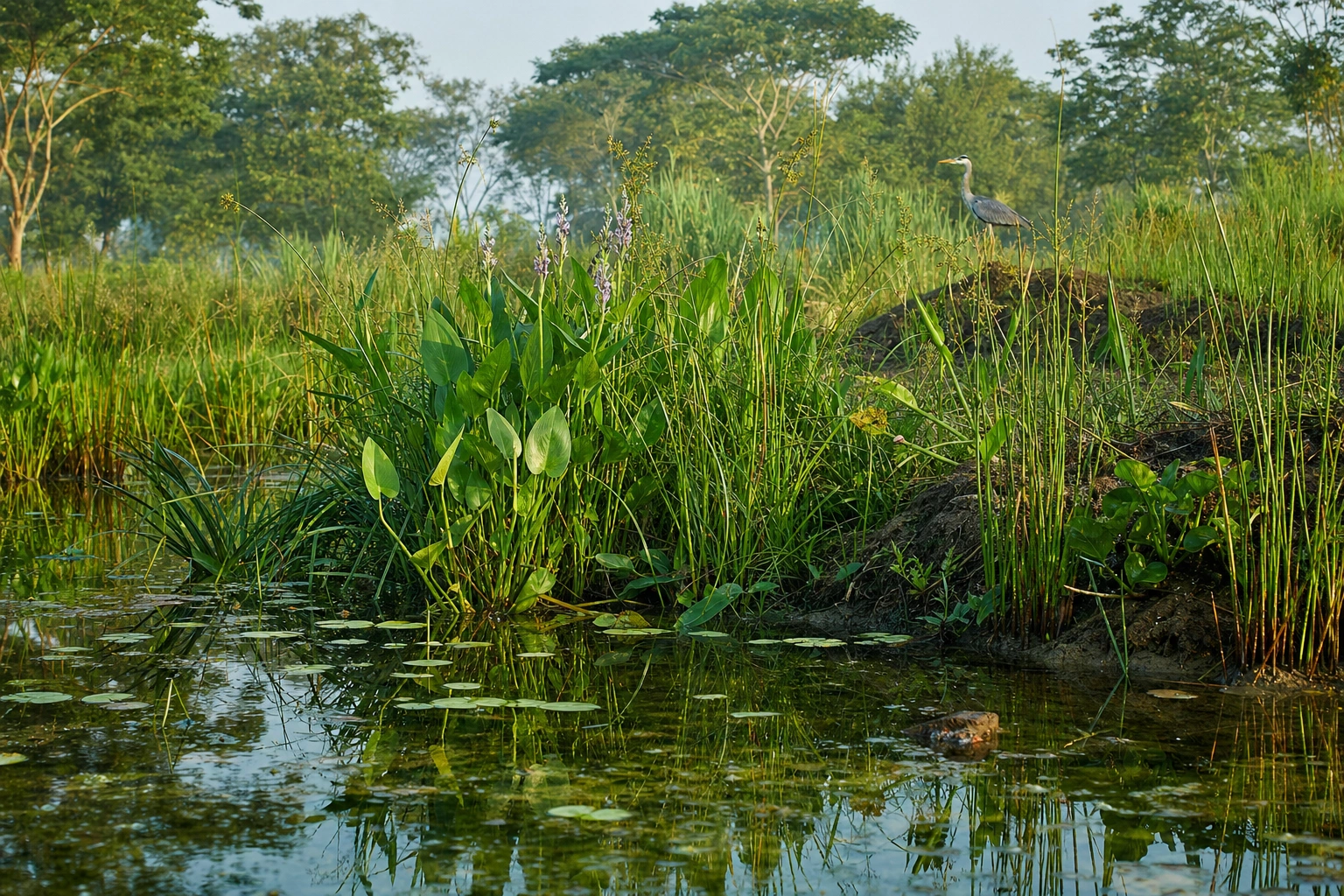
An ecosystem is a living network. Plants, animals, fungi, microorganisms, soil, water and climate interact continuously, exchanging energy and materials. Biodiversity is the variety within that network: the diversity of genes within a species, the range of species in a community, and the variety of ecosystems across a landscape.
These forms of diversity are not decorative additions to nature. They help ecosystems function. A wetland with varied plants can filter water, hold floodwater and provide habitat for fish and birds. A farm with different crops, healthy soil organisms and pollinating insects can be more stable than one that depends on a single crop and a narrow range of inputs. In this sense, ecosystems depend on biodiversity because different living organisms perform connected roles that keep natural systems productive, balanced and able to recover from disturbance.
What biodiversity includes
Biodiversity is often described at three connected levels.
- Genetic diversity: the variation within a species. Different varieties of maize, beans or cassava may have different levels of tolerance to drought, pests or disease. This variation gives a species more options when environmental conditions change.
- Species diversity: the number and relative abundance of species in a habitat. A woodland containing many kinds of plants, insects, birds and mammals has a wider set of ecological roles than one dominated by a single species.
- Ecosystem diversity: the range of habitats and ecological processes in a region, such as forests, grasslands, rivers, lakes, wetlands, coastal areas and drylands.
These levels reinforce one another. Genetic diversity can help a species survive, species diversity can support interactions within a habitat, and a variety of ecosystems can provide refuge and alternative sources of food or water when conditions change.
How species make ecosystems work
Every organism occupies a role, sometimes called an ecological niche. The role may involve producing food, breaking down organic matter, pollinating flowers, controlling other populations, building soil or modifying physical conditions.
Producers capture energy
Plants, algae and some microorganisms capture energy from sunlight or chemical reactions. Through photosynthesis, plants convert sunlight, water and carbon dioxide into organic matter. This provides the foundation for most food webs. The variety of plants in an ecosystem affects the amount of food available, the structure of habitats and the nutrients returned to the soil.
Different plants also use resources differently. One may have deep roots that reach water below the surface, while another may grow quickly after rain. Some provide shade, others protect the ground from erosion, and many offer flowers, fruits or seeds to animals. A diverse plant community can therefore support more forms of life than a single uniform plant cover.
Consumers transfer energy
Herbivores, predators, birds, fish and other animals transfer energy through food webs. Their feeding relationships influence population sizes and prevent one group from expanding without limit. For example, predators may reduce the abundance of herbivores, which can prevent excessive pressure on vegetation. Seed-eating animals can also move seeds to new places, helping plants reproduce and spread.
Food webs are usually more complex than simple food chains. A bird may eat insects and fruit, while a mammal may consume several plant species and occasionally act as a seed disperser. This complexity creates alternative pathways for energy to move through an ecosystem.
Decomposers return nutrients
Fungi, bacteria, earthworms and many small soil organisms break down dead plants and animals. Their activity releases nutrients that plants can use again. Without decomposition, nutrients would remain locked in dead material and ecosystems would gradually become less productive.
Healthy soils are biodiversity-rich environments. They contain organisms that decompose organic matter, form relationships with plant roots, improve soil structure and influence the movement of water. Soil biodiversity is largely invisible, but it is essential to farms, forests and grasslands.
Benefits ecosystems provide to people
Ecosystem services are the benefits people obtain from functioning ecosystems. Biodiversity supports many of these services, although the exact contribution differs between places.
Food and livelihoods
People depend on biodiversity for crops, livestock breeds, fish, wild foods and materials such as fibres, timber and natural medicines. Genetic variation is particularly important in agriculture. If all crops of one type had identical weaknesses, a disease, pest or period of extreme weather could affect the entire harvest. Maintaining different crop varieties creates options for farmers and plant breeders.
In Kenya and other parts of Africa, smallholder farmers may combine crops, trees and livestock in ways that spread risk across the farm. A mixture of crops can provide food at different times, improve soil cover and reduce dependence on a single harvest. The best combination depends on local soils, rainfall, markets and cultural practices, but the underlying principle is widely applicable: diversity can make production systems less exposed to one kind of failure.
Pollination
Many flowering plants depend on animals to transfer pollen. Bees are well-known pollinators, but butterflies, moths, beetles, birds and bats may also perform this role. A diversity of pollinators can be valuable because different species are active at different times, visit different flowers or remain active under different weather conditions.
Protecting flowering plants, nesting spaces and areas of natural vegetation can support pollinators around farms and gardens. Reducing unnecessary pesticide use and avoiding the destruction of all non-crop vegetation can also help maintain the relationships on which fruit and seed production depend.
Water purification and regulation
Wetlands, forests, grasslands and riparian vegetation influence how water moves through a landscape. Plant roots hold soil, while soils and microorganisms can retain or transform some pollutants. Wetlands can slow water flow and temporarily store water during heavy rainfall. Vegetation can also reduce erosion and help water infiltrate the ground.
Biodiversity strengthens these functions by providing a range of root systems, decomposers and habitat structures. When a riverbank contains varied vegetation rather than bare soil, it may be better able to resist erosion and support aquatic life. In cities, diverse green spaces can contribute to drainage, shade and local cooling.
Climate regulation and carbon storage
Plants and soils store carbon, while oceans and other ecosystems influence the movement of carbon through the environment. Forests, mangroves, grasslands and peat-rich areas differ in how they store carbon and respond to disturbance. A diverse ecosystem may contain species with different growth rates, root depths and tolerances to heat or drought.
Protecting biodiversity is therefore closely connected to climate action. Conserving natural habitats can reduce emissions associated with land degradation, while restoring ecosystems can improve soil, water and habitat conditions. Climate action should not focus only on planting trees; the choice of species, the condition of the site and the recovery of the wider ecosystem also matter.
Why diversity improves resilience
Resilience is the ability of an ecosystem to absorb disturbance, continue functioning and recover over time. Disturbances may include drought, flooding, fire, disease, invasive species, storms or human land-use changes.
Biodiversity can support resilience in several ways. First, different species may respond differently to the same disturbance. If drought reduces one plant species, another may continue growing. Second, species may perform similar functions in different ways. If one pollinator declines, other pollinators may partly maintain pollination. Third, a variety of habitats can provide refuges where organisms survive and later recolonise damaged areas.
This does not mean that biodiversity makes ecosystems immune to harm. A severe disturbance can damage even a diverse system, especially when pressures occur together. However, losing biodiversity generally removes options and weakens the relationships that support recovery.
What happens when biodiversity declines?
Biodiversity loss can occur when habitats are destroyed, divided into isolated fragments or degraded. Other causes include overharvesting, pollution, invasive species, disease and climate change. These pressures often interact rather than acting separately.
The consequences may begin quietly. A decline in insects can reduce pollination. The disappearance of vegetation along a stream can increase sediment in the water. The loss of predators can alter herbivore populations. A reduction in soil organisms can slow nutrient cycling. Over time, these changes can affect food production, water quality and livelihoods.
When one species disappears, the result depends on its ecological role and the presence of alternatives. Losing a species that performs a unique function may have a greater immediate effect than losing one whose role is shared by several other species. Nevertheless, repeated losses can simplify food webs and make ecosystems less stable.
Biodiversity and human decisions
Many biodiversity outcomes are shaped by practical decisions about land, water, energy and consumption. Farmers decide which crops to grow and how to manage soil. Businesses choose raw materials and waste practices. Local authorities plan roads, housing, drainage and green spaces. Households influence demand through food choices, water use and disposal of waste.
Good decisions begin with understanding the whole system rather than focusing on one output. Clearing vegetation may create short-term space for construction, but it can also increase runoff, heat and erosion. Removing all insects from a farm may reduce pests temporarily, but it can also harm pollinators and natural enemies of pests. A more sustainable approach asks which ecological functions are being lost and whether they can be maintained through better planning.
Applying this in practice
- Identify the ecosystem. Consider whether you are working in a farm, garden, river corridor, rangeland, forest edge, urban area or coastal zone.
- List the main living components. Include plants, animals, fungi and soil organisms, not only the species that are easy to see.
- Map the relationships. Ask who pollinates plants, who eats whom, who decomposes waste, where water flows and which organisms provide shelter or food.
- Look for pressure points. Identify habitat loss, pollution, overuse of resources, invasive species, soil disturbance or climate-related stress.
- Protect variety and connections. Retain native vegetation, maintain habitat corridors where possible, protect water sources and avoid practices that remove an entire ecological group.
- Measure more than short-term output. Track soil condition, water quality, pest levels, plant variety, pollinator activity and recovery after disturbance.
For a household, this may involve planting several locally suitable species, keeping soil covered and avoiding the careless use of chemicals. For a school or business, it may mean protecting trees, managing stormwater, reducing waste and creating habitat around buildings. For a farm, it may include crop rotation, mixed planting, agroforestry, composting and careful use of pesticides. Large conservation projects require scientific planning and community participation, but everyday decisions also shape biodiversity.
Questions to consider
- Which species or habitats does this activity depend on?
- What would happen if one important species declined?
- Are there several species performing similar ecological roles, or has the system become too dependent on one?
- Does the activity protect soil, water and habitat, or does it degrade them?
- How can local knowledge, scientific evidence and community needs be considered together?
Conclusion
Ecosystems depend on biodiversity because life is connected through food webs, nutrient cycles, pollination, decomposition, water movement and habitat formation. Diversity gives natural systems both capability and flexibility: different organisms perform different roles, and some can continue supporting the system when others are under pressure.
Protecting biodiversity is therefore not only about saving rare species, although that is important. It is also about maintaining the living processes that support agriculture, clean water, healthy soils, climate regulation and human livelihoods. When people protect the variety of life and the relationships among living things, they protect the foundations on which resilient communities and economies depend.
No comments yet.