
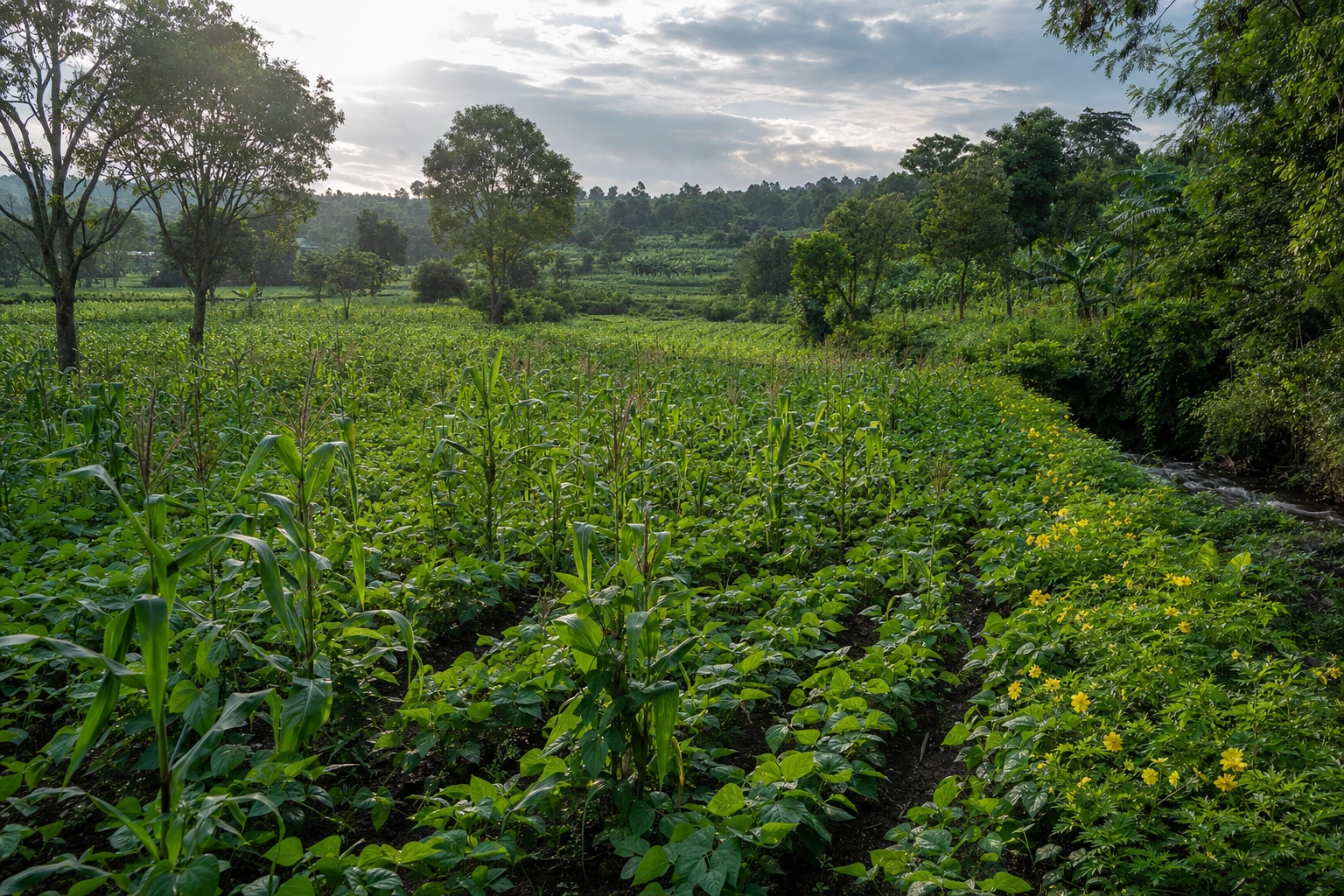
Agriculture and biodiversity are closely connected. Every farm depends on living organisms, from soil microbes and earthworms to pollinators, birds, livestock breeds and the plants that make up a harvest. At the same time, farming decisions can either protect or reduce the variety of life in fields, grazing areas, wetlands and surrounding landscapes.
Understanding this relationship is important for farmers, entrepreneurs, policymakers, consumers and professionals working in food systems. Biodiversity is not simply a conservation concern separate from production. It supports the ecological processes that make agriculture possible and can help farms cope with drought, pests, diseases, changing markets and other pressures.
What Biodiversity Means in Agriculture
Biodiversity refers to the variety of life and the relationships among living organisms. In agriculture, it can be understood at three connected levels.
- Genetic diversity: the variation within a crop, livestock species or tree species. Different varieties of beans, maize, sorghum or goats may have different qualities, such as drought tolerance, disease resistance, taste or maturity periods.
- Species diversity: the range of plants, animals, fungi and microorganisms present on a farm or in a landscape. This includes crops, weeds, beneficial insects, birds, livestock, soil organisms and wild plants.
- Ecosystem diversity: the variety of habitats and ecological systems, such as cropland, pasture, forest edges, rivers, wetlands, hedgerows and grazing commons.
A farm with one crop planted across a large area may still contain some biodiversity, but it usually has less genetic, species and habitat diversity than a mixed farm with several crops, trees, livestock and uncultivated areas. The quality of relationships among organisms also matters. A flowering plant may provide food for a bee, while the bee supports the production of fruit and seed.
Why Agriculture Depends on Biodiversity
Pollination
Many food crops benefit from pollination by bees, butterflies, moths, birds, bats and other animals. Some crops can pollinate themselves or rely mainly on wind, but a diverse community of pollinators can be important for fruit set, seed production and crop quality in other crops. Maintaining flowering plants, nesting sites and pesticide practices that reduce unnecessary harm can support pollinator activity.
Natural pest control
Not every insect in a field is harmful. Ladybirds, lacewings, spiders, predatory beetles, parasitic wasps and insect-eating birds can help limit pest populations. When a farm removes all vegetation except the crop, it may also remove shelter and food for these natural enemies. This can make the farm more dependent on purchased pest-control products.
This does not mean that every predator will eliminate a pest or that pesticides are never needed. It means that biodiversity can form part of an integrated pest-management approach, in which farmers monitor crops, identify the actual problem and combine several control methods rather than automatically applying a chemical.
Soil health
Soil is a living system. Bacteria, fungi, earthworms, termites and other organisms help break down organic matter, cycle nutrients and build soil structure. Healthy soil structure can improve infiltration and reduce the movement of soil during heavy rain. A diversity of plants also contributes different root patterns and residues, which can support soil life at various depths.
For example, a farm that combines crop residues, compost, cover crops and reduced soil disturbance may create more favourable conditions for soil organisms than a system that leaves soil bare and repeatedly disturbs it. Good soil management does not depend on one practice alone; it is shaped by climate, crops, available materials and local knowledge.
Water regulation and climate resilience
Vegetation helps slow rainfall, hold soil in place and support water infiltration. Trees, grasses, wetlands and ground cover can all influence how water moves through a farm landscape. Diverse farming systems may also spread risk. If one crop performs poorly because of drought, disease or a fall in market price, other crops or farm enterprises may still provide food or income.
In parts of Kenya and other dryland regions, farmers may combine drought-tolerant crops, livestock, trees and water-conservation measures. Such diversity cannot remove climate risk, but it can reduce reliance on a single harvest and make recovery easier after a difficult season.
How Agriculture Can Reduce Biodiversity
Agriculture affects biodiversity through land-use change, farming methods and decisions made across the supply chain. Converting natural habitats into fields or pasture can remove food, shelter and breeding sites for wild species. Clearing vegetation along rivers can increase erosion and disturb aquatic habitats. Overgrazing can reduce plant cover and leave land more vulnerable to degradation.
Other pressures include repeated cultivation of a single crop, excessive use of fertilisers or pesticides, burning of residues, drainage of wetlands and the loss of traditional crop varieties. Pollution can move beyond farm boundaries through water or wind, affecting neighbouring fields and natural ecosystems.
It is useful to distinguish between production intensity and efficient resource use. Producing more from existing land can sometimes reduce pressure to clear additional habitats, but intensification that damages soil, water or pollinator populations may create long-term costs. Sustainable agriculture therefore asks not only how much is produced, but also what happens to the land, water and living systems that support future production.
Farming Practices That Support Biodiversity
Grow a wider range of crops
Crop rotation breaks the continuous cycle that allows some pests and diseases to build up. It can also vary the demands placed on soil. A rotation might include cereals, legumes, vegetables, fodder crops or green manures, depending on the farm. Intercropping can place two or more crops together, such as maize with beans, where the combination suits local conditions and management capacity.
Crop diversity should be practical rather than decorative. Farmers need to consider labour, water, seed availability, market demand, storage and the timing of different harvests. A crop that improves ecological diversity but cannot be sold or consumed may not be a viable choice unless it serves another clear purpose, such as fodder or soil improvement.
Protect genetic diversity
Traditional and locally adapted varieties can carry useful traits that may be valuable under changing conditions. Farmers can maintain diversity by saving suitable seed where appropriate, using reputable seed sources, participating in community seed systems and avoiding the replacement of every local variety with one uniform option.
Livestock diversity matters too. Different breeds may vary in their tolerance of heat, feed quality, disease pressure or water scarcity. Maintaining more than one suitable breed or selecting animals for locally relevant traits can strengthen a farm's options, although breeding decisions should also consider animal welfare, productivity and available veterinary support.
Integrate trees and perennial plants
Agroforestry combines trees with crops or livestock. Trees may provide shade, fruit, fodder, fuelwood, timber, wind protection or soil benefits. Their roots can occupy different soil layers from annual crops, while their flowers and foliage can provide habitat for insects and birds.
Tree selection requires care. Farmers should choose species suited to the site and avoid planting trees where they compete excessively with crops for water or light. Invasive species should not be introduced casually. Local extension guidance can help with spacing, species choice and management.
Keep and restore habitat on the farm
Field margins, grass strips, riparian buffers, hedges, ponds, small woodlots and uncultivated corners can provide shelter and food for wildlife. These areas do not need to be unmanaged. They may require controlled grazing, pruning, removal of invasive plants or protection from fire and pollution.
Habitat is most valuable when it connects with other suitable areas. A narrow vegetated strip beside a stream may protect water quality, while a network of flowering margins can offer pollinators more continuous access to food. Cooperation among neighbouring farms can produce benefits that one farm cannot achieve alone.
Use integrated pest management
Integrated pest management begins with prevention and observation. Farmers can use resistant varieties, crop rotation, clean planting material, field sanitation, appropriate planting dates and habitat for beneficial organisms. Regular scouting helps distinguish a serious pest problem from the normal presence of insects.
If intervention is necessary, the least damaging effective option should be considered first, while following product labels and relevant professional guidance. Incorrect application can harm farm workers, beneficial organisms, water sources and consumers. Good records of pest levels, weather, treatments and results make future decisions more precise.
Build living soil
Useful measures include keeping soil covered, adding well-managed organic matter, reducing unnecessary disturbance, controlling erosion and using crop residues responsibly. Cover crops can protect the surface between main crops, but they must be selected and managed so that they do not compete with the next crop or consume scarce water.
Compost and manure can support soil fertility when they are properly handled. Their quality, maturity and application rate matter. More is not always better: excessive nutrients can run into waterways or create imbalances. Soil testing and local agronomic advice can improve decisions.
Biodiversity and Farm Business Decisions
For entrepreneurs and agricultural businesses, biodiversity can be treated as part of operational risk management. A farm, processor or retailer that depends on one crop, one supplier, one pollination period or one water source may be vulnerable to disruption. Diversified sourcing and support for responsible production can strengthen supply continuity, although they require careful planning.
Biodiversity-friendly practices may involve initial costs, such as planting trees, changing equipment, training workers or establishing buffer zones. Benefits may appear gradually rather than in one season. A business case should therefore consider several forms of value: reduced erosion, improved soil condition, more stable yields, lower dependence on some inputs, additional products such as fruit or fodder, and protection of the natural assets on which the enterprise depends.
Claims about sustainability should be specific and evidence-based. Saying that a product is environmentally friendly without explaining the practices behind the claim can mislead customers. Businesses can instead describe measurable actions, such as maintaining riparian vegetation, diversifying suppliers, reducing unnecessary pesticide applications or tracking soil and water indicators.
Applying This in Practice
A practical biodiversity plan can begin with a simple assessment rather than an expensive project.
- Map the farm or operating area. Identify fields, watercourses, wetlands, grazing areas, trees, boundaries, steep slopes and places where erosion or pollution occurs.
- List the diversity already present. Record crops, livestock breeds, useful trees, flowering plants, birds, insects and visible soil-life indicators. Farmers do not need to identify every species before taking action.
- Identify the main risks. Ask whether the farm relies heavily on one crop, has bare soil for long periods, loses vegetation beside water, experiences recurring pest outbreaks or uses inputs without regular monitoring.
- Select two or three realistic changes. Options might include a crop rotation, a flowering field margin, protection of a stream bank, a cover crop, mixed livestock enterprises or improved pest scouting.
- Set indicators and review results. Track practical measures such as crop diversity, survival of planted trees, visible erosion, pest pressure, input use, soil cover and yields. Review what worked and adapt the plan to local conditions.
Consumers and professionals can also influence biodiversity. Buying seasonally appropriate food, reducing waste, asking suppliers about production practices and supporting products from diversified farms can help create demand for better management. Public and private decisions are most effective when they recognise the needs of farmers, including reliable markets, useful extension services, suitable finance and access to quality planting material.
Key Takeaways
- Biodiversity includes genetic diversity, species diversity and the variety of habitats within agricultural landscapes.
- Farms depend on biodiversity for pollination, natural pest control, soil processes, water regulation and resilience.
- Crop rotation, intercropping, agroforestry, habitat protection and living-soil practices can support both nature and production.
- More biodiversity is not achieved by adding random species; practices must suit local climate, markets, labour and available resources.
- Integrated pest management uses monitoring and several control methods instead of relying automatically on chemical treatments.
- Farm businesses can treat biodiversity as a long-term asset and a way to reduce ecological and supply-chain risks.
No comments yet.