
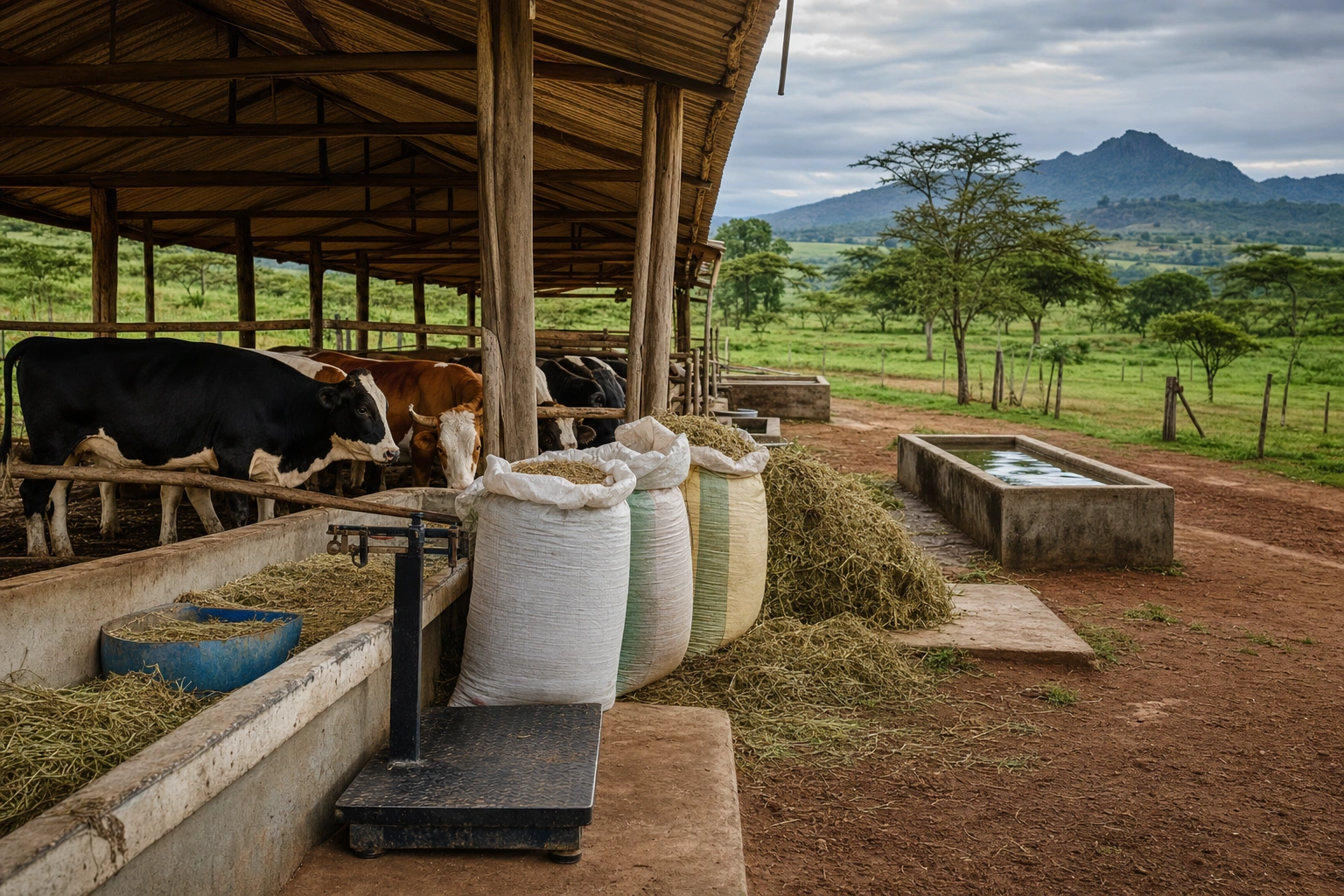
Livestock production is both a biological activity and a business system. Animals convert feed, water, labour and management into products such as milk, meat, eggs, hides, skins, manure and breeding stock. The economics of the enterprise depends on how efficiently those inputs are used, how reliably animals produce, and what price the farmer receives at the point of sale.
A profitable livestock enterprise is therefore not necessarily the one with the largest herd. It is the one that produces valuable outputs at a cost the market can support while managing disease, weather, price changes, animal welfare and cash-flow pressures. Whether the enterprise is a small dairy unit in Kenya, a poultry farm in Ghana, a pastoral system in northern Tanzania or a commercial beef operation elsewhere, the same economic principles help guide decisions.
What Makes Livestock Production Economically Different?
Livestock enterprises differ from many crop businesses because animals are living, growing assets. They require daily care and continue consuming feed even when market prices are temporarily weak. Production also takes time: a calf, lamb or kid may need months before it can be sold, while a young dairy animal may require a much longer period before producing milk.
This creates several important features:
- Biological time lags: decisions made today may affect production and income months or years later.
- Continuous costs: feed, labour, water, housing and health care may be required every day.
- Multiple outputs: one enterprise may produce milk, calves, manure and animals for sale.
- Perishability: fresh milk, eggs and some meat products can lose value quickly without appropriate storage or marketing.
- Asset value: breeding animals represent capital, not merely current production.
- Risk exposure: disease, drought, theft, feed shortages and market fluctuations can affect both costs and revenue.
These characteristics make record-keeping and forward planning especially important. A farmer who looks only at daily sales may miss the cost of replacing animals, maintaining buildings or feeding unproductive stock.
The Main Economic Inputs
Feed and pasture
Feed is often one of the largest operating costs in intensive livestock systems. It may include purchased concentrates, forage, hay, silage, crop residues, minerals and supplements. In grazing systems, pasture may appear free, but it still has an economic cost. Land, fencing, water points, pasture improvement and herding labour all require resources.
The relevant question is not simply, “How much feed does each animal consume?” It is, “How much saleable output does the animal produce from that feed?” A high-producing dairy cow may eat more than a low-producing cow but still be more profitable if the additional milk revenue exceeds the additional feed and health costs.
Labour
Labour includes feeding, cleaning, milking, herding, collecting eggs, monitoring animals, record-keeping and transporting products. Family labour should not automatically be treated as costless. If a family member could earn income elsewhere, the value of that forgone opportunity is an opportunity cost.
Understanding labour costs can reveal whether a small enterprise is genuinely profitable or merely replacing paid employment with long working hours. It can also help a farmer decide whether equipment, improved housing or a different production schedule would save time.
Animal health and breeding
Vaccination, disease prevention, veterinary services, medicines, parasite control and biosecurity are costs, but they also protect production. Skipping preventive care may reduce expenses in the short term while increasing mortality, treatment costs and lost output later.
Breeding decisions influence economics through fertility, growth rate, milk yield, litter size, feed conversion, maturity and resistance to local conditions. A genetically superior animal is not automatically the best choice if it requires feed, housing or health support that the farm cannot provide.
Buildings, equipment and land
Housing, milking equipment, water systems, fencing, storage facilities, transport equipment and handling structures are usually fixed assets. They support production over several years, so their full cost should not be charged to only one production cycle.
Farmers can account for this through depreciation, which spreads the cost of an asset across its useful life. For example, if a piece of equipment costs £1,000 and is expected to have a useful life of five years with no meaningful resale value, a simple annual depreciation estimate would be £200. This is an accounting estimate rather than an immediate cash payment, but it reminds the owner that equipment will eventually need replacement.
Fixed Costs, Variable Costs and Total Cost
Fixed costs do not change greatly with short-term production volume. Examples include building depreciation, land rent, insurance and some equipment costs. Variable costs change as the scale or intensity of production changes. Examples include feed purchased per animal, packaging, transport per delivery, medicines and casual labour.
The distinction is useful when making decisions. Suppose a poultry farmer already owns a suitable house. The cost of that house may be fixed in the short term, while additional chicks, feed and vaccines are variable costs. The decision to place another batch should be based on the extra revenue compared with the extra variable cost, while also considering space, disease risk and cash availability.
Total cost can be represented simply as:
Total cost = fixed costs + variable costs.
For meaningful analysis, costs should be recorded per animal, per litre of milk, per kilogram of live weight, per tray of eggs or per production cycle. Unit costs allow comparison between enterprises of different sizes.
Measuring Revenue and Profitability
Livestock revenue may come from several sources. A dairy enterprise can earn from milk, calves, culled cows and manure. A beef enterprise may sell finished animals, breeding stock and hides. A poultry unit may earn from eggs, spent layers, manure and sometimes day-old chicks. All relevant outputs should be recorded, including products consumed by the household where they have a realistic market value.
A basic measure is:
Profit = total revenue ? total cost.
However, profit should be interpreted carefully. A business may show a cash surplus because it has not included depreciation, family labour or the value of animals retained for breeding. Conversely, it may show a low accounting profit during a period of expansion because it is investing in productive assets.
Gross margin
A gross margin is usually calculated as enterprise revenue minus variable costs. It helps compare enterprises that use the same farm resources. For example, a farmer can compare the gross margin from dairy cows with that from poultry, sheep or fodder production.
Gross margin is not the same as final profit because fixed costs are excluded. An enterprise with a strong gross margin may still be unprofitable if it carries excessive debt, expensive buildings or underused equipment.
Break-even analysis
Break-even analysis identifies the level of output or price needed to cover costs. If a farmer knows the total cost of producing 10,000 litres of milk, dividing total cost by 10,000 gives the break-even cost per litre. The result can be compared with the expected selling price.
For a product sold at a known price, the break-even quantity can be estimated by dividing fixed costs by the contribution margin per unit. The contribution margin is selling price per unit minus variable cost per unit. This calculation is particularly useful for poultry cycles, feedlot finishing and milk production.
Break-even results are not predictions. They depend on assumptions about mortality, yield, prices, feed costs and production time. Farmers should test several scenarios rather than rely on one optimistic estimate.
Productivity and Efficiency
Economic performance depends on productivity, but productivity must be measured in a useful way. Possible measures include litres of milk per cow per day, eggs per hen over a laying cycle, kilograms of weight gain per animal, lambs weaned per ewe or saleable output per labour hour.
Physical productivity and financial efficiency are related but not identical. An animal may produce a high volume of milk but generate little profit if feed costs are excessive. A smaller animal adapted to local forage and disease conditions may deliver a better return on limited resources.
Useful efficiency questions include:
- How much feed is required to produce one unit of output?
- What proportion of breeding females produce offspring successfully?
- How many days are animals unproductive between cycles?
- What is the mortality rate, and what does each death cost the enterprise?
- How much labour is required for each unit sold?
- What percentage of the selling price is absorbed by transport, collection or marketing?
Improving efficiency can involve better genetics, but it may also involve simple measures such as reliable water, accurate feeding, timely treatment, improved hygiene, reduced wastage and better records.
Markets, Value Chains and Price Risk
Farmers rarely receive the final consumer price. Livestock products pass through collectors, traders, processors, transporters, retailers and other intermediaries. Each stage performs functions such as bulking, grading, cooling, processing or distribution and adds costs or value.
Market access affects which enterprise is suitable. A farm far from a reliable milk collection point may face spoilage and transport losses, even if its cows produce well. A poultry farmer may earn more by selling graded eggs to a dependable customer than by selling irregular quantities through a low-price channel. A beef producer may improve returns through accurate weighing, animal condition management and planned sales rather than selling under urgent financial pressure.
Price risk can be managed, although not eliminated. Practical approaches include diversifying enterprises, staggering production, maintaining more than one buyer, improving storage where appropriate, producing part of the farm’s own feed and keeping an emergency cash reserve. Contracts can provide greater certainty, but their terms should be understood before animals or products are committed.
Risk, Sustainability and Resilience
Economic analysis must include risks that may not appear in a normal production year. Drought can reduce pasture and raise feed costs. Flooding can damage housing and disrupt transport. Disease can reduce output or cause animal deaths. Theft, unreliable electricity and sudden changes in input prices can also affect returns.
Resilience often comes from reducing dependence on a single fragile resource. Examples include conserving fodder during periods of abundance, protecting water sources, maintaining quarantine procedures for newly purchased animals and keeping accurate breeding and health records.
Sustainability has an economic dimension. Soil fertility, pasture condition, water quality and animal welfare affect future productivity. Manure can become a useful fertiliser or biogas input when handled safely. Crop residues can reduce feed purchases, provided they are nutritionally appropriate and do not compromise soil protection. Overgrazing may reduce current feed costs temporarily but damage the productive capacity of the land.
Choosing Between Livestock Enterprises
Enterprise choice should reflect available resources, skills, market access and risk tolerance. Dairy farming may suit a household with reliable water, labour and a nearby milk market. Poultry can generate revenue in shorter cycles but may be highly sensitive to feed prices, disease and management quality. Sheep and goats may fit environments where browse or grazing is available, although reproduction, theft and market timing still matter. Beef production may tie up capital for a long period before sale.
A useful comparison considers:
- Resource fit: Does the enterprise match the land, water, labour and housing available?
- Capital requirement: How much money is needed before the first sale?
- Cash-flow timing: Are income and expenses spread throughout the year or concentrated in one period?
- Market reliability: Who will buy the product, at what quality standard and under what payment conditions?
- Management demands: Does the owner have the knowledge and time required?
- Downside risk: What happens if feed prices rise, production falls or the selling price declines?
Applying This in Practice
Before expanding a livestock enterprise, prepare a simple enterprise budget. List every expected output and assign a realistic price. Then list variable costs such as feed, health care, transport, packaging and hired labour. Add fixed costs, including depreciation, rent, interest where relevant and a fair allowance for family labour.
Next, calculate the expected profit, cost per unit and break-even point. Test a conservative scenario in which output is lower, mortality is higher or the selling price falls. If the enterprise remains viable under reasonable adverse conditions, the plan is stronger than one based only on the best expected result.
During production, record actual results rather than relying on memory. Record animal numbers, births, deaths, feed purchased, treatments, labour time, sales, prices and rejected or wasted products. At the end of each cycle or month, compare actual results with the budget. The purpose is not to produce complicated accounts; it is to identify where money is being lost and which decisions are improving returns.
For example, if a dairy farmer discovers that feed cost per litre is rising, the next step is not automatically to buy more cows. The farmer should examine forage quality, wastage, animal yield, disease, water access and the cost of purchased concentrates. The best response may be improved fodder production, culling persistently unproductive animals or changing the ration with professional guidance.
Key Takeaways
- Livestock profitability depends on the relationship between total costs, saleable output and market prices, not herd size alone.
- Separate fixed costs from variable costs and include depreciation, family labour and opportunity costs when assessing performance.
- Measure efficiency using practical indicators such as cost per litre, feed per kilogram of gain, mortality and labour per unit sold.
- Include every important output, including breeding stock, manure, culled animals and products consumed by the household.
- Use gross margins, break-even calculations and conservative scenarios before investing in expansion.
- Strong livestock businesses manage biological, market and environmental risks through records, prevention, diversification and resource planning.
No comments yet.