
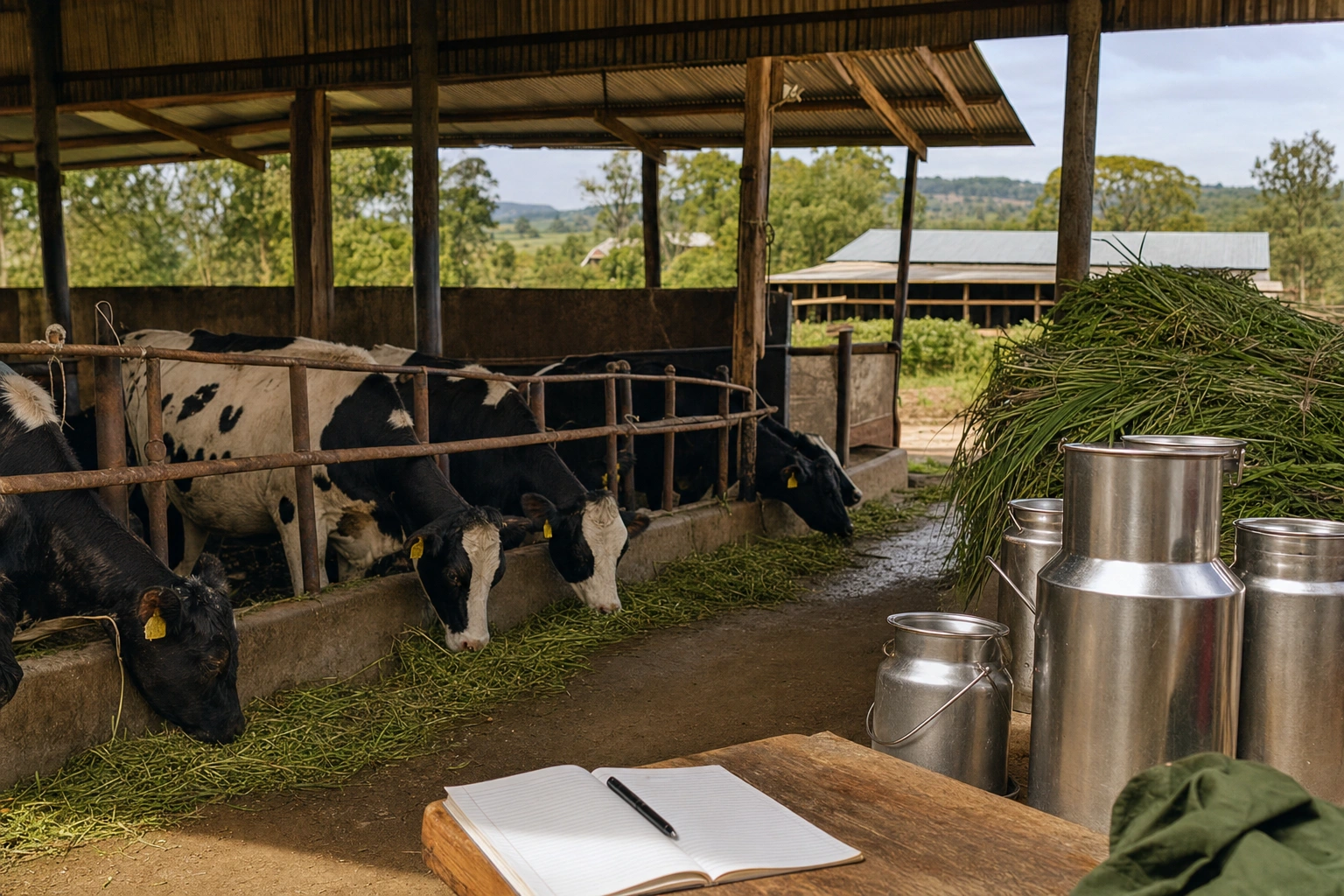
Dairy farming can provide regular income, employment and valuable manure, but producing milk does not automatically make a farm profitable. A dairy enterprise succeeds when the value of milk and other outputs consistently exceeds the full cost of producing them, including feed, labour, animal health, housing, finance and the farmer’s own time.
The economics of dairy farming therefore involves more than counting litres sold. It requires understanding how cows convert feed and management into milk, how fixed and variable costs behave, how prices and seasonal production affect cash flow, and how decisions about breeding, herd size and marketing influence long-term returns.
What Makes Dairy Farming an Economic Activity?
A dairy farm combines biological assets, physical infrastructure and daily management. The main productive asset is the cow, but the cow only generates income during certain stages of her production cycle. She must be reared, bred, fed during pregnancy, calved and maintained in good health before and during lactation.
Income may come from several sources:
- Sale of fresh milk to households, traders, cooperatives, processors or institutions.
- Sale of calves, young stock or surplus breeding animals.
- Sale of culled cows at the end of their productive life.
- Sale or use of manure, which can reduce fertiliser costs or generate additional income.
- Processed products such as yoghurt, fermented milk, butter or cheese, where the farmer has the skills, equipment, market and regulatory approvals required.
Milk is usually the central source of cash income, but the other outputs affect the overall profitability of the enterprise. A farm that sells milk at a reasonable price may still perform poorly if it loses calves, buys excessive feed, experiences long periods when cows are not producing, or borrows heavily to build facilities.
Understanding the Main Costs
Accurate costing is essential because many dairy farmers notice only cash expenses. For example, a farmer may record purchased feed and veterinary treatment but ignore family labour, depreciation of buildings and equipment, interest on borrowed money or the value of land used for fodder. This can make the farm appear more profitable than it really is.
Variable costs
Variable costs change as the number of animals or the volume of production changes. Common examples include:
- Purchased feeds such as concentrates, hay, silage and mineral supplements.
- Seed, fertiliser, irrigation and labour for growing fodder.
- Veterinary medicines, vaccination and treatment.
- Breeding services, including artificial insemination where used.
- Water, transport, milking supplies, cleaning materials and packaging.
- Marketing costs and commissions.
Feed is often one of the most important variable costs because milk production depends heavily on the quantity and quality of the ration. However, reducing feed costs carelessly can lower milk yield, delay conception, weaken animals and increase disease risk. The relevant question is not simply, “How can I spend less on feed?” It is, “Which ration produces the best financial return after its cost is considered?”
Fixed and semi-fixed costs
Fixed costs do not change greatly with short-term changes in milk output. They include the construction of a zero-grazing unit or milking shed, water infrastructure, equipment, land-related costs, insurance where applicable and certain administrative expenses. Depreciation reflects the gradual loss of value of buildings, machines and tools over their useful lives.
Some costs are semi-fixed. A farm may employ one worker for a small herd, but need additional labour as the herd expands. Similarly, a tractor may be underused on a small farm but economically useful when it serves several activities or neighbouring farms.
Separating costs helps the farmer understand operating performance. If milk income does not cover variable costs, the farm has an immediate production problem. If it covers variable costs but not fixed costs, the enterprise may be operating but not recovering the investment needed to remain viable.
Revenue, Gross Margin and Net Profit
Milk revenue is calculated as:
Milk revenue = litres sold × price per litre
If a farmer sells 80 litres per day at a hypothetical price of KSh 55 per litre for 30 days, monthly milk revenue is KSh 132,000. This is an illustration, not a market quotation; actual prices vary by location, buyer, quality, season and contract.
Gross margin provides a useful short-term measure:
Gross margin = revenue ? variable costs
Suppose the same farm spends KSh 78,000 per month on feed, animal health, transport, water and other variable costs. Its monthly gross margin would be KSh 54,000. The farmer must then consider labour, repairs, depreciation, loan interest and other fixed or overhead costs before calculating net profit.
Net profit = total revenue ? total costs
Net profit should include the value of all important outputs, not only milk. For instance, manure used on the farm can be recorded as a saving in fertiliser expenditure, while the value of calves should be recognised even if they are not sold immediately. At the same time, a farmer should avoid counting the same output twice. Manure used in crop production cannot also be treated as cash income unless it is sold.
Milk Yield Is Not the Same as Profitability
A cow producing more milk is not necessarily more profitable. A high-yielding cow may also require more expensive feed and closer management. The key measure is the margin generated after the cost of producing that milk.
For example, consider two cows:
- Cow A produces 18 litres daily and requires KSh 850 per day in feed and other variable costs.
- Cow B produces 12 litres daily and requires KSh 500 per day in feed and other variable costs.
At a hypothetical milk price of KSh 55 per litre, Cow A produces KSh 990 of daily milk revenue and a contribution of KSh 140 before fixed costs. Cow B produces KSh 660 and a contribution of KSh 160. Cow B would generate the stronger daily contribution in this simplified example, although the final decision would also depend on health, fertility, longevity and other factors.
This is why farmers should examine margin per cow, margin per litre and, where land is limited, margin per unit of land or feed. These measures reveal whether resources are being used efficiently.
Break-Even Analysis for a Dairy Enterprise
Break-even analysis shows the level of production or sales needed to cover costs. It is useful when deciding how many cows to keep, whether to borrow money or whether a new investment is justified.
A simple break-even volume formula is:
Break-even litres = fixed costs ÷ contribution per litre
Contribution per litre is the milk price minus the variable cost of producing one litre. If milk sells for KSh 55 per litre and variable production costs equal KSh 35 per litre, the contribution is KSh 20 per litre. If monthly fixed costs are KSh 60,000, the farm must sell 3,000 litres per month, or about 100 litres per day, to reach operating break-even.
This calculation has limitations. Milk production fluctuates, some costs are difficult to allocate precisely, and the price may change. Nevertheless, it provides a practical warning: a farm with high fixed costs must either produce enough milk, secure a better price, reduce overheads or develop additional income streams.
Cash Flow and the Dairy Production Cycle
Profit and cash flow are related but different. A farm may be profitable over a year and still face a cash shortage in a particular month. Dairy farmers must pay for feed, labour and veterinary care regularly, while income may be delayed by a buyer or reduced when cows are dry.
The production cycle creates several important cash-flow pressures. A heifer requires feeding and care before she begins producing milk. A cow may produce little or no milk during the dry period before calving. Calving can bring veterinary expenses, while breeding failure extends the period without a productive lactation. Seasonal feed shortages may force the farmer to buy expensive hay or concentrates.
A simple monthly cash-flow record should show:
- Opening cash balance.
- Expected milk receipts and other income.
- Feed, labour, health, breeding, transport and household withdrawals.
- Loan repayments and planned capital purchases.
- Closing cash balance.
Separating farm money from household money is especially important for small enterprises. If all milk income is withdrawn for household needs, the farm may lack funds for feed, breeding or repairs. A planned owner’s drawing is more useful than taking money whenever cash is available.
Productivity: The Economic Value of Good Management
Many improvements in dairy farming do not require the largest herd. They require better use of the existing herd and resources.
Feeding and fodder planning
Growing suitable fodder can reduce dependence on purchased feed, but it also has a cost. The farmer should account for land preparation, seed, fertiliser, water, harvesting, storage and labour. Good fodder planning includes a reserve for dry seasons rather than assuming that fresh pasture will always be available.
Balanced nutrition supports milk production, body condition, fertility and resistance to stress. Rations should be adjusted to the animal’s stage of production. A recently calved cow, a late-lactation cow, a dry cow and a growing heifer do not have identical needs.
Breeding and herd structure
Every day that a cow remains unproductive because of delayed breeding or poor conception can reduce the farm’s return on feed and housing. Accurate records of heat signs, service dates, calving dates and milk yield help the farmer identify reproductive problems early.
A herd should also contain animals at different stages of production. If many cows become dry at the same time, milk income may fall sharply. Planned breeding can spread calving and production more evenly, subject to animal welfare and sound reproductive management.
Animal health and prevention
Preventive care is generally easier to budget for than major disease treatment, but prevention is not costless. Farmers should work with qualified animal-health professionals, follow appropriate vaccination and treatment guidance, maintain clean housing and isolate sick animals when necessary.
Record the date, animal, problem, treatment and cost of every health event. Repeated illness in one animal may make culling economically sensible, while a recurring problem across the herd may indicate weaknesses in housing, hygiene, nutrition or biosecurity.
Choosing a Market and Adding Value
The best market is not always the one offering the highest advertised price. Farmers should consider payment reliability, quality requirements, transport distance, rejected milk, collection schedules and the time needed to sell directly.
Selling to a cooperative or processor may offer more predictable collection and payment, while direct sales may provide greater control over customer relationships. Direct marketing, however, can increase packaging, delivery, administration and food-safety responsibilities.
Value addition can increase revenue per litre, but it also introduces new costs and risks. A farmer making yoghurt must account for cultures, heating, cooling, packaging, labour, electricity, spoilage, distribution and compliance requirements. The relevant calculation is:
Value-added margin = selling price ? all processing, packaging, marketing and production costs
Value addition makes economic sense only when the extra margin justifies the additional work, capital and risk. Before investing, test demand with a small, carefully controlled product range and calculate the cost per unit honestly.
Managing Financial and Production Risk
Dairy income can be affected by milk-price changes, feed-price increases, drought, disease, theft, equipment breakdown and unreliable buyers. Risk management begins with identifying which events could threaten the farm and how quickly the enterprise could respond.
Practical measures include maintaining feed reserves, diversifying fodder sources, keeping accurate health records, avoiding excessive debt, servicing equipment and building relationships with dependable buyers. Insurance may be appropriate in some situations, but the farmer should understand the cover, exclusions and claims process before purchasing a policy.
Debt should be matched to the life of the asset. Long-term infrastructure may justify longer-term financing, while borrowing for daily feed requires careful attention to repayment timing. A loan can increase productive capacity, but it can also turn a manageable cost problem into a serious cash-flow crisis if expected yields or prices do not materialise.
Applying This in Practice
- List every enterprise output. Record milk, calves, culled animals, manure and processed products separately.
- Classify every cost. Separate variable, fixed, financing and household expenses. Include family labour and depreciation where possible.
- Measure production consistently. Record milk per cow, feed quantities, dry periods, breeding results, disease events and mortality.
- Calculate margins. Review revenue, variable cost, gross margin and net profit monthly, then compare results across the year.
- Test investment decisions. Estimate the additional income, additional costs, payback period and worst-case cash-flow effect before expanding the herd or building facilities.
- Review the market. Compare price, payment reliability, quality deductions, transport and administrative demands rather than looking at price alone.
For a small farm in Kenya, this process might begin with a notebook, a weighing container or milk meter, feed receipts and a simple spreadsheet. The tool matters less than the discipline of recording information and using it to change decisions. Over time, records reveal which cows, feeds, seasons and markets produce the strongest returns.
Key Takeaways
- Profit is the value of all farm outputs minus the full cost of production, not simply milk income minus purchased feed.
- Feed decisions should be judged by the margin generated after feed costs, not by feed price alone.
- Break-even analysis shows how much milk must be sold to cover variable and fixed costs.
- Profitability and cash flow are different; dry periods, feed purchases and loan repayments must be planned for.
- High milk yield does not guarantee high profit, so compare margins per cow and per litre.
- Value addition is worthwhile only when the extra margin covers processing, packaging, marketing and compliance costs.
- Accurate records turn daily dairy activities into information for better breeding, feeding, health and investment decisions.
No comments yet.