
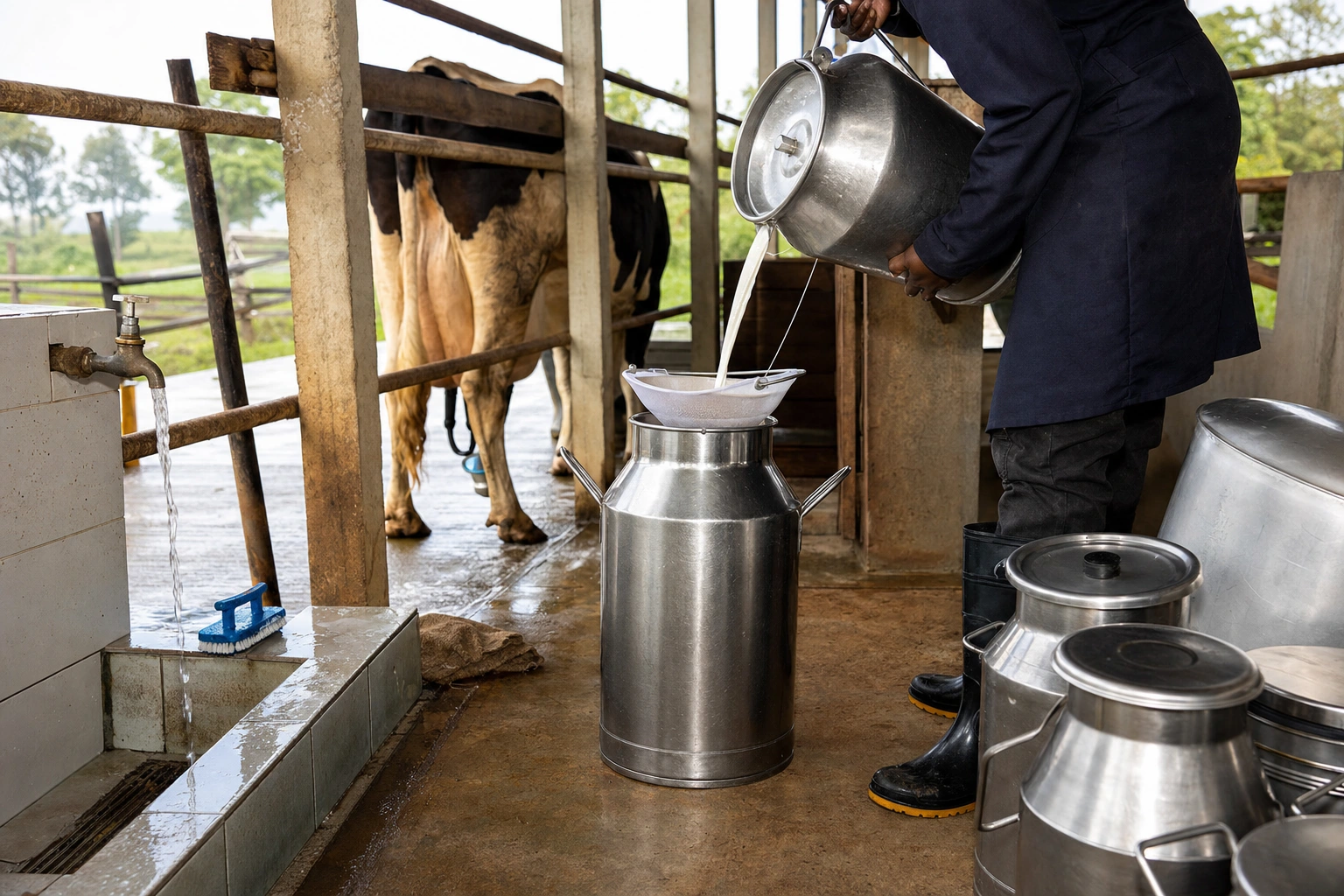
Milk quality is not created at the processing plant alone. It begins with the health and feeding of the cow, continues through milking and storage, and depends on careful transport and handling before the milk reaches a consumer. A small failure at any stage can reduce shelf life, affect taste, introduce hazards or cause financial losses for farmers and buyers.
For dairy farmers, maintaining quality means controlling three related areas: the milk must come from healthy animals, it must be protected from contamination, and it must be cooled and delivered promptly. The same principles apply whether milk is sold directly to households, collected by a cooperative, transported to a cooling centre or delivered to a processor.
What Milk Quality Means
Milk quality has several dimensions. It is not simply a question of whether milk looks white and fresh. Good-quality milk should be safe, clean, suitable for processing and consistent in composition.
- Safety: Milk should not contain harmful microorganisms, veterinary medicine residues, cleaning chemicals or other dangerous contaminants.
- Cleanliness: It should be protected from dirt, manure, dust, hair, insects, dirty water and unclean containers.
- Freshness: Milk should be cooled and handled quickly enough to slow the growth of bacteria.
- Normal composition: Milk should not be diluted with water or altered by the removal of cream or the addition of other substances.
- Processing suitability: Milk should have characteristics that allow it to be pasteurised and made into products such as yoghurt, cheese, butter or milk powder.
These qualities are connected. For example, milk from a cow with mastitis may contain a high number of somatic cells and may have poorer processing properties. Milk that is clean at milking but left warm for several hours can still become unsafe or spoil quickly.
Start with Healthy Animals
The condition of the herd is the first control point. Healthy cows are more likely to produce milk with normal composition and lower contamination risks. Farmers should maintain regular observation of the animals, including appetite, movement, udder condition, body condition and changes in milk appearance.
Mastitis, an inflammation of the udder, is one of the most important milk-quality problems in dairy farming. It may be visible, with clots, flakes, watery milk, swelling or heat in the udder, or it may be hidden and detected only through testing. Affected cows should be identified and managed according to veterinary advice. Milk from treated or visibly affected quarters should not be mixed with the main supply.
Good herd health also depends on clean housing, adequate nutrition, reliable water and effective control of injuries and parasites. Cows should not be forced to lie in wet or heavily contaminated bedding immediately before milking. Clean, dry resting areas reduce the amount of manure and dirt that can reach the udder.
Feed, Water and Environmental Management
Feed should be stored to prevent mould, chemical contamination and contact with animals or pests. Poor-quality or mouldy feed can affect animal health and may introduce undesirable substances into the food chain. Farmers should also avoid sudden, poorly managed changes in the diet, because digestive problems can reduce production and weaken general health.
Water supplied to cows should be clean and available in sufficient quantity. Water used to wash udders, hands, buckets or milking equipment must also be clean. Washing a dirty utensil with contaminated water does not make it safe; it may spread contamination across the entire milking system.
The milking area should be protected from dust, poultry, pets and unnecessary movement. It does not need to be an expensive building, but it should be well drained, reasonably clean and arranged so that animals, milk, manure and cleaning materials are kept apart.
Prepare Before Milking
Quality is easier to maintain when preparation is consistent. Before milking begins, the farmer should check that equipment, containers and the milking area are clean and ready. The milker should wash hands thoroughly, keep fingernails short and cover cuts with a suitable waterproof dressing. Clean clothing or protective garments help prevent dirt and hair from entering the milk.
The cow's udder and teats should be examined and cleaned when necessary. Excessive washing can leave water on the teats, and dirty water can increase contamination. After cleaning, the teats should be dried with a clean, individual towel or another hygienic method. Moisture and remaining dirt can carry bacteria into the teat opening.
It is useful to examine a small amount of milk from each quarter before adding the milk to the main container. Abnormal milk should be kept separate and assessed. Forestripping also helps reveal clots or unusual changes, although it should be done hygienically and not onto the floor or the cow's skin.
Milk from cows known to be ill, under treatment or within a medicine withdrawal period must be handled separately. A clear identification system, such as a record or marked stall, reduces the risk of accidentally mixing it with saleable milk.
Use Hygienic Milking Practices
During milking, the main objective is to prevent bacteria and foreign matter from entering the milk. Milkers should avoid touching the inside of containers, lids or teat cups. Buckets should be kept covered when possible, and milk should not be placed on dirty floors or near manure.
For hand milking, the milker should use a clean, smooth-sided container that is easy to wash. Milking should be gentle and orderly. Rough handling can injure the udder, frighten the cow and make the process more difficult. For machine milking, liners, tubes, clusters and seals should be inspected regularly for cracks, wear or trapped residues.
The first milk from a newly calved cow, colostrum, is essential for the calf but is different from ordinary market milk. It should be managed separately according to the farm's production and animal-health plan. Milk from cows receiving medicines must also remain separate until the required withdrawal period has passed.
Clean and Sanitise Equipment Correctly
Milk residues support bacterial growth, especially in scratches, joints, rubber parts and narrow pipes. Equipment should therefore be cleaned as soon as possible after milking rather than being left until later in the day.
- Rinse promptly: Use suitable water to remove milk residues before they dry. Water that is excessively hot at the beginning can cause milk proteins to stick to surfaces.
- Wash with an appropriate detergent: Follow the product instructions for concentration, contact time and temperature. Scrubbing should reach all surfaces, including lids, taps, teat cups and pipe connections.
- Rinse thoroughly: Remove detergent and loosened residues with clean water.
- Sanitise when appropriate: Use a suitable sanitising method before the next milking, following the instructions for the product and equipment.
- Drain and air-dry: Store utensils upside down or in a way that allows complete drainage. Damp, closed containers encourage bacterial growth.
Cleaning chemicals must be stored away from milk, feed and animals. Incorrectly mixed chemicals can damage equipment or leave residues. Farmers should also replace worn rubber parts and repair cracked containers because cleaning cannot reliably remove contamination from damaged surfaces.
Cool Milk Quickly and Keep It Cold
Fresh milk naturally contains nutrients that support bacterial growth. Cooling does not make dirty milk clean, but it slows the multiplication of bacteria and helps preserve freshness. Milk should be cooled as soon as practical after milking and kept cold during storage and collection, in line with the requirements of the buyer or processor.
Where a farm has a bulk milk cooler, the tank should be clean, functional and large enough for the volume produced. The cooling system must be able to cool the milk effectively, and the milk should be protected from warm additions that raise the temperature of the whole tank. A faulty thermometer can hide a serious problem, so temperature readings and equipment performance should be checked regularly.
Small-scale farmers without a bulk cooler still need a reliable plan. Milk can be delivered promptly to a functioning collection centre or cooling facility using clean, food-grade containers. The important principles are to reduce the time milk spends warm, avoid direct sunlight and prevent repeated opening or transfer between containers.
Milk containers should be designed for food use, smooth inside and easy to clean. Containers previously used for chemicals, fuel or non-food products must never be used for milk, even if they appear clean.
Control Medicines and Chemical Residues
Veterinary medicines can be essential for animal health, but milk from a treated cow may contain residues for a period after treatment. Every medicine has instructions on use and, where applicable, a withdrawal period. The withdrawal period is the time that must pass before milk or meat from the treated animal is considered suitable for sale under the product instructions and veterinary guidance.
Farmers should record the cow's identification, the medicine used, the date of treatment, the person who administered it and the date when milk can return to the supply. When treatment is given through the udder, farmers must be particularly careful not to mix milk from the treated quarter or cow with other milk.
Milk contaminated with antibiotics can fail quality tests and may interfere with the manufacture of cultured products such as yoghurt and cheese. It may also contribute to wider public-health concerns about medicine use. Never extend, shorten or guess a withdrawal period, and never use unlabelled medicines.
Testing and Traceability
Visual inspection is useful but cannot detect every quality problem. Buyers and collection centres may test milk for temperature, smell, appearance, acidity, added water, antibiotic residues, bacterial load or somatic cell levels. The exact tests and acceptance criteria depend on the market and applicable requirements.
Farm records make testing results more useful. A simple record can include the date and time of milking, approximate quantity, animal treatments, cleaning activities, cooling information, collection time and any rejected milk. If a problem is found, these records help the farmer identify what happened instead of relying on memory.
Traceability means being able to follow milk backwards to its source and forwards through handling or processing. At a cooperative or collection centre, keeping batches separate where necessary and recording supplier information can help locate contamination quickly. Traceability protects both consumers and honest farmers because it supports targeted corrective action.
Transport and Collection
Transport should preserve the work done at the farm. Milk should be moved in clean, covered, food-grade containers or an appropriate milk tanker. Containers should be protected from dust, rain, direct sunlight, animals and other cargo. Milk should not be transported alongside fuel, pesticides, detergents or strong-smelling materials.
Delays are a quality risk, particularly when milk is warm. Collection routes and schedules should minimise waiting time. At a collection centre, milk from different suppliers should be accepted only after appropriate checks, and rejected or suspect milk should not be poured into the common tank.
Handlers should keep the receiving area clean, maintain equipment and wash hands before contact with milk or food-contact surfaces. A clean container that is filled in a dirty environment can quickly become contaminated again.
Common Quality Failures and Their Causes
- Sour milk: Often linked to high bacterial numbers, delayed cooling, dirty equipment or long storage.
- Visible dirt or foreign matter: Usually caused by poor udder preparation, uncovered containers, dirty clothing or an untidy milking area.
- Abnormal flavour: May result from contaminated feed, strong-smelling surroundings, poor cleaning or chemical residues.
- Milk that fails an antibiotic test: Commonly caused by mixing treated milk with normal milk or misunderstanding the withdrawal period.
- Rapid spoilage despite cooling: May indicate that the milk was heavily contaminated before cooling, the cooler is not working correctly or containers were not properly cleaned.
- Unstable processing: Can be associated with mastitis, adulteration, residues or poor raw-milk handling.
Corrective action should address the cause, not merely the visible symptom. For example, adding more detergent to a damaged bucket will not solve the problem; replacing the bucket and improving inspection may be necessary.
Applying This in Practice
A practical quality routine can be organised into four checkpoints.
- Before milking: Check animal health, separate treated cows, clean the milking area, wash hands and prepare clean equipment.
- During milking: Inspect foremilk, keep abnormal milk separate, avoid touching food-contact surfaces and protect the milk from dirt and insects.
- Immediately after milking: Filter only through a clean, suitable food-grade filter if filtering is part of the handling system, cool the milk promptly and record important information.
- Before collection: Confirm that containers are covered and clean, check storage conditions, deliver on time and report any suspected contamination.
Farm managers can review the routine by asking: Are all treated animals clearly identified? Is the water used for cleaning safe? Can every container be fully drained and dried? Is the cooling method reliable? Are rejected batches recorded? Do workers understand why withdrawal periods matter? These questions turn milk quality from a general intention into a repeatable management system.
Key Takeaways
- Milk quality starts with healthy cows, clean housing, safe feed and clean water.
- Prepare the udder, hands, milking area and equipment before milk enters the container.
- Keep milk from sick or treated cows separate and observe every medicine withdrawal period.
- Clean equipment promptly, use suitable detergents and allow containers to drain and air-dry.
- Cool milk quickly, keep it protected during storage and transport, and minimise delays.
- Use testing and accurate records to identify problems and improve traceability.
No comments yet.