
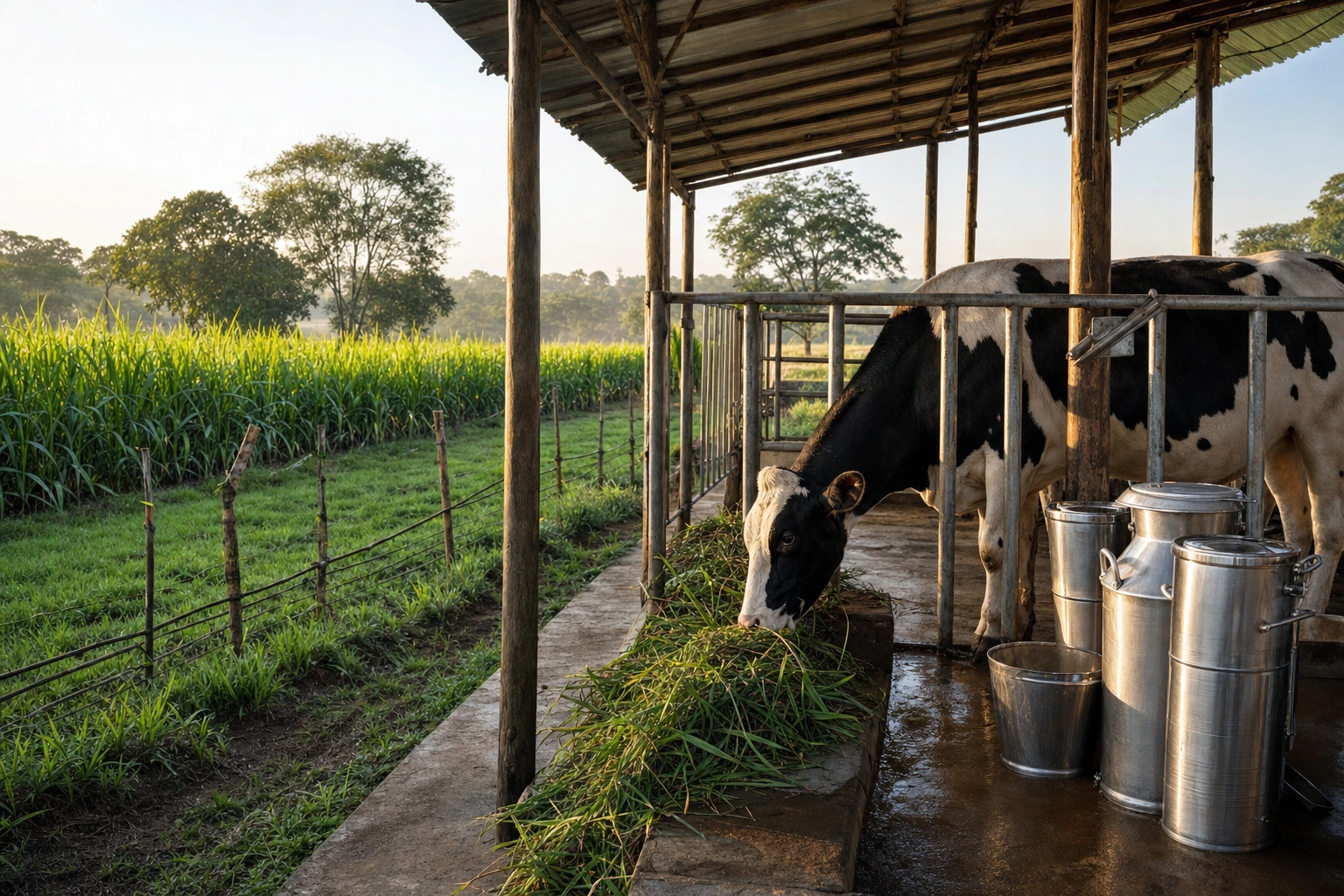
Dairy production is more than keeping cows and collecting milk. It is an organised system in which farmers manage animals, feed, water, housing, breeding, health, labour, equipment and markets to produce safe milk consistently. The best system depends on climate, land availability, capital, labour, feed resources, market access and the farmer’s goals.
Understanding how dairy production systems work helps farmers make practical decisions rather than copying a model that may not suit their circumstances. A smallholder near Nakuru, a commercial farm in South Africa and a family enterprise in the United Kingdom may all produce milk successfully, but they may use very different combinations of grazing, purchased feed, housing and technology.
What Is a Dairy Production System?
A dairy production system is the complete method used to raise dairy animals and turn feed and farm resources into milk, income and, in some cases, meat or manure. It includes both biological processes and business decisions.
The biological side involves animal growth, reproduction, lactation and health. A cow must grow to maturity, become pregnant, give birth and begin producing milk. Her milk yield is influenced by genetics, nutrition, water, disease control, comfort and the stage of her lactation cycle.
The management side involves decisions such as:
- Which dairy breed or crossbreed to keep
- Whether animals will graze, remain housed or use both methods
- How much feed will be grown on the farm and how much will be purchased
- When to breed, dry off, sell or replace animals
- How milk will be cooled, transported and marketed
- How costs, labour and risks will be controlled
A system is therefore judged not only by the litres produced. It should also be assessed by profitability, animal welfare, environmental sustainability, food safety and its ability to cope with changing conditions.
The Main Dairy Production Systems
Pasture-based or extensive systems
In a pasture-based system, animals obtain much of their feed by grazing natural or planted pasture. The farmer may provide minerals, conserved forage or supplementary concentrates, especially during dry seasons or periods of high milk production.
This approach generally requires less investment in buildings and feeding equipment than a fully housed system. It can work well where land is available, rainfall supports pasture growth and animals can move safely between grazing areas. Manure is often deposited directly on the land, returning nutrients to the soil.
However, pasture quality changes with season and management. Poor grazing control can lead to overgrazing, soil erosion and declining feed quality. Long walking distances, heat stress, parasites or muddy conditions may also reduce production. Pasture-based farms need good fencing, water points, pasture rotation and a plan for periods when grass growth is low.
Semi-intensive systems
Semi-intensive production combines grazing with supplementary feeding and some housing. Cows may graze during part of the day and receive cut grass, hay, silage, crop residues or concentrates in a shed or feeding area.
This is common among small and medium-sized dairy farms because it offers a balance between land use and production control. In East Africa, for example, a farmer may grow Napier grass or other suitable forage, allow cows limited grazing, and provide additional feed in a zero-grazing unit. The exact combination depends on land size, labour and available feed.
Semi-intensive systems can improve milk consistency compared with relying entirely on natural pasture. They also allow manure to be collected for crop production or biogas. Their main challenge is that the farmer must coordinate several feed sources and maintain good hygiene in both grazing and housing areas.
Intensive or zero-grazing systems
In an intensive or zero-grazing system, animals are kept in a controlled housing area and feed is brought to them. The feed may include fresh forage, hay, silage, crop by-products, concentrates and mineral supplements.
Zero-grazing can suit farms with very limited land, high land prices or reliable access to purchased and conserved feeds. It may also reduce walking and make it easier to monitor individual animals, collect manure and manage feeding. A farmer can measure the amount of feed offered and observe changes in milk yield more closely.
Nevertheless, zero-grazing is not automatically more productive or profitable. It requires adequate capital, dependable water, daily labour, well-designed housing and a year-round feed plan. If the shed is overcrowded, poorly ventilated or badly drained, animals may suffer from heat stress, mastitis, foot problems and respiratory disease. Feed costs can also become a major risk when prices rise.
Specialised commercial systems
Large commercial dairy farms often use a highly specialised version of intensive or pasture-based production. These farms may have purpose-built parlours, bulk milk cooling tanks, machinery, computerised records and staff assigned to specific tasks.
Specialisation can create efficiency through scale. For example, a farm may use a planned breeding programme, formulate rations according to milk yield and monitor milk quality for a processor. However, larger operations also face high fixed costs, complex labour management and exposure to changes in milk prices, fuel costs, feed prices and regulations.
The Core Components of a Working Dairy System
1. The dairy animal
Breed selection should match the production environment. High-producing exotic breeds may perform well where farmers can provide high-quality feed, cooling, disease control and close management. In hotter or more challenging environments, hardy local breeds and crossbreeds may be better suited because they can tolerate local conditions and feed limitations.
Important selection traits include milk yield, fertility, udder health, feet and legs, temperament, heat tolerance and resistance to locally important diseases. Choosing animals only because they are large or currently producing a lot of milk can be risky if they cannot maintain health and reproduction on the available resources.
2. Feed and nutrition
Feed is often the largest operating cost in a dairy enterprise. A useful feeding plan supplies energy, protein, fibre, minerals and vitamins in suitable amounts. Clean water is equally essential because milk contains a high proportion of water, and restricted water intake can quickly reduce feed intake and milk production.
Forages such as pasture, fresh-cut grass, hay and silage provide fibre needed for proper rumen function. Concentrates can supply additional energy or protein, but they should complement—not replace—the foundation of a balanced ration. Sudden changes in feed, mouldy forage or excessive concentrate feeding can cause digestive problems.
Farmers should plan feed according to the whole annual cycle. This means estimating how many animals will be present, calculating likely forage demand, conserving feed when it is abundant and identifying backup sources before shortages occur. Crop residues can be useful, but their nutritional value varies and they may need treatment or supplementation.
3. Housing and comfort
Good housing protects animals from excessive rain, sun, wind and mud while allowing them to rest, eat, drink and move comfortably. A suitable shed needs adequate space, ventilation, drainage, non-slip flooring and easy access to feed and water.
Clean, dry resting areas help reduce udder contamination and injuries. In hot climates, shade and airflow are important because heat stress can reduce feed intake, fertility and milk yield. Housing should also support safe handling, milking and isolation of sick animals.
4. Breeding and replacement management
A dairy herd must reproduce regularly if it is to maintain a stable supply of milk. Farmers monitor heat signs, plan mating or artificial insemination where available, and keep records of service dates, calving dates and pregnancy results.
After calving, the cow enters lactation. Milk production usually changes over time rather than remaining constant. The early period requires careful attention to nutrition and health, while the later period may involve preparing the cow for a planned dry period before the next calving. The dry period gives the udder time to recover and allows the developing calf to be supported before birth.
Replacement heifers should be grown steadily, not underfed or overconditioned. Good calf care influences the future productivity and survival of the herd. Newborn calves need prompt attention, a clean environment and adequate colostrum according to sound veterinary guidance.
5. Animal health and biosecurity
Prevention is usually less costly than treating disease after it spreads. A herd health programme may include vaccination, parasite control, hoof care, mastitis prevention, clean calving areas and regular observation.
Farmers should recognise changes such as reduced appetite, abnormal manure, coughing, lameness, swollen udders, unusual milk, failure to stand or a sudden fall in production. Sick animals should be handled promptly, and veterinary or animal health advice should be sought when needed.
Biosecurity reduces the introduction and spread of disease. Practical measures include quarantining newly purchased animals, controlling visitors, cleaning equipment and avoiding the sharing of contaminated tools between healthy and sick animals. Medicines must be used responsibly, with attention to dosage, withdrawal periods and professional advice.
6. Milking and milk quality
Milk quality begins before milking. Cows should be calm, the udder and teats should be clean, and milking equipment should be washed and maintained correctly. Poor hygiene can introduce bacteria, while rough handling can injure animals and interfere with milk let-down.
After milking, milk should be protected from contamination and cooled as quickly as the available system allows. Where farmers sell through a cooperative or processor, quality may affect acceptance and payment. Antibiotic residues, added water, dirt, high bacterial counts and abnormal milk can make milk unsafe or reduce its value.
How Resources Move Through the System
A dairy farm can be understood as a flow of resources. Land and labour produce forage; forage and purchased feeds support the animals; animals produce milk, calves and manure; milk creates income; and manure can return nutrients to crop fields.
This flow is strongest when different farm activities support one another. A mixed farm may grow fodder alongside maize or vegetables, use manure to improve soil fertility and sell milk daily to meet household expenses. Such integration can reduce waste and dependence on external inputs, although it still requires careful management to prevent nutrient losses, contamination or competition between food and livestock feed.
Records make these flows visible. Useful records include daily milk sales, feed purchases, breeding events, treatments, deaths, animal identification, labour and equipment costs. Even a simple notebook can help a farmer compare cows, identify recurring problems and calculate whether increased production is actually increasing profit.
Choosing a Suitable Production System
There is no single best system for every farm. A practical choice begins with an honest assessment of available resources.
- Assess the land: Measure the area available for grazing and fodder production, and consider soil, rainfall, water access and the risk of erosion.
- Assess the feed supply: Identify what can be grown, conserved, purchased or obtained as a safe by-product throughout the year.
- Assess capital and labour: Include construction, animals, equipment, veterinary care, transport and the daily time needed for feeding and milking.
- Assess the market: Consider who will buy the milk, collection times, transport distance, payment arrangements and quality requirements.
- Match animals to the system: Select breeds or crosses that can maintain health and reproduction under the available climate and feeding conditions.
- Plan for risk: Prepare for drought, disease, feed-price changes, water shortages, equipment failure and temporary market disruption.
A farmer can improve a system gradually. For example, improving water access and forage quality may deliver more benefit than purchasing expensive milking equipment too early. Investment should follow the main constraint identified by records and observation.
Applying This in Practice
Suppose a small farm has limited land, reliable water and a nearby milk collection centre. The farmer might choose a semi-intensive or zero-grazing approach. Before buying more cows, the farmer could calculate the daily feed requirement, establish a fodder plot, create a dry-season feed reserve, improve drainage and confirm how milk will be cooled and transported.
The farmer could then introduce a simple monitoring routine:
- Check every animal each morning for appetite, movement, udder changes and signs of illness.
- Record milk from each cow where practical, noting sudden changes.
- Measure or estimate feed use and review whether purchased concentrates are producing a worthwhile return.
- Record breeding dates, calvings, treatments and veterinary recommendations.
- Review income and expenses monthly rather than judging success by milk volume alone.
If milk production falls, the cause should be investigated systematically. Possible explanations include inadequate water, poor forage, disease, heat stress, a change in the ration, late lactation or reproductive problems. Increasing concentrate feed without identifying the cause may raise costs without solving the problem.
Key Takeaways
- A dairy production system combines animals, feed, land, housing, labour, health care, records and markets.
- Pasture-based, semi-intensive and zero-grazing systems can all work when matched to local resources and management capacity.
- Feed quality, reliable water, animal comfort and disease prevention are central to consistent milk production.
- Breed choice should reflect climate, feed availability, disease risks and the farmer’s ability to manage the animals.
- Milk hygiene, cooling and responsible medicine use protect consumers and preserve market value.
- Records help farmers identify constraints, control costs and decide where investment will have the greatest benefit.
No comments yet.