
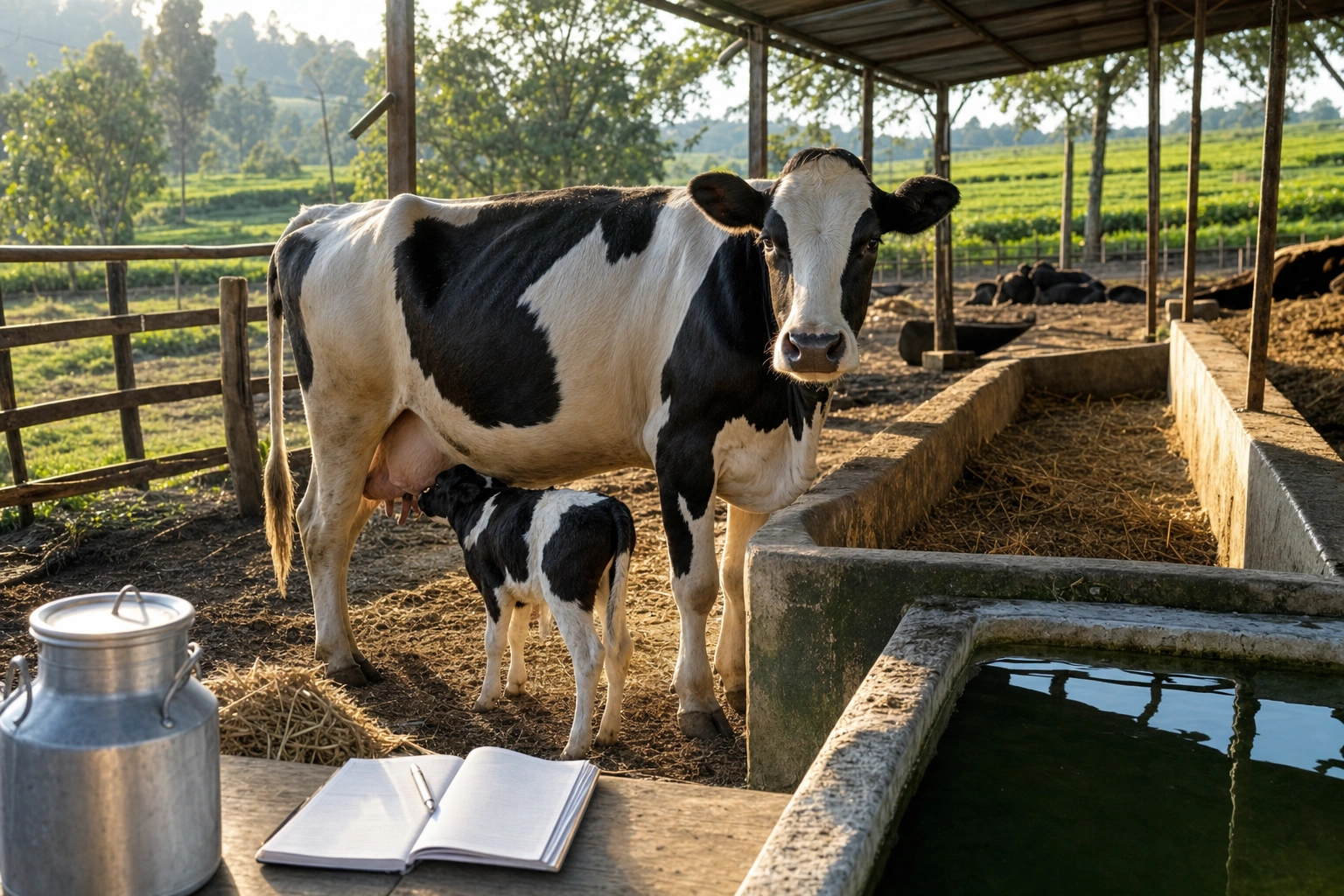
In a dairy enterprise, reproduction and milk production are closely connected. A cow normally begins or renews her productive cycle after calving, produces milk for several months, becomes pregnant again and eventually enters a dry period before the next calf is born. Managing these stages as one system helps a farmer maintain a healthy herd and a predictable milk supply.
Reproduction is not simply a matter of mating a cow. It involves raising heifers properly, recognising heat, choosing suitable breeding methods, supporting pregnancy, preparing for calving and caring for the cow and calf afterwards. Good decisions at each stage influence fertility, animal welfare, milk quality, replacement stock and the profitability of the farm.
How the dairy production cycle works
The dairy production cycle begins before a female animal produces milk. A heifer must grow steadily from birth until she is physically ready for breeding. After she is successfully bred and gives birth to her first calf, she becomes a lactating cow. Milk production is stimulated by calving, because the udder is prepared to nourish the newborn calf.
After calving, the cow enters lactation. Milk yield usually rises during the early weeks, reaches a peak and then gradually declines. The cow may be bred again during this lactation. If she conceives, the pregnancy continues while milk production proceeds. Later in the pregnancy, the cow is allowed a dry period so that the udder can recover and the unborn calf can develop without placing excessive demands on the animal.
The cycle can be viewed in these broad stages:
- Birth and calf rearing.
- Heifer growth and preparation for breeding.
- Heat detection and mating or artificial insemination.
- Pregnancy and care of the pregnant animal.
- Calving and the start of a new lactation.
- Early, peak and late lactation.
- The dry period and preparation for the next calving.
The exact timing varies with breed, nutrition, health, management and the individual animal. Farmers should use these stages as a management framework rather than a rigid timetable.
Stage 1: Raising the calf and heifer
Reproductive performance is influenced by how an animal is managed from birth. A weak or poorly nourished calf may grow slowly, suffer disease and reach breeding age late. In contrast, a healthy heifer with steady growth is more likely to calve at an appropriate age and become a productive member of the herd.
Immediately after birth, the calf should receive adequate colostrum as soon as possible. Colostrum is the first milk produced after calving and provides important antibodies and nutrients. The calf should also receive clean drinking water, suitable milk or milk replacer where used, and gradually introduced calf feed according to the farm system. The navel should be treated hygienically, and the calf should be observed for diarrhoea, pneumonia, weakness and difficulty suckling.
As the heifer grows, the aim is steady development rather than excessive fatness or stunting. Feeding should provide energy, protein, minerals, fibre and clean water. Regular health checks, vaccination programmes where recommended locally, parasite control and accurate identification help protect the future breeding animal.
Heifers should not be bred only because they have reached a certain age. Body size, body condition, breed characteristics and general health also matter. Breeding an undersized or poorly conditioned heifer can increase calving difficulties and reduce future performance. A livestock professional can help the farmer set suitable breeding targets for the breed and local environment.
Stage 2: The oestrous cycle and heat detection
A cow that is not pregnant normally experiences repeated oestrous cycles. The cycle is often around three weeks, although it can vary. During oestrus, commonly called heat, the cow is receptive to a bull or ready for artificial insemination at the appropriate time.
Heat detection is one of the most important practical skills in dairy farming. Signs may include standing to be mounted, mounting other animals, increased movement, restlessness, frequent calling, a swollen vulva, clear mucus discharge, reduced feeding or a temporary change in milk yield. The most dependable sign is usually a cow standing still while another animal mounts her.
Heat may be missed when cows are observed only once a day, when floors are slippery, when animals are kept in crowded conditions or when the cow has health or nutritional problems. Observation is often most useful during cooler periods, such as early morning and evening, when animals are more active. Farmers should record the date, animal identification and signs observed.
Some cows show weak or silent heats. This can occur after calving, especially when the cow is underfed, ill, losing excessive body condition or affected by a reproductive disorder. A cow that does not show heat for a long time should not simply be assumed to be infertile. A trained animal health professional may examine her and determine whether she is cycling, pregnant or experiencing a problem.
Stage 3: Breeding the cow
Breeding may take place through natural service, artificial insemination or a combination of methods. In natural service, a healthy, well-managed bull mates with cows in heat. The bull must be suitable for the herd, regularly assessed and managed safely. Keeping a bull also creates feeding, housing and disease-control responsibilities.
Artificial insemination allows a farmer to use semen from selected bulls without keeping a bull on the farm. It can support genetic improvement and reduce some risks associated with bull management, but it depends on accurate heat detection, proper semen handling and a skilled inseminator. Poor timing or careless handling can result in unsuccessful service.
The correct timing of insemination depends on when standing heat is first observed and on the advice of the inseminator. A common management principle is that insemination should occur after heat has been clearly identified rather than at an arbitrary time. Farmers should follow the protocol used by their veterinary or breeding service because semen type, local practice and the timing of observations can affect recommendations.
Before breeding, the cow should have adequate nutrition, clean water and a suitable body condition. Severe underfeeding, mineral deficiencies, disease, heat stress and difficult calving can all reduce conception. Good reproductive management therefore begins with the whole farm system, not with the insemination event alone.
Stage 4: Pregnancy management
Cattle pregnancy lasts approximately nine months, with normal variation between animals and breeds. A pregnancy diagnosis is valuable because it confirms whether breeding was successful and helps the farmer plan feeding, drying off and the expected calving date. Diagnosis may be carried out by a trained veterinarian or other qualified professional using an appropriate method.
Once pregnancy is confirmed, the animal should continue receiving a balanced ration. The ration should support the cow without causing excessive fatness. Good-quality forage, suitable concentrates where needed, minerals and clean water are important. Abrupt feed changes should be avoided, particularly in late pregnancy and around calving.
Pregnant cows also need safe housing, adequate lying space, shade or ventilation in hot conditions and careful handling. Vaccination, parasite control and disease prevention should follow advice suited to the local area. Near calving, the farmer should watch for udder development, relaxation around the tail head, enlargement of the vulva, restlessness and other signs of approaching labour.
Good records connect each breeding event to the expected calving period. If a cow was served but has not shown heat again, she may be pregnant, but this cannot be confirmed reliably from observation alone. A cow that repeatedly returns to heat may need examination for reproductive, nutritional or management problems.
Stage 5: Calving and the first days after birth
Calving is a high-risk transition for both cow and calf. The calving area should be clean, dry, quiet and easy to observe. The farmer should allow normal labour to progress but seek professional help when labour is prolonged, the cow is exhausted, the calf is positioned abnormally or there are other warning signs.
After calving, the calf should receive colostrum promptly and be checked for breathing, weakness and failure to suckle. The cow should be observed for retained foetal membranes, excessive bleeding, fever, severe weakness, inability to stand, poor appetite or signs of milk fever. These conditions require prompt attention from a veterinarian or qualified animal health provider.
The first milk after calving is colostrum, followed by transitional milk before the composition becomes more like ordinary saleable milk. Milk from a cow receiving veterinary treatment may need to be withheld for the required withdrawal period. Farmers must follow medicine instructions and avoid sending milk for sale when it is not legally or technically suitable.
Stage 6: Lactation and the return to breeding
Lactation commonly follows a curve rather than remaining constant. Milk production rises after calving, reaches a peak during early lactation and then declines gradually. The cow is also recovering from calving, producing milk and beginning to cycle again, so this period places heavy demands on her body.
During early lactation, feed intake may not immediately match the energy needed for milk production. Some loss of body condition can occur, but excessive loss is associated with poorer health and fertility. The farmer should provide high-quality forage, appropriate concentrates, minerals and water while monitoring appetite, manure, body condition and milk yield.
A voluntary waiting period is often used after calving before breeding begins. This gives the reproductive tract time to recover and allows the farmer to address illness or calving complications. The appropriate period depends on the farm system and professional advice. Breeding too early may reduce conception, while delaying breeding unnecessarily can lengthen the interval between calvings and reduce efficiency.
Common causes of poor fertility include failure to detect heat, inadequate nutrition, uterine infection, difficult calving, lameness, poor semen handling and incorrect insemination timing. The best response is to investigate the pattern rather than blame one factor. Records showing calving dates, heat observations, services, pregnancy results, illness and milk production can reveal where the problem lies.
Stage 7: The dry period
The dry period is the planned time when a pregnant cow is not milked before her next calving. It allows udder tissue to recover and supports preparation for the next lactation. It also gives the farmer an opportunity to manage udder health and adjust the cow's ration before calving.
Drying off should be planned rather than carried out casually. The farmer should consider the expected calving date, current milk yield, body condition and udder health. Milking routines, hygiene and any dry-cow treatment should follow veterinary guidance and the instructions for the specific product. Incorrect use of antibiotics can cause residue problems and contribute to antimicrobial resistance.
During the dry period, the cow still needs good-quality forage, minerals and clean water, but excessive energy intake should be avoided. In the final weeks before calving, management should prepare the cow gradually for the ration she will receive after calving. Sudden changes can increase digestive problems.
The dry cow should be monitored for mastitis, lameness, injury, loss of appetite and abnormal discharge. She should be moved to a clean calving area at the right time, with as little stress as possible. This preparation links the end of one production cycle to the beginning of the next.
Using records to improve the cycle
Simple records can turn daily observations into useful management decisions. For each breeding female, record the identification number, birth date, calving dates, heat dates, service dates, pregnancy diagnosis, illnesses, treatments, drying-off date and milk information where available.
These records help answer practical questions. Which cows have not shown heat after calving? Which animals return to heat after service? Which cows have long intervals between calving and conception? Are difficult calvings linked to particular sires, heifers or feeding conditions? Are milk yields falling because of nutrition, disease or late lactation?
Records are most useful when updated immediately and reviewed regularly. A notebook, wall calendar, spreadsheet or farm-management application can work, provided information is accurate and easy to retrieve. The system should be simple enough to use consistently.
Applying This in Practice
- Identify every animal clearly. Use ear tags or another reliable identification method and keep the same identity in all records.
- Observe cows deliberately. Check for heat, illness, changes in appetite, lameness and abnormal discharge at suitable times each day.
- Prepare before breeding. Review body condition, health, feeding, heat history and the suitability of the bull or insemination plan.
- Confirm pregnancy. Do not rely only on the absence of heat; arrange pregnancy diagnosis through a qualified professional.
- Plan for calving. Note expected calving dates, prepare a clean area and know which signs require urgent assistance.
- Protect the transition period. Give special attention to the cow from several weeks before calving through the first weeks of lactation.
- Review performance regularly. Use breeding and milk records to identify repeat problems and seek technical advice early.
Key Takeaways
- Reproduction and milk production form one connected cycle, beginning with heifer growth and continuing through breeding, calving, lactation and the dry period.
- Steady nutrition, disease prevention and good calf care support future fertility and productivity.
- Accurate heat detection is essential for well-timed natural service or artificial insemination.
- Pregnancy diagnosis and breeding records help farmers plan feeding, drying off and calving management.
- The weeks around calving require close observation because both the cow and calf face increased health risks.
- A planned dry period allows the udder and cow to prepare for the next lactation.
- Simple, consistent records help reveal reproductive problems and improve decisions on the farm.
No comments yet.