
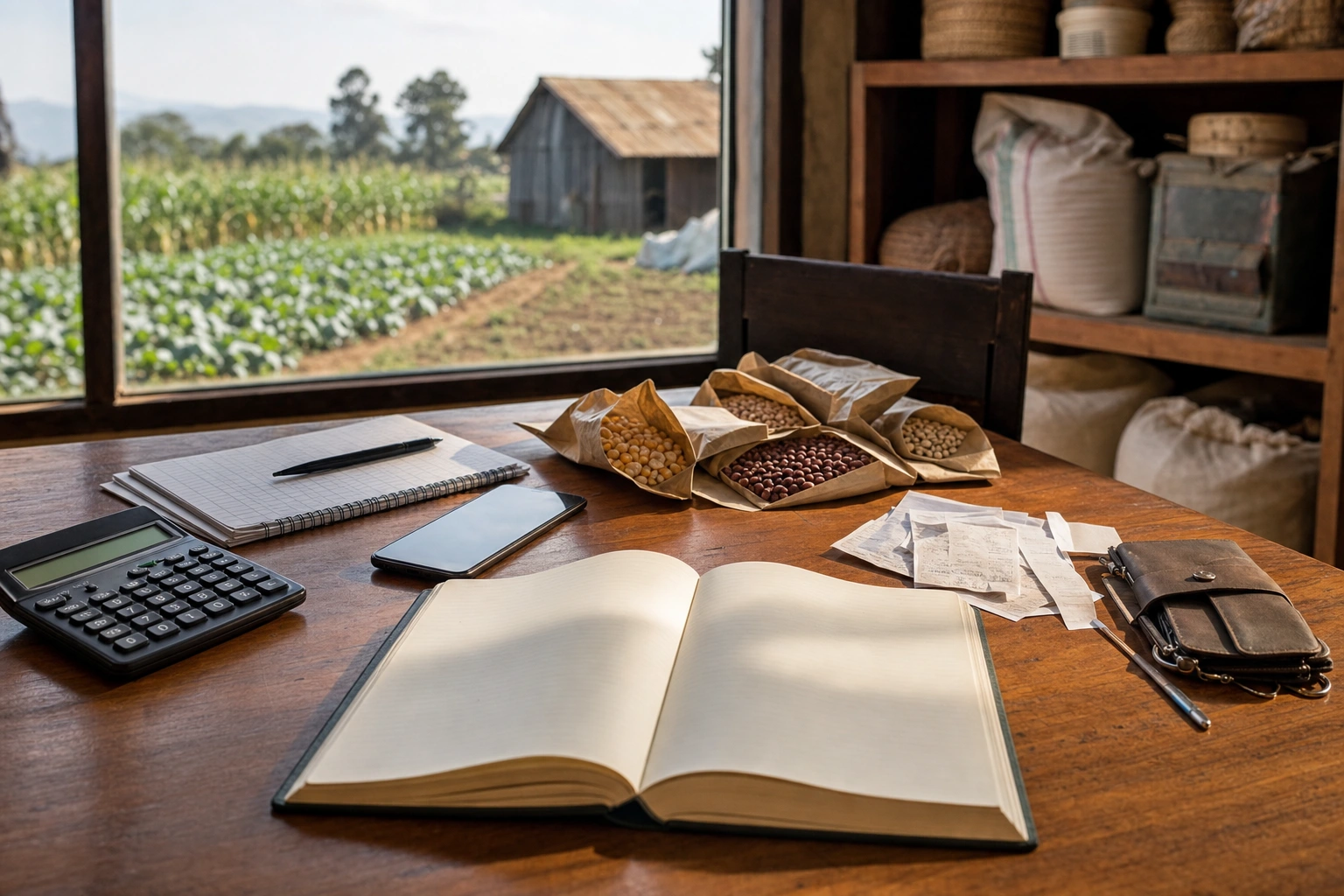
Farming can generate strong returns, but it also involves financial uncertainty that is greater than in many other businesses. A farmer may invest in seed, fertiliser, labour, machinery and land preparation months before knowing the selling price or the size of the harvest. Weather conditions, pests, diseases, transport problems and changing market demand can all affect the final result.
Managing financial risk in agriculture does not mean trying to eliminate every uncertainty. That is rarely possible. It means understanding what could go wrong, estimating the potential effect, preparing practical responses and making decisions that protect the farm’s ability to continue operating. The same principles apply to a smallholder farmer, a commercial farm, a cooperative, a food processor or an agricultural entrepreneur.
What Financial Risk Means in Agriculture
Financial risk is the possibility that an event or decision will reduce income, increase costs, damage assets or make it difficult to meet financial obligations. In agriculture, risk often comes from several sources at the same time.
- Production risk: Crops may fail or livestock may perform poorly because of drought, excessive rain, pests, disease, poor-quality inputs or mistakes in farm management.
- Price or market risk: The price received for produce may fall, or the price of feed, fertiliser, fuel and other inputs may rise.
- Financial risk: Loans, interest payments and supplier credit can place pressure on cash flow, especially when income is seasonal.
- Operational risk: Equipment breakdowns, labour shortages, theft, fire, poor storage or transport delays may interrupt production or sales.
- Institutional and relationship risk: Changes in regulations, unreliable buyers, unclear contracts or disputes within a partnership or cooperative may create losses.
These risks are connected. For example, a dry season may reduce maize yields, lower household income and make it harder to repay a loan. If the farmer then sells immediately after harvest because of cash pressure, the sale may occur when prices are weak. Good risk management considers this chain of effects rather than treating each problem in isolation.
Start with a Farm Risk Assessment
A useful risk assessment begins with a clear picture of the farm’s activities and financial commitments. List the main enterprises, such as maize, vegetables, dairy cattle, poultry, coffee, fish or agricultural trading. For each enterprise, identify the resources invested, the timing of costs, the expected income and the events that could disrupt the plan.
A simple risk register can make this process practical. Create columns for the risk, its likelihood, its possible financial impact, early warning signs and the planned response. For instance:
- Risk: Heavy rainfall damages a vegetable crop.
- Likelihood: Moderate, based on local seasonal experience.
- Impact: High, because the crop requires substantial purchased inputs.
- Warning signs: Blocked drainage, waterlogged soil or weather forecasts indicating prolonged rain.
- Response: Improve drainage, stagger planting, use suitable varieties and avoid putting the entire vegetable budget into one field.
This exercise helps separate serious risks from minor inconveniences. A risk is especially important when it is both likely and financially damaging. However, a low-probability event with a severe effect, such as a major fire or loss of breeding livestock, also deserves attention.
Understand the Farm’s Cash Flow
Profit and cash are not the same thing. A farm may appear profitable over a full season but still lack money to pay workers, buy feed or service a loan at a particular time. Cash-flow planning shows when money is expected to enter and leave the business.
Prepare a monthly or seasonal cash-flow budget that includes:
- Opening cash balance;
- Expected sales from each enterprise;
- Input purchases, wages, transport and repairs;
- Loan repayments, interest and other fixed commitments;
- Household withdrawals, where farm and household finances are connected; and
- Closing cash balance.
Use realistic assumptions rather than ideal outcomes. It is helpful to prepare at least three scenarios: an expected case, a difficult case and a stronger-than-expected case. In the difficult case, test what would happen if yields fell, prices weakened or input costs increased. The purpose is not to predict the future precisely, but to identify when cash shortages could occur and what actions would reduce the pressure.
For example, a dairy farmer in Kenya might receive regular milk income but face a sharp increase in feed costs during a dry period. A cash-flow budget could show whether the business can manage the increase, whether fodder should be conserved earlier, or whether the number of animals needs to be adjusted before the shortage becomes severe.
Control Production Risk
Production risk can be reduced through sound technical and management practices. The exact measures depend on the enterprise, but the underlying principle is to avoid relying on one fragile assumption.
Use appropriate production plans
Choose crops, livestock breeds and production methods that fit the local climate, soil, water availability, labour capacity and market. A high-value enterprise may look attractive on paper but become financially dangerous if it requires skills, equipment or water that the farm cannot reliably provide.
Protect soil, water and livestock health
Soil improvement, water conservation, good sanitation, vaccination where appropriate, biosecurity and timely pest monitoring can reduce avoidable losses. These measures may require spending, but they should be assessed against the likely cost of a major failure. Preventive action is often more manageable than emergency spending after damage has occurred.
Keep reliable records
Record planting dates, input quantities, treatments, labour, yields, animal performance, sales and losses. Records help identify which enterprises are genuinely performing well. They also make it easier to compare seasons and detect problems early. Without records, farmers may continue investing in an enterprise because it feels familiar, even when it is consistently consuming more cash than it generates.
Diversify Carefully
Diversification means spreading income or investment across enterprises, markets or production periods. A mixed farm may combine crops with livestock, while an agribusiness may serve several buyers or offer grading, storage or processing services.
Diversification can reduce dependence on one source of income. If one crop performs poorly, another enterprise may still generate cash. Different enterprises can also use farm resources at different times. For example, poultry may provide more frequent sales while an orchard or coffee enterprise takes longer to produce income.
However, diversification is not automatically safe. It can increase complexity, working-capital needs and management demands. Starting several unfamiliar enterprises at once may create more risk rather than less. Before diversifying, ask:
- Do we have the skills and labour required?
- Will the enterprise compete for land, water or cash with existing activities?
- Is there a dependable market and a clear route to the buyer?
- How long will it take to generate income?
- What is the maximum affordable loss if the trial fails?
A phased approach is often sensible. Test a new enterprise on a manageable scale, keep separate records and expand only after reviewing the results.
Manage Price and Market Risk
Many farmers face uncertainty about the price they will receive. Market risk can be managed by improving information, timing sales and strengthening bargaining power.
Monitor prices in relevant local and regional markets, but do not focus on price alone. Compare the net return after transport, grading, storage, commissions, packaging and spoilage. A buyer offering a higher gross price may provide a lower net return if the produce must travel much farther or meet costly specifications.
Consider several marketing options where available:
- Staggering production or sales to avoid placing all produce on the market at once;
- Improving grading, packaging and quality consistency;
- Using safe storage when the product can be stored without excessive losses;
- Negotiating clear supply agreements with buyers;
- Working through a credible cooperative or producer group; and
- Adding value through processing, such as cleaning, drying, milling or packaging, when the extra cost and market demand justify it.
Contracts can clarify quantity, quality, delivery dates, payment terms and price arrangements. Read them carefully and understand what happens if production falls short or the buyer delays payment. A written agreement does not remove all risk, but it can reduce misunderstandings and improve planning.
Use Insurance and Other Risk-Transfer Tools
Some risks are better transferred than absorbed by the farm. Agricultural insurance may cover specified losses related to crops, livestock, assets or other events, depending on the product and policy terms. Before purchasing cover, examine the insured risks, exclusions, excesses, claim procedures, waiting periods and payment conditions. Do not assume that every type of loss is covered.
Insurance should complement, not replace, good farm management. A policy cannot compensate for poor records, unsuitable production choices or inadequate maintenance. Keep purchase receipts, production records, photographs where useful and other documents required by the insurer.
Other forms of risk transfer include equipment maintenance agreements, transport arrangements, supply contracts and carefully negotiated partnerships. When using credit, compare the total cost of borrowing, repayment schedule, security requirements and consequences of late payment. Borrowing for an income-generating asset may be reasonable, but borrowing to cover repeated operating losses requires a deeper review of the business model.
Protect Working Capital and Build Reserves
Working capital is the money available for day-to-day operations. Farms need enough liquidity to purchase inputs, pay labour and respond to unexpected repairs before the next major sale. A reserve can prevent a temporary problem from becoming a forced sale of livestock, land or equipment.
Set a target reserve based on the farm’s seasonal obligations and the risks it faces. Keep business money separate from personal spending as far as possible. A separate account, simple cashbook or mobile-money record can improve visibility and reduce accidental use of operating funds.
Also review inventory carefully. Excessive stocks of feed, fertiliser or packaging tie up cash and may deteriorate. Too little stock can cause production delays or force emergency purchases at unfavourable prices. The right level depends on storage conditions, supplier reliability and the timing of the production cycle.
Make Investment Decisions with Numbers
Before buying machinery, expanding a herd, leasing more land or constructing a facility, estimate the full financial effect. Include the purchase price, installation, maintenance, fuel, labour, depreciation, insurance and the cost of finance. Compare the investment with alternatives such as hiring equipment, sharing machinery or outsourcing a service.
Ask how the investment performs under different conditions. If a new irrigation system only makes sense when yields and prices are high, it may expose the business to excessive risk. A more modest investment with lower fixed costs may be safer, even if its potential return is smaller.
Use a break-even calculation where possible. Break-even analysis estimates the quantity or price needed to cover costs. For example, if a poultry enterprise has fixed costs and a known margin per bird, the farmer can estimate the number of birds that must be sold before the enterprise begins generating a surplus. This does not guarantee success, but it provides a clear reference point for planning.
Applying This in Practice
- List the main risks. Consider production, market, cash flow, credit, equipment, labour, storage and personal or partnership risks.
- Measure exposure. Estimate how much money, income or productive capacity could be lost from each major risk.
- Prioritise. Address risks that are both financially serious and reasonably manageable.
- Choose a response. Prevent the risk, reduce its effect, transfer it through insurance or contracts, or accept it deliberately when the cost of protection is too high.
- Set warning indicators. Track rainfall, animal health, input prices, buyer payments, stock levels and cash balances.
- Review regularly. Update the plan after each production cycle, major purchase, loan decision or significant change in the market.
For a small farm, this process may fit on a few pages. For a larger agribusiness, it may involve budgets by enterprise, approval limits for spending, documented procedures and regular financial reporting. The scale can change, but the discipline remains the same: make risks visible before they become emergencies.
Key Takeaways
- Identify production, market, financial and operational risks before committing money.
- Use cash-flow budgets to match seasonal income with costs, loan repayments and household withdrawals.
- Reduce production losses through suitable enterprises, preventive management and accurate records.
- Diversify gradually and only where the farm has the skills, resources and market access to manage the new activity.
- Compare net returns, not just selling prices, and use contracts or cooperatives where they improve market certainty.
- Protect major exposures with appropriate insurance, reserves, maintenance and carefully assessed borrowing.
No comments yet.