
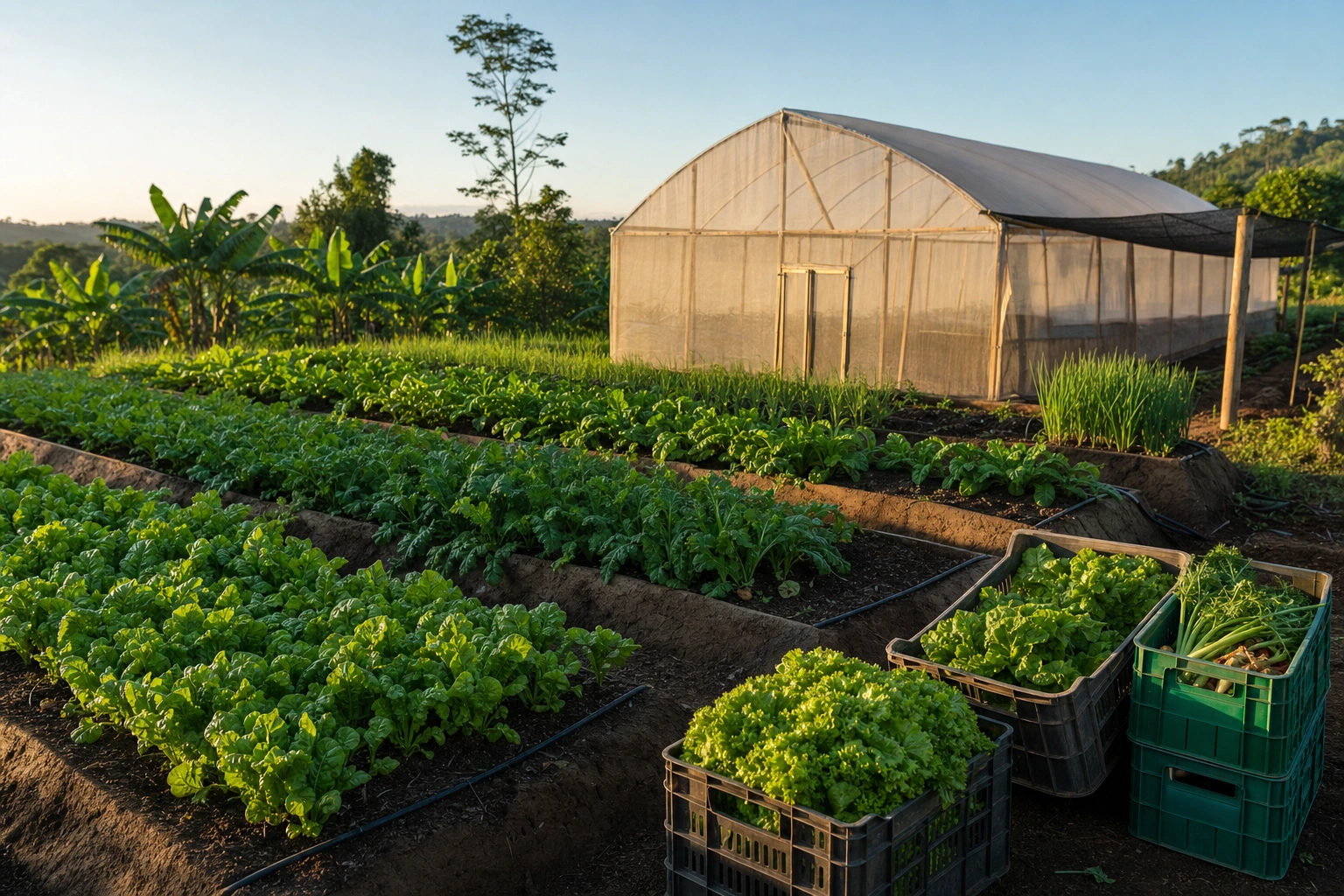
Vegetable production is more than planting seeds and waiting for a harvest. It is a coordinated system in which the grower manages crops, soil or another growing medium, water, nutrients, pests, labour, timing and markets. The best system depends on the crop, climate, available resources, production scale and the quality that customers expect.
A smallholder supplying a local market, an urban grower producing sukuma wiki, and a commercial farm supplying supermarkets may all use different methods. However, the underlying logic is similar: select a suitable crop and variety, establish healthy plants, provide the right growing conditions, protect the crop, harvest at the correct stage and handle the produce carefully after harvest.
What is a vegetable production system?
A vegetable production system is the complete set of methods and resources used to produce vegetables from planning to sale or consumption. It includes the physical production environment as well as management decisions.
The main parts of a system are:
- Production environment: open field, greenhouse, shade house, tunnel, container, raised bed or soilless unit.
- Crop and variety: the vegetable selected, its growth habit, maturity period and suitability to the local climate and market.
- Water and nutrition: irrigation, soil fertility, fertilisers, organic matter and, where relevant, nutrient solutions.
- Crop protection: prevention and control of weeds, insect pests, diseases and other problems.
- Labour and equipment: tools, irrigation components, structures, transport and skilled workers.
- Post-harvest management: harvesting, sorting, grading, cooling, packaging, storage and marketing.
Thinking in systems helps a grower identify connections. For example, poor drainage can weaken roots, weakened roots can reduce nutrient uptake, and nutrient-stressed plants may be more vulnerable to pests and diseases. Solving only the visible symptom may not solve the underlying problem.
Major types of vegetable production systems
Open-field production
Open-field production takes place directly in the soil without a permanent protective structure. It is widely used for crops such as kale, cabbage, onions, carrots, beans, spinach and many indigenous vegetables. Crops may be planted on flat ground, ridges, beds or mounds, depending on soil, drainage and irrigation needs.
Its main advantages are relatively low structural cost, the ability to cultivate larger areas and the use of natural sunlight and rainfall. Its limitations include exposure to heavy rain, drought, wind, temperature extremes, pests and diseases. Production schedules can also be affected by changing weather.
Good field management begins with a suitable site. The grower should assess soil texture, drainage, previous crops, water access and the risk of contamination. A soil test, where available, can guide decisions about acidity and nutrients. Crop rotation is useful because repeatedly growing related crops in the same place can encourage the build-up of certain pests and diseases and can increase pressure on particular nutrients.
Protected production
Protected production uses structures such as greenhouses, tunnels, shade houses or insect-proof net houses to modify the crop environment. Protection can reduce the impact of rain, wind, excessive sunlight or some insect pests. It may also extend the production season and improve uniformity when the structure is properly designed and managed.
A greenhouse does not automatically guarantee high yields. It requires ventilation, appropriate spacing, reliable irrigation, sanitation and careful monitoring of temperature, humidity, pests and diseases. A closed or poorly ventilated structure can create conditions that favour disease or excessive heat. The cost of construction, repairs and management must be compared with the expected market return.
Protected systems are often used for tomatoes, peppers, cucumbers, herbs, leafy vegetables and seedlings. Net houses may be useful where insect exclusion is important, while a shade structure may suit crops that are sensitive to intense sunlight. The choice should follow the production problem rather than the appearance of the structure.
Container, sack and raised-bed production
Container and sack systems are suited to small spaces, household gardens, schools, institutions and urban or peri-urban production. Vegetables can be grown in bags, buckets, boxes, troughs or raised beds using soil, compost and other growing materials. Leafy vegetables, herbs, onions, strawberries and some compact varieties are commonly adapted to limited spaces.
The growing container must have adequate drainage, enough volume for the crop and a stable position. A container that holds too little growing medium may dry out quickly and restrict roots. A container without drainage can become waterlogged, causing root damage. Because the growing volume is limited, nutrients and water may need more frequent attention than in a field.
Urban growers should consider the safety of water, soil amendments and containers. Materials that may have contained chemicals, oils or other contaminants should not be used for food production. Compost and manure should be well processed, and produce should be washed using safe water before consumption or sale.
Soilless and hydroponic systems
In soilless production, plants grow without field soil. Their roots may be supported by materials such as coco coir, perlite, gravel or other suitable media, while nutrients are supplied through water. In hydroponic systems, the nutrient solution may flow past the roots, circulate through channels or be delivered to individual plants.
These systems can use space efficiently and allow the grower to manage water and nutrients precisely. They may be valuable where land is limited or soil-borne problems are difficult to control. However, they require technical knowledge, reliable water, suitable fertiliser formulations, monitoring equipment and dependable power where pumps are involved. A mistake in the nutrient solution, irrigation schedule or water quality can affect many plants quickly.
Soilless production is therefore not simply a cheaper or easier alternative to soil. It changes the type of management required. Instead of focusing mainly on soil structure and field fertility, the grower must closely manage water quality, nutrient concentration, root-zone conditions, hygiene and equipment.
How a vegetable production system operates
1. Plan around the market and the production environment
Production should begin with a market and resource assessment. Identify who will buy the vegetables, the preferred size and quality, expected volumes, delivery days and likely price conditions. A crop that grows well but has no reliable buyer may still produce a poor business result.
Next, assess land, water, labour, tools, capital and technical skills. Consider whether the site is accessible during wet weather, whether irrigation water is safe and sufficient, and whether fencing or security is needed. In Kenya, for example, a grower near an urban market may benefit from frequent harvests of leafy vegetables, while a producer farther from the market may need crops with better storage or transport characteristics.
2. Select suitable crops and varieties
Crop selection should match climate, altitude, soil, water availability, disease pressure, production period and customer demand. Varieties differ in maturity time, yield potential, fruit or leaf characteristics, tolerance to particular conditions and suitability for transport.
Use clean, viable seed or healthy planting material from a dependable source. Seed quality affects germination, plant population and uniformity. Keep records of the variety, seed source, planting date and batch where possible. This information helps the grower compare results and investigate problems.
3. Establish a healthy crop
Some vegetables are sown directly into the field, while others are raised in a nursery and transplanted. Nursery production can make it easier to manage young plants, save seed and establish a more uniform crop. Seedlings need clean media, appropriate moisture, adequate light, protection from damaging pests and gradual hardening before transplanting.
Before planting, prepare the soil or growing medium to provide good root contact, drainage and aeration. Incorporate suitable organic matter where it is safe and properly prepared. Avoid working very wet soil, because this can damage its structure. Plan spacing according to the crop's mature size, airflow needs and harvesting method rather than simply trying to fit in the maximum number of plants.
4. Manage water and nutrients
Water management aims to supply enough moisture without prolonged waterlogging or unnecessary waste. Drip irrigation can deliver water near the root zone, while watering cans, sprinklers and furrows may be suitable in other situations. The appropriate method depends on crop needs, soil, scale, water availability and budget.
Monitor the crop and soil rather than irrigating by habit alone. Young plants and shallow-rooted crops may require more frequent attention, while overwatering can encourage root diseases and leach nutrients. Mulches can help reduce evaporation, suppress weeds and limit soil splash, provided they are clean and appropriately used.
Nutrients can come from soil reserves, compost, manure, mineral fertilisers or combinations of these. The correct approach depends on soil test results, crop demand and the quality of the nutrient source. Too little nutrition limits growth, while excessive fertiliser can waste money, damage plants, increase salinity or contribute to environmental pollution. A balanced nutrient plan is more useful than applying a large quantity of one fertiliser without diagnosis.
5. Prevent and manage pests, diseases and weeds
Integrated pest management, or IPM, combines prevention, monitoring and carefully selected control measures. It does not mean waiting until a crop is severely damaged before taking action. Prevention may include crop rotation, resistant varieties where available, clean planting material, field sanitation, appropriate spacing, insect netting and removal of badly affected plant material.
Inspect crops regularly and record what is observed. Look at the underside of leaves, growing points, stems, roots and nearby weeds. Distinguish between insect damage, disease symptoms, nutrient disorders, water stress and physical injury. Similar symptoms can have different causes, so diagnosis should come before treatment.
Weed control is important because weeds compete for water, light and nutrients and may provide shelter for pests. Hand weeding, shallow cultivation, mulching and timely planting can all help. If a pesticide is necessary, use a product legally approved for the intended crop and pest, follow the label, observe the pre-harvest interval and use appropriate protective equipment. Pesticides should not be applied according to guesswork or used at stronger concentrations simply because damage is visible.
6. Harvest and handle produce carefully
Harvest timing affects taste, texture, appearance, shelf life and price. Leafy vegetables are often harvested when leaves are tender and marketable. Tomatoes, beans, cucumbers and peppers may be harvested at different stages depending on whether they will be sold nearby or transported over a longer distance.
Harvest during the cooler part of the day where practical, use clean tools and avoid dropping or compressing produce. Sort out damaged, diseased or over-mature items. Keep harvested vegetables shaded and move them to the buyer promptly. Clean crates or suitable containers generally protect produce better than overfilled sacks, especially for delicate vegetables.
Post-harvest losses often begin with bruising, heat, contamination or delayed transport. A grower should therefore include harvesting labour, packaging, transport and market coordination in the production plan from the beginning.
Choosing the right system
No production system is best in every situation. Compare systems using a simple set of questions:
- Does the system suit the local climate and crop?
- Is adequate, safe water available throughout the production period?
- Can the grower afford construction, inputs, repairs and labour?
- What skills are needed to operate and troubleshoot the system?
- Will the expected market price justify the production and post-harvest costs?
- How will pests, diseases, waste and environmental impacts be managed?
- What happens if rainfall fails, power is interrupted or the market price falls?
Starting with a manageable area or pilot unit can reduce risk. A grower can compare varieties, irrigation methods or production structures before expanding. Expansion should follow evidence from records, not enthusiasm alone.
Applying this in practice
- Choose one target market: identify the customer, preferred crop, quality requirements and delivery schedule.
- Map available resources: measure the production area and confirm water, labour, tools, capital and transport.
- Select a suitable system: compare open field, protected, container or soilless options against the actual production problem.
- Prepare a crop calendar: include seed purchase, nursery work, planting, irrigation, scouting, feeding, harvesting and marketing.
- Set up records: record input costs, labour, weather, irrigation, pest observations, harvest quantities, rejected produce and sales.
- Review each cycle: calculate the cost per production unit, identify the main losses and adjust the next crop plan.
A basic record can reveal issues that are otherwise easy to miss. If harvests are low, the cause may be poor germination, overcrowding, water interruptions, pest damage, weak market timing or post-harvest loss. Separating these factors helps the grower choose a practical response.
Conclusion
Vegetable production systems work by linking biological processes with management decisions. Healthy crops require more than fertile soil or a modern structure: they need suitable varieties, reliable water, balanced nutrition, prevention-focused crop protection, careful harvesting and a realistic route to market.
The most effective system is the one that fits the grower's environment, skills, finances and customers. By planning before planting, monitoring throughout the crop cycle and learning from reliable records, growers can improve productivity, reduce avoidable losses and make better decisions about when and how to invest in vegetable production.
No comments yet.