
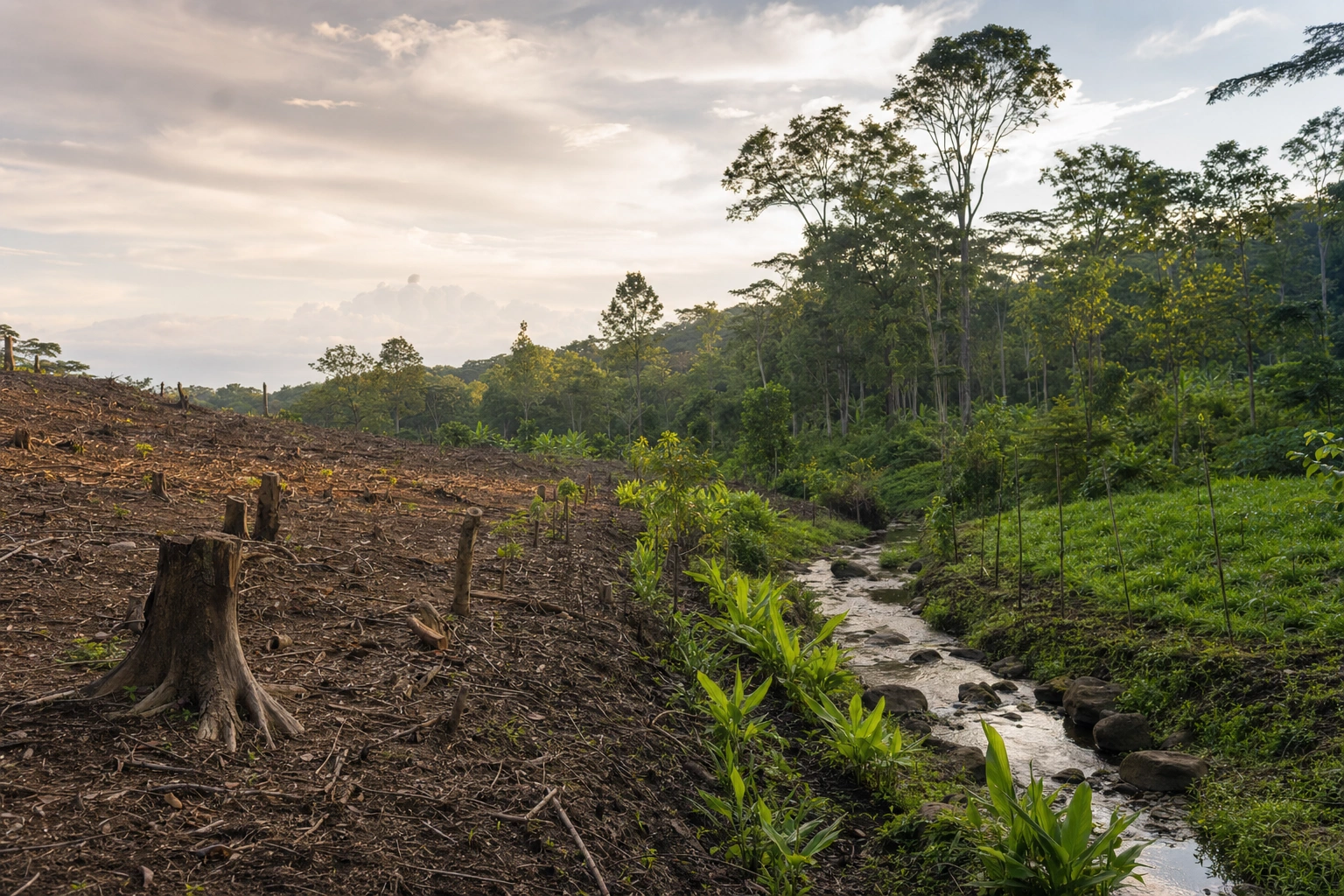
Natural resources support nearly every part of human life. Food depends on fertile soil, clean water and pollinators; homes and businesses use timber, minerals and energy; communities rely on rivers, forests, rangelands and coastal ecosystems for income and protection. These resources may appear abundant, but their availability is not unlimited. When extraction or use happens faster than nature can recover, overexploitation gradually depletes the resource.
Overexploitation is not simply the act of using a resource. Responsible use can support livelihoods and economic development. The problem begins when consumption exceeds the resource’s regeneration rate, when extraction damages the wider ecosystem, or when access is so poorly managed that users have strong incentives to take as much as possible before somebody else does. Understanding this process is essential for farmers, businesses, policymakers, households and communities seeking long-term security.
What overexploitation means
A natural resource is overexploited when it is harvested, extracted or consumed at a rate that reduces its ability to renew itself or perform its ecological functions. Renewable resources, such as forests, fish, groundwater and grasslands, can recover under suitable conditions, but only within limits. Non-renewable resources, such as many mineral deposits and fossil fuels, do not regenerate on a human timescale, so every unit removed reduces the remaining stock.
The key distinction is between use and unsustainable use. A community may harvest firewood from a woodland without destroying it if cutting remains below natural regrowth and damaged areas are allowed to recover. However, repeated cutting of young trees, clearance of entire areas or harvesting during drought can reduce future growth. The same principle applies to fishing, grazing, groundwater pumping and mineral extraction.
Overexploitation can be visible, such as a forest becoming bare, or gradual, such as groundwater levels falling over many years. It can also be hidden by technology. More powerful fishing equipment, deeper boreholes or improved mining machinery may increase short-term production while concealing the decline of the underlying resource.
How overexploitation depletes resources
Harvesting faster than regeneration
Many renewable resources have a natural growth cycle. Trees need time to mature, fish populations need breeding adults, and grazing land needs vegetation and adequate rest. If extraction consistently exceeds regeneration, the stock becomes smaller. Once the breeding population, seed sources or healthy vegetation cover falls below a critical level, recovery may become slow or difficult.
For example, a fishery may remain productive for years while boats gradually catch more fish than the population replaces. As larger breeding fish become scarce, the remaining stock may contain mostly younger or smaller individuals. Catch levels then fall, even though fishing effort and operating costs increase.
Removing the most valuable parts first
Resource depletion is often accelerated by selective extraction. Loggers may target mature trees with valuable timber, miners may remove high-grade ore, and hunters may target large animals. Removing the most commercially valuable individuals can alter the structure and quality of the remaining resource. In forests, for instance, the loss of mature trees can reduce seed production and habitat complexity. In wildlife populations, removing breeding adults can affect reproduction and social behaviour.
Damaging the supporting ecosystem
A resource does not exist in isolation. Fish depend on clean water, wetlands and breeding grounds. Crops depend on soil organisms, water and pollinators. Livestock depend on pasture that can recover after grazing. When extraction damages these supporting systems, depletion becomes more severe.
Mining may clear vegetation, disturb soil and introduce sediment into rivers. Poorly managed farming can expose soil to erosion, while excessive grazing can remove plant cover and compact the ground. Destruction of mangroves, wetlands or riverbanks can reduce natural protection against floods and weaken habitats that support fisheries. In each case, the immediate resource loss is linked to wider ecological damage.
Creating a cycle of declining productivity
Once a resource begins to decline, users may try to compensate by increasing effort. A farmer may cultivate land more intensively, a fisher may spend longer at sea, or a household may collect firewood from increasingly distant areas. This can produce short-term income or supply, but it may intensify the original problem.
This cycle is especially serious where people have few alternatives. A rural household that depends on charcoal sales may continue cutting trees even when local woodland is visibly declining because it needs immediate income. The activity may be individually understandable while collectively damaging. Effective management therefore needs both resource rules and realistic livelihood alternatives.
Major examples of overexploitation
Forests and woodland
Forests provide timber, fuel, fruits, medicines, shade, wildlife habitat and water-regulation services. Overexploitation occurs when trees are cut faster than they regenerate or when clearing removes the ecological conditions needed for regrowth. Uncontrolled fuelwood harvesting, illegal logging, agricultural expansion and poorly planned infrastructure can all contribute.
The effects include loss of biodiversity, soil erosion, reduced water infiltration and greater exposure to floods or drought. Communities may also spend more time collecting fuel and water as nearby supplies decline. Sustainable forestry requires decisions about which trees may be harvested, when cutting can occur, how regeneration will be protected and how benefits will be shared.
Water resources
Groundwater is particularly vulnerable because its decline may not be immediately visible. If wells and boreholes withdraw water faster than rainfall and natural seepage recharge underground aquifers, water levels fall. Users may respond by drilling deeper or installing stronger pumps, increasing costs and potentially affecting nearby users.
Excessive withdrawal can reduce river flows, dry wetlands and increase competition between households, farms, industries and ecosystems. Pollution can make the problem worse: although water may still be physically present, contamination reduces the amount that is safe or affordable to use. Water management therefore involves both controlling abstraction and protecting recharge areas and water quality.
Soil and agricultural land
Soil is often treated as a permanent asset, yet fertile topsoil can take a long time to form. Continuous cultivation without restoring nutrients, overgrazing, cultivation on unsuitable slopes and poor irrigation practices can cause erosion, compaction, nutrient depletion and salinity.
At first, farmers may maintain production by applying more inputs or cultivating additional land. Over time, however, declining soil structure reduces water retention and increases vulnerability to dry periods and heavy rainfall. Practices such as crop rotation, mulching, agroforestry, terracing where appropriate and controlled grazing can help protect the productive base.
Fisheries and wildlife
Overfishing removes aquatic animals faster than populations can reproduce. Harmful practices may also damage breeding grounds or capture non-target species. The result can be smaller catches, reduced household nutrition, loss of employment and weakened coastal economies.
Wildlife overexploitation includes illegal hunting, excessive harvesting of wild plants and the capture of animals for trade. Beyond reducing populations, it can disrupt food webs and remove species that perform important ecological roles. Strong enforcement matters, but so do community participation, fair access to benefits and viable alternatives to illegal harvesting.
Minerals and fossil fuels
Minerals and fossil fuels are finite on a human timescale. Their extraction does not merely reduce the remaining deposit; it can also disturb landscapes, consume water, generate waste and affect nearby communities. The depletion challenge is therefore both geological and environmental.
Mining can deliver important materials and employment, but responsible management requires careful site assessment, safe waste handling, rehabilitation planning and monitoring. A project that produces revenue while leaving unusable land, polluted water or unsafe infrastructure transfers costs to future communities.
Why overexploitation happens
Population growth and rising consumption can increase demand, but they are not the only causes. Poverty, insecure land rights, weak enforcement, corruption, inadequate information and unequal access may all encourage unsustainable use. Markets can also reward rapid extraction while failing to reflect environmental damage in the price of a product.
Open-access resources are especially vulnerable. If nobody has clear responsibility for a forest, grazing area, fishery or aquifer, each user may have an incentive to take as much as possible. This is sometimes described as a shared-resource problem. It does not mean that shared resources must be mismanaged; communities can create effective rules, monitoring systems and sanctions when they have recognised rights and meaningful decision-making power.
Short-term decision-making is another factor. A business under financial pressure may prioritise immediate production. A household facing food insecurity may harvest immature fish or cultivate a fragile slope. Sustainable management must acknowledge these pressures rather than assuming that information alone will change behaviour.
Consequences for people, economies and ecosystems
The first consequence is often reduced availability. Water sources become less reliable, fuel becomes harder to collect, catches become smaller, or farm yields decline. These changes raise costs and can reduce income, especially for people whose livelihoods depend directly on local resources.
Depletion can also increase inequality. Wealthier users may afford deeper boreholes, larger boats, alternative fuels or access to distant markets, while poorer households remain dependent on degraded local resources. Competition may intensify between farmers and pastoralists, upstream and downstream users, or local communities and commercial operators.
Ecosystem services may decline even before a resource disappears. Forests that are heavily degraded may still contain trees but provide less water regulation and habitat. A wetland may still hold water but filter pollution less effectively. Soil may still produce crops but require more fertiliser and irrigation. These losses can reduce resilience to droughts, floods, disease and price changes.
Depletion also creates intergenerational costs. Decisions made today can leave future users with fewer choices, higher restoration expenses and more conflict over access. Sustainable management is therefore not about preventing all use; it is about maintaining the resource base and the ecological functions on which future use depends.
Principles of sustainable natural resource management
Measure the resource and set limits
Management begins with reliable information: how much water is available, how quickly trees are regenerating, how many fish are reproducing, or how much soil is being lost. Where information is uncertain, managers can use precautionary limits and adjust them as evidence improves.
Match extraction to regeneration
Harvest levels should reflect seasonal and local conditions. A rule that is safe during a wet period may be damaging during drought. Rotational grazing, closed fishing seasons, selective harvesting and groundwater abstraction limits are examples of ways to allow recovery.
Protect the ecosystem around the resource
Resource management should include habitats, catchments, riverbanks, wetlands, soils and breeding grounds. Protecting only the extraction point is rarely enough. Land-use planning, erosion control, pollution prevention and habitat restoration can strengthen the resource’s capacity to recover.
Make rules fair and enforceable
Rules work better when users understand them, help shape them and see that enforcement is consistent. Local knowledge can identify seasonal patterns and practical solutions. Monitoring may combine community observation, inspections, records and appropriate technology. Penalties should be clear, proportionate and applied fairly.
Reduce waste and improve efficiency
Using resources more efficiently reduces pressure without necessarily reducing the benefits people receive. Examples include repairing leaks, improving irrigation, reducing post-harvest food loss, using energy-efficient equipment, recycling materials and designing products for longer use. Efficiency is most effective when it complements, rather than replaces, extraction limits.
Support alternative livelihoods and restoration
People are more likely to follow conservation rules when they can meet essential needs through dependable alternatives. Sustainable enterprises, improved agricultural practices, renewable energy options, skills development and fair market access can reduce pressure on vulnerable resources. Restoration may include replanting indigenous vegetation, rebuilding soil, protecting wetlands or rehabilitating mined land, but restoration is usually slower and more expensive than prevention.
Applying This in Practice
Individuals, enterprises and community organisations can use a simple resource-management process:
- Identify the resource. Specify what is being used, who depends on it and whether it is renewable or finite.
- Track use and condition. Record quantities, seasons, costs, quality changes and signs of decline. A farmer might monitor soil cover and water use; a small business might measure material waste and energy consumption.
- Find the pressure points. Ask whether the main problem is excessive demand, inefficient equipment, pollution, weak access rules, habitat damage or lack of alternatives.
- Set a practical limit or target. This could be a reduced water-use level, a protected grazing period, a no-cut zone, a waste-reduction target or a purchasing standard that favours responsibly produced materials.
- Assign responsibility. Decide who records information, checks compliance, maintains equipment and responds when conditions change.
- Review and adapt. Compare results with the original target. If the resource continues to decline, reduce pressure or strengthen protection rather than waiting for complete failure.
Consider a small food-processing enterprise in Kenya that uses water for washing produce. Its managers could map where water enters and leaves the operation, repair leaks, reuse suitable rinse water, protect nearby drainage channels and monitor monthly consumption. The same approach applies at household level: reducing waste, choosing durable products and avoiding unnecessary demand can support wider resource-management efforts, especially when many users act consistently.
Good decisions also require asking who benefits and who carries the cost. A project may appear efficient while shifting pollution or access restrictions onto neighbouring communities. Including affected users in planning can reveal risks that a purely financial assessment misses.
Key Takeaways
- Overexploitation occurs when resource use exceeds regeneration or causes damage to the ecosystem that supports renewal.
- Forests, groundwater, soil, fisheries, wildlife and minerals can all be depleted, although each requires different management responses.
- Depletion often develops gradually through repeated extraction, selective harvesting, habitat damage and short-term decision-making.
- Resource decline can reduce livelihoods, increase inequality, weaken ecosystem services and transfer costs to future generations.
- Sustainable management combines measurement, extraction limits, ecosystem protection, fair rules, monitoring and adaptation.
- Efficiency, waste reduction, alternative livelihoods and restoration can reduce pressure, but preventing depletion is usually more effective than repairing severe damage.
No comments yet.