
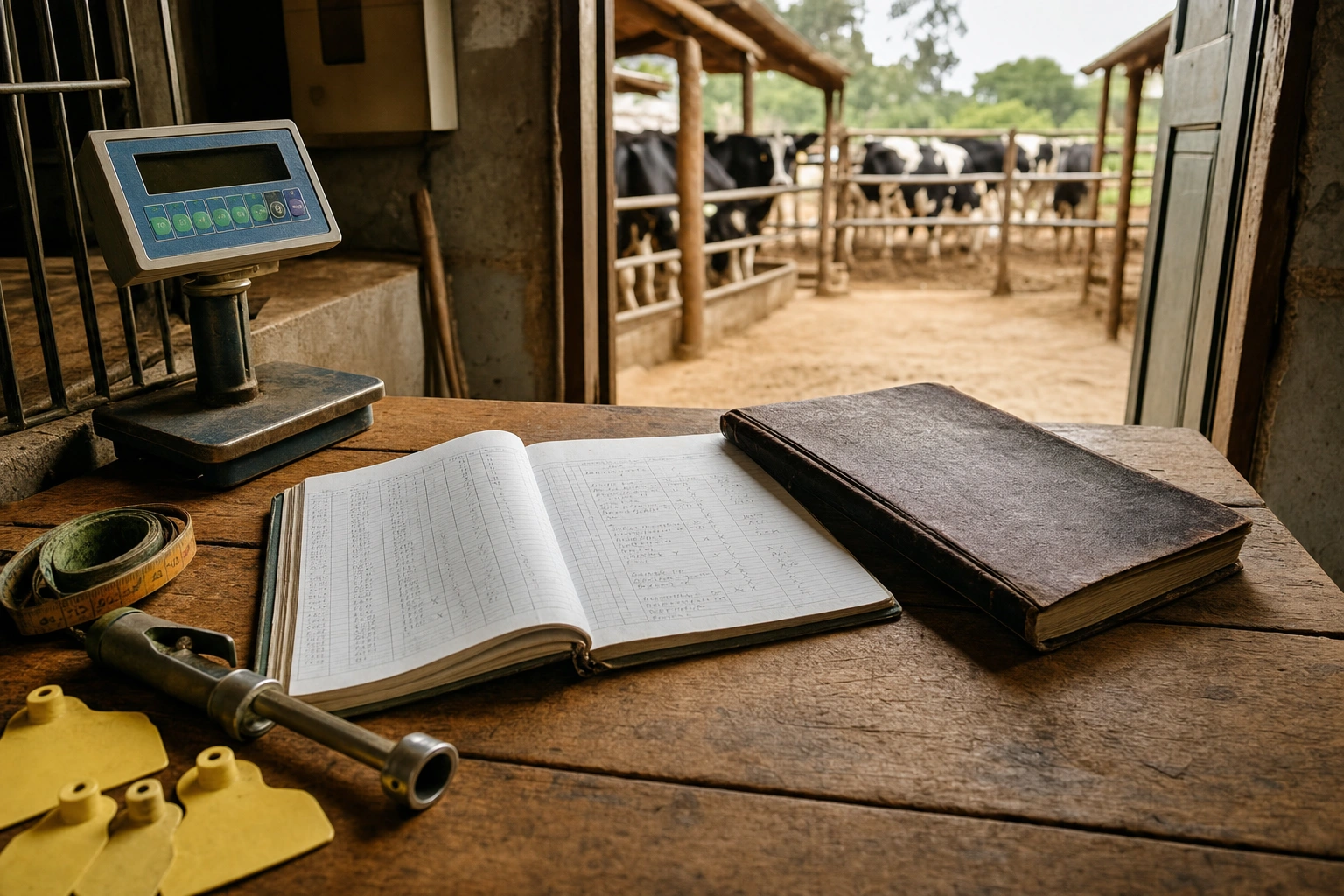
Livestock farming involves hundreds of decisions: which animals to breed, when to vaccinate, how much feed to buy, whether a treatment is working, and when an animal should be sold or replaced. Without reliable records, these decisions are often based on memory, habit or guesswork. Records provide a clearer basis for action.
Livestock records do not need to be complicated or expensive. A smallholder keeping dairy cattle, goats, sheep, pigs or poultry can begin with a notebook, while a larger enterprise may use spreadsheets or farm-management software. The important point is consistency: information should be recorded at the right time, stored safely and reviewed regularly.
What Livestock Records Are
Livestock records are organised notes about animals, farm activities, inputs, outputs and financial transactions. They may describe an individual animal, a group of animals or the whole farm. Useful records connect an event to a date, an animal or group, the action taken and the result observed.
For example, a breeding record might show that a dairy cow identified as C014 was served on 12 March, by which bull or method, and whether she later became pregnant. A health record might show the symptoms observed, treatment given, dosage, withdrawal period and recovery. A financial record might show how much was spent on feed and how much income came from milk or livestock sales.
The purpose is not simply to collect information. The purpose is to make better decisions. A record becomes valuable when it helps the farmer answer a question such as:
- Which animals are producing well enough to justify their feed costs?
- Which animals repeatedly become sick?
- Is the current breeding programme producing healthy young stock?
- How much money is the enterprise actually making?
- When should feed, medicine or replacement animals be purchased?
Main Types of Livestock Records
1. Identification and ownership records
Each animal or group should be identifiable. Identification may use ear tags, brands, photographs, names, wing bands, tattoos or simple group codes, depending on the species and farm system. The method should be safe, durable and easy to read.
An identification register can include the animal's identification number, species, breed or type, sex, colour or distinguishing features, date of birth or purchase, source and current status. For poultry or fish, individual identification may not be practical, so records can be kept by flock, batch or production unit.
Clear identification prevents records from being assigned to the wrong animal. It also helps with tracing an animal's history when making breeding, health or sale decisions.
2. Breeding and reproduction records
Breeding records track events such as heat detection, mating or artificial insemination, pregnancy checks, expected birth dates, actual births, abortions and weaning. They may also record the sire, dam, litter size and condition of offspring.
These records help farmers evaluate reproductive performance. If a cow is served repeatedly without becoming pregnant, or a sow regularly produces small litters, the pattern should prompt investigation. Possible causes may include nutrition, disease, poor heat detection, unsuitable breeding stock or management problems. Records do not diagnose the cause on their own, but they reveal where attention is needed.
Accurate dates also improve planning. Knowing when animals are likely to give birth allows the farmer to prepare housing, monitor them more closely and arrange feed or assistance if necessary.
3. Production records
Production records measure outputs such as milk yield, egg numbers, egg weight, live-weight gain, wool, honey or the number of marketable animals produced. The measurement may be daily, weekly or at another practical interval.
For a dairy enterprise, a simple record might include the cow's identification, morning and evening milk quantities, total daily yield and any unusual change. For layers, a flock record may track eggs collected, broken eggs, mortality and feed used. For meat animals, periodic weights can show whether animals are growing at the expected rate.
Production records make it easier to distinguish a temporary change from a persistent pattern. A single low milk reading may follow stress, illness or a change in routine. Several low readings may indicate a more serious management or health issue.
4. Feeding and input records
Feed is often one of the largest operating costs in livestock farming. Feed records can include the type and quantity of feed offered, the number of animals fed, changes in ration, purchased feed prices and wastage.
Keeping these records helps the farmer compare input use with production. If feed consumption rises while milk, eggs or weight gain remains unchanged, the ration, animal health, feed quality or feeding method may need review. Records also help with budgeting and stock control. A farmer who knows the approximate rate of feed use can plan purchases before supplies run out.
Other useful input records cover water provision, mineral supplements, bedding, breeding services, equipment and labour. Recording these costs gives a more realistic picture of enterprise performance.
5. Health and treatment records
Health records should document illness, injury, vaccination, deworming, diagnosis where available, treatment, dosage, date and outcome. They should also include the name of the person who administered treatment when several people work on the farm.
These records support early recognition of repeated problems. For example, if young goats frequently develop diarrhoea after being moved to a particular pen, the farmer can investigate hygiene, feed changes, water quality or overcrowding. If several animals become ill within a short period, the records provide useful information for a veterinarian or animal-health professional.
Treatment records are also important for food safety. Medicines may have withdrawal periods during which milk, meat or eggs should not enter the food chain. Recording the treatment date and withdrawal instructions helps prevent accidental sale of affected products. Farmers should follow the label and professional guidance rather than relying on memory.
6. Sales, purchases and financial records
Financial records show where money enters and leaves the enterprise. Sales may include milk, eggs, animals, manure, wool or breeding services. Expenses may include feed, medicines, transport, labour, equipment, water, breeding fees and repairs.
Each transaction should ideally include the date, item, quantity, price, buyer or supplier and payment status. Separating farm money from household or personal spending makes the results easier to interpret.
A farmer may appear to have strong sales but little cash available because buyers have not paid, expenses were underestimated or money was withdrawn for unrelated purposes. Financial records reveal these differences and support more realistic planning.
How Records Improve Farm Decisions
Choosing animals for breeding
Breeding decisions should consider more than appearance or size. Records can show an animal's reproductive history, growth, health, mothering ability and production. A dairy farmer, for instance, may choose replacement heifers from healthy cows with consistent production and reliable reproductive performance, rather than selecting solely by colour or body size.
Records also help identify animals that should not be used extensively for breeding. Repeated infertility, poor growth, recurring disease or serious structural problems may indicate that an animal is unsuitable for producing replacements. Professional advice is valuable when making important breeding decisions.
Managing feeding
Farmers can compare feed use with production and body condition. If animals are losing condition, producing less or growing slowly, the ration and feeding routine require attention. If animals receive more feed than necessary without a corresponding improvement, the enterprise may be wasting money.
For example, a goat farmer in a semi-arid area may record the amount of purchased concentrate used during the dry season alongside body condition and weight changes. The information can help determine whether to adjust the ration, improve forage storage or reduce herd numbers before feed costs become unmanageable.
Planning animal health
Health records support preventive management rather than only emergency treatment. A calendar based on previous vaccination, parasite or disease events can help organise routine checks. Records may also show that particular housing areas, age groups or seasons are associated with greater health problems.
They do not replace veterinary diagnosis. Instead, they make professional consultations more efficient by providing a timeline and evidence of what has already been done.
Deciding when to sell or replace animals
An animal may be consuming resources without producing enough income, but this can be difficult to judge from memory. Production, health and financial records allow the farmer to assess the animal over time.
Replacement decisions should consider the whole enterprise. A low-producing animal may still have breeding value, while a high-producing animal with repeated health problems may create treatment and management costs. Farmers should consider welfare, market conditions and advice from qualified professionals when deciding whether to sell.
Preparing budgets and managing risk
Past records provide a starting point for future budgets. A farmer can estimate likely feed needs, medicine costs, breeding expenses and expected sales using actual farm experience. The records can also show seasonal pressure points, such as months when forage is scarce or milk production falls.
This supports practical risk management. The farmer may decide to conserve fodder, keep an emergency fund, diversify species or schedule sales at suitable times. No record can remove uncertainty, but good records make uncertainty easier to manage.
Turning Records into Useful Information
Recording information is only the first step. The next step is reviewing it at a regular time, such as every week for production and health records and every month for finances. During the review, look for trends, unusual changes and relationships between inputs and outputs.
Simple calculations can be useful:
- Average production: total milk, eggs or weight gain divided by the number of recording days or animals.
- Mortality rate: number of animals that died divided by the number at risk, expressed as a percentage when appropriate.
- Cost per unit: total relevant cost divided by litres of milk, trays of eggs, kilograms gained or animals sold.
- Pregnancy or conception rate: successful pregnancies divided by animals served, using a clearly defined period.
- Net cash position: money received minus money paid during the selected period.
These measures must be interpreted carefully. A change may result from weather, feed quality, disease, animal age, market prices or a recording error. Compare similar periods and similar groups where possible. Avoid making a major decision from one isolated number.
Building a Record-Keeping System
- List the decisions that matter most. Start with breeding, health, production or finances rather than trying to record everything at once.
- Choose a practical format. Use a waterproof notebook, printed forms, a spreadsheet or an application. The best system is one that the people doing the work can use accurately.
- Create simple fields. Include date, animal or group identification, event, quantity, cost and outcome where relevant.
- Record events immediately. Delayed recording increases the risk of forgotten dates, incorrect quantities and mixed-up animal identities.
- Assign responsibility. Everyone involved should know who records treatments, production, births, deaths, purchases and sales.
- Review and correct. Check entries regularly for missing information or obvious errors. Do not erase important history; correct it in a way that leaves a clear note.
- Use the findings. At the end of each review period, identify one or two decisions that the records support and note what happens afterwards.
Digital tools can make sorting and calculations easier, but they introduce new responsibilities. Back up files, protect passwords and keep a paper or offline alternative if electricity or internet access is unreliable. A simple system that remains available is often more useful than an advanced system that is rarely updated.
Common Record-Keeping Mistakes
One common mistake is recording only sales while ignoring costs. This can make an enterprise look more profitable than it is. Another is keeping records without animal identification, which makes it difficult to link production or treatment to a specific animal.
Inconsistent units can also cause confusion. Decide whether feed will be recorded in kilograms, bags or another unit, and use the same approach throughout. Dates should be written in a clear format. Estimates should be labelled as estimates rather than presented as exact figures.
Farmers sometimes collect too much information and then stop because the system becomes burdensome. Begin with a few important records, make the routine manageable and expand only when the basic system is working. Records should support farm work, not prevent essential animal care.
Applying This in Practice
Imagine a small dairy farm with six cows. The farmer begins by assigning each cow an identification code and records calving dates, service dates, daily milk yield, illness, treatment, feed purchases and milk sales. Each week, the farmer checks for falling yields, missed breeding opportunities and unusual health events. Each month, the farmer compares milk income with feed, medicine and transport costs.
After several months, the records may show that one cow produces consistently well, another has repeated fertility problems and a third experiences a fall in yield whenever her health condition changes. The farmer can then seek advice, adjust management, plan replacement decisions and prepare a more accurate budget. The value comes not from the notebook itself, but from the decisions made using the information.
When reviewing your own farm records, ask:
- Can every animal or production group be identified reliably?
- Which records are missing when an important decision must be made?
- What has changed compared with the previous week, month or season?
- Which input costs are rising without improving production?
- What evidence supports the next breeding, treatment, feeding or sales decision?
Key Takeaways
- Record dates, animal identification, actions, quantities and outcomes consistently.
- Use breeding and production records to select animals and plan replacements more carefully.
- Compare feed, health and other input costs with production rather than judging performance by sales alone.
- Keep treatment records, including withdrawal information, to support animal care and food safety.
- Review records regularly for trends, unusual changes and repeated problems.
- Start with a simple system that farmers can maintain accurately, then expand it as needs grow.
No comments yet.