
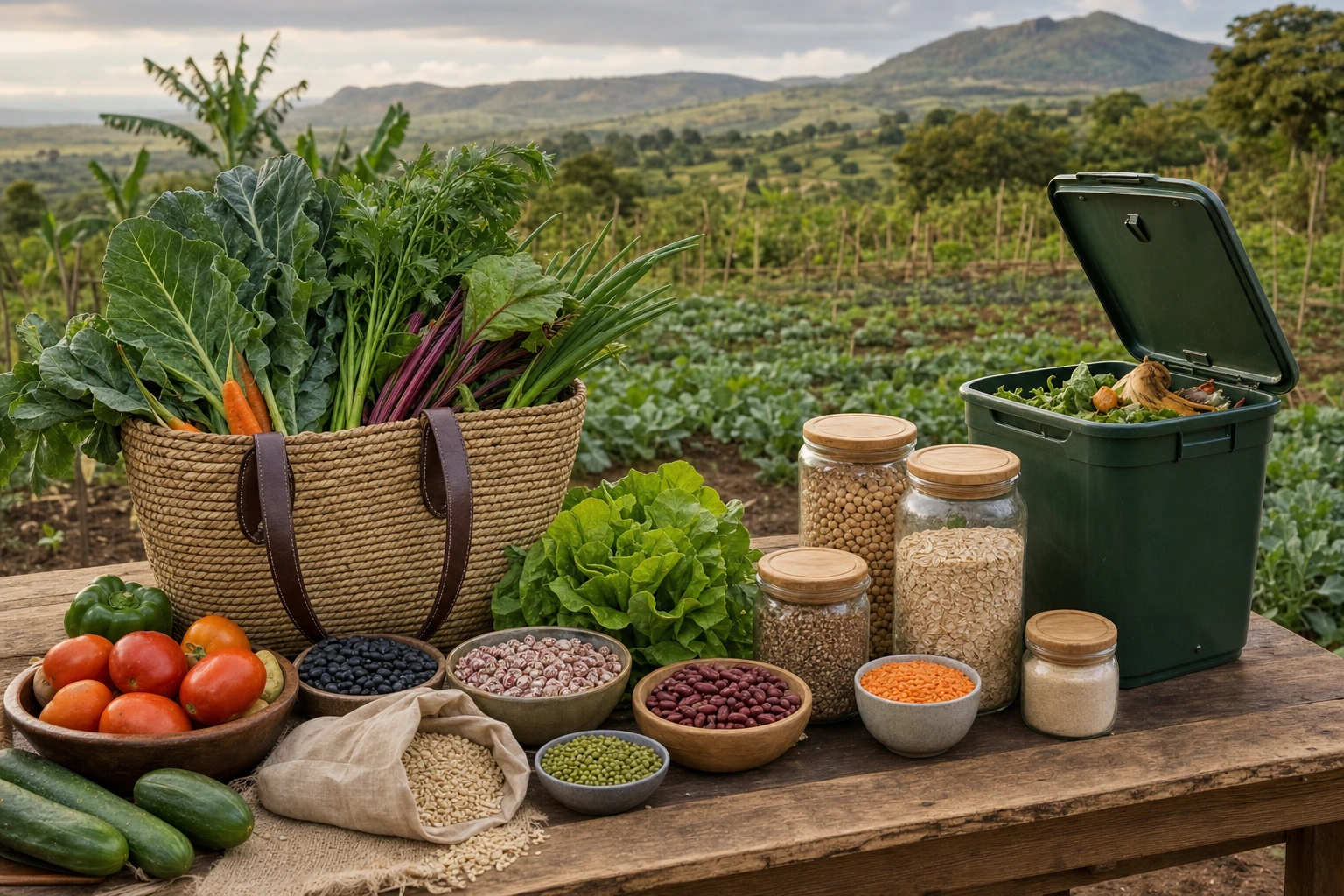
Food choices are personal, but their effects extend far beyond the plate. What we eat influences how land is used, how much water and energy are required, which farming systems remain viable, and how much waste enters the environment. These effects occur across the entire food chain, from growing crops and raising animals to processing, transport, storage, cooking and disposal.
Eating sustainably does not mean following one rigid diet or buying only expensive products. It means understanding the main environmental pressures associated with food and making realistic choices that reduce avoidable harm. For a household in Nairobi, Kisumu or London, this may involve different foods and priorities, but the underlying questions are similar: How was the food produced? How much of it will be eaten? Can more of it be sourced locally, seasonally or responsibly?
How a Food’s Environmental Impact Is Created
A food’s environmental footprint is not determined by one factor. It is the combined result of several stages in its life cycle.
Production on farms and in fisheries
Farming requires land, water, seed, fertiliser, animal feed, energy and labour. Livestock production may also involve grazing land and feed crops. Fisheries depend on healthy aquatic ecosystems, fuel for boats and responsible management of fish populations. The methods used matter: well-managed grazing, agroforestry, efficient irrigation and soil-conserving practices can produce different outcomes from intensive land clearing, soil degradation or poorly managed water use.
Processing and packaging
Some foods are eaten almost as they are harvested, while others undergo milling, refining, freezing, drying, cooking or extensive manufacturing. Processing can increase shelf life and reduce spoilage, but it also uses energy and materials. Packaging protects food from damage and contamination, yet single-use packaging can create pollution when collection and recycling systems are limited.
Transport, refrigeration and retail
Food may travel from a farm to a collection centre, processor, warehouse, shop and finally a household. Refrigeration can be essential for safety and quality, particularly for meat, dairy, fish and fresh produce. Transport is part of the footprint, but it is not always the largest part. The production method, type of food, distance, transport mode, storage and whether the food is wasted all need to be considered together.
Cooking and disposal
Energy used at home or in restaurants contributes to the impact of a meal. In some settings, cooking with efficient appliances can reduce pressure on fuel resources. At the other end of the chain, food that is thrown away represents wasted land, water, labour, energy and money. If discarded food decomposes without enough oxygen, it can produce methane, a powerful greenhouse gas. Preventing waste is therefore one of the most direct ways to make food consumption more sustainable.
Why Food Choices Affect Climate Change
Food systems contribute to climate change through emissions released during farming, land conversion, energy use, processing, transport and waste management. Different foods have different patterns of impact.
Ruminant livestock such as cattle and goats produce methane during digestion. Raising animals can also require pasture or feed crops, while manure management and land-use change create additional pressures. This does not mean that all livestock systems are identical. In some dry regions, well-managed grazing can make use of land that is not suitable for growing crops and can support livelihoods. However, high demand combined with poor land management can contribute to deforestation, overgrazing and soil loss.
Plant foods usually require fewer resources than many animal products, but the phrase “plant-based” does not automatically mean “environmentally harmless”. Crops can be grown with excessive fertiliser, irrigation or pesticide use, and some agricultural expansion can damage forests, wetlands or grasslands. The responsible question is not simply whether a food comes from a plant or animal, but how it was produced and what alternatives are available.
Reducing reliance on foods with particularly high environmental pressures, while eating a varied diet rich in beans, peas, lentils, vegetables, fruits, grains, nuts and other locally suitable foods, can lower the impact of meals. For many people, reducing the frequency and portion size of certain animal products may be more realistic than trying to remove every product at once.
Land Use, Soil and Biodiversity
Food production is one of the main ways people use land. When forests, wetlands or natural grasslands are converted into farms or pasture, habitats can be lost and ecosystems can become fragmented. This affects wild plants and animals, pollinators, soil organisms and the natural processes that support food production.
Agriculture can also either protect or weaken soil. Repeated cultivation without restoration may reduce organic matter, increase erosion and lower the soil’s ability to hold water. Practices such as crop rotation, mulching, composting, agroforestry, cover crops and reduced soil disturbance can support soil health when adapted to local conditions. These approaches are not identical or equally suitable everywhere, so farmers need to match them to rainfall, soil type, crops, labour and available resources.
Consumers influence land use through demand. Choosing a variety of foods rather than relying heavily on a narrow group of products can support more diverse farming systems. Buying seasonal produce from local growers may also help, although “local” alone is not a guarantee of sustainability. A local crop grown with severe water stress or damaging practices may have greater environmental concerns than a responsibly produced food from farther away.
Water Use and Pollution
Food requires water for crops, livestock, processing and cleaning. Water use becomes especially important in areas where rainfall is unreliable or communities compete for limited supplies. Irrigated crops can provide valuable food and income, but inefficient irrigation may waste water, while heavy abstraction can reduce the water available for households, rivers and ecosystems.
Food production can also affect water quality. Fertilisers and animal waste may run into rivers and lakes, carrying nutrients that encourage excessive plant and algae growth. Pesticides can harm aquatic organisms when they are misused or washed into waterways. Better soil management, careful application of inputs, buffer vegetation near streams and responsible waste handling can reduce these risks.
Consumers do not need to calculate the exact water footprint of every meal. Practical decisions include avoiding unnecessary food waste, supporting producers who use water responsibly, and being thoughtful about foods that are grown in water-stressed regions. The most sustainable choice can vary by place and season, so local knowledge is valuable.
Packaging, Convenience and Food Waste
Packaging has legitimate purposes. It can prevent bruising, extend shelf life, protect food from contamination and make distribution possible. For example, strong packaging may prevent more waste than a lightly packaged product that is damaged before it reaches the customer. The environmental question is therefore not simply whether packaging exists, but whether its materials, quantity, design and disposal system are appropriate.
People can reduce packaging impacts by buying suitable quantities, choosing refillable or reusable options where safe and available, carrying reusable shopping bags, and selecting products with less unnecessary wrapping. Businesses can contribute by redesigning packaging, offering refill systems and improving collection or recovery arrangements.
Food waste often begins with over-purchasing, poor storage, confusing date labels, oversized portions or low demand for imperfect produce. Households can plan meals, check existing supplies before shopping, store food correctly, freeze suitable items and use leftovers creatively. Restaurants and caterers can monitor portions, improve stock control and provide responsible options for unavoidable surplus where food safety permits.
Eating Sustainably Without Losing Nutritional Balance
Sustainability should support health rather than replace it. A lower-impact diet still needs enough energy, protein, fibre, vitamins and minerals. Beans, lentils, peas, whole grains, vegetables, fruits, nuts and seeds can contribute to varied meals, while animal-source foods may provide important nutrients for some people. Individual needs differ according to age, health, activity, income, culture and access to food.
Traditional and locally adapted foods can offer useful lessons. In many African communities, meals based on grains, legumes, vegetables, leafy greens, fruits and modest amounts of animal products can be both nutritious and resource-conscious. Examples might include ugali with beans and sukuma wiki, millet or sorghum dishes, vegetable stews, or meals using locally available pulses. The goal is not to label one cuisine as perfect, but to recognise that affordable, familiar foods can often be part of sustainable eating.
Affordability matters. Recommendations that ignore income, refrigeration, cooking fuel, time and market access are unlikely to work. A sustainable choice is one that a person can maintain without compromising food security. Buying in season, cooking larger batches, sharing surplus and selecting less processed staples may reduce both environmental pressure and household costs, but these options should be adapted to each family’s circumstances.
Local, Seasonal and Responsibly Produced Food
Buying local and seasonal food can have several advantages. It may shorten supply chains, strengthen local farmers and reduce the need for long storage or energy-intensive cultivation. It can also make it easier to understand where food comes from and how it was produced. However, local food is not automatically better in every environmental category, and imported food is not automatically worse.
Seasonality affects resource use and quality. A food grown naturally during a region’s rainy or cooler season may need fewer artificial inputs than the same food produced out of season. For consumers, the practical approach is to ask vendors, farmers or cooperatives what is currently abundant and to build meals around those foods.
Responsible sourcing also applies to fish, timber-related products and agricultural commodities. Where credible information is available, consumers and businesses can favour suppliers who demonstrate good land management, fair handling of natural resources and transparent production practices. When such information is not available, reducing waste and choosing diverse, less resource-intensive meals remain useful actions.
Applying This in Practice
Use the following process to turn environmental awareness into ordinary food decisions:
- Review your current pattern. For one week, notice which foods are frequently wasted, heavily packaged, rarely eaten or bought in quantities that exceed your needs. Avoid judgement; the purpose is to identify opportunities.
- Choose one high-impact change. This might be replacing one or two meat-heavy meals each week with a meal based on beans or lentils, serving more seasonal vegetables, or reducing a product that your household regularly throws away.
- Plan before shopping. Check cupboards and the refrigerator, write a realistic list and estimate the number of meals required. Include a plan for leftovers rather than treating them as accidental extras.
- Compare the whole option. Consider production, seasonality, packaging, storage, price, nutrition and likely waste. A slightly more expensive product is not necessarily more sustainable if it spoils before use; a cheap product is not a good choice if it encourages over-consumption.
- Improve storage and preparation. Keep foods in suitable containers, understand which items need refrigeration, cook appropriate portions and use edible parts where safe. These small operational decisions often prevent avoidable waste.
- Build a routine that fits your context. Households, schools, offices, hotels and restaurants can set simple measures such as buying in season, offering varied portions, separating organic waste where facilities exist and reviewing purchasing records regularly.
Businesses can extend these actions through menu design, supplier standards, stock rotation, staff training and accurate monitoring of discarded food. A café in Mombasa, a school kitchen in Eldoret and a corporate canteen in Johannesburg will face different supply and waste challenges, but each can examine what is purchased, what is served and what remains uneaten.
Key Takeaways
- Food affects the environment across its full life cycle, from production and processing to cooking and disposal.
- Reducing avoidable food waste saves the land, water, energy, labour and money used to produce that food.
- Eating a varied diet with more suitable plant foods can reduce environmental pressure while supporting nutritional balance.
- Production methods, seasonality and local environmental conditions matter more than simple labels such as “local” or “natural”.
- Choose practical changes that fit your income, health needs, culture, access to food and available storage or cooking facilities.
- Households and businesses can improve sustainability through meal planning, responsible purchasing, better storage and portion control.
No comments yet.