
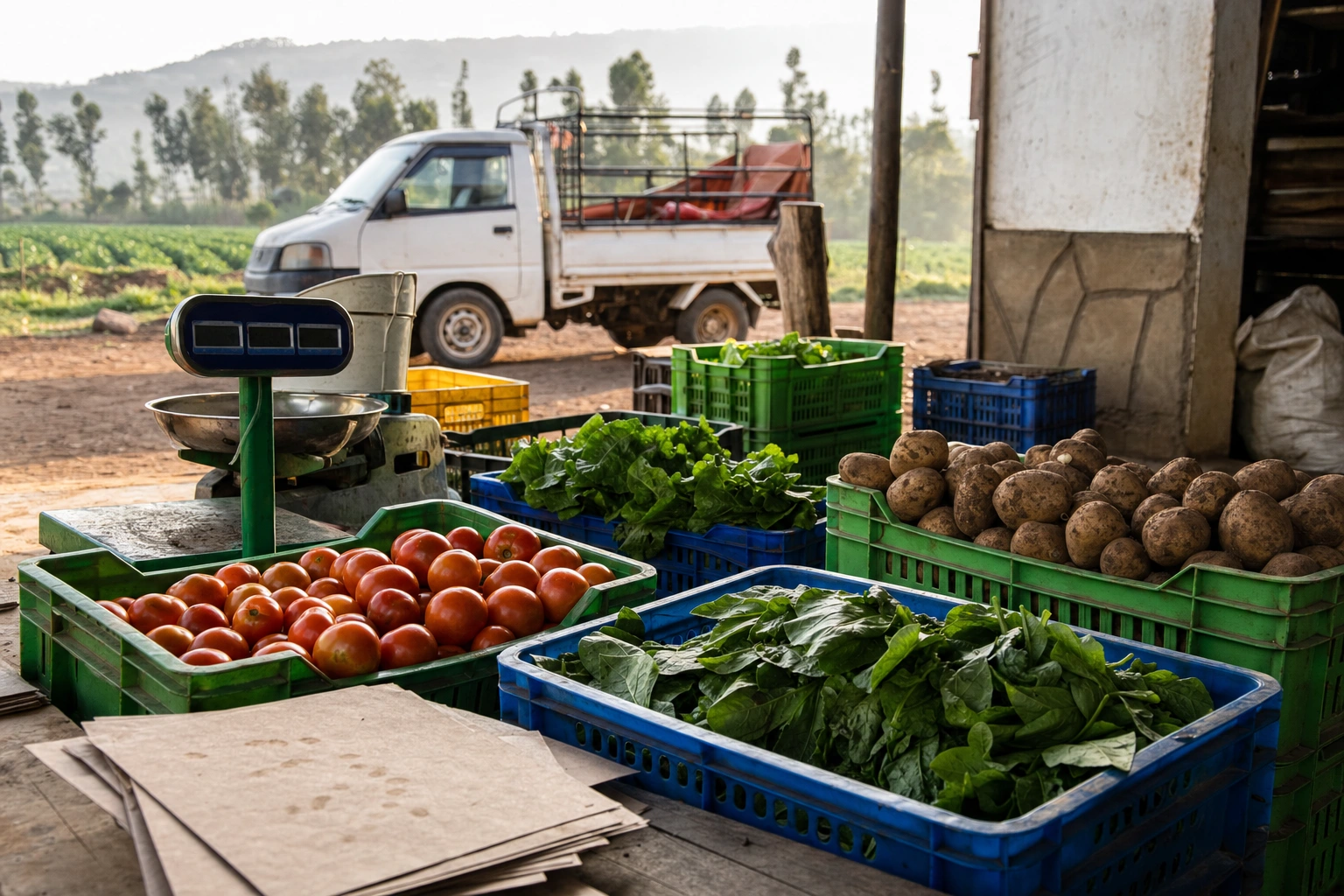
Producing a good crop or keeping healthy livestock does not automatically guarantee a profitable sale. Farmers also need to understand who is likely to buy, what those buyers require, when they need it, how they prefer to receive it and whether they can pay reliably. This process is known as identifying potential buyers.
Potential buyers may include households, traders, retailers, wholesalers, restaurants, schools, processors, exporters, institutions and other farmers. The most suitable buyer is not always the one offering the highest advertised price. A useful buyer should match the farm’s quantity, quality, timing, location, packaging and payment needs.
What Identifying Potential Buyers Involves
Identifying potential buyers means finding and assessing people or organisations that have a genuine need for a farm product. It involves more than collecting telephone numbers. A farmer must establish whether a buyer wants the product, can purchase the available quantity, accepts the expected quality and has a dependable way of paying.
For example, a farmer growing tomatoes may consider several markets. A nearby market trader may buy small quantities every few days and pay immediately. A restaurant may pay a better price but require uniform, clean tomatoes delivered early in the morning. A processor may accept larger volumes but require a specific variety, maturity level and delivery schedule. Each buyer creates different opportunities, costs and risks.
The purpose of buyer identification is therefore to find a suitable match between what the farm can supply and what the market is prepared to purchase.
Why Farmers Should Identify Buyers Early
Many marketing problems begin before harvesting. Farmers may plant a crop because neighbours are growing it, because prices were recently attractive or because an input supplier recommended it. By harvest time, several producers may be offering the same product, while the number of ready buyers remains limited.
Early buyer research helps a farmer make better production decisions. It can influence the choice of crop variety, planting period, production scale, harvesting method, packaging and storage plans. A farmer who has spoken to likely buyers before planting is in a stronger position than one who begins searching only after the produce is ready.
Early contact does not always create a guaranteed sale. Prices and demand can change, and informal promises may not be binding. However, conversations with possible buyers can reveal useful information about specifications, delivery periods, common purchasing quantities and the conditions required to enter a market.
Start with the Farm’s Supply Profile
Before approaching buyers, describe what the farm can realistically provide. This prevents farmers from making promises they cannot keep and makes discussions more professional.
Prepare information on the following areas:
- Product: Identify the crop, livestock product or processed item clearly. Include the variety or type where relevant.
- Expected quantity: Estimate the volume available and separate the expected total harvest from the quantity that will meet buyer standards.
- Timing: Record when the product will be ready and whether supply will be a single delivery or spread over several weeks.
- Quality: Describe size, colour, maturity, freshness, cleanliness, moisture condition, grading and any other important features.
- Location: State where the product is produced and whether it can be collected or delivered.
- Packaging: Note whether the product will be supplied in crates, sacks, cartons, baskets, containers or another suitable form.
- Production practices: Be ready to explain relevant practices such as irrigation, harvesting methods, traceability records or handling procedures when a buyer asks.
Use realistic estimates. If a farm expects to harvest 2,000 kilograms of potatoes but only 1,500 kilograms are likely to meet the preferred grade, the farmer should present the marketable quantity honestly. Accurate information builds trust and supports better planning.
Understand the Different Types of Buyers
Different buyers solve different marketing problems. A farmer should compare them rather than assuming that one market is suitable for every product.
Direct consumers
Households and individual consumers may buy vegetables, eggs, milk, fruit, meat or processed products directly from the farm, a local stall or a delivery service. Direct sales can provide useful customer feedback and may produce a higher price per unit. However, they often involve smaller quantities, more communication and additional time spent selling.
Traders and assemblers
Traders may collect produce from several farms and sell it in larger markets. They can be convenient when a farmer needs to move a substantial quantity quickly. Their price may reflect transport, sorting, market fees, losses and their own margin. Farmers should ask how the price was determined and whether weighing and grading will take place before payment.
Retailers and wholesalers
Retailers buy for resale to consumers, while wholesalers generally handle larger quantities and distribute products to other businesses. These buyers may offer regular demand but often expect consistent quality, packaging and delivery arrangements.
Restaurants, hotels and catering businesses
Food businesses often value freshness, dependable delivery and consistent specifications. A restaurant may need smaller quantities than a wholesaler but may place orders frequently. It may also reject produce that is bruised, overripe, too large or poorly cleaned. The farmer should ask about ordering routines, delivery times, acceptable substitutions and payment terms.
Schools, hospitals and other institutions
Institutions may purchase food in planned quantities and through formal procedures. They can offer a useful market, but a farmer may need to meet documentation, invoicing, delivery and payment requirements. Before relying on an institutional buyer, confirm the purchasing process and expected payment period.
Processors and manufacturers
Processors buy raw materials for products such as flour, juice, yoghurt, animal feed or cooking ingredients. They may require specific varieties, moisture levels, sizes, volumes or delivery schedules. A processor may be suitable for produce that is not attractive in fresh retail markets but meets processing standards.
Research Demand Before Making Contact
Buyer research can begin locally. Visit markets, shops, restaurants, collection points and processing facilities. Observe which products are displayed, which grades appear common, how produce is packaged and whether sellers frequently run out of stock. Ask respectful questions about the products buyers seek and the periods when demand changes.
Farmers can also use agricultural groups, cooperatives, extension officers, producer organisations, community networks and business associations to learn about possible markets. Digital platforms and messaging groups may help locate buyers, but online information should be verified before products or money are exchanged.
Useful questions include:
- What product and variety does the buyer normally purchase?
- How much is required per order or per week?
- What quality standards cause a delivery to be accepted or rejected?
- When is the product needed?
- Who arranges transport?
- How is the product weighed, graded and priced?
- When and how is payment made?
Do not ask only about price. A buyer offering a higher price may require expensive transport, strict grading or delayed payment. The farmer needs the full commercial picture.
Use a Buyer Qualification Checklist
After identifying possible buyers, compare them systematically. A simple buyer record can include the buyer’s name, location, contact person, product required, expected volume, quality requirements, buying period, price basis, collection or delivery arrangement, payment terms and previous transaction history.
Assess each buyer against five practical questions:
- Is there genuine demand? Has the buyer clearly explained what is needed, or is the discussion only vague interest?
- Can the buyer handle the available quantity? A small retailer may not be able to absorb a large harvest, while a processor may not be interested in a few crates.
- Does the buyer accept the farm’s quality? Confirm specifications before harvesting and agree how quality will be assessed.
- Is the transaction financially worthwhile? Calculate the expected net return after packaging, transport, loading, market charges, sorting and losses.
- Is the buyer reliable? Check references where possible, start with a manageable transaction and be cautious about unclear payment promises.
A buyer scorecard can make comparisons easier. Give each buyer a simple rating for price, volume, distance, payment reliability, quality fit and relationship potential. The scoring need not be complicated; its purpose is to make hidden trade-offs visible.
Calculate the Net Selling Price
The quoted price is not the same as the money the farmer earns. For a fair comparison, calculate the net selling price:
Net return = selling revenue minus marketing costs.
Marketing costs may include harvesting labour, sorting, grading, packaging, transport, loading, storage, communication, commissions, fees and losses. Suppose two buyers offer different prices for a similar product. One is nearby and pays on collection, while the other is farther away and pays later. The second offer may look better per kilogram but become less attractive after transport costs and the risk of delayed payment are considered.
Also consider the value of the farmer’s time and the risk of rejected goods. If a buyer’s standards are unclear, the farmer may face unexpected losses. Asking for clear requirements before delivery reduces this risk.
Confirm Quality and Quantity Requirements
Quality should be discussed in specific terms rather than general phrases such as “good produce”. For fresh produce, the discussion may cover size, colour, maturity, cleanliness, damage, disease, freshness and packaging. For grains, it may include dryness, foreign material, infestation, variety and storage condition. For milk or eggs, handling, cleanliness, freshness and container requirements may be important.
Ask the buyer to explain how goods will be inspected. Will grading occur at the farm, collection point or buyer’s premises? Who pays when a delivery is rejected? Can lower grades be purchased at a different price? These questions are particularly important when transport costs are high.
Farmers should keep separate records for different grades where possible. Mixing high-quality and low-quality produce can cause the whole consignment to be valued at the lowest grade or rejected. Good sorting also helps a farmer direct premium products to demanding buyers and other grades to processors or alternative markets.
Discuss Price and Payment Professionally
Price negotiation works best when both parties understand the basis of the offer. Confirm whether the price is per kilogram, crate, bag, tray, animal or delivery. Establish whether the product is weighed before or after packaging and whether the price includes transport, loading or other services.
Payment terms deserve the same attention as price. Immediate payment, a deposit, payment on delivery and credit sales carry different levels of risk. If payment will be delayed, record the due date and the agreed amount. For a new buyer, begin with a smaller order until reliability has been demonstrated.
Written records do not need to be complicated. A message confirming product, quantity, price, quality requirements, delivery date and payment terms can prevent misunderstandings. For larger or repeated transactions, use a clear written agreement and retain copies of invoices, delivery notes, weighbridge records and payment confirmations.
Build More Than One Market Option
Depending entirely on one buyer can leave a farmer vulnerable if the buyer cancels, changes requirements or delays payment. A stronger approach is to develop a small portfolio of buyers. For example, a farmer may supply a regular retailer, sell a portion through a local market and reserve lower grades for a processor or livestock feed channel.
Having alternatives does not mean breaking promises. It means planning responsibly so that produce has more than one possible destination. Different buyers can also serve different seasons, grades and quantities.
Producer groups can improve bargaining power and market access by combining volumes, coordinating quality and sharing transport or storage. However, group marketing works best when members agree on grading, records, delivery responsibilities, payment distribution and how disputes will be handled.
Maintain Buyer Relationships
Finding a buyer is only the first step. Repeat business depends on reliable performance. Communicate early if the expected harvest, quantity or delivery time changes. Do not hide quality problems; explain them and offer practical options where possible.
After a sale, ask for feedback. Was the produce too mature, poorly packed, inconsistent or delivered late? Record the response and use it to improve the next transaction. A simple customer record can show which buyers purchase regularly, which products they prefer and which issues have caused disputes.
Professional conduct matters even in informal markets. Be punctual, use accurate weights, keep agreed records and respond to messages. Trust is built through repeated evidence, not through one conversation.
Applying This in Practice
Use the following process before the next marketing season:
- List the products, grades, quantities and likely harvesting dates on your farm.
- Identify at least three categories of possible buyers in or beyond the local area.
- Contact each buyer and ask about volume, quality, timing, delivery and payment requirements.
- Record the answers in a notebook, spreadsheet or organised phone document.
- Calculate the likely net return after all marketing costs.
- Choose buyers whose requirements match your supply and whose payment arrangements are clear.
- Confirm the agreement in writing before harvesting or transporting the product.
- Keep records after delivery and review what worked, what caused losses and which relationships deserve further development.
For example, a vegetable farmer near Nakuru might discover that a local trader wants mixed grades collected twice a week, while a restaurant wants smaller, carefully sorted deliveries. The farmer could send premium vegetables to the restaurant, supply suitable remaining grades to the trader and use damaged produce for another appropriate purpose. This approach can reduce waste while matching each grade to a realistic market.
Questions to Consider
- Which buyer needs my product most consistently?
- What quality features do my best potential buyers value?
- Can I meet the required quantity and delivery schedule without harming quality?
- What will remain after transport, packaging, labour and other selling costs?
- How will I verify the buyer’s payment reliability?
- What is my alternative if the main buyer does not purchase the full quantity?
Key Takeaways
- Identify potential buyers before production or harvesting decisions are finalised.
- Match each buyer’s quantity, quality, timing and delivery requirements with the farm’s actual supply.
- Compare net returns, not just quoted prices, after including transport, packaging, labour and losses.
- Clarify weighing, grading, rejection and payment terms before delivering produce.
- Use records, written confirmations and small trial transactions to assess buyer reliability.
- Develop more than one market option and maintain relationships through consistent quality and communication.
No comments yet.