
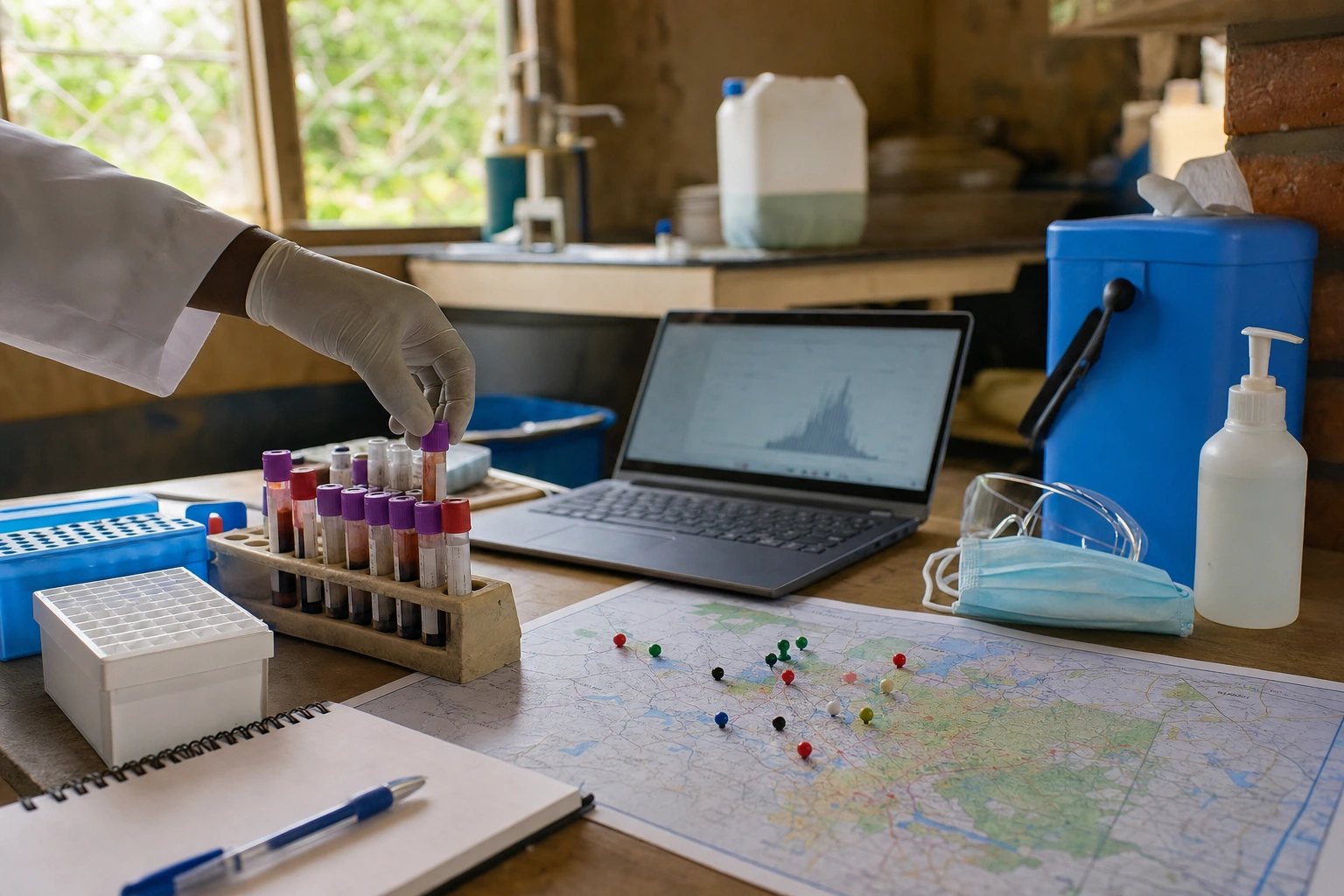
Diseases spread through populations when an infectious agent moves from a source to a susceptible person through a particular route of transmission. This process is shaped not only by biology, but also by human behaviour, living conditions, mobility, access to healthcare, climate and the strength of public health systems.
Understanding disease transmission helps people make better decisions during everyday illnesses and outbreaks. It also explains why measures such as vaccination, safe water, ventilation, hand hygiene, isolation and mosquito control can protect both individuals and entire communities.
The Chain of Infection
Public health professionals often describe disease spread as a chain of infection. The chain has six linked parts. If any link is removed or weakened, transmission becomes less likely.
- Infectious agent: This is the organism or biological agent that can cause disease. Examples include viruses, bacteria, fungi and parasites. Not every agent causes the same level of illness, and some can survive longer outside the human body than others.
- Reservoir: The reservoir is where the agent normally lives and multiplies. It may be a person, an animal, water, soil or another part of the environment. Humans can carry an infection without obvious symptoms and still pass it on.
- Portal of exit: This is the route by which the agent leaves its reservoir. Respiratory droplets may leave through the nose or mouth; bloodborne infections may leave through blood; intestinal infections may leave through faeces.
- Mode of transmission: The agent must travel from its source to another person. It may spread through air, direct contact, contaminated food or water, blood, sexual contact, objects or insects.
- Portal of entry: The agent enters the next person through a route such as the respiratory tract, mouth, eyes, broken skin or the reproductive and urinary tracts.
- Susceptible host: The person must be vulnerable to infection. Susceptibility can be influenced by vaccination, previous infection, age, pregnancy, underlying health conditions, nutrition and exposure to the agent.
Consider a respiratory virus. An infected person may release the virus while speaking, coughing or breathing. Another person nearby may inhale infectious particles, allowing the virus to enter the respiratory tract. If that person has little immunity, infection may develop. Measures such as staying home when ill, improving ventilation and wearing a well-fitting mask in higher-risk situations can weaken several links at once.
How Infectious Diseases Are Transmitted
Direct transmission
Direct transmission occurs when an infectious agent passes from one person to another without needing an intermediate object, food, water or insect. Skin-to-skin contact, sexual contact and the exchange of respiratory particles at close range can all be forms of direct transmission.
Close contact matters because distance, duration and the amount of infectious material can affect risk. A brief interaction outdoors may create a different level of exposure from spending hours in a crowded, poorly ventilated room. The exact risk depends on the disease and the circumstances.
Indirect transmission
Indirect transmission involves something between the infected source and the new host. This may be a contaminated object, food, water, medical equipment or another surface. For example, an intestinal infection can spread when food is prepared with contaminated hands or water.
Not every object touched by an infected person is equally dangerous. Transmission depends on whether the agent survives in that setting, whether enough of it reaches another person, and whether it enters through a suitable portal. Cleaning frequently touched surfaces can help in some situations, but surface cleaning alone cannot control diseases that mainly spread through inhaled air.
Airborne and respiratory transmission
Respiratory infections can spread through particles released when people breathe, speak, sing, cough or sneeze. Some particles are relatively large and fall quickly, while smaller particles can remain suspended in the air for longer, particularly indoors where ventilation is poor.
This is why improving airflow is an important public health measure. Opening suitable windows, using well-maintained ventilation systems, reducing overcrowding and avoiding close contact with people who are unwell can reduce exposure. The importance of each measure varies by pathogen and setting.
Foodborne and waterborne transmission
Foodborne and waterborne diseases occur when an infectious agent is swallowed in contaminated food or water. Contamination can happen at the source, during transport, in markets, during preparation or through unsafe storage.
Prevention includes using safe water, washing hands at critical times, separating raw and cooked food, cooking food thoroughly where appropriate, protecting food from insects and storing it at safe temperatures. In homes, restaurants, schools and food businesses, several small controls must work together because one failure can reintroduce contamination.
Vector-borne transmission
A vector is a living organism that carries an infectious agent between hosts. Mosquitoes, ticks, fleas and certain flies can transmit diseases. Malaria is a familiar example in many African settings, where particular mosquito species transmit parasites between people.
Vector control may involve reducing breeding sites, using insecticide-treated bed nets where recommended, applying appropriate repellents, improving housing and supporting local control programmes. Personal protection is valuable, but community-level action is often necessary because vectors move through shared environments.
Bloodborne and sexual transmission
Some infections spread through infected blood or sexual fluids. Transmission can occur through unprotected sexual contact, shared injecting equipment, unsafe medical procedures or other situations involving blood exposure. Prevention includes appropriate barrier protection, testing, treatment, sterile equipment and safe clinical practices.
People should seek qualified medical advice after a possible exposure because some preventive treatments are time-sensitive. Health services can also provide confidential testing, counselling and treatment.
Why Some Infections Spread Faster Than Others
The speed and scale of disease spread depend on several interacting factors. A pathogen may be highly infectious but cause mild illness, or it may spread less easily while causing severe disease. Transmission also changes when people alter their behaviour or when control measures are introduced.
Important factors include:
- Infectiousness: how readily the agent establishes infection in an exposed person.
- Duration of infectiousness: how long an infected person can pass the agent to others.
- Timing of infectiousness: whether transmission occurs before symptoms, during illness or after recovery.
- Contact patterns: how many people interact, how closely they interact and how often they meet.
- Population immunity: the protection provided by vaccination or previous infection, although immunity may vary over time and between diseases.
- Environmental conditions: such as ventilation, temperature, rainfall, water quality, housing and crowding.
- Access to care: whether people can obtain diagnosis, treatment, isolation advice and preventive services.
Public health specialists sometimes use reproduction numbers to describe transmission. In simple terms, such a measure estimates how many additional infections one case may generate under particular conditions. It is not a permanent property of a disease: behaviour, immunity, treatment and public health measures can change the number over time. A single number should therefore never replace careful interpretation of local evidence.
From Isolated Cases to Pandemics
Health professionals use different terms to describe the pattern of disease in a population.
- Sporadic cases: infections occur irregularly and infrequently, without a clear continuous pattern.
- Endemic disease: a disease is consistently present in a particular population or geographical area, sometimes at predictable levels.
- Outbreak: more cases occur than expected in a defined place, group or period. The word is often used for a local event, although its practical use can vary.
- Epidemic: disease occurrence rises above the expected level across a community or wider population.
- Pandemic: an epidemic spreads across countries or continents and affects large numbers of people.
These labels describe patterns, not automatic judgements about how severe an illness is. A local outbreak can be serious, while a widespread infection may cause a range of outcomes from mild to severe. Public health decisions depend on the agent, the number of cases, the health effects, the people affected and the capacity of health services.
How Public Health Teams Detect and Respond to Spread
Disease control begins with surveillance, the systematic collection and interpretation of health information. Clinics, laboratories, hospitals, community health workers and other services may report cases or unusual patterns. Surveillance can identify an increase in symptoms, a cluster in one location or a change in who is becoming ill.
When an unusual pattern appears, investigators may:
- Confirm that the illness and diagnosis are correctly identified.
- Define what counts as a suspected, probable or confirmed case for the investigation.
- Determine when and where cases occurred and look for links between them.
- Interview affected people about symptoms, contacts, travel, food, water and possible exposures.
- Collect and test suitable clinical or environmental samples through authorised services.
- Identify people who may have been exposed and provide appropriate advice or follow-up.
- Introduce measures that match the likely transmission route, while monitoring whether they work.
Contact tracing is one possible response. It involves identifying people who may have been exposed, informing them of what to do and connecting them to testing, treatment or monitoring when appropriate. It works best when people can access trusted services and when confidentiality is respected.
Risk communication is equally important. Clear messages should explain what is known, what is uncertain, how people can protect themselves and where to obtain help. Confusing or stigmatising communication can discourage people from reporting symptoms or seeking care, which may allow transmission to continue.
Breaking the Chain of Infection
Effective prevention usually combines several measures rather than relying on one action. The best combination depends on the disease and the setting.
- Vaccination: vaccines prepare the immune system to respond to specific infections and can reduce the likelihood of illness and transmission for some diseases. Following the recommended schedule helps maintain protection.
- Hand and respiratory hygiene: washing hands with soap and safe water, using alcohol-based hand rub when suitable, covering coughs and sneezes, and avoiding touching the face can reduce certain routes of spread.
- Ventilation and safer indoor environments: fresh air and reduced crowding can lower exposure to some respiratory pathogens.
- Early testing and treatment: diagnosis can help a person receive care and understand how to reduce exposure to others. Treatment may also reduce the period or level of infectiousness for particular diseases.
- Isolation and staying home when ill: limiting close contact during infectious periods can protect household members, colleagues, customers and classmates.
- Safe food and water practices: water treatment, sanitation, hygienic food handling and proper storage interrupt faecal-oral transmission.
- Vector control: reducing contact with disease-carrying insects can protect individuals and communities.
- Protective healthcare practices: gloves, sterilised equipment, appropriate waste disposal and standard infection-prevention procedures reduce exposure in clinical settings.
Prevention should be practical and proportionate. For example, a small business can improve airflow, provide handwashing facilities, develop a clear policy for staff who are unwell and keep high-touch areas clean. A school can combine vaccination support, health education, sanitation, ventilation and a process for responding to suspected cases. These actions protect continuity as well as health.
Applying This in Practice
When assessing a possible disease risk, ask five questions:
- What is the likely source? Consider an infected person, animal, food, water, object or insect.
- How does it leave the source? Think about breath, saliva, faeces, blood, skin or another material.
- How does it travel? Identify the most likely route rather than assuming that every route is equally important.
- Who may be especially vulnerable? Consider infants, older adults, pregnant people, people with certain health conditions and those with limited access to care.
- Which link can be interrupted most effectively? Choose measures that are evidence-informed, feasible and suitable for the setting.
For a household facing a suspected contagious illness, this may mean contacting a healthcare professional, limiting close contact, improving ventilation, avoiding sharing personal items where relevant and following advice about testing or treatment. For a workplace, it may mean reviewing sick-leave arrangements, cleaning practices, ventilation and communication procedures. People should avoid diagnosing themselves solely from online information, particularly when symptoms are severe, unusual or worsening.
Key Takeaways
- Disease spread depends on an infectious agent, a source, a route out, a mode of transmission, a route in and a susceptible host.
- Respiratory, contact, foodborne, waterborne, vector-borne, bloodborne and sexual transmission require different prevention measures.
- Transmission is influenced by infectiousness, immunity, contact patterns, environmental conditions and access to healthcare.
- Outbreaks and epidemics describe increases above expected disease levels, while pandemics cross international or continental boundaries.
- Surveillance, testing, contact tracing and clear communication help public health teams identify and control spread.
- Vaccination, ventilation, hygiene, safe food and water, early care and appropriate isolation can break links in the chain of infection.
No comments yet.