
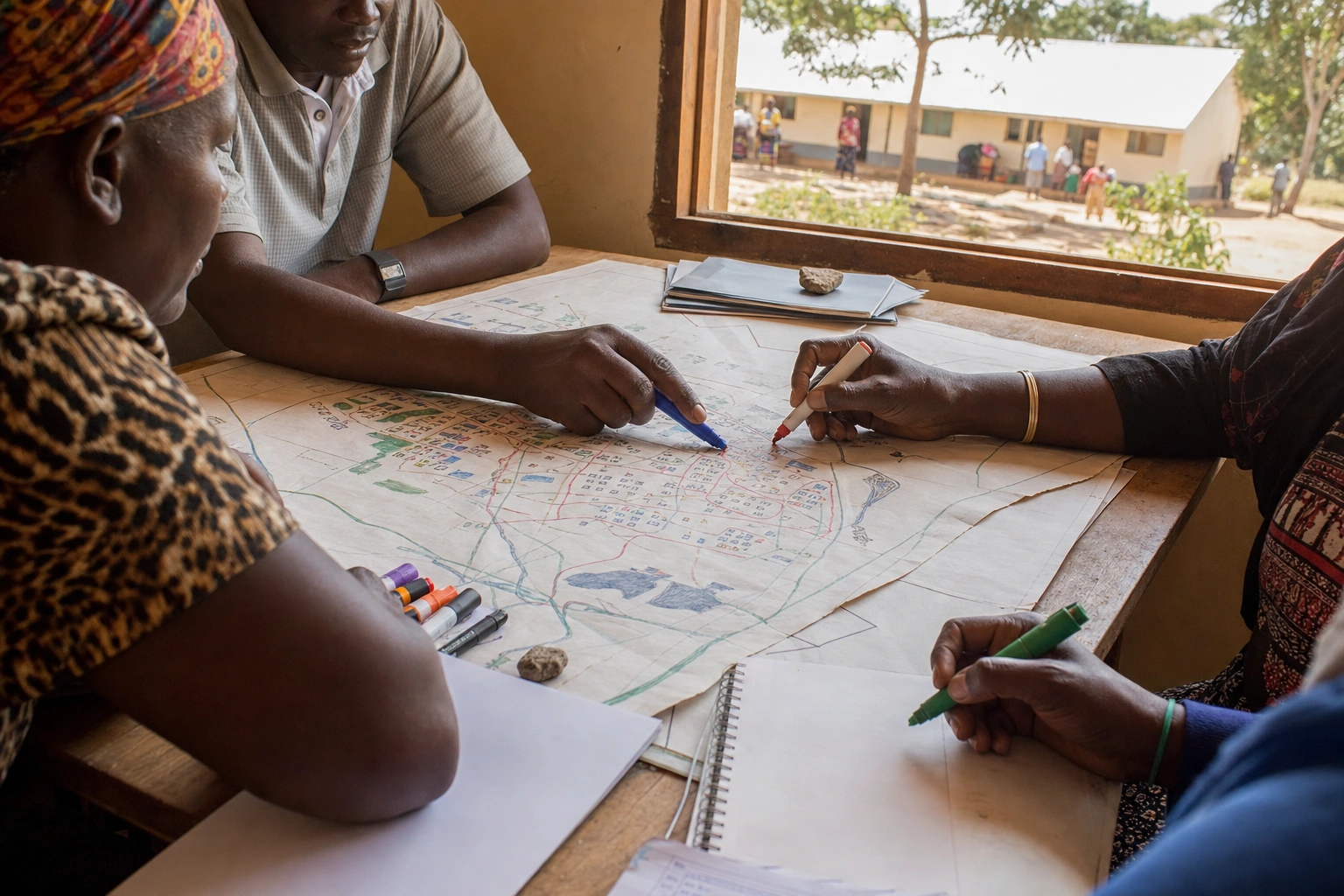
Health promotion is not limited to hospitals, clinics or health education campaigns. It includes the conditions, knowledge, relationships, services and local decisions that help people improve their health and exercise greater control over factors affecting their wellbeing. Because these factors are part of everyday community life, effective health promotion depends on meaningful community participation.
Community participation means that people are involved in identifying health concerns, setting priorities, planning responses, taking action and reviewing results. It is more than asking residents to attend a meeting or distribute leaflets. Genuine participation gives communities a voice in decisions that affect them and recognises the knowledge, skills and resources already present within the community.
What Community Participation Means in Health Promotion
A community may be defined by location, such as a village, estate or neighbourhood, or by shared identity, experience or interest. Examples include young people, people living with disabilities, informal workers, faith communities, older adults or families managing a particular health condition.
Participation can take different forms. At a basic level, people may receive information about a health programme. A stronger form involves consultation, where community members give opinions before decisions are made. More meaningful participation occurs when residents help set priorities, design activities, implement solutions and assess whether the approach is working.
The central distinction is between participation as attendance and participation as influence. A crowded meeting does not necessarily mean that people have power. For participation to be meaningful, community members should understand the issue, have opportunities to contribute, see how their views are considered and share responsibility for appropriate decisions.
Why Community Participation Matters
It improves relevance
Health professionals may understand disease patterns and clinical guidance, while community members understand local routines, beliefs, costs, transport challenges and practical constraints. Combining these forms of knowledge produces interventions that fit real life.
For example, a campaign encouraging families to use health services may fail if it ignores clinic opening hours, transport costs, long queues or concerns about privacy. Community members can identify these barriers and suggest workable alternatives, such as outreach sessions, flexible appointment arrangements or clearer communication.
It builds trust
People are more likely to engage with health information and services when they trust the individuals and organisations providing them. Community health workers, local leaders, peer educators and respected groups can help explain health messages in familiar language and respond to concerns. Trust should not be assumed, however; it is built through honesty, respectful conduct and consistent action.
It strengthens ownership
When a project is designed and delivered entirely by an outside organisation, activity may reduce when funding, staff or equipment is withdrawn. When people help shape the work, they are more likely to understand its purpose, adapt it to local conditions and protect it over time.
It can address wider causes of health
Many health outcomes are influenced by factors beyond individual choices. Housing, income, education, food availability, safety, sanitation, transport and social support all affect wellbeing. Community participation can bring together residents, schools, businesses, local authorities and health services to address these wider conditions rather than placing responsibility solely on individuals.
Common Roles Communities Can Play
Communities are not a single group with identical views. Different members may contribute in different ways, depending on their experience, availability and skills.
- Identifying priorities: Residents describe health concerns, risks and service gaps that may not be visible in official records.
- Sharing local knowledge: People explain language, customs, routines and beliefs that affect health behaviour.
- Designing solutions: Community members help develop messages, activities and services that are practical and acceptable.
- Mobilising participation: Local groups encourage attendance, share information and connect people with services.
- Providing peer support: Individuals with relevant experience can help others manage challenges and seek appropriate care.
- Monitoring quality: Residents can report whether services are accessible, respectful, safe and responsive.
- Advocating for change: Community organisations can raise shared concerns with institutions and decision-makers.
These roles should not be used to shift professional or institutional responsibility onto unpaid community members. Participation works best when organisations provide training, safeguarding, resources, feedback and appropriate recognition.
How Communities Participate: A Practical Process
1. Understand the community before proposing a solution
Begin by learning about the community’s population, priorities, assets and concerns. This may involve listening sessions, household discussions, mapping exercises, observation, service-user feedback and review of available local information. Ask not only, “What is the problem?” but also, “What is already working?” and “Who is affected most?”
Community mapping can identify health facilities, schools, water points, markets, transport routes, safe spaces, support groups and organisations. It can also reveal people who are often overlooked, such as migrants, people with disabilities, isolated older adults or those who work during standard meeting hours.
2. Include a broad range of voices
Inviting only formal leaders may produce an incomplete picture. Leaders can open doors and help coordinate action, but they may not represent every group. Participation should include people directly affected by the issue, as well as those who may face barriers to speaking publicly.
Consider age, gender, disability, language, livelihood, location, income and social status. Separate discussions or accessible formats may sometimes be necessary so that people can speak freely. For example, young people may contribute more openly through peer groups, while people with hearing or visual impairments may need communication support.
3. Agree on the health priority
Communities may identify many important concerns. A clear process is needed to decide which issue to address first. Useful criteria include the seriousness of the problem, the number of people affected, the degree of inequality involved, the feasibility of action and the community’s readiness to participate.
Priority-setting should be transparent. If one issue is selected over another, explain why. This helps prevent consultation from becoming a symbolic exercise and reduces unrealistic expectations.
4. Co-design the response
Co-design means developing the intervention with the people who will use, deliver or be affected by it. Questions might include:
- What behaviour, service or environmental change is being sought?
- What makes the change difficult at present?
- Which communication channels are trusted and accessible?
- Who should be involved in delivery?
- What resources are available locally?
- What unintended effects or risks should be considered?
Suppose a community wants to improve physical activity. A solution should not simply instruct people to exercise more. Residents might identify unsafe roads, lack of shade, limited time, cultural expectations or the absence of suitable spaces. Possible responses could include organised walking groups, safer use of existing spaces, school-based activities or advocacy for better public facilities.
5. Implement with clear responsibilities
Before activities begin, agree who will do what, by when and with which resources. A simple action plan can list the activity, responsible person or group, required support, timing and indicator of progress.
Health workers may provide technical guidance, while community groups organise venues, communicate locally or identify people needing support. Local businesses, schools, faith organisations and public agencies may contribute space, transport, materials or specialist services. Roles should be realistic, voluntary commitments should be respected and sensitive tasks should be assigned only to people with appropriate training.
6. Review and adapt
Evaluation should examine both activities and results. It may ask whether the intended people were reached, whether they found the intervention acceptable, whether access improved and what barriers remained. Feedback can be collected through short interviews, suggestion systems, group discussions, attendance records or service data, provided privacy is protected.
Evaluation is not only a final assessment. Regular review allows a programme to change when circumstances change. If meetings are poorly attended, the issue may be timing, location, childcare, safety or communication rather than lack of interest.
Examples of Community Participation
Promoting healthy environments
Residents can work with schools, landlords, businesses and local authorities to identify sanitation problems, unsafe waste disposal, stagnant water or hazards affecting children. Community members may help map problem areas, communicate agreed practices, monitor maintenance and advocate for services. They should not be expected to replace public authorities where infrastructure or enforcement is required.
Supporting maternal and child health
Women’s groups, fathers’ groups, community health workers and local leaders can help identify barriers to antenatal care, skilled delivery, immunisation or child nutrition support. Their contribution may include peer education, referral support, transport planning and feedback about respectful treatment. Communication should remain accurate, non-judgemental and consistent with qualified health advice.
Improving mental wellbeing
Communities can create supportive spaces where people discuss stress, grief, isolation and other concerns without stigma. Peer networks may help people recognise when additional support is needed and connect them with appropriate services. Community participation must include clear boundaries: peer supporters should not diagnose conditions or manage emergencies without professional assistance.
Responding to public health threats
During an outbreak or other health emergency, local residents can help identify trusted communication channels, clarify rumours, support people who are isolated and explain practical constraints affecting protective measures. Authorities and organisations should communicate uncertainty honestly, protect confidentiality and avoid blaming particular groups.
Barriers to Meaningful Participation
Participation can be weakened by unequal power, token consultation, inaccessible meetings, technical language, political competition, lack of feedback or repeated promises that are not followed by action. People may also be reluctant to participate because of previous negative experiences, stigma, cost, work commitments or fear of exposing private information.
Organisations can reduce these barriers by using plain language, translating information where necessary, choosing accessible venues, offering different ways to contribute and scheduling activities around community routines. Small practical supports, such as transport assistance, refreshments or childcare arrangements, may make participation more possible, provided they are managed fairly and transparently.
Facilitators should prevent a few confident voices from dominating. Ground rules, small-group discussions, anonymous feedback and skilled moderation can help. Disagreement should not automatically be treated as failure; it may reveal genuine differences in needs or values that require careful negotiation.
Ethical and Safe Participation
Respect is central to health promotion. People should receive enough information to understand the purpose of an activity, what their involvement means and how their information will be used. Participation should be voluntary where appropriate, and individuals should not be pressured to disclose personal health details in public settings.
Confidentiality, safeguarding and referral arrangements are especially important when activities involve children, survivors of violence, people living with stigmatised conditions or individuals experiencing mental distress. Community representatives should also be clear about the limits of their role and know when to refer someone to a qualified professional or emergency service.
Power should be shared responsibly. Organisations must not present community consultation as genuine influence if decisions have already been made. If a suggestion cannot be adopted because of legal, financial or safety constraints, explain the reason and explore alternative options.
Applying This in Practice
A local organisation planning a health-promotion project can use the following sequence:
- Define the purpose: State the health issue, the intended change and what is open for community decision.
- Identify stakeholders: Include affected residents, service providers, local institutions and groups that may be overlooked.
- Listen first: Gather views through more than one method, rather than relying on a single public meeting.
- Set priorities together: Agree on a manageable issue and explain the criteria used.
- Develop an action plan: Assign responsibilities, resources, timelines and safeguards.
- Communicate progress: Report what has happened, what has changed and what remains difficult.
- Evaluate with the community: Review reach, experience, outcomes and unintended effects, then adapt the work.
For an individual professional, useful questions include: Whose knowledge is missing? Who may be excluded by the way this activity is organised? Are we asking people to contribute without giving them influence? Have we explained how feedback affected the decision? Are we measuring participation only by attendance, or also by access, voice, ownership and results?
Key Takeaways
- Meaningful participation gives communities influence over health priorities, decisions and evaluation, not merely a role in attending events.
- Local knowledge helps health programmes fit people’s language, routines, resources, beliefs and practical realities.
- Inclusive participation requires deliberate attention to groups who may be excluded by location, disability, age, income, language or social status.
- Community members can identify problems, design solutions, mobilise support, provide peer assistance and monitor services.
- Organisations must provide accurate information, safeguarding, feedback and resources rather than shifting professional responsibility onto volunteers.
- Regular evaluation should examine who was reached, how people experienced the intervention, what changed and what needs adapting.
No comments yet.