
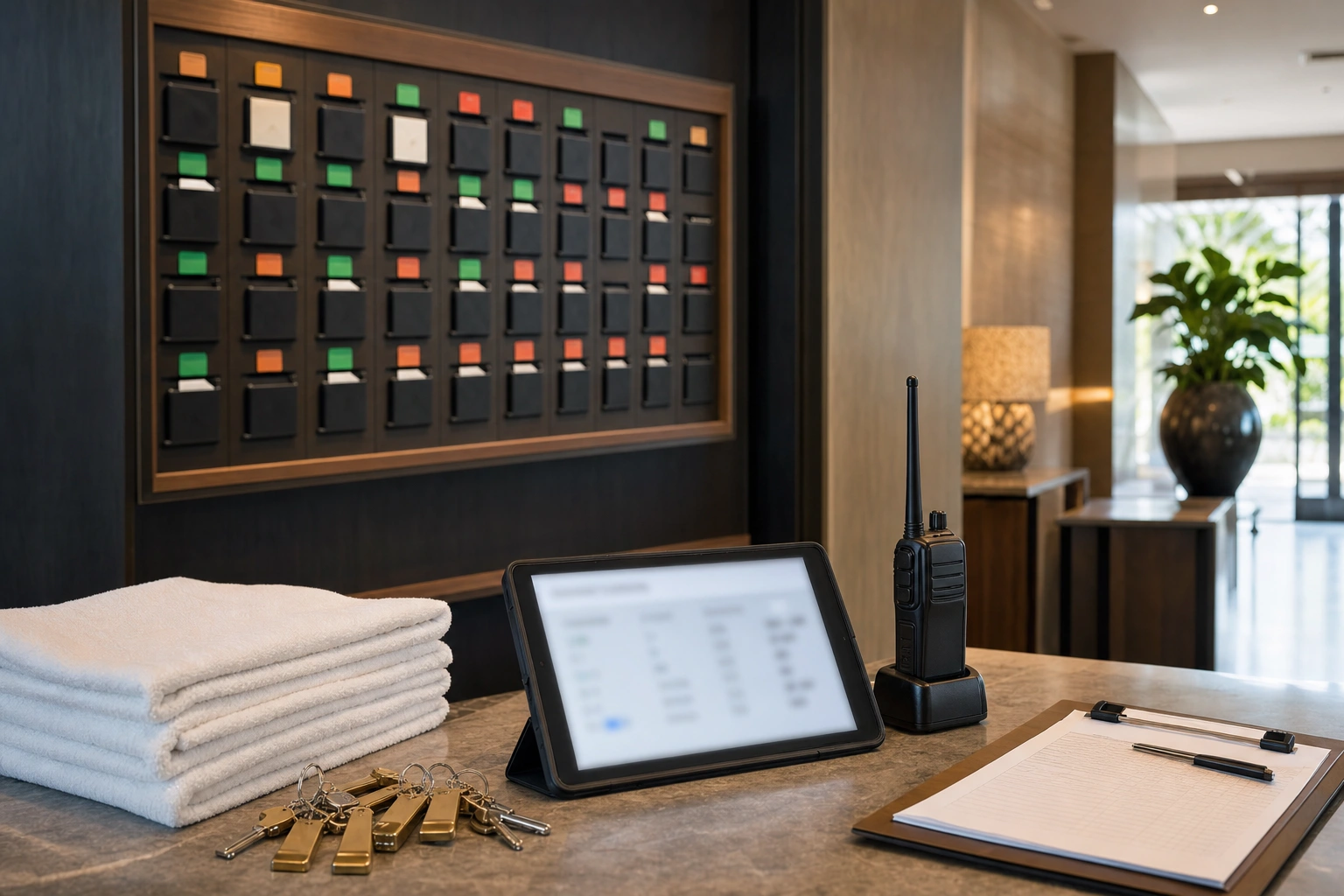
Housekeeping and front office are two of the most closely connected departments in a hotel. Front office staff manage reservations, arrivals, departures, guest requests and room sales, while housekeeping prepares rooms, maintains cleanliness and reports their condition. Neither department can work effectively in isolation because decisions in one department directly affect the other.
When communication is accurate and timely, guests are more likely to receive the right room at the right time, maintenance problems are handled sooner and room revenue is protected. When communication fails, the results may include assigning an unclean room, delaying a guest’s check-in, selling a room that is unavailable or disturbing a guest who has requested privacy. This article explains how the two departments should communicate throughout the guest cycle and how staff can handle common operational challenges.
Why Communication Between Housekeeping and Front Office Matters
Front office normally has the most direct contact with guests and controls much of the information related to reservations, room assignments and guest accounts. Housekeeping has direct knowledge of the physical condition of rooms, public areas, linen supplies and cleaning progress. Each department therefore holds information that the other needs.
For example, the front office may see a room as vacant in the property management system, but only housekeeping can confirm whether it has been cleaned, inspected and released for sale. Similarly, housekeeping may find a guest’s valuable item, observe a maintenance defect or discover that a room appears to be occupied despite the system showing it as vacant. These situations require prompt communication rather than assumptions.
Good communication supports several important objectives:
- Accurate room status: The hotel knows which rooms are occupied, vacant, clean, dirty, inspected, out of order or ready for arrival.
- Efficient room sales: Front office can assign available rooms confidently and reduce unnecessary waiting at check-in.
- Guest satisfaction: Requests such as extra towels, baby cots, laundry collection or special room preparation are passed to the correct staff member.
- Safety and security: Suspicious activity, hazards, lost property and welfare concerns are reported through the appropriate channels.
- Reduced operating costs: Accurate information prevents repeated work, unnecessary room moves, wasted amenities and avoidable complaints.
Understanding the Different Responsibilities
Front office responsibilities
Front office staff receive and record guest information, manage reservations, allocate rooms, process arrivals and departures, and communicate guest preferences or problems to other departments. They may also coordinate airport transfers, wake-up calls, room changes and special occasions.
Front office should not promise a room is ready simply because a guest has arrived or because the room appears vacant on the system. Staff should confirm the room’s operational status and, where required, wait for housekeeping inspection or approval.
Housekeeping responsibilities
Housekeeping staff clean and maintain guest rooms, corridors, public areas and service areas. They report the progress and condition of rooms, replenish supplies, identify maintenance issues and handle lost property according to hotel procedure.
Housekeeping should update room information promptly and accurately. A room should not be marked ready merely because cleaning has started. The hotel’s agreed procedure may require completion of cleaning, a final inspection and confirmation that equipment, linen, amenities and safety conditions meet the required standard.
Shared responsibility
Both departments are responsible for protecting guest privacy and using professional language. They should share only the information needed for a legitimate operational purpose. Personal details, complaints, medical information and payment information should not be discussed openly or with unauthorised people.
Room Status: The Core Information Exchange
Room status is one of the most important subjects communicated between the departments. Hotels may use different abbreviations or colour codes, so every employee should learn the terminology used by their workplace. Common descriptions include:
- Vacant and clean: The room is unoccupied and has been cleaned according to standard.
- Vacant and dirty: The room is unoccupied but still requires cleaning.
- Occupied: A guest is registered or believed to be staying in the room.
- Inspected or ready: The room has completed any required quality check and may be assigned.
- Out of order: The room is unavailable because of a significant maintenance, safety or operational problem.
- Out of service: The room may be temporarily unavailable for a less serious or planned operational reason, depending on hotel policy.
- Do not disturb: The guest has requested privacy, although urgent welfare or safety procedures may still apply.
The exact labels differ between properties. The important principle is that the system status, housekeeping report and physical condition of the room should agree. A mismatch is sometimes called a discrepancy. For instance, the system may show a room as vacant while the housekeeper finds luggage and personal belongings inside. Such a room should not be sold or entered casually. The discrepancy must be reported and investigated according to hotel procedure.
Communication Throughout the Guest Cycle
Before arrival
Before guests arrive, front office should communicate information that affects room preparation. This may include early arrivals, groups, VIP treatment, accessibility needs, honeymoon or birthday arrangements, connecting-room requests, long-stay guests and rooms requiring special amenities.
Housekeeping should receive this information early enough to organise linen, amenities, decorations or additional cleaning. A clear arrivals list helps the department prioritise work. In a busy Nairobi city hotel, for example, a group arriving after a conference may require many rooms within a short period. Front office and housekeeping need an agreed preparation sequence instead of dealing with requests randomly at the last minute.
During check-in
As rooms become ready, housekeeping communicates their status through the property management system, telephone, radio, messaging platform or a written room report, depending on the hotel’s procedures. Front office then assigns rooms that meet the reservation requirements.
If a guest arrives before the room is ready, front office should provide an honest update rather than guessing. Staff can check the estimated completion time, offer luggage storage where available and explain the next step. Housekeeping should treat urgent room requests fairly and safely; rushing must not result in poor cleaning, missing amenities or overlooked hazards.
During the stay
Front office passes guest requests to housekeeping with complete and useful details. A message such as “guest needs service” is less effective than “Room 214 requests two extra bath towels and one pillow before 18:00”. The message should identify the room, request, priority and any relevant timing.
Housekeeping should confirm completion or report any difficulty. If a requested item is unavailable, staff should inform the supervisor or front office so that an alternative can be offered. Unanswered requests create repeat calls and give guests the impression that the hotel is disorganised.
At departure
When a guest checks out, front office updates the departure information so housekeeping can service the room. In some hotels, front office may request a quick room check before finalising the guest account, particularly where the property has a policy concerning minibar use or damaged items. Any such check must follow the hotel’s written procedure and should not become an excuse for discourteous or intrusive behaviour.
Housekeeping reports lost property, damage, unusual conditions or items requiring urgent maintenance. The report should be factual and specific. Staff should avoid making accusations or discussing a guest’s belongings with other guests.
Effective Communication Channels
A hotel may use several communication channels, but each should have a clear purpose. The property management system is useful for formal room-status updates, reservations and recorded notes. A telephone or radio may be appropriate for urgent operational matters. A daily briefing can help teams discuss occupancy, groups, maintenance priorities and special preparations before work begins.
Written reports remain useful for shift handovers, lost property, maintenance defects and incidents. Digital messages can be efficient, but staff should follow the hotel’s rules for access, confidentiality and record-keeping. Informal conversations should not replace an official record when the information affects guest safety, room availability, money or accountability.
Good messages answer five questions:
- Who or what is involved? Identify the room, area, guest request or operational issue.
- What has happened? State the facts without exaggeration or blame.
- What action is required? Explain what the receiving department needs to do.
- When is it needed? Include a deadline or urgency level where appropriate.
- Who has received or completed the message? Confirm ownership so the matter is not overlooked.
Read-back or confirmation is valuable for important messages. A front office agent might repeat, “Room 308 needs a baby cot before 16:00; housekeeping supervisor has accepted the request.” This small habit reduces errors caused by noise, accents, poor telephone connections or multitasking.
Handling Difficult or Urgent Situations
Room not ready at check-in
Front office should verify the actual status with housekeeping and provide the guest with a realistic update. Housekeeping should give an honest estimate and communicate immediately if the work is delayed by damage, missing linen or an unusually deep clean. If the delay is significant, the supervisor and duty manager may need to decide on an alternative room or service recovery.
Room status discrepancy
Neither department should ignore a mismatch. The room should be protected from sale or unnecessary entry while the supervisor investigates. Possible explanations include a delayed system update, an unreported room move, a guest extending their stay or a registration error. The matter should be documented and corrected by authorised staff.
Maintenance problem
Housekeeping often discovers leaking taps, broken air-conditioning units, faulty lights, blocked drains or damaged furniture first. The problem should be reported with the room number, defect, severity and any immediate safety action taken. Front office needs the information to avoid assigning the room and to explain delays accurately to the guest.
Lost property
Found items should be handled according to the hotel’s lost-property procedure. The staff member should avoid placing the item in a personal bag or handing it informally to another person. Front office may need to contact the guest, while housekeeping or the supervisor completes the official record. Valuable, sensitive or identity-related items should be escalated promptly.
Safety or welfare concern
If staff hear a call for help, observe smoke or flooding, find a person who appears unwell, or encounter another serious concern, they should follow the emergency procedure and notify the appropriate supervisor or security team. Confidentiality matters, but it should never prevent immediate action where a person may be in danger.
Professional Standards That Improve Teamwork
Communication quality depends on behaviour as well as technology. Staff should use respectful language, listen without interrupting and avoid blaming another department in front of guests. A disagreement about a room should be handled away from public areas whenever possible.
Messages should be factual: “The bathroom tap is leaking and the floor is wet” is more useful than “Maintenance never fixes anything.” Staff should also distinguish between urgent and routine matters. A flooded room requires immediate escalation; a request for an additional decorative cushion may be handled through the normal queue.
Shift handovers deserve particular attention. The outgoing employee should identify unfinished requests, rooms awaiting inspection, rooms blocked for maintenance, expected early arrivals, guest complaints and any safety concerns. The incoming employee should ask questions and confirm responsibility. A short, structured handover is more reliable than assuming that everyone has seen a message.
Applying This in Practice
Managers and supervisors can strengthen communication by creating simple routines:
- Hold a brief daily coordination meeting covering arrivals, departures, occupancy, groups, special requests, maintenance and priority rooms.
- Use one agreed method for official room-status updates and make sure all staff understand the terms.
- Require confirmation for urgent requests and important changes.
- Review room discrepancies, delayed requests and guest complaints to identify process weaknesses rather than simply assigning blame.
- Train new employees through realistic scenarios, including an early arrival, a lost item, a room-status error and a maintenance emergency.
- Protect guest information by limiting access to authorised staff and avoiding sensitive conversations in public areas.
Employees can also use a simple personal checklist before ending a shift: Have all completed requests been recorded? Have unresolved matters been handed over? Have room-status changes been communicated? Have safety, maintenance and lost-property issues been escalated? These questions help prevent small omissions from becoming guest-facing failures.
Key Takeaways
- Housekeeping confirms the physical condition of rooms, while front office uses that information to manage arrivals, departures and room assignments.
- Room status must be updated promptly and should match the room’s actual condition.
- Guest requests should include the room, exact requirement, priority and expected completion time.
- Important information should be recorded through the hotel’s approved system rather than left as an informal conversation.
- Discrepancies, maintenance defects, lost property and safety concerns require prompt escalation and accurate documentation.
- Respectful language, confirmation and structured shift handovers reduce mistakes between the two departments.
No comments yet.