
Observation and assessment are central to high-quality early childhood education. They help educators move beyond assumptions and understand what children know, can do, enjoy, find difficult and are ready to learn next. When used well, they make teaching more responsive and ensure that each child’s development is noticed over time.
In early childhood settings, assessment should not feel like a formal examination or a competition. Young children demonstrate learning through play, conversation, movement, exploration, drawing, construction, relationships and everyday routines. Effective educators therefore gather evidence from real experiences, interpret it carefully and use it to improve the learning environment.
What Observation and Assessment Mean
Observation is the deliberate process of watching, listening to and recording what a child does, says and shows in a particular situation. It may involve noticing how a child joins a group game, handles a puzzle, communicates a need or solves a practical problem.
Assessment is the wider process of collecting, interpreting and using information about a child’s learning and development. Observation is one important source of assessment evidence, but assessment may also include samples of children’s work, conversations, information from families, developmental checklists and records of participation in activities.
The distinction matters. A note such as “Amina counted six bottle tops correctly and then grouped them by colour” is an observation. Deciding that Amina is developing confidence with one-to-one counting and classification is an assessment interpretation. Planning a game involving larger groups of objects is the next teaching response.
Why Observation Matters in Early Childhood
Children do not all show their abilities in the same way or at the same pace. One child may speak confidently during circle time but remain quiet in a large group. Another may communicate detailed ideas through block construction or drawing before using many spoken words. Regular observation helps educators recognise these different forms of competence.
Observation can help an educator to:
- identify children’s interests, strengths and emerging skills;
- understand how children approach challenges and solve problems;
- notice patterns in communication, behaviour, relationships and participation;
- plan activities that are appropriately challenging;
- identify barriers that may prevent a child from taking part;
- monitor progress over time rather than relying on one incident; and
- share specific, useful information with families and other professionals.
It also supports reflective teaching. If several children avoid a particular activity, the issue may not be a lack of ability. The materials could be unfamiliar, the instructions unclear, the space overcrowded or the activity poorly matched to their interests. Observation encourages educators to examine the learning environment as well as the child.
Areas of Development to Observe
Developmental areas are connected rather than separate. A child building a tower may be developing fine-motor control, spatial understanding, language, persistence and social skills at the same time. Even so, broad areas provide a useful framework for noticing learning.
Physical development
Observe gross-motor skills such as balancing, running, climbing and coordination, as well as fine-motor abilities such as drawing, threading, using tools and manipulating small objects. Consider also stamina, body awareness and confidence in movement. Avoid judging physical development from a single performance, since tiredness, clothing, space and opportunity can affect what a child demonstrates.
Communication and language
Notice how children listen, express ideas, ask questions, follow instructions, tell stories and use gestures or other forms of communication. For children learning more than one language, record the full range of their communication rather than treating proficiency in the setting’s main language as the only measure of ability.
Cognitive development
Look for curiosity, memory, attention, reasoning, classification, counting, prediction, problem-solving and the ability to make connections. The process is often more informative than a correct answer. A child who changes strategies after a tower falls is demonstrating valuable learning, even if the final structure is unsuccessful.
Social and emotional development
Observe how children form relationships, manage transitions, express feelings, cope with frustration, take turns and seek support. These observations should be sensitive and contextual. A child may withdraw because the room is noisy, because they are unfamiliar with the language used or because a recent change has affected their sense of security.
Creative expression and understanding of the world
Children communicate ideas through music, movement, art, imaginative play and design. They also develop knowledge of people, places, nature, materials and everyday systems. Local experiences, such as observing weather, visiting a market with a family member or exploring plants in a compound, can provide meaningful evidence of learning.
Different Ways to Observe
No single observation method gives a complete picture. Educators should choose a method according to the purpose, setting and amount of detail needed.
Running records
A running record is a detailed account of what happens during a short period, usually written as events occur. It is useful when an educator wants to understand a sequence, such as how a child approaches a difficult task or enters a group activity. The record should separate what was seen and heard from the educator’s interpretation.
Anecdotal records
An anecdotal record is a brief account of a significant moment. For example: “During outdoor play, Brian gave the watering can to another child after being asked and said, ‘You can use it when I finish.’” This provides more useful evidence than a general statement such as “Brian was cooperative.”
Event or frequency sampling
Event sampling records whenever a particular behaviour occurs, such as a child leaving a group activity or asking peers for help. Frequency sampling counts how often something happens within a defined period. These methods can reveal patterns, but they should be used carefully. Counting behaviour without considering its context may lead to unfair conclusions.
Time sampling
Time sampling involves checking what a child is doing at set intervals. It can help an educator understand participation across different parts of the day. For instance, a child may appear engaged during practical activities but become restless during long periods of waiting. The finding may suggest a need to adjust routines rather than label the child negatively.
Learning stories and work samples
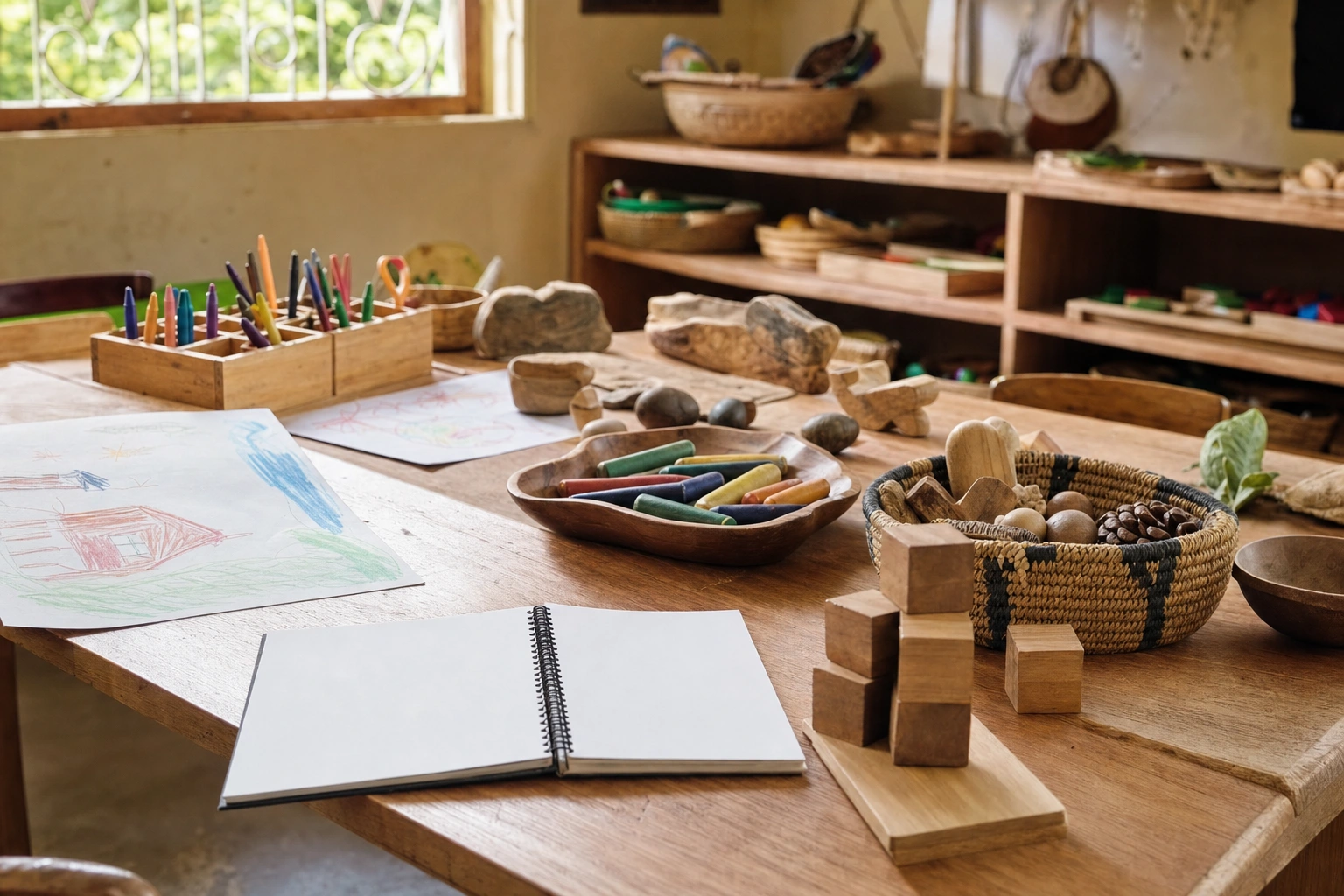
A learning story describes a meaningful episode, the learning it may demonstrate and possible next steps. Work samples, such as drawings, mark-making, models or photographs of constructions, show change over time. These records are particularly valuable when accompanied by the child’s own explanation of what they made or intended.
Checklists and developmental grids
Checklists can help educators review a range of skills and ensure that important areas are not overlooked. However, they are not complete assessments on their own. A tick does not explain how a skill was demonstrated, whether it is used consistently or what support made it possible. Checklists should prompt further observation, not replace professional judgement.
From Observation to Assessment
Useful assessment follows a cycle rather than a one-off event. A practical cycle includes five connected steps:
- Plan a purpose. Decide what you want to understand. Instead of observing everything, focus on a question such as, “How does this child communicate during cooperative play?”
- Gather evidence. Observe in a natural situation and record specific actions, words, materials and interactions. Include the date, context and people involved where relevant.
- Interpret carefully. Ask what the evidence might show about learning, development, interests or barriers. Compare observations made at different times and, where possible, in different settings.
- Respond through planning. Adapt the environment, provide materials, model a strategy, change the group arrangement or offer a new challenge based on the evidence.
- Review the impact. Observe again to see how the child responds. The cycle continues as new evidence informs the next decision.
For example, an educator may notice that a child watches peers during pretend-shop play but rarely joins in. A first interpretation might be shyness, but further observation could show that the child is unsure how to enter an established game. The educator might introduce a smaller group, provide role cards or model phrases such as “Can I help in the shop?” A later observation can show whether these changes improve participation.
Making Assessment Fair and Inclusive
Fair assessment recognises that children have different experiences, languages, abilities, personalities and opportunities. It does not lower expectations; it removes unnecessary barriers to showing what a child knows and can do.
Educators should consider whether a child has access to appropriate materials, enough time, clear instructions and a comfortable way to communicate. A child with a hearing difficulty may need to see the educator’s face. A child with limited mobility may need an adapted layout. A child who is still acquiring the language of instruction may demonstrate understanding through objects, gestures, home-language explanations or practical action.
Inclusive observation also requires awareness of bias. Avoid interpreting quietness as lack of understanding, active movement as deliberate disobedience or eye contact as the universal sign of attention. Ask what else might explain the behaviour, gather more evidence and discuss observations with colleagues and families before making significant decisions.
Working with Families
Families possess important knowledge about a child’s interests, routines, language, health, relationships and experiences outside the learning setting. Sharing observations respectfully creates a fuller picture of development.
Effective communication is specific and two-way. Instead of saying, “Your child is behind in language,” an educator might explain, “During story discussion, your child communicates ideas clearly through gestures and short phrases, and is beginning to answer questions about familiar events. What languages and storytelling activities does your child use at home?” This approach focuses on evidence, strengths and possible support.
Families should understand the purpose of records and how information will be stored and shared. Obtain appropriate permission for photographs or recordings, keep records secure and discuss sensitive concerns privately. Children should also be treated with dignity: documentation must never embarrass, label or expose them unnecessarily.
Common Mistakes to Avoid
- Observing without a question: collecting many notes without knowing how they will inform teaching can create workload without useful insight.
- Writing judgement instead of evidence: “lazy”, “naughty” or “not ready” describes an opinion, not an observable action.
- Focusing only on weaknesses: strengths often provide the best starting point for supporting an emerging skill.
- Comparing children publicly: development is individual, and public comparison can damage confidence and relationships.
- Relying on one observation: illness, fatigue, conflict or an unfamiliar activity can temporarily affect performance.
- Confusing assessment with diagnosis: an educator may identify a pattern that deserves further attention, but should not assign a medical or developmental diagnosis without the appropriate professional process.
- Recording without responding: assessment has little value if it does not influence the environment, teaching approach or support offered.
Applying This in Practice
An educator can begin with a simple observation plan. Select two or three children each week and identify one focused question for each child. Observe during ordinary experiences such as free play, outdoor activity, snack time or story sessions. Write brief factual notes, then review them at the end of the day or week.
When reviewing a note, ask:
- What exactly did the child do, say or communicate?
- What skills, interests or dispositions might this demonstrate?
- What factors in the environment may have helped or hindered participation?
- What could I change or provide next?
- What would show that the change was useful?
A low-cost setting can still gather rich evidence. Educators may use notebooks, dated folders, children’s work, simple charts and carefully selected photographs where permission has been given. The quality of assessment depends less on sophisticated equipment than on purposeful observation, accurate recording, thoughtful interpretation and responsive action.
Key Takeaways
- Observation records what children do and communicate; assessment interprets that evidence and guides the next teaching decision.
- Observe children in varied natural experiences because learning is expressed through play, routines, relationships and creative activity.
- Use specific factual descriptions rather than labels or assumptions about behaviour and ability.
- Consider context, language, culture, access needs and the learning environment when interpreting evidence.
- Use an ongoing cycle of planning, gathering evidence, interpreting, responding and reviewing.
- Work respectfully with families and protect children’s privacy, dignity and wellbeing in all records.
No comments yet.