
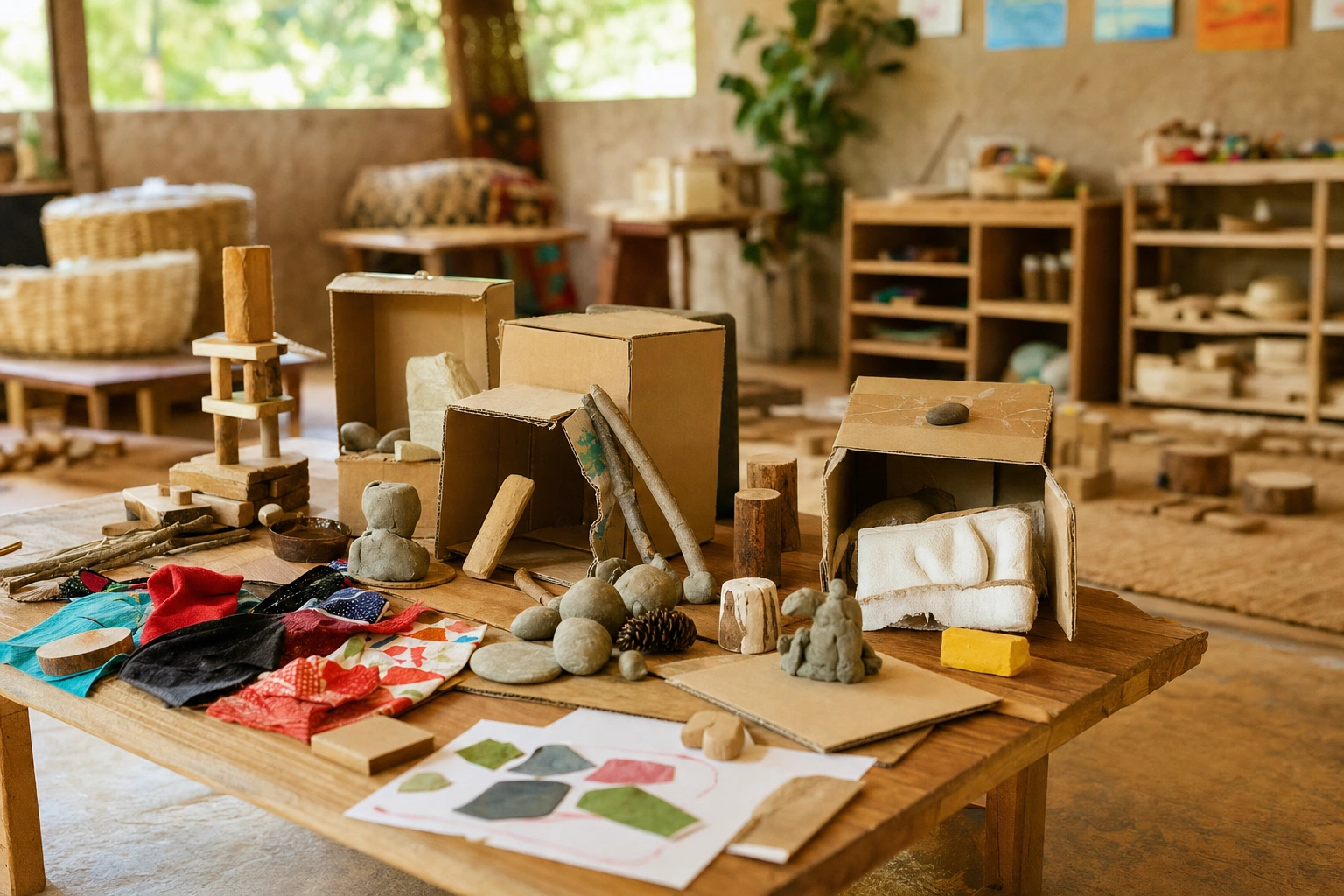
Creative learning in early childhood is more than drawing pictures or making crafts. It is a way of learning in which children explore ideas, test possibilities, express their understanding and make connections through active experiences. Young children may learn creatively while building with blocks, inventing a story, mixing colours, singing, pretending to run a shop or finding different ways to solve a practical problem.
For parents, caregivers, teachers and education leaders, understanding creative learning is important because early experiences shape how children approach knowledge. When children are encouraged to ask questions, make choices and explain their thinking, they begin to see learning as an active process rather than something that only happens when an adult gives the correct answer.
What Creative Learning Means
Creative learning is a process in which children use imagination, curiosity, experimentation and communication to understand the world. It can happen in structured activities, such as creating a collage, and in ordinary moments, such as deciding how to carry water without spilling it.
The word creative does not mean that a child must produce something beautiful or original by adult standards. A child who finds a new use for a cardboard box, changes the ending of a familiar story or develops a different method of sorting objects is demonstrating creative thinking. The value lies in the thinking process, not only in the finished product.
Creative learning usually includes several connected behaviours:
- Exploring: investigating materials, ideas, sounds, movement and relationships.
- Questioning: asking what, why, how and what might happen next.
- Experimenting: trying an approach, noticing the result and making adjustments.
- Representing: expressing an idea through speech, drawing, movement, music, construction, drama or symbols.
- Reflecting: describing what happened, what changed and what the child might try next.
Why Creative Learning Matters in the Early Years
Early childhood is a period of rapid development across language, physical ability, emotional regulation, social understanding and thinking. Creative experiences can support these areas at the same time. For example, when a group of children builds a pretend market, they may practise speaking, counting, negotiating roles, organising objects and responding to one another.
It develops thinking and problem-solving
Open-ended activities do not always have one correct answer. A set of cardboard boxes could become a house, a bus, a shop or a tunnel. Children must decide what they want to create, select materials and respond when their design does not work. This strengthens flexible thinking and persistence.
A teacher might ask, “How can we make the bridge strong enough for the toy animals?” Rather than providing an immediate solution, the teacher allows children to compare materials, test different structures and discuss their observations. The learning includes early engineering ideas such as balance, support, size and weight.
It strengthens language and communication
Creative activities give children meaningful reasons to use language. A child may describe a painting, explain the rules of a game, negotiate a role in dramatic play or tell a story about a model they have built. These situations encourage vocabulary, sequencing, listening and explanation.
Adults can extend language without taking control of the activity. Instead of asking only, “What colour is this?”, they might say, “Tell me about what is happening here,” or “What could happen after the rain stops?” Such prompts invite fuller responses and show children that their ideas are worth hearing.
It supports social and emotional development
Creative play often involves cooperation. Children may need to share materials, agree on a storyline, wait for a turn or solve a disagreement about how a game should continue. These experiences provide natural opportunities to practise empathy, self-control and collaboration.
Creative expression can also help children communicate feelings that they cannot yet explain directly. Through puppets, music, drawing or role-play, a child may explore fear, excitement, jealousy, family relationships or a difficult transition. Adults should listen carefully without assuming that every fictional detail is a direct report of the child’s personal life.
It builds confidence and agency
When children make meaningful choices, they experience themselves as capable learners. Choosing materials, deciding how to approach a task and seeing an idea develop can increase confidence. This does not mean praising every result without thought. More useful feedback describes the child’s actions and decisions: “You noticed that the paper was bending, so you added another layer underneath.”
Such feedback helps children recognise strategies they can use again. It also separates learning from perfection. A child can feel successful because they investigated a problem, even when the final structure falls down or the picture looks different from the original plan.
Creative Learning and Play: Related but Not Identical
Play is one of the main contexts for creative learning, especially when it is child-led and imaginative. In play, children often take on roles, establish rules, use objects symbolically and rehearse real-life experiences. A stick may become a spoon, a microphone or a fishing rod depending on the story being created.
However, not all play is equally creative, and creative learning can also occur in guided activities. A teacher may introduce a challenge, demonstrate a technique or provide particular materials while leaving room for children to make decisions. The balance matters. If the adult controls every step, children may simply copy. If there is no support at all, some children may struggle to begin or may not encounter new possibilities.
A useful approach is guided participation: the adult prepares an interesting environment, observes what children are trying to do, asks thoughtful questions and offers help when it enables further exploration. The adult remains involved without turning the experience into a demonstration that children must reproduce exactly.
Creative Learning Through Different Areas of Experience
Art and visual expression
Painting, drawing, printing, collage and modelling help children explore colour, texture, shape, pattern and visual representation. Adults should avoid treating art as a test of neatness. Young children benefit from access to varied materials such as paper, fabric scraps, leaves, safe recycled packaging, clay or natural objects, provided these are clean, suitable and supervised.
Process-focused art may begin with an invitation such as, “Can you make a picture of a windy day?” Children can choose how to represent wind rather than being required to copy a sample. Displaying children’s work with a short explanation of their ideas also communicates that their thinking, not only the appearance of the work, is valued.
Music, rhythm and movement
Music supports listening, memory, coordination and self-expression. Children can clap patterns, move in response to different sounds, make simple instruments from safe materials or create a song about washing hands and tidying up. Traditional songs and local rhythms can make activities culturally meaningful, while exposure to unfamiliar music can broaden children’s experience.
Movement does not need to be highly organised. Asking children to move like falling leaves, growing plants or different animals encourages imagination and body awareness. Adults should provide enough space and clear safety boundaries.
Stories, drama and language play
Storytelling encourages children to connect events, characters, motives and consequences. After reading a story, an adult might ask children to create a different ending, act out a scene or tell the story from another character’s perspective. Children can also make up stories using objects, pictures or puppets.
In multilingual communities, children may use more than one language during creative play. This should generally be treated as a resource for meaning-making rather than a problem. A child who explains an idea in a familiar language and then learns a useful word in English is expanding communication, not failing to learn.
Construction, science and early mathematics
Blocks, bottle tops, containers, sticks and other safe loose parts can support early mathematical and scientific thinking. Children compare sizes, count objects, notice patterns, explore weight and investigate cause and effect. A simple activity such as building a road for toy vehicles can lead to questions about length, slopes, bridges, direction and planning.
Adults can encourage investigation by asking, “What do you notice?”, “What changed when you moved that piece?” and “How could we test your idea?” These questions are more productive than turning every activity into a worksheet or requiring children to name a concept before they have explored it.
The Adult’s Role in Supporting Creative Learning
Adults influence creative learning through the environment they provide, the questions they ask and the way they respond to mistakes. A supportive adult does not need to be an artist, musician or expert craftsperson. The essential skills are careful observation, patience and respect for children’s ideas.
- Prepare accessible materials. Place a manageable selection of safe, varied resources where children can reach and use them. Too many materials can be overwhelming, while too few may restrict choice.
- Offer an invitation rather than a fixed product. Say, “Can you design a shelter for this small animal?” instead of showing children exactly what their shelter must look like.
- Observe before intervening. Watch how children approach the activity. They may already be testing a valuable idea that is not immediately obvious.
- Use open questions. Ask questions that encourage explanation, prediction and comparison. Avoid asking a long series of questions that makes the interaction feel like an examination.
- Allow productive struggle. Give children time to attempt a task before stepping in. Offer a hint, a new material or a question rather than solving the problem for them.
- Document the process. Record children’s words, choices, drawings or photographs of stages where appropriate. Documentation helps adults plan next steps and helps families see the learning behind play.
Common Mistakes to Avoid
One common mistake is confusing creativity with decoration. If every child makes an identical flower, house or paper animal by following adult instructions, the activity may develop fine-motor skills but offers limited opportunity for independent decision-making. Repeated models can have a place when teaching a technique, but they should not dominate the creative programme.
Another mistake is valuing speed and tidiness above investigation. A child who takes longer to mix colours, rebuild a tower or explain an idea may be engaged in deeper learning. Clear routines for cleaning and safety are important, but they can coexist with time for experimentation.
Adults should also avoid interpreting children’s work too quickly. A dark drawing is not automatically evidence of sadness, and an unusual story is not necessarily a behavioural concern. Ask the child what they have made and listen to the explanation before making assumptions.
Finally, avoid presenting creativity as an activity reserved for certain children. Some children express ideas through movement or construction rather than drawing. Others may need adaptations because of language differences, disability, sensory needs or limited access to materials. Inclusive creative learning offers different ways to participate and demonstrate understanding.
Creating Opportunities with Limited Resources
Creative learning does not depend on expensive equipment. In a home, centre or classroom, adults can use clean boxes, paper packaging, fabric pieces, bottle tops, stones, leaves, sticks and containers, taking care to remove sharp edges and small items that may be unsafe for younger children. The material itself is less important than the possibilities it offers.
For example, a family in Nairobi, Kisumu or any other community might collect safe packaging for a pretend shop. Children can sort items, create signs using drawings, assign roles, count objects and practise conversation. In a rural setting, supervised outdoor observation may inspire stories about plants, insects, weather or animal tracks. These experiences can be connected to children’s local knowledge without turning culture into a decorative theme.
Resources should be used respectfully and sustainably. Natural objects should not be collected in ways that damage living plants or disturb animals. Adults should also consider hygiene, allergies, choking risks and the needs of children who may find certain textures or sounds uncomfortable.
Applying This in Practice
To plan a creative learning experience, begin with a broad learning intention rather than a finished craft. The intention might be to encourage children to describe changes, cooperate on a shared task or explore balance and construction.
- Choose a familiar starting point. Use a local story, a market, rainfall, transport, cooking, animals or a recent classroom event.
- Gather open-ended materials. Select a few resources that can be combined in different ways.
- Introduce a simple challenge. For example: “Can you make a container that carries three small objects?”
- Give children time to explore. Avoid correcting every attempt or showing the preferred method too early.
- Talk about the process. Invite children to describe what they tried, what changed and what they might do next.
- Extend the learning. Add a story, count materials, test the design outdoors or invite children to explain their work to another group.
Afterwards, reflect on which children participated, which materials encouraged sustained attention and what support was useful. This reflection helps adults improve future experiences. It also prevents creative learning from becoming an isolated activity: children’s questions can guide later work in language, mathematics, science, social development and physical learning.
Key Takeaways
- Creative learning is a process of exploring, experimenting, communicating and representing ideas, not simply producing attractive artwork.
- Play, stories, music, movement, construction and everyday problem-solving can all support creative development.
- Open-ended activities give children opportunities to make choices, test ideas and develop flexible thinking.
- Adults support creativity by preparing safe materials, observing carefully, asking useful questions and allowing time for productive struggle.
- Process-focused feedback is more valuable than judging children’s work mainly by neatness or similarity to an adult’s model.
- Creative learning can be meaningful and inclusive even when resources are limited, provided children have varied ways to participate.
No comments yet.