
Families play a central role in early childhood education because learning begins long before a child enters a classroom. Everyday conversations, stories, songs, play, routines and relationships help children develop language, thinking skills, emotional security and curiosity. A school or early learning centre builds on this foundation, but it cannot replace the influence of a child’s home environment.
Family involvement does not mean that parents or guardians must become trained teachers, purchase expensive learning materials or spend long hours supervising formal lessons. It means creating a safe, responsive and stimulating environment, noticing how a child is developing, and working with early childhood educators to support learning consistently across home and school.
Why Families Matter in Early Childhood Education
Young children learn through relationships and repeated experiences. The adults who care for them provide the conversations, encouragement and boundaries through which children begin to understand themselves and the world. A child who is listened to learns that communication matters. A child who is encouraged to try again begins to develop persistence. A child whose questions are taken seriously becomes more willing to explore.
Families also know the child more deeply than any institution can know them at first. They understand the child’s routines, languages, interests, fears, strengths and ways of expressing discomfort. This knowledge helps teachers respond more effectively. For example, a caregiver may explain that a quiet child participates confidently when given time to answer, or that a child has recently experienced a change at home that may affect behaviour in class.
The family’s role is therefore both educational and relational. Families support learning directly through activities, and indirectly by providing stability, affection, health care, nutrition, protection and opportunities to communicate. These conditions make it easier for children to concentrate, engage with others and benefit from early learning.
Building Language and Early Literacy at Home
Language development is one of the most important areas of early childhood education. Children need frequent opportunities to hear language, express ideas, listen to others and learn new words. Families can support these abilities through ordinary activities rather than formal drills.
- Talk during routines: Describe what is happening while preparing food, travelling, washing clothes or getting dressed. Words such as “before”, “after”, “under”, “heavy” and “empty” introduce useful concepts.
- Share stories: Tell family stories, make up simple stories or look at picture books together. Ask what the child thinks might happen next and invite them to retell part of the story.
- Sing and recite: Songs, rhymes and traditional oral games develop listening, memory, rhythm and pronunciation. They also connect learning with family culture.
- Respect home languages: A strong foundation in a child’s first language supports communication, identity and understanding. Families can use the language in which they express affection and ideas most naturally while gradually introducing other languages where appropriate.
- Respond, do not only question: Instead of asking a series of test-like questions, follow the child’s interest. If the child notices a bird, discuss its movement, sound, colour and habitat.
Early literacy is broader than memorising letters. It includes handling books, understanding that pictures and marks carry meaning, recognising sounds, listening to stories and wanting to communicate. A child may develop these foundations while helping to read a shopping list, identifying familiar signs or drawing a picture and explaining it.
Learning Through Play and Everyday Activities
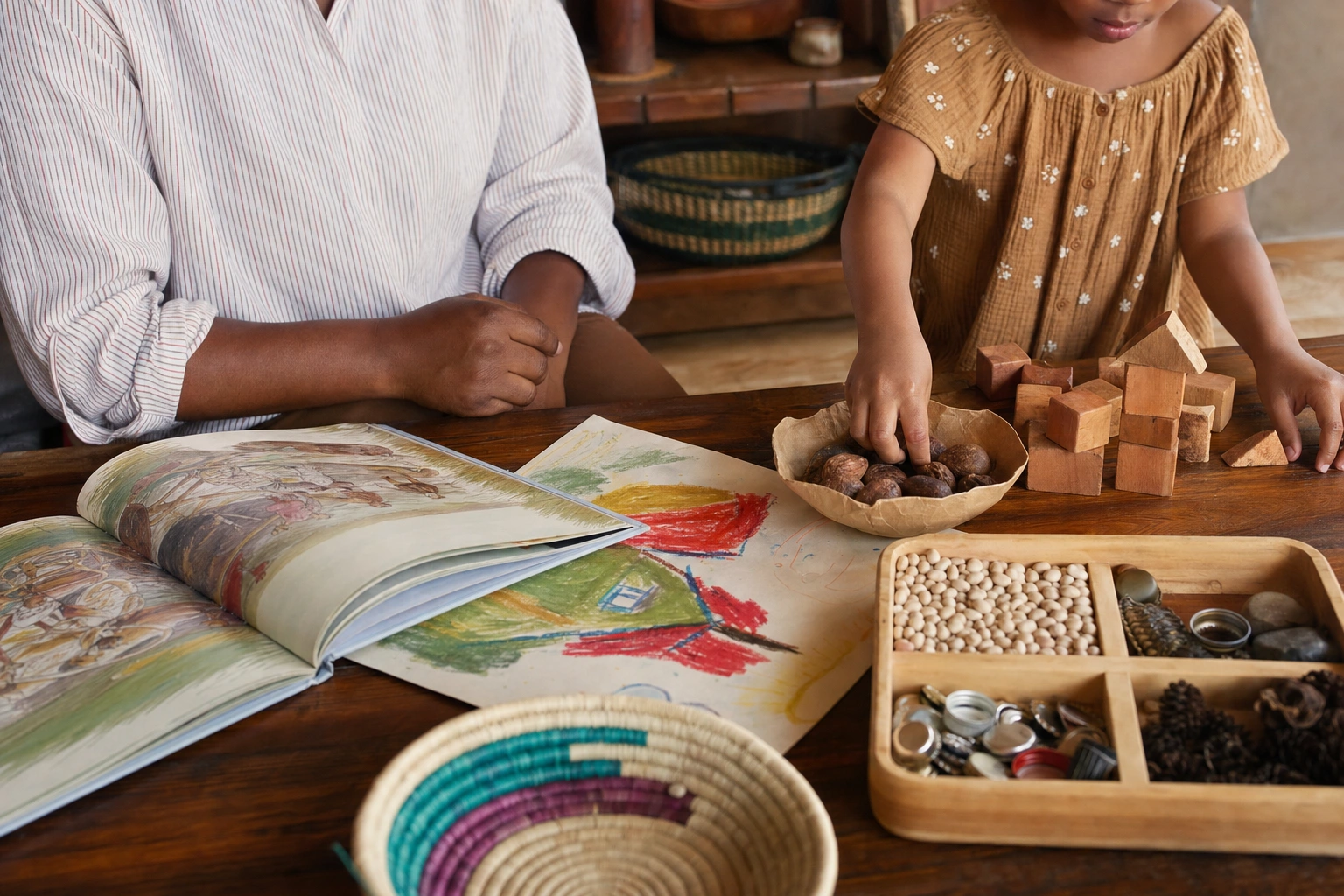
Play is a major way young children investigate ideas. Through pretend play, construction, movement, games and creative activity, children practise planning, problem-solving, communication and self-regulation. Families do not need specialised toys to make play meaningful. Household objects such as containers, fabric, cardboard boxes, bottle tops and safe kitchen utensils can support sorting, building, counting and imaginative play when used responsibly.
For example, a child helping to prepare vegetables may compare sizes, count items, notice colours and follow a sequence of instructions. While walking to a local shop, a caregiver and child can discuss distance, traffic safety, shapes, sounds and changes in the environment. During water play, children can explore which objects float or sink, provided that the activity is supervised and safe.
Adults should allow children time to lead play rather than controlling every step. The adult’s role is to observe, add language, ask thoughtful questions and introduce a manageable challenge. If a child is building a tower, an adult might ask, “What could make the bottom stronger?” rather than immediately showing the child what to do. This approach supports independent thinking while maintaining encouragement.
Supporting Social and Emotional Development
Early childhood education includes learning how to recognise feelings, manage frustration, cooperate, wait, share space and repair relationships. Families influence these abilities through daily interactions and the way adults respond to children’s emotions.
Young children often need help naming what they feel before they can manage it. A caregiver might say, “You are disappointed because the game has ended,” while still maintaining a clear boundary: “It is time to stop now, and we can play again tomorrow.” This acknowledges the emotion without allowing unsafe behaviour.
Consistent routines also help children feel secure. Regular times for waking, meals, play, rest and bedtime give children a sense of predictability. Routines do not need to be rigid, particularly in households affected by work schedules, travel or other responsibilities. However, clear expectations and calm reminders can make transitions easier.
Children learn social behaviour by watching adults. Respectful disagreement, apologising after mistakes, listening without interrupting and treating others fairly provide practical lessons. Families can also give children manageable responsibilities, such as putting away toys, carrying a light item or helping to care for a shared space. These tasks build participation and a sense of belonging.
Creating a Healthy and Supportive Learning Environment
A supportive home learning environment is not necessarily a separate room filled with educational equipment. It may be a safe corner where a child can draw, look at books, build objects or complete a puzzle. The important features are access, consistency and adult interest.
Families can keep a small selection of books, drawings, natural objects, recycled materials and age-appropriate toys within reach. Materials should be rotated when possible so that familiar items can encourage new forms of play. Children also benefit from time outdoors, movement and rest. Physical development supports later classroom participation because children need to coordinate their bodies, use their hands and maintain attention.
Health and safety are part of education. Families should provide suitable supervision, teach children how to respond to common risks and seek appropriate professional support when developmental, hearing, vision or health concerns arise. A teacher’s observation is not a diagnosis, but it may identify an issue that deserves further discussion with a qualified health professional.
Working as Partners with Early Childhood Educators
The strongest family–school relationships are based on mutual respect. Teachers bring knowledge of child development, classroom practice and group learning. Families bring knowledge of the individual child and the home context. Both perspectives are needed.
Effective communication is regular, specific and two-way. A teacher might share that a child is beginning to use longer sentences or is finding turn-taking difficult. A parent or guardian can explain whether similar behaviour appears at home and what strategies are helpful. Communication may happen through brief conversations, written notes, scheduled meetings or agreed digital channels, depending on the setting.
Families should feel able to ask questions about the curriculum, routines, safety procedures and ways to support learning at home. They can also share songs, stories, celebrations, local knowledge and cultural practices that enrich the learning environment. In a Kenyan early learning setting, for example, families may contribute familiar Kiswahili or local-language vocabulary, oral histories, counting games or knowledge of local plants and community life. Such contributions should be welcomed without treating one family’s culture as the standard for everyone.
Partnership also requires confidentiality and care. Teachers should discuss a child’s progress privately, and families should avoid comparing children in ways that create shame. Concerns are more productive when adults focus on observable behaviour, possible needs and agreed next steps rather than blame.
Making Family Participation Inclusive
Family involvement can take many forms. A child may live with parents, grandparents, older siblings, foster carers, relatives or other responsible adults. Early childhood settings should recognise the people who provide consistent care rather than assuming that every household has the same structure.
Practical barriers also affect participation. Some caregivers work long hours, live far from the centre, have limited access to transport or digital communication, or may feel uncomfortable in formal school settings. Others may have limited literacy, a disability or a different first language. These circumstances do not indicate a lack of interest in the child’s education.
Inclusive practice means offering more than one way to participate. A centre might provide flexible meeting times, simple verbal explanations, translated communication where feasible, home activity suggestions that use available materials and opportunities for short informal conversations. Teachers can ask families what kind of communication is realistic instead of assuming that attendance at every event is the only evidence of engagement.
Families should also avoid comparing their resources with those of other households. A child does not need costly toys or private tutoring to experience valuable learning. Responsive conversation, shared play, household participation and emotional support can be highly significant.
What Families and Teachers Can Do When Challenges Arise
Children develop at different rates, but persistent difficulties should not be ignored. A child who rarely responds to sound, struggles to communicate needs, loses previously acquired abilities or experiences ongoing difficulty with movement, attention or interaction may benefit from further observation and professional advice. Families and teachers should approach such concerns sensitively and avoid labelling the child.
A useful process is to describe what has been observed, consider when it occurs, identify strengths and agree on a small number of supportive strategies. For instance, if a child finds group instructions difficult, adults might use shorter instructions, visual cues, repetition and opportunities to practise in a smaller group. Progress can then be reviewed rather than assumed.
Behaviour challenges also need context. Hunger, tiredness, illness, changes at home, sensory discomfort or difficulty expressing language can affect a child’s actions. Calm collaboration helps adults address the underlying need while maintaining appropriate boundaries.
Applying This in Practice
- Choose one daily routine for conversation. Talk with the child during breakfast, travel, bathing or bedtime, and give them time to respond.
- Set aside regular play time. Follow the child’s interests and use simple questions or comments to extend thinking.
- Create a small learning space. Keep safe, accessible materials such as paper, crayons, books, blocks or recyclable objects in one place.
- Connect home and school. Ask the educator what the child is learning and share observations from home.
- Strengthen emotional language. Help the child name feelings, state boundaries clearly and practise ways to calm down or solve disagreements.
- Review what is working. Notice which activities engage the child and adjust support according to their interests, abilities and circumstances.
Key Takeaways
- Families are children’s first educators and provide the relationships that make learning possible.
- Everyday conversation, stories, songs and routines build language and early literacy.
- Play with ordinary household materials can develop problem-solving, creativity and social skills.
- Predictable routines, emotional support and safe responsibilities strengthen children’s wellbeing and independence.
- Teachers and families should exchange specific observations and combine their knowledge of the child.
- Inclusive family involvement recognises different household structures, languages, schedules and resources.
No comments yet.