
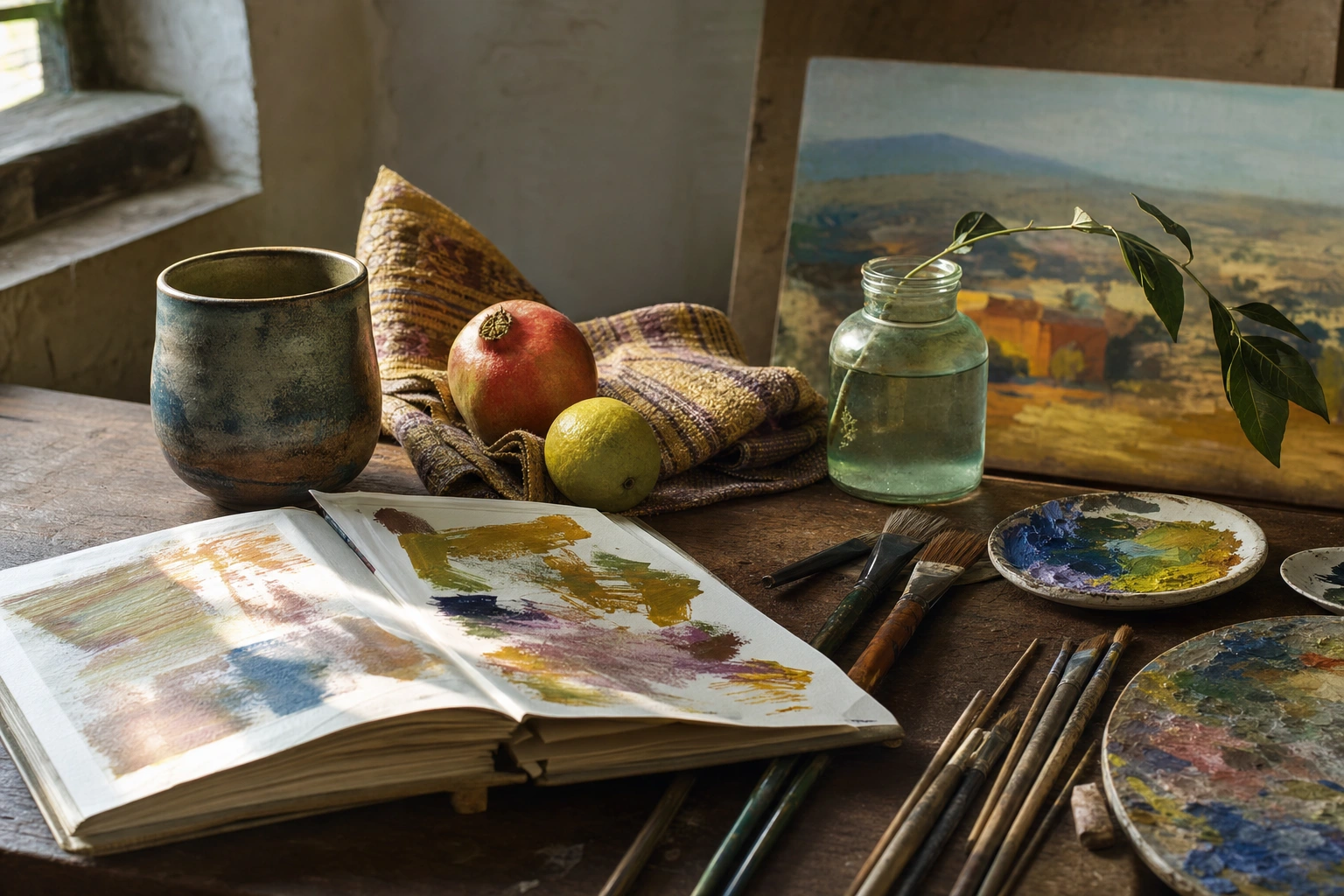
Painting begins with looking. Before an artist mixes colour or makes a mark, they must notice what is in front of them: the direction of light, the shape of a shadow, the relationship between objects, the character of a surface and the visual details that make one subject different from another. Observation turns a general idea into a specific image.
Observation in painting is not simply copying what the eye sees. It is an active process of selecting, comparing, interpreting and recording information. Whether you are painting a still life in a Nairobi studio, a landscape near Lake Naivasha, a market scene in Kumasi or an imagined interior based on memory, stronger observation helps you make more convincing and intentional decisions.
What Observation Means in Painting
In everyday life, people often look at objects quickly and identify them by name. We see a cup, a tree, a face or a building and rely on memory to fill in the details. Painters need to look more slowly. They must temporarily set aside symbols and assumptions so that they can study the subject's actual visual qualities.
For example, a beginner may paint a tree using a familiar symbol: a brown trunk with a rounded green crown. An observant painter asks more precise questions. Is the trunk straight or divided into several branches? Where is the foliage dense, and where can the sky be seen through it? Is the green warm, cool, dark or affected by nearby colours? Does the tree lean into the composition? These questions produce a painting based on evidence rather than habit.
Observation therefore involves three connected activities:
- Looking closely: noticing shapes, edges, colours, spaces and changes in light.
- Comparing: judging size, angle, distance, value and position in relation to other elements.
- Interpreting: deciding what information is essential to communicate the subject, mood or idea.
Why Observation Matters
It improves proportion and structure
Proportion refers to the size of one part in relation to another. In portrait painting, the placement of the eyes, nose, mouth, ears and hairline affects whether the face feels believable. In a still life, the height of a bottle compared with the width of a bowl determines whether the arrangement appears stable.
Careful observation helps artists compare measurements instead of guessing. A painter might use the length of a brush as a simple measuring guide, checking how many times that length fits into the height of an object. They may also compare angles, such as the slope of a shoulder, the rim of a vessel or the line of a roof. These methods are not mechanical restrictions; they are ways of testing visual relationships.
It reveals form and depth
A flat shape becomes a convincing three-dimensional form through changes in value, colour and edge quality. Observation helps the artist identify where a surface turns away from the light, where a cast shadow begins and where one plane meets another.
Consider a painted orange. Its roundness is not created by outlining it with a dark line. It is suggested by a gradual shift from the lighter, illuminated side to the middle tone and then to the darker side. A small reflected light may appear near the bottom, while the cast shadow anchors the fruit to the table. The painter discovers these relationships by studying the actual object rather than applying a fixed formula.
It makes colour more accurate and expressive
Objects do not have one unchanging colour. A white shirt can appear blue in shadow, yellow near warm sunlight or green beside foliage. A red wall may contain muted violet, orange or brown depending on the light and surrounding surfaces.
Observation encourages painters to see colour relationally. Instead of asking, “What colour is this object?” ask, “How does this area compare with the area next to it?” Is it lighter or darker, warmer or cooler, brighter or duller? This approach is useful in both realistic and expressive painting. Even when an artist deliberately changes the palette, the decision becomes more convincing when it responds to observed relationships.
It strengthens composition
Composition is the arrangement of visual elements within the picture. Observation helps an artist recognise patterns of movement, balance and emphasis before committing to a finished painting.
When studying a street scene, for example, you may notice that power lines create diagonals, a group of figures forms a dark shape and a bright wall draws attention towards one side of the image. These relationships can guide the composition. The final painting may simplify or rearrange the scene, but observation provides the visual material from which those choices are made.
Observation and the Difference Between Seeing and Knowing
One of the greatest challenges in painting is the difference between what we know and what we see. We know that a plate is circular, so we may paint it as a circle from every viewpoint. In reality, a plate viewed from above at an angle usually appears as an ellipse. We know that eyes are similar in structure, so we may place them symmetrically, even when a person's head is turned.
To overcome this habit, focus on visible shapes rather than object names. Instead of painting “an eye”, observe the dark and light shapes around the eye, the angle of the eyelid, the shadow beneath the brow and the surrounding skin tones. Instead of painting “a chair”, observe the connected angles and negative spaces between its legs and back.
Negative space is the area around and between objects. It is often easier to assess than the object itself. If you are drawing a seated figure, study the triangular gap between the arm and torso or the shape beneath the chair. Accurate negative spaces frequently lead to more accurate positive forms.
Different Forms of Observation
Direct observation
Direct observation involves working from a subject that is physically present. Still-life arrangements, live models, buildings, plants and landscapes are common subjects. This approach provides immediate information about light, atmosphere, scale and texture. It also teaches the artist to work within changing conditions.
Working from photographs
Photographs are useful references, especially when a subject moves quickly or cannot remain available. However, a photograph is not a complete substitute for seeing in person. It may flatten depth, alter colour, crop important context or freeze a moment that feels unusual.
When using a photograph, study it critically. Identify the light source, check whether the camera angle distorts proportions and decide which details support the painting's purpose. Combining several references can help you avoid treating one photograph as an unquestionable record.
Memory and imaginative observation
Imaginative painting still depends on observation. An artist painting a fictional landscape needs knowledge of how clouds gather, how buildings occupy space, how fabric folds and how bodies balance. Memory can simplify these observations, but it becomes more reliable through repeated study.
Many artists move between observation and imagination. They may sketch a local market, remember its colours and sounds, then create a larger composition that communicates atmosphere rather than documenting one exact moment. Observation supplies credibility; imagination supplies selection and meaning.
Practical Observation Techniques
Begin with large shapes
Before adding detail, identify the largest masses in the subject. In a landscape, these might be the sky, distant land, middle ground and foreground. In a portrait, they may be the head shape, neck, hair mass and shoulders. Block these areas in lightly and check their placement before refining them.
This prevents a common problem: spending too much time on a small feature while the overall structure remains inaccurate. A beautifully painted eye cannot rescue a portrait if the head is incorrectly positioned.
Use comparative measurement
Choose one dimension as a unit and compare other dimensions against it. You might compare the width of a jar with its height, or the distance between two facial features with the width of the nose. You can also compare positions: how high is the horizon in relation to the canvas? How far is the subject from the nearest edge?
Measurement does not require sophisticated equipment. A pencil, ruler or viewfinder can help, but the central skill is comparison. Recheck measurements throughout the painting because later marks can change your perception of earlier ones.
Study light and value before colour
Squinting slightly can reduce distracting detail and help you see broad light and dark patterns. You can also make a small monochrome study before beginning a colour painting. This allows you to test the arrangement of values and identify the focal point.
Ask whether the main subject separates clearly from its background. If everything has a similar value, the painting may feel confused even if the colours are attractive. Strong observation helps you see the structure beneath surface colour.
Observe edges
Edges may be sharp, soft, broken or lost. A hard edge can indicate a strong change in form or a sharply focused area. A soft edge may suggest a rounded turn, atmospheric distance or gentle lighting. A lost edge occurs when adjacent areas have similar values or colours.
Painting every boundary with the same dark outline often makes an image look flat. Observe where edges are most distinct and where they dissolve. This creates depth and directs attention.
Make quick studies
Short studies encourage decisive looking. Set a timer for five or ten minutes and record only the main shapes, value groups and direction of movement. Do not aim for a finished artwork. Make several studies from different viewpoints, then choose the strongest arrangement for a longer painting.
Observation, Texture and Material
Texture is not merely a collection of surface marks. It is the visual evidence of a material's structure. Glass may show sharp reflections and transparent overlaps. Wood may contain directional grain and uneven edges. Woven fabric may display repeated rhythms, while rough stone may contain irregular changes in value.
Observe how light behaves on the material before trying to imitate its appearance. Smooth surfaces often produce clearer, more concentrated highlights; rough surfaces break light into smaller, less predictable changes. A painter does not need to render every mark. A few carefully placed observations can communicate the material more effectively than uniform detail across the entire image.
Observation in Portrait and Figure Painting
When painting people, observation must include both structure and individuality. Head shape, posture, gesture and the distribution of light contribute to likeness. Small features matter, but they work within a larger arrangement.
Start by studying the direction of the head and the body's overall gesture. Notice whether the weight is balanced on one leg, whether the shoulders tilt and how the spine curves. Then compare the large planes of the face: forehead, cheek, nose, mouth and jaw. Skin is not a single colour; it responds to surrounding light and nearby surfaces.
Respectful observation also means avoiding stereotypes. African faces, bodies and hairstyles are not one visual type. A good portrait painter studies the particular person in front of them, including their individual proportions, expression, complexion and presence.
Common Problems and How to Correct Them
- Drawing from symbols: Replace familiar icons with studies of actual shapes and negative spaces.
- Adding detail too early: Return to the largest shapes, proportions and value groups.
- Ignoring the background: Observe how the background affects edges, contrast and colour temperature.
- Using local colour mechanically: Compare each colour with its neighbours and with the light source.
- Painting what you expect to see: Pause and describe the visible evidence without naming the object.
- Overworking every area: Reserve the sharpest detail and strongest contrast for the intended focal point.
Applying This in Practice
Try the following exercise with a simple household arrangement, such as a cup, a folded cloth and a fruit. Place the objects near a single window or lamp.
- Spend two minutes looking without painting. Identify the dominant shapes, the light direction and the darkest area.
- Make three small thumbnail sketches using only light and dark masses.
- Choose one thumbnail and lightly place the objects on your canvas, checking their proportions and negative spaces.
- Block in the main value groups before mixing detailed colours.
- Compare the temperature and intensity of neighbouring colours rather than relying on the objects' names.
- Refine only the edges and textures that help describe form or attract attention.
- After finishing, place the painting beside the subject and write down three observations that were accurate and three that were guessed.
Repeat the exercise with different lighting or viewpoints. For a more advanced challenge, paint the same arrangement twice: once as accurately as possible and once with a deliberately altered palette or composition. The comparison will show which imaginative changes remain supported by convincing observation.
Key Takeaways
- Observation means actively studying relationships of shape, proportion, value, colour, edge and space.
- Compare parts of a subject instead of relying on symbols or assumptions about how objects should look.
- Begin paintings with large shapes and value groups before adding small details.
- Use negative spaces, comparative measurement and quick studies to test accuracy.
- Study how light behaves on different materials to communicate texture convincingly.
- Observation supports imagination by giving invented subjects believable structure and visual evidence.
No comments yet.