
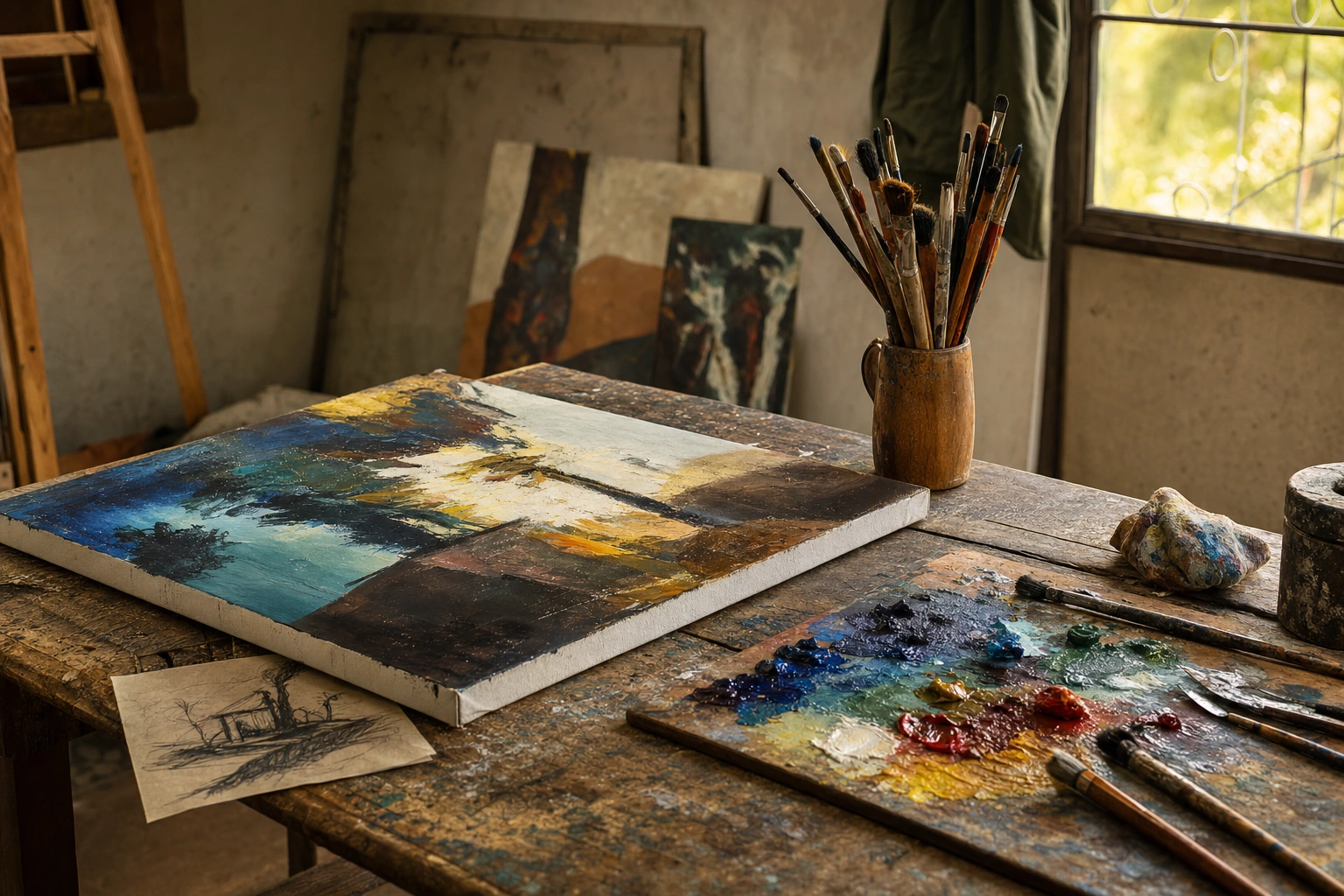
Painting is one of the oldest and most adaptable forms of visual expression. Through colour, line, shape, texture and composition, a painter can record what is seen, communicate what is felt, explore an idea or invite viewers to see an ordinary subject differently. A painting may represent a person or place recognisably, or it may use simplified and abstract forms to communicate an experience that words cannot easily describe.
Understanding painting as visual expression helps both makers and viewers look beyond the question, “What does this picture show?” A more useful question is, “How has the artist used visual choices to communicate meaning?” This approach is valuable for students, practising artists, designers, educators and anyone developing visual literacy.
What Is Painting as Visual Expression?
Painting is the process of applying a medium such as paint to a surface in order to create an image, arrangement or visual experience. The surface may be canvas, paper, board, a wall, fabric, wood or another suitable material. Common painting media include watercolour, acrylic, oil, gouache and tempera. Each medium has different qualities: watercolour can appear transparent and fluid, acrylic dries relatively quickly and can be layered, while oil paint often remains workable for longer and allows rich blending.
Visual expression refers to the communication of thoughts, emotions, observations and ideas through what can be seen. In painting, meaning is not carried by a single feature. It develops through the relationship between the subject, materials, colours, marks, scale, spatial arrangement and the viewer’s interpretation.
For example, a painting of a market may document a place, but it may also express energy through crowded shapes, movement through diagonal lines, warmth through strong oranges and reds, or social connection through the arrangement of figures. The artist’s decisions transform a simple scene into a personal statement.
Why Painting Communicates So Effectively
Painting can communicate across differences in language and education because viewers respond directly to visual qualities. A dark, confined composition may suggest tension even before the viewer understands its subject. A wide arrangement with open space may create a sense of calm or solitude. These responses are not always identical, because viewers bring their own memories and cultural knowledge, but the visual structure gives them a starting point.
Painting also allows several layers of meaning to exist at once. A portrait can show physical appearance, social position, family history and the sitter’s relationship with the painter. A landscape can be a study of light, a record of environmental change or an expression of belonging to a particular place. A still life can explore beauty, mortality, domestic life or material value.
Unlike a written explanation, a painting does not always present its message in a fixed sequence. The eye may move from a bright area to a face, then to a background detail and back to the main subject. This makes viewing an active process. The artist guides attention, but the viewer completes the experience through observation and interpretation.
The Main Elements of Painting
Artists use the elements of visual language as writers use words and sentences. Learning to recognise these elements makes it easier to plan a painting and discuss its effect.
Colour
Colour can describe reality, establish mood, create emphasis and suggest symbolism. Warm colours such as red, orange and yellow may appear lively, intimate or urgent, while cool colours such as blue and green may suggest distance, quietness or reflection. These associations are not universal rules. Cultural context, personal experience and the surrounding colours can change how a colour is understood.
Artists also work with hue, or the colour family; value, meaning lightness or darkness; and intensity, meaning brightness or dullness. A painting with strong value contrast may feel dramatic, while a painting using closely related values may feel gentle and unified.
Line and Mark
Line may be visible as a clear contour or suggested by the edge between two colour areas. Smooth, controlled lines can communicate order or delicacy. Broken, rough or energetic marks can communicate movement, uncertainty or emotion. Brushwork itself becomes part of the subject. A painter may use short strokes to suggest leaves, broad strokes to describe architecture or irregular marks to show the pressure of an emotional moment.
Shape and Form
Shape is a two-dimensional area enclosed by an edge, while form suggests three-dimensional volume. A painter creates the impression of form through changes in value, colour and perspective. Geometric shapes can make a composition feel structured, whereas organic shapes may feel natural and spontaneous.
In a portrait, the shape of the head, shoulders and surrounding space affects how the sitter is understood. Enlarging the hands may draw attention to labour or skill. Simplifying the body into strong shapes may make the painting more symbolic than descriptive.
Texture
Texture describes how a surface appears or feels. Paint can be applied smoothly, scraped, layered, dotted or mixed with materials to create a tactile surface. Even when viewers cannot touch the artwork, visible texture can suggest rough stone, soft fabric, wet soil or weathered wood.
Texture also reveals the artist’s physical process. Thick, visible paint may make the act of painting noticeable, while thin, carefully blended layers may direct attention towards the represented subject.
Space and Depth
Space refers to the areas occupied by objects and the gaps around them. Artists create depth through overlapping forms, changes in scale, linear perspective, atmospheric effects and the placement of objects in the foreground, middle ground and background. They may also reject realistic depth altogether and arrange shapes on a flatter surface.
The amount of empty or unpainted space matters. A figure surrounded by open space may appear isolated, important or contemplative. A crowded composition can suggest abundance, social activity or pressure.
Composition
Composition is the organisation of visual elements within the picture. It includes the position of the main subject, the balance of light and dark areas, the direction of movement and the path followed by the viewer’s eye. A central arrangement may communicate stability or importance. An off-centre arrangement may create tension or invite the viewer to consider what lies outside the frame.
Balance does not always mean symmetry. A small, bright shape can balance a large, dark area. Repetition can create rhythm, while contrast can establish a focal point. Good composition supports the intended meaning rather than following a single formula.
Representation, Interpretation and Abstraction
Painting can express ideas through different degrees of resemblance to the visible world. Representational painting recognisably depicts people, objects or places. It may be realistic, stylised or selective. A painter does not need to copy every detail to communicate the character of a subject.
Interpretive painting changes or emphasises aspects of reality to communicate a personal response. An artist might exaggerate colour, distort proportions or simplify a landscape to convey heat, memory or movement.
Abstract painting reduces or removes direct references to recognisable objects. It may communicate through colour relationships, gesture, rhythm, scale and structure. Abstraction is not the absence of meaning; its meaning is often built through visual associations and the viewer’s experience of the work.
These approaches can overlap. A painter may begin with a recognisable Kenyan coastal scene, for instance, then flatten the buildings, intensify the turquoise sea and repeat curved forms to express memory rather than provide a literal record. The important issue is whether the chosen approach supports the artist’s purpose.
Painting, Culture and Identity
Painting can preserve cultural knowledge and make personal or collective identities visible. Artists may draw on clothing, architecture, ceremonies, landscapes, family objects, patterns, oral histories or everyday work. Such references can communicate where a subject belongs and how it relates to a community.
At the same time, cultural imagery should be approached thoughtfully. A symbol may carry meanings that are not obvious to an outside viewer, and borrowing from a community without understanding its context can lead to simplification or misrepresentation. Artists should research relevant traditions, acknowledge influences honestly and avoid treating living cultures as decorative material.
Contemporary African painters work across many approaches, including portraiture, social commentary, landscape, abstraction and mixed media. A painting of a matatu stop, a family compound, a market stall or a changing urban neighbourhood can address wider questions about work, mobility, class, memory and development. Local subject matter can have global significance when it is explored with depth and specificity.
The Painting Process as a Form of Thinking
Painting is not only the final image; the process itself can help an artist discover meaning. A practical process may include the following stages:
- Identify the intention. Decide what you want the viewer to notice, feel, question or remember. The intention might be to study light, honour a person, explore a social issue or investigate a colour relationship.
- Research and observe. Make sketches, take notes, study reference material and look carefully at the subject. Observation helps distinguish between a general idea and a specific visual experience.
- Generate small studies. Create quick thumbnail sketches or colour tests. Try different viewpoints, crops, backgrounds and value arrangements before committing to a large surface.
- Prepare the materials. Select a suitable surface, brushes, palette and medium. Consider drying time, layering, transparency and the scale of the work. Practical preparation protects the idea from avoidable technical problems.
- Establish the main structure. Lightly place the largest shapes and check proportions, spatial relationships and the position of the focal point. A strong underlying structure makes later detail more effective.
- Develop colour and form. Build layers, adjust values and clarify the relationship between foreground and background. Work from large relationships towards smaller details rather than polishing one area too early.
- Review and revise. Step away from the painting, view it from a distance or turn it upside down to assess the overall arrangement. Ask whether the visual choices still support the original intention.
This process is flexible. Some artists plan carefully, while others rely on improvisation. Both methods can produce strong work when the painter remains attentive to the decisions being made.
How to Read and Discuss a Painting
Viewers can analyse a painting without reducing it to a single correct answer. Begin with observation: what colours, shapes, objects, marks and spatial relationships are visible? Next, describe the arrangement. Where does the eye go first, and what creates that emphasis?
Then consider interpretation. What mood or idea might the painting communicate? Which visual choices support that reading? Finally, consider context: who made the work, when, where and for what purpose? Information about the artist can deepen understanding, but the visible evidence in the painting should remain central.
A useful discussion separates observation from interpretation: “The figure is placed near the edge of the canvas” is an observation, while “the figure appears excluded” is an interpretation that should be supported by the composition.
This distinction is particularly useful in classrooms and professional critique. Instead of saying that a painting is simply “good” or “bad”, discuss what it is attempting to do, which decisions are effective and where the visual communication could become clearer.
Common Challenges for Developing Painters
Many beginners focus on detail before establishing proportion, value and composition. A carefully painted eye cannot rescue a portrait whose head is incorrectly positioned. Working first with large shapes and a limited palette can make the structure easier to evaluate.
Another challenge is copying reference images without developing a point of view. Reference material is useful, but the artist should decide what to include, omit or change. Ask what makes the subject meaningful to you and how the medium can express that response.
Fear of mistakes can also produce stiff work. Painting involves adjustment: colours can be changed, surfaces can be layered and sections can be removed or painted over, depending on the medium. Keeping experiments small and maintaining a visual journal can make risk-taking more manageable.
Applying This in Practice
Choose a familiar subject such as a cooking pot, a bicycle, a roadside tree or a view from a window. Make three small sketches. In the first, focus on accurate shape; in the second, exaggerate the colour to communicate a mood; in the third, simplify the subject into a few large abstract forms.
Before painting, write one sentence describing your intention. During the process, use a limited number of colours and pause regularly to assess the overall value pattern. When finished, record which decisions helped express the intention and which ones distracted from it. Ask another viewer what they noticed first, without explaining your idea beforehand. Their response can reveal whether the composition is directing attention as you intended.
Key Takeaways
- Painting communicates through the combined use of colour, line, shape, texture, space and composition.
- Visual expression can represent reality, interpret it selectively or communicate through abstraction.
- Colour, value and spatial arrangement influence mood, emphasis and the viewer’s movement through an image.
- Research and observation help artists create work that is specific, meaningful and culturally responsible.
- Small sketches and colour studies allow painters to test ideas before committing to a large work.
- Useful critique separates what is visibly present from the interpretations drawn from it.
No comments yet.