
First aid is the immediate care given to someone who is injured or suddenly unwell before professional medical help is available. It may take place at home, in a workplace, on a farm, beside a road or in a public space. Its purpose is not to replace diagnosis or hospital treatment, but to preserve life, prevent a condition from becoming worse and support recovery.
Good first aid depends less on having an impressive collection of equipment than on using a calm, organised approach. A first aider must protect themselves, identify the most urgent problem, take sensible action and arrange appropriate medical assistance. Even simple steps—such as applying firm pressure to severe bleeding or placing an unconscious but normally breathing person in a safe position—can make an important difference.
What First Aid Is Designed to Achieve
The traditional aims of first aid are often expressed as three priorities:
- Preserve life: support breathing and circulation, control severe bleeding and respond quickly to life-threatening emergencies.
- Prevent deterioration: protect an injury, reduce further harm and avoid unsafe movement or treatment.
- Promote recovery: provide reassurance, comfort and suitable care while the person receives further help.
These aims help a first aider decide what matters most. A minor cut should not distract someone from a person who is unconscious. Similarly, a painful arm injury is important, but it normally comes after checking whether the casualty can breathe and whether there is life-threatening bleeding.
The Core Principles of First Aid
1. Protect yourself and make the scene safe
Do not rush into danger. Traffic, fire, electrical wires, collapsing structures, violence, chemical spills, deep water and infectious bodily fluids can injure a rescuer. Look around before approaching and, where possible, remove hazards or keep other people away.
Use disposable gloves or another suitable barrier when there may be blood or other body fluids. If gloves are unavailable, avoid direct contact and wash your hands thoroughly afterwards. Personal safety is not selfish: a second injured person creates a larger emergency and may prevent help from reaching the original casualty.
2. Obtain consent and respect dignity
If the person is conscious and able to communicate, explain who you are, what you think is wrong and what you want to do. Ask permission before providing care. Give the person a chance to describe symptoms and respect cultural, personal and privacy needs as far as the situation allows.
In a life-threatening emergency, a person who is unconscious or unable to respond cannot give direct consent. In most settings, providing reasonable emergency assistance is understood as acting in their best interests. Avoid unnecessary exposure of the body, ask bystanders to give privacy and never share photographs or personal details without permission.
3. Assess the casualty systematically
Use a simple sequence so that stress does not cause you to miss a critical problem. From a safe position, check whether the person responds when you speak to them and gently tap their shoulders if appropriate. Ask someone nearby to call emergency services and bring a first-aid kit or automated external defibrillator (AED), if available.
Next, check whether the person is breathing normally. Occasional gasping or irregular snorting is not normal breathing. If the person is unresponsive and not breathing normally, begin CPR and use an AED as soon as one is available, following its spoken or visual instructions. If the person is unresponsive but breathing normally, place them in the recovery position if there is no reason to suspect that movement would cause greater harm, and monitor their breathing continuously.
If the person is responsive, ask about the main problem and look for urgent signs such as heavy bleeding, difficulty breathing, severe chest pain, confusion, weakness on one side, burns, poisoning or serious injury. A useful principle is to deal first with problems that threaten the airway, breathing or circulation.
4. Call for professional help early
First aid should happen alongside, not instead of, professional assistance. Tell emergency services what happened, the exact location, the number of people affected and the person’s condition. Follow the dispatcher’s instructions and send someone to guide responders if the location is difficult to find.
Do not assume that someone else has made the call. In a workplace, school or public place, assign a specific person: “Please call emergency services and return to tell me when it has been done.” If you are alone, use your local emergency procedure and place the call as soon as possible without abandoning an immediate life-saving action.
5. Give only appropriate care
A first aider should work within their training and confidence. Do not give medicines, food or drink unless it is safe, appropriate and within your training. Do not attempt procedures that could worsen the injury, and do not delay urgent medical help while searching for a perfect solution.
Monitor the person regularly. Note changes in breathing, responsiveness, pain, skin colour or behaviour. Reassure them without making promises about the outcome. Keep them warm, but do not overheat them, and record useful information for the medical team, including known allergies, medicines, events leading to the emergency and care already provided.
Practical Responses to Common Emergencies
Severe bleeding
Severe bleeding can become life-threatening quickly. Help the person lie down if possible and apply firm, direct pressure to the wound using a sterile dressing, clean cloth or gloved hand. Keep pressure continuous. If blood soaks through, place another dressing or cloth over the first rather than removing it.
If an object is embedded in the wound, do not pull it out. Apply pressure around it and support it with dressings. If a limb has been severely injured or bleeding cannot be controlled by direct pressure, emergency services may give specific instructions about a tourniquet. Do not improvise one unless you have appropriate training or are directed by a qualified emergency dispatcher.
Burns and scalds
First remove the person from the source of heat if it is safe to do so. Cool the burn under cool, clean running water for about 20 minutes, as soon as possible. Remove jewellery, watches and loose clothing near the injury before swelling develops, but do not remove anything stuck to the skin.
Cover the cooled burn loosely with a sterile non-stick dressing or clean plastic film. Do not apply ice, butter, oil, toothpaste or unknown creams, and do not burst blisters. Seek urgent medical help for extensive, deep or electrical burns, burns involving the face, hands, feet, genitals or major joints, and burns in very young or vulnerable people.
Choking
If a person can cough forcefully or speak, encourage them to keep coughing and observe them closely. Do not put your fingers blindly into their mouth. If they cannot speak, breathe or cough effectively, give up to five firm back blows between the shoulder blades, checking after each one. If this does not clear the blockage, give up to five abdominal thrusts, then alternate between back blows and abdominal thrusts while arranging emergency help.
Do not use abdominal thrusts on a pregnant person or someone whose abdomen cannot be reached; chest thrusts may be used instead by a trained rescuer. If the person becomes unresponsive, lower them safely to the floor, call for emergency help and begin CPR according to your training and dispatcher guidance.
Suspected fractures, sprains and spinal injury
Keep the injured area still and support it in the position found. Do not straighten a deformed limb or push a protruding bone back under the skin. Check for serious bleeding and protect any open wound with a clean dressing. Cold packs wrapped in cloth may help swelling from a minor sprain, but should not be placed directly on the skin.
After a major fall, road crash or blow to the head, neck or back, assume a spinal injury is possible. Tell the person to remain still and avoid moving them unless there is immediate danger, they need CPR or their airway cannot otherwise be protected. Keep monitoring breathing and responsiveness.
Medical emergencies
Chest pressure, tightness or pain—especially with sweating, nausea, breathlessness or pain spreading to the arm, back, neck or jaw—may indicate a heart attack. Help the person rest in a comfortable position and arrange emergency medical help immediately. Do not allow them to drive themselves.
For a possible stroke, remember FAST: Face—is one side drooping? Arms—can both arms be raised? Speech—is speech slurred or unusual? Time—seek emergency help immediately. Note when symptoms began or when the person was last known to be well.
During a seizure, remove nearby hazards, cushion the head and time the seizure. Do not restrain the person and do not put anything in their mouth. When the movements stop, check breathing and place them in the recovery position if appropriate. Seek urgent help if the seizure lasts unusually long, repeats, occurs in water, causes serious injury, happens during pregnancy or is the person’s first known seizure.
What First Aiders Should Avoid
- Do not place yourself in danger or create additional casualties.
- Do not move a seriously injured person unless necessary for safety, CPR or airway protection.
- Do not give an unconscious person anything to eat or drink.
- Do not remove embedded objects, break blisters or apply household substances to burns.
- Do not diagnose confidently when the signs are uncertain; describe what you observe and seek professional advice.
- Do not leave a seriously ill or injured person alone unless you must obtain emergency help.
Preparing for First-Aid Situations
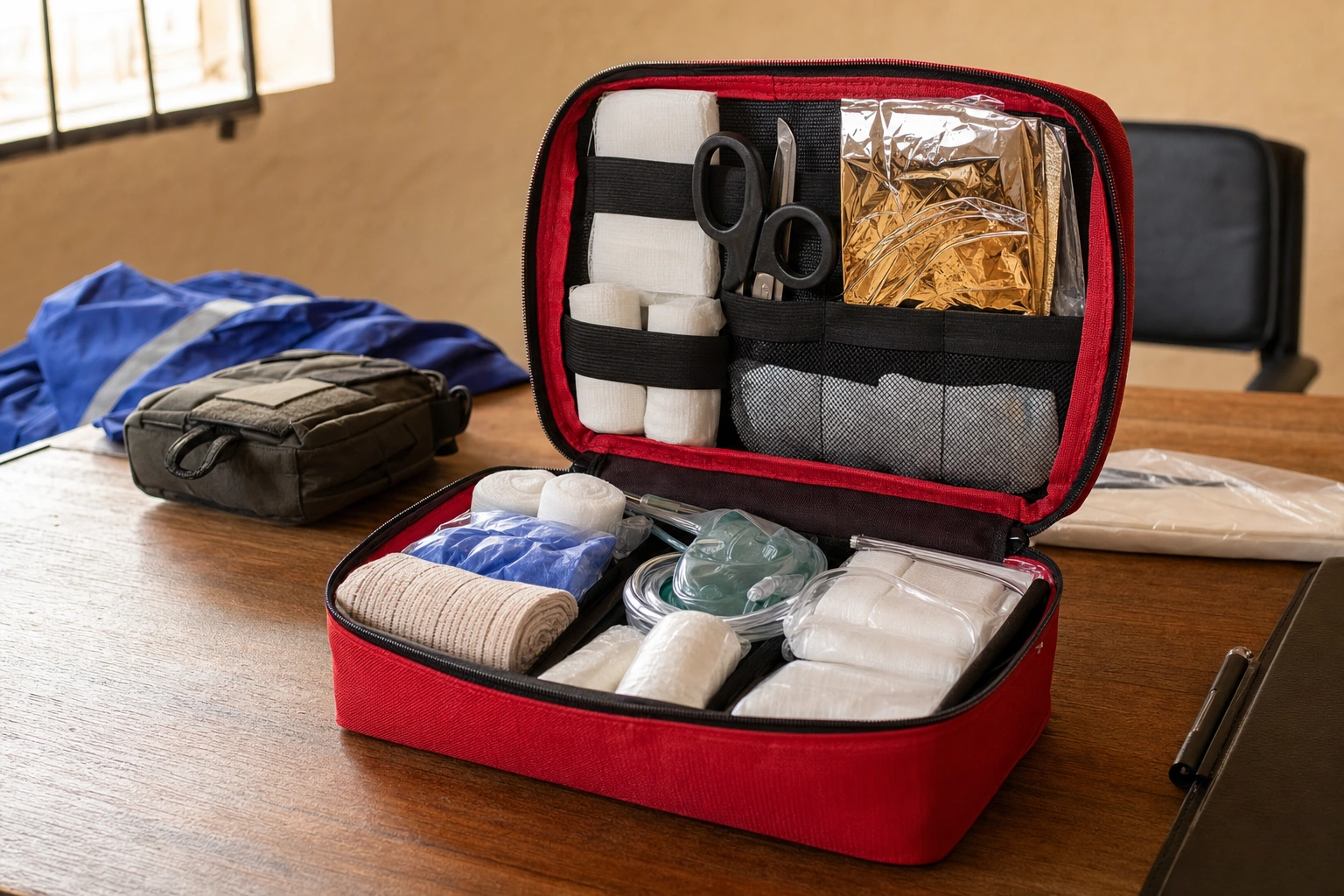
Preparation makes sound decisions easier. Keep a stocked first-aid kit where people can find it, and check it regularly for expired, damaged or missing supplies. Useful items may include gloves, sterile dressings, adhesive tape, bandages, triangular bandages, scissors, a foil blanket, antiseptic wipes and a resuscitation face shield. A kit should support trained care, not encourage untrained procedures.
Businesses, schools, community groups and households should identify emergency contacts, clear addresses, access points and local healthcare facilities. Workplaces should consider hazards specific to their activities, such as machinery, chemicals, construction, kitchens or field work. First-aid training, refreshed periodically through a recognised provider, is more valuable than relying on written instructions alone.
Applying This in Practice
- Pause and scan: identify danger before approaching.
- Check response and breathing: determine whether the person needs immediate life-saving care.
- Delegate clearly: ask a named person to call emergency services, fetch equipment or meet responders.
- Treat the greatest threat first: address airway, breathing, circulation and severe bleeding before less urgent injuries.
- Reassure and monitor: keep observing the person and respond to changes.
- Handover accurately: tell medical professionals what happened, what you found and what care you gave.
Consider how this sequence would work in your home, office or community setting. Is the emergency address easy to explain? Does everyone know where the first-aid kit is? Who would call for help if several people were present? Thinking through these questions before an incident reduces hesitation and confusion.
Key Takeaways
- First aid preserves life, prevents deterioration and supports recovery until professional care is available.
- Always check scene safety before approaching, and use barriers when contact with blood or body fluids is possible.
- Assess responsiveness and normal breathing first, then prioritise airway, breathing, circulation and severe bleeding.
- Call emergency services early, give clear information and follow the dispatcher’s instructions.
- Use simple, evidence-based actions: direct pressure for severe bleeding, running water for burns and safe positioning for an unresponsive person who is breathing normally.
- Do not move seriously injured people unnecessarily or use treatments outside your training.
No comments yet.