
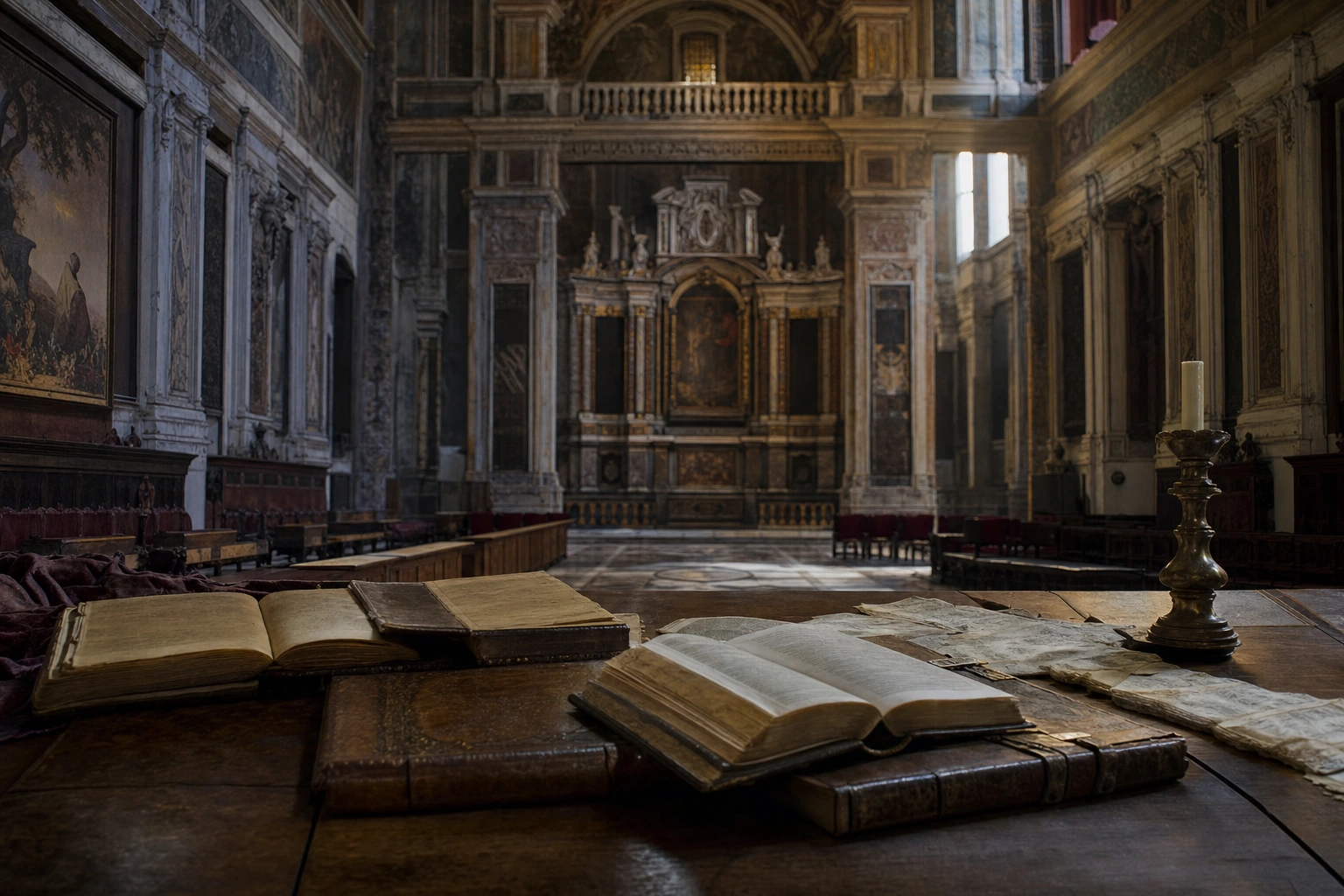
The Catholic Reformation was the Catholic Church’s major programme of renewal and response during the sixteenth and seventeenth centuries. It developed at a time when Protestant reformers were challenging Catholic teaching, church leadership and religious practice across Europe. The movement addressed external criticism, but it was not only a reaction to Protestantism: many Catholic leaders had already called for improved discipline, better education and spiritual renewal before Martin Luther’s challenge in 1517.
Historians often use the term Counter-Reformation to emphasise the Catholic response to Protestantism. However, Catholic Reformation is often preferred because it highlights the Church’s internal changes as well as its efforts to defend Catholic doctrine. Understanding the movement requires attention to both dimensions: the defence of Catholic identity and the reform of Catholic life.
Why the Catholic Reformation Emerged
By the early sixteenth century, the Catholic Church was the dominant Christian institution in western and central Europe, but it faced serious problems. Some church offices were held by individuals who were more interested in status and income than in pastoral responsibility. In certain places, bishops did not live in the dioceses they were expected to supervise. Some priests had limited theological training, making it difficult for them to teach effectively or serve parish communities well.
There were also concerns about financial practices and the abuse of religious authority. The sale of indulgences became especially controversial. An indulgence was traditionally connected with the remission of temporal punishment associated with sin after guilt had been forgiven. In practice, however, some preachers presented indulgences in ways that made them appear to be payments for spiritual benefits. This damaged trust and became one of the issues criticised by Martin Luther.
At the same time, humanist scholars and religious reformers were encouraging Christians to return to Scripture, improve preaching and cultivate a more sincere spiritual life. The printing press allowed religious arguments to spread quickly. Political rulers also had reasons to support reform or challenge papal authority, including disputes over taxation, church property and control of religious institutions.
The Catholic response therefore had several purposes:
- to clarify Catholic teaching;
- to correct abuses and improve the discipline of clergy;
- to strengthen religious education and preaching;
- to renew personal devotion and community life; and
- to defend Catholicism against Protestant expansion.
The Council of Trent
The central institutional event of the Catholic Reformation was the Council of Trent. It met in three main periods between 1545 and 1563 in the city of Trent, then part of the Holy Roman Empire. The council brought together bishops and other church representatives to address doctrine, discipline and reform.
On doctrine, the Council of Trent reaffirmed Catholic teachings that Protestant reformers had questioned. It upheld the importance of both Scripture and Church tradition in transmitting Christian teaching. It confirmed the Catholic understanding of the seven sacraments, rather than the Protestant tendency to recognise only baptism and the Eucharist as sacraments instituted by Christ. It also defended the Catholic teaching that justification involved God’s grace received through faith and expressed in a life of love and obedience, rejecting the idea that faith should be understood as entirely separate from transformed Christian living.
The council reaffirmed the Catholic teaching on the Eucharist, including the real presence of Christ, and maintained the sacrificial character of the Mass. It also defended the veneration of saints, relics and sacred images, while making clear that such practices should direct believers towards God rather than become excuses for superstition or abuse. The council’s decisions established clearer boundaries between Catholic and Protestant positions.
Discipline was equally important. The council required bishops to reside in their dioceses and placed greater emphasis on their responsibility for local churches. It called for the establishment of seminaries to provide systematic training for priests. This was a significant development because it connected priestly ministry with formal education in theology, Scripture, pastoral care and moral teaching. The council also addressed clerical marriage, pluralism and other practices that had weakened discipline in parts of the Church.
The Council of Trent did not solve every problem immediately. Its decrees required implementation by popes, bishops, religious orders and governments, and the quality of reform varied from place to place. Nevertheless, it created a clearer framework for Catholic belief and established standards that shaped Catholic life for centuries.
New and Renewed Religious Orders
Religious orders played a major role in putting Catholic reform into practice. One of the most influential was the Society of Jesus, commonly known as the Jesuits. Founded by Ignatius of Loyola and formally approved by Pope Paul III in 1540, the Society combined disciplined spiritual formation with education, preaching and missionary work.
Jesuit education became one of the most effective instruments of the Catholic Reformation. Jesuits established schools and colleges in many parts of Europe and beyond. Their schools trained clergy, educated laypeople and strengthened Catholic intellectual life. The Society’s Spiritual Exercises, associated with Ignatius, provided a structured method of prayer, reflection and examination of one’s life. Jesuit missionaries also travelled to Asia, Africa and the Americas, adapting their work to local circumstances while seeking to spread Catholic Christianity.
Other orders contributed in different ways. The Capuchins, a reform branch of the Franciscans, emphasised poverty, preaching and service among ordinary people. The Discalced Carmelites promoted a life of prayer and spiritual discipline. Teresa of Ávila and John of the Cross became important figures in the renewal of Carmelite spirituality. Existing orders, including the Benedictines and Dominicans, also pursued reforms in education, discipline and community life.
These orders show that the Catholic Reformation was not simply a campaign directed from Rome. It involved networks of priests, monks, nuns, teachers, missionaries and lay supporters. Their work affected parish worship, education, charitable activity and the everyday religious practices of communities.
Education, Preaching and Parish Life
Reformers recognised that official decrees would have limited effect unless ordinary Christians and local clergy understood Catholic teaching. Catholic leaders therefore placed greater value on catechisms, sermons and the education of priests. A catechism presented essential Christian teaching in an organised question-and-answer format, making it useful for instruction in parishes and schools.
Priests were expected to preach more regularly and to teach the basic elements of Christian belief, including the sacraments, the Ten Commandments, the Lord’s Prayer and the creed. Seminaries improved the consistency of clerical training, although standards differed between institutions. Bishops and religious orders also promoted confession, Eucharistic devotion, pilgrimages, devotional confraternities and works of charity.
In many communities, reform strengthened the relationship between the parish and the wider Church. Parish registers became more important for recording baptisms, marriages and burials. Churches were reorganised, liturgical practices were made more uniform and religious celebrations became more carefully supervised. These changes helped create a more disciplined and identifiable Catholic culture.
Defending Catholicism and Controlling Religious Debate
The Catholic Church also took measures to limit the spread of Protestant ideas and regulate publications. The Roman Inquisition, reorganised in 1542, investigated suspected heresy and sought to protect Catholic teaching. The Index of Forbidden Books listed works that Catholic authorities considered dangerous or unsuitable. Such measures could involve censorship, examination and punishment, and they demonstrate the coercive side of the Catholic Reformation.
It is important to distinguish between reform and repression without pretending that they were entirely separate. Catholic authorities believed that religious unity was essential to social and political order. As a result, they often treated doctrinal disagreement as a threat to both the Church and public stability. In regions where Catholic rulers retained power, Protestant worship could be restricted. In areas contested between Catholic and Protestant authorities, religious conflict sometimes became violent.
This approach had serious human consequences. Religious minorities faced pressure, exclusion or persecution in some territories. The Catholic Reformation strengthened Catholic institutions, but it did not create an atmosphere of broad religious freedom. Its history must therefore be studied with attention to both spiritual renewal and the limits imposed on dissent.
Catholic Art, Worship and Communication
Art and architecture became important means of teaching and strengthening Catholic identity. The style later called Baroque used movement, dramatic lighting, rich decoration and emotional intensity. Churches and artworks were designed to engage the senses and communicate biblical stories, the lives of saints and the significance of the sacraments.
Art was not merely decorative. In societies where many people could not read, paintings, sculptures and church ceremonies communicated religious ideas visually and emotionally. Catholic authorities encouraged images that were clear, dignified and doctrinally appropriate. The Council of Trent supported the use of sacred art while warning against confusion, superstition and inappropriate representation.
Music, processions, preaching and public religious festivals also contributed to Catholic renewal. The Mass remained the centre of worship, and greater attention was paid to order and uniformity. In this way, the Catholic Reformation engaged the whole religious environment: buildings, images, education, ritual, music and personal devotion.
Missionary Expansion Beyond Europe
The Catholic Reformation coincided with major European overseas expansion. Catholic missionaries travelled to the Americas, parts of Africa and Asia, carrying the Church’s teachings and institutions with them. Some missionaries learned local languages, established schools and defended Indigenous communities against certain forms of exploitation. Others operated within colonial systems and became connected to European political power.
Missionary history is therefore complex. It includes education, translation, medical and charitable work, and the formation of new Christian communities. It also includes cultural pressure, conflict with existing religious traditions and the close relationship between evangelisation and empire. A careful study avoids describing missionary activity as either entirely benevolent or entirely destructive.
In Africa, Catholic missions developed in different ways depending on the region, period and relationship with local rulers and communities. The long-term history of Christianity in Africa cannot be explained only by European action. African converts, teachers, catechists and church leaders actively interpreted, adapted and shaped Christian practice. This wider perspective is essential when connecting the Catholic Reformation to later global Catholic history.
Results and Historical Significance
By the seventeenth century, the Catholic Church had become more centralised, disciplined and clearly defined. Seminaries produced better-trained priests, religious orders expanded their educational and missionary work, and Catholic teaching was more precisely stated. Catholic rulers and institutions also recovered or defended territory in several areas affected by Protestant reform.
The movement helped produce a more confessional Europe, in which states and communities were increasingly identified as Catholic, Lutheran, Calvinist or associated with other Christian traditions. This sharpened religious boundaries but also contributed to conflict. The division of western Christianity became a long-term reality rather than a temporary dispute.
The Catholic Reformation also influenced the global development of Catholicism. Schools, missions, devotional practices and administrative structures carried Catholic ideas well beyond Europe. At the same time, local communities shaped those ideas in ways that varied according to language, culture and political circumstances.
For students of church history, the most useful interpretation is balanced. The Catholic Reformation was a response to Protestantism, but it was also a programme of internal renewal. It corrected some abuses and improved clerical education, while also strengthening censorship and opposition to religious dissent. It renewed Catholic spirituality and expanded the Church’s global reach, but its missionary and political history must be examined within the realities of colonial power.
Applying This in Practice
When studying the Catholic Reformation, use a framework that separates its major dimensions rather than treating it as one simple event.
- Start with context: identify the religious, political, intellectual and technological changes that shaped the sixteenth century.
- Examine doctrine: compare Catholic decisions at Trent with the specific Protestant teachings they addressed.
- Examine discipline: ask how seminaries, residential bishops, preaching and parish supervision changed church life.
- Study people and institutions: consider the roles of the Jesuits, Capuchins, reforming bishops, Teresa of Ávila and other actors.
- Assess methods: distinguish education, spiritual renewal and charity from censorship, coercion and persecution.
- Include global perspectives: investigate how missionaries, African and Asian communities, Indigenous peoples and local leaders shaped Catholic history.
For an essay, a strong argument might be that the Catholic Reformation succeeded because it combined clear doctrinal definition with institutional reform and renewed religious communication. That argument can then be tested against its limitations, including uneven implementation, repression and the effects of European imperial expansion.
Key Takeaways
- The Catholic Reformation combined internal Catholic renewal with a response to Protestant challenges.
- The Council of Trent clarified Catholic doctrine and introduced important standards for clerical education and discipline.
- Religious orders, especially the Jesuits, helped advance education, spirituality, preaching and missions.
- Catechisms, seminaries, parish supervision, art and worship strengthened Catholic religious identity.
- The movement included censorship and persecution as well as reform, so it should be studied critically.
- Catholic missions expanded globally, but local communities actively shaped the development of Christianity.
No comments yet.