
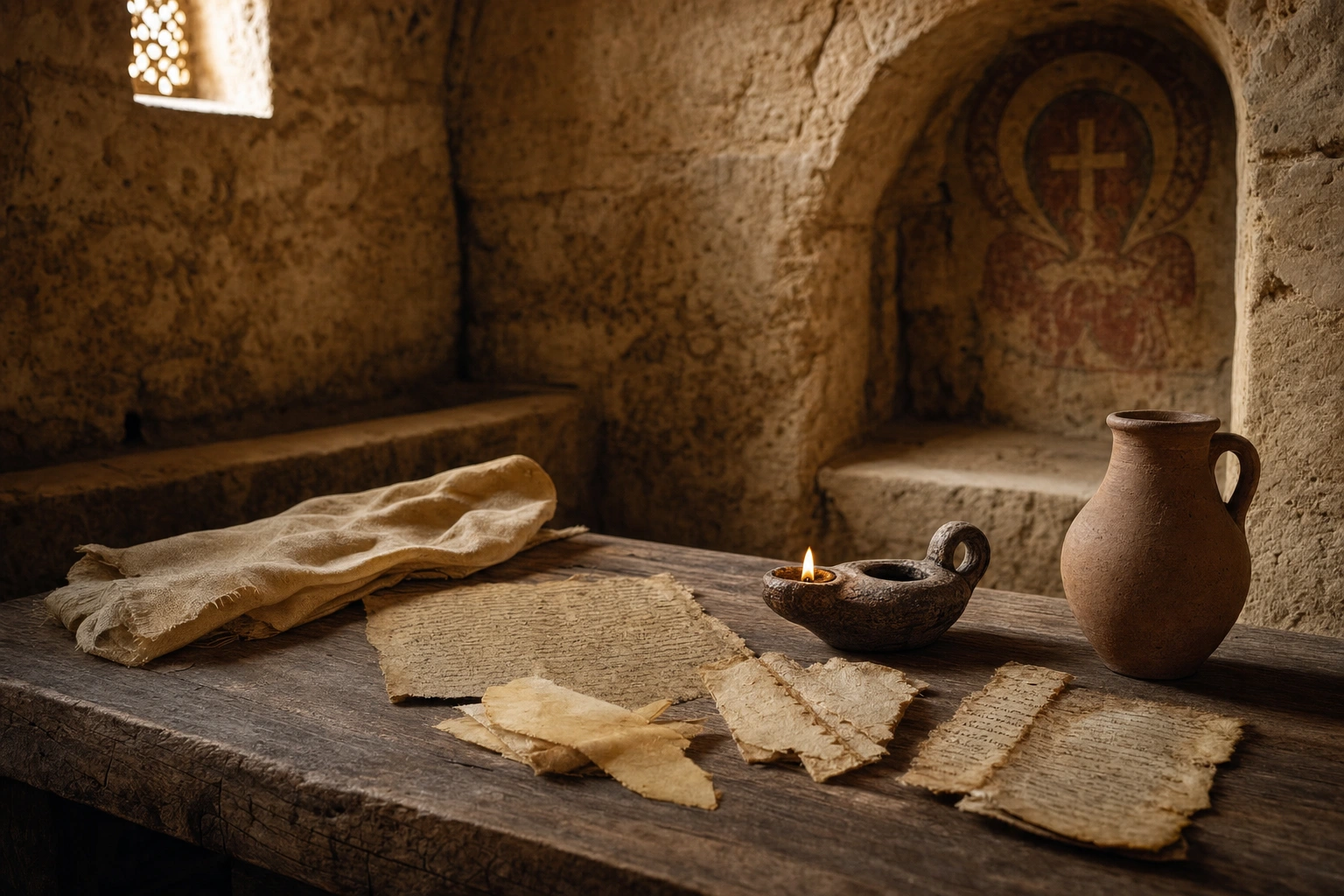
The history of early Christianity includes periods of hostility, imprisonment, violence and martyrdom. Yet the common picture of Christians being persecuted continuously throughout the Roman Empire is too simple. Opposition varied greatly by place and period. Some Christians lived for years without serious interference, while others faced local accusations, public trials or organised imperial action.
To understand persecution and the early Christians, it is important to examine the political, religious and social world of the Roman Empire. Christians were a small and often misunderstood movement. Their refusal to participate in certain public religious practices could be interpreted as disloyalty, while their private meetings and exclusive beliefs sometimes created suspicion. At the same time, persecution was not inevitable everywhere, and Roman authorities did not always seek Christians out.
What persecution meant in the early church
Persecution can refer to several forms of pressure. Early Christians might be mocked, excluded from family or professional networks, accused before local officials, imprisoned, fined, beaten, exiled or executed. These experiences were not equally distributed. A Christian in one city might worship with little interference, while another in a neighbouring city could be arrested after a public accusation.
It is also useful to distinguish between social hostility and official persecution. Neighbours might distrust Christians without the state taking action. A local crowd might demand punishment, but a governor could dismiss the case or require a formal charge. Conversely, an official order could produce serious consequences even where ordinary people had previously shown little interest in Christianity.
The word “martyr” comes from a term meaning witness. In Christian use, it came to describe a person who remained faithful despite the threat of death. Martyrdom became an important part of Christian memory and teaching, but not every Christian was expected to seek suffering. Many church leaders taught believers to remain faithful without deliberately provoking authorities.
Why Christians attracted suspicion
Roman society was religiously pluralistic. People honoured many gods, local deities, household spirits and the emperor’s public role. Religious practice was closely connected with civic life. Festivals, public sacrifices and ceremonies were not viewed merely as private beliefs; they could also express loyalty to the city and the empire.
Christians worshipped one God and rejected the worship of other gods. They also confessed Jesus Christ as Lord. This confession had religious meaning, but it could appear politically troubling in a society where loyalty to Rome was publicly expressed through ritual. Christians were not necessarily trying to overthrow the government, yet their refusal to participate in civic sacrifices could be interpreted as rejection of the community.
Christian gatherings could also be misunderstood. Believers met in homes, shared meals and described one another as brothers and sisters. Outsiders who did not understand these practices sometimes spread false rumours. The Lord’s Supper, for example, was distorted by hostile observers into accusations of immoral or violent behaviour, even though Christian teaching rejected such conduct.
Economic interests sometimes contributed to conflict. Religious festivals supported craftsmen, traders and temple-related activities. If people stopped buying religious objects or rejected traditional rituals, those who depended on such practices could feel threatened. The story in Acts about opposition to Paul in Ephesus illustrates how religious conviction could intersect with commercial concerns, although individual episodes should not be treated as a complete explanation for persecution across the empire.
Persecution before the Roman Empire
Before Roman authorities launched major actions against Christians, the movement already experienced opposition from some religious and social groups within Jewish and wider Mediterranean settings. The earliest followers of Jesus were Jews, and the first Christian communities developed within the world of Second Temple Judaism.
The New Testament records disputes involving religious leaders, arrests of apostles and the killing of Stephen. It also describes Saul, later known as Paul, participating in opposition to the early church before becoming a Christian missionary. These accounts show that conflict in the earliest period was sometimes connected to debates over Jesus’ identity, the interpretation of Scripture and the place of non-Jewish believers.
These tensions should be handled carefully. They were conflicts within a complex religious environment, not a simple story of two completely separate religions from the beginning. The destruction of Jerusalem and the Temple in 70 CE, the growth of Gentile Christianity and changing relationships between Christian and Jewish communities all affected later developments. It is historically inaccurate and ethically dangerous to use early conflicts as a reason for hostility towards Jewish people today.
Nero and the fire of Rome
The first major persecution of Christians associated with a Roman emperor occurred under Nero after the great fire of Rome in 64 CE. The fire destroyed large parts of the city, and rumours blamed Nero for allowing or causing it. The Roman historian Tacitus, writing later, reported that Nero directed blame towards Christians and subjected some to brutal punishments.
This episode appears to have been limited mainly to Rome rather than an empire-wide campaign. Its importance lies partly in the way Christians became a convenient minority to blame during a political crisis. The punishments described by Tacitus were intended not only to kill but also to humiliate and frighten. This demonstrates how public spectacle, imperial power and social prejudice could combine.
Later Christian tradition associates the deaths of the apostles Peter and Paul with the period of Nero, but the precise details of their deaths are not established by all the earliest sources. A responsible study of church history distinguishes between what is strongly documented, what is likely and what comes from later tradition.
Local action and the question of Roman law
For much of the second century, there was no single, consistently enforced policy that caused every Christian to be arrested. A valuable example comes from correspondence between Pliny the Younger, a Roman governor in Bithynia, and the emperor Trajan in the early second century.
Pliny asked how he should deal with people accused of being Christians. His procedure involved questioning them and requiring them to honour the Roman gods and the emperor’s image. Those who renounced Christianity could be released, while those who persisted could be punished. Trajan’s reply indicated that Christians were not to be actively hunted down through anonymous accusations, but that known Christians who refused to recant could face punishment.
This exchange helps explain the uncertain position of Christians. They were not necessarily arrested simply because officials suspected their existence. However, once a formal accusation was made and a person refused to comply with the governor’s demands, the refusal could be treated as stubborn defiance. The issue was therefore not only what Christians believed privately, but whether they would perform acts that Roman authorities considered signs of public loyalty.
Important periods of persecution
Second-century outbreaks
During the second century, some communities suffered local outbreaks of violence. The persecution at Lyons and Vienne in Gaul in 177 CE is described in a letter preserved by the church historian Eusebius. Christians were subjected to imprisonment, public abuse and execution. The account includes the enslaved Christian woman Blandina, whose endurance became an important part of Christian memory.
Such accounts must be read both as historical evidence and as texts shaped to encourage believers. They preserve information about accusations, trials and suffering, while also presenting moral examples of courage and faith. They should not be dismissed, but neither should every detail be treated as if it were a neutral modern report.
The third-century imperial persecutions
Persecution became more organised during the third century. Under Emperor Decius, beginning in 249 CE, inhabitants of the empire were required to perform a public sacrifice and obtain official documentation. The policy was connected to concerns about the stability and unity of the empire during a troubled period. Christians who refused faced serious pressure.
The Decian persecution created a major internal crisis. Some believers sacrificed, some obtained certificates without personally performing the act, some went into hiding and others were imprisoned or executed. Afterward, churches had to decide how people who had compromised under pressure might be restored. This led to debates about repentance, forgiveness, the authority of bishops and the boundaries of church discipline.
Under Valerian, further measures in the 250s targeted Christian leaders and meeting places. Bishops, clergy and influential members of churches faced particular danger. These actions show that persecution could aim not only to punish individuals but also to weaken the organisation of Christian communities.
The Great Persecution
The most extensive imperial persecution began under Diocletian in 303 CE and continued, with different levels of intensity, under several rulers. Churches were destroyed, Christian writings were confiscated and clergy were pressured to sacrifice. The severity varied across the empire. In some regions, officials enforced the measures more aggressively than in others.
Some Christians resisted publicly and were killed. Others fled, hid sacred texts or tried to preserve their communities quietly. The persecution also exposed difficult questions: Was a Christian leader who surrendered Scriptures still fit to serve? Could someone who had sacrificed later return to church fellowship? These questions contributed to long-lasting divisions in parts of North Africa.
In 311 CE, the emperor Galerius issued a policy of toleration that ended the most intense phase of persecution in his territories. A few years later, Constantine and Licinius issued an agreement commonly associated with religious toleration in 313 CE. This did not immediately make Christianity the sole religion of the empire, but it changed the legal environment and allowed confiscated property and places of worship to be restored in some circumstances.
African Christians and the history of martyrdom
North Africa played a significant role in early Christian history. Carthage, Alexandria and other cities became important centres of Christian learning, leadership and debate. The region also produced influential writers and church leaders, including Tertullian, Cyprian and Augustine in later periods.
The account of Perpetua and Felicity, associated with Carthage in the early third century, is one of the best-known martyr narratives from the ancient church. Perpetua was a young woman from a socially privileged family, while Felicity was enslaved and pregnant. Their story has been remembered because it presents both women as active witnesses to their faith in the face of imprisonment and execution.
Cyprian, bishop of Carthage, lived through the Decian persecution and later faced execution under Valerian. His writings reveal the pastoral problems created by persecution: how should churches respond to those who had denied their faith, and how could communities remain united after fear and imprisonment had divided them? These African examples remind us that church history was not centred only in Rome or the eastern Mediterranean. African Christians helped shape Christian teaching, leadership and memory from the earliest centuries.
How early Christians responded
Christians responded to persecution in several ways. Some remained in their cities and openly confessed their faith. Others fled to safer areas, a practice that many church leaders regarded as different from denying Christ. Some protected family members, preserved Christian texts or supported prisoners. Responses were shaped by age, health, social position, local conditions and the presence or absence of supportive communities.
Churches also developed practical systems of care. Believers visited prisoners, assisted families who had lost income and gathered to remember those who had died. Stories of martyrs were read to teach courage, but Christian communities also had to manage ordinary responsibilities such as caring for children, widows and the poor.
Persecution influenced Christian theology and worship. It strengthened the language of faithful witness, encouraged reflection on suffering and raised questions about forgiveness and restoration. At the same time, martyr stories should not be used to romanticise violence. The suffering of real people involved fear, grief, family separation and bodily harm. Historical study should honour their convictions without treating persecution as desirable in itself.
Reading the sources critically
Knowledge of early Christian persecution comes from different kinds of evidence: Christian letters, martyr acts, sermons, church histories, Roman administrative documents, inscriptions and archaeological remains. Each source has strengths and limitations.
- Official correspondence can reveal legal procedures, but it usually records only a particular administrative problem.
- Martyr narratives preserve memories of suffering and faith, but some were written or edited to provide models for later believers.
- Church histories connect events across generations, yet their authors selected material according to theological and pastoral aims.
- Archaeological evidence can show patterns of burial, worship and community life, but it rarely explains the beliefs or emotions of individuals by itself.
A good historical question is not simply, “Were Christians persecuted?” It is also: Who acted, where did the event occur, what evidence survives, what did officials demand, and how did Christians and their neighbours interpret the conflict? These questions prevent exaggerated claims and make the history more meaningful.
Applying This in Practice
When studying a particular persecution, use a simple five-step method:
- Identify the setting. Note the city, province, ruler and approximate date.
- Separate the actors. Distinguish imperial officials, local crowds, accusers, Christian leaders and ordinary families.
- Examine the demand. Ask whether people were required to sacrifice, hand over Scriptures, renounce Christianity or accept another penalty.
- Compare the evidence. Read the available Christian and non-Christian material, paying attention to each source’s purpose.
- Consider the consequences. Look beyond the execution itself to questions of community leadership, family life, forgiveness and memory.
This method is useful for learners, teachers and church groups because it combines chronology with critical thinking. It also helps distinguish ancient persecution from later political uses of martyr stories. The early church’s history is best understood through both the courage of individual believers and the complicated decisions made by communities under pressure.
Key Takeaways
- Persecution of early Christians was uneven: some episodes were local, while others were organised across wider parts of the empire.
- Roman authorities often treated public religious rituals as expressions of civic loyalty, making Christian refusal appear politically troubling.
- The persecution under Decius created major debates about Christians who had sacrificed, obtained certificates or denied their faith under pressure.
- The Great Persecution began in 303 CE, but its intensity varied by region and it ended through changing imperial policies.
- North African Christians, including Perpetua, Felicity and Cyprian, made an important contribution to the history and theology of martyrdom.
- Reliable study requires comparing official documents, Christian narratives, church histories and archaeological evidence rather than relying on one source.
No comments yet.