
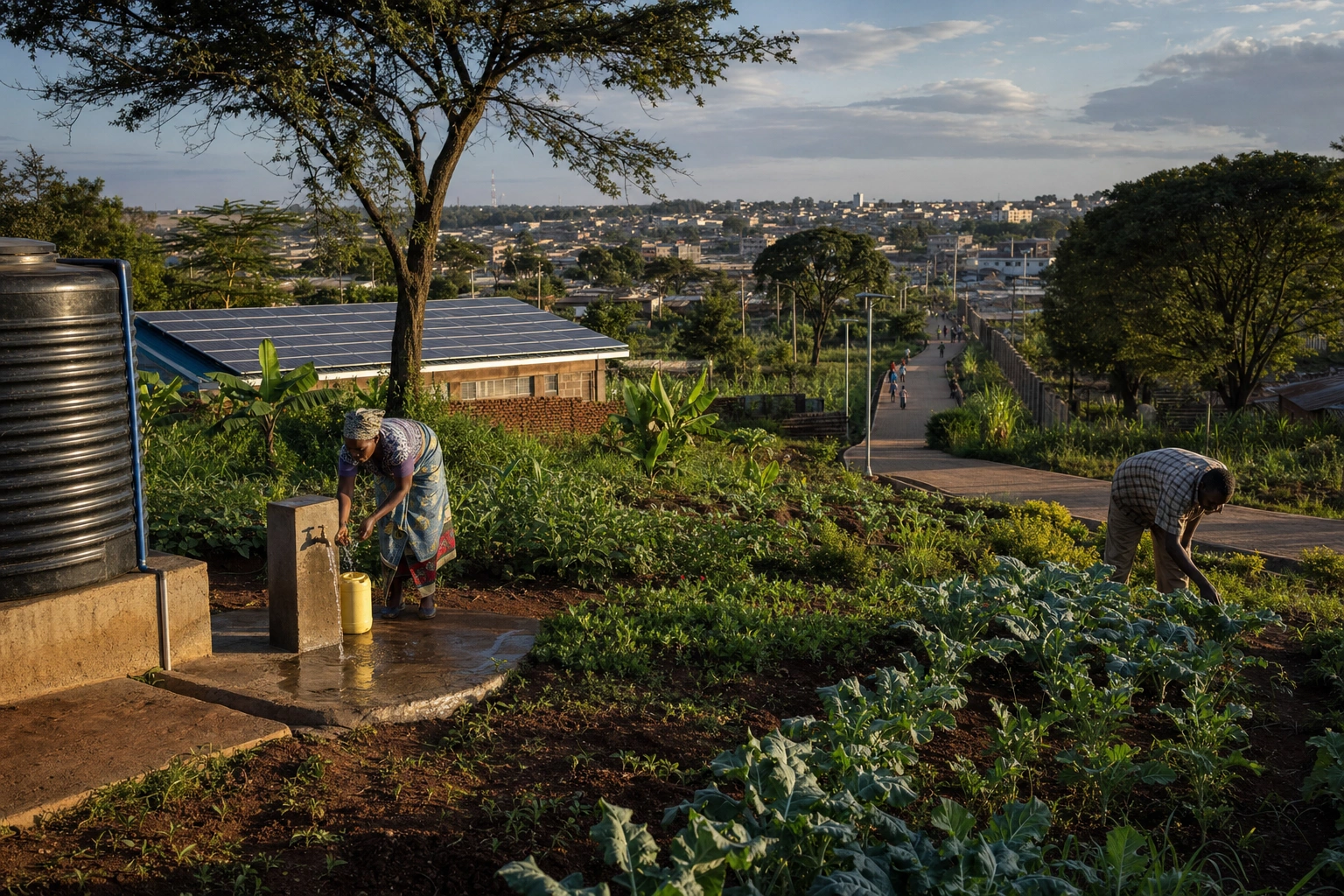
The Sustainable Development Goals (SDGs) provide a shared framework for addressing the economic, social and environmental challenges that affect communities around the world. For Kenya, they are not simply international commitments. They connect directly with everyday concerns such as access to clean water, the cost of food, the quality of education, employment opportunities, public health, housing, environmental protection and accountable institutions.
Understanding the SDGs helps citizens, businesses, public bodies, civil society organisations and educators see how separate decisions can contribute to wider development. A county investment in water infrastructure, a farmer adopting climate-smart practices, a company improving working conditions and a school reducing barriers to learning may all support different goals at the same time.
What are the Sustainable Development Goals?
The Sustainable Development Goals are 17 global goals adopted by United Nations member states in 2015 as part of the 2030 Agenda for Sustainable Development. They are intended to guide action towards a fairer, healthier, more prosperous and environmentally secure world by 2030. The goals cover poverty, hunger, health, education, gender equality, water, energy, work, infrastructure, inequality, cities, consumption, climate, oceans, land ecosystems, peace and partnerships.
The goals are interconnected. Poverty can restrict a child’s access to education; limited education can reduce future employment options; insecure employment can increase vulnerability to poor health; and environmental damage can undermine farming, fishing, water supplies and livelihoods. This means that development planning is more effective when it considers these relationships rather than treating each problem as completely separate.
The SDGs apply to every country, regardless of income level. They are not a single project or funding programme, and they do not replace national laws, policies or development plans. Instead, they offer a common language for setting priorities, coordinating action and assessing progress.
Why the SDGs matter in Kenya
Kenya has a diverse economy, a young population, varied landscapes and significant entrepreneurial energy. It also faces development pressures that require joined-up solutions. These include unequal access to services, unemployment and underemployment, rapid urbanisation, climate-related risks, pressure on land and water, and the need to strengthen public institutions.
National priorities are expressed through frameworks such as Kenya Vision 2030, medium-term planning and county development plans. The SDGs can complement these frameworks by helping planners compare local priorities with global targets and by encouraging attention to groups that may be left behind. County governments are especially important because many services and investments are experienced locally: water provision, health facilities, markets, roads, waste management, early childhood education and support for local enterprise.
Localisation is essential. A national goal becomes meaningful when it is translated into practical questions. For example:
- Which households in a county lack safe and affordable water?
- Are girls, boys and learners with disabilities able to attend and complete school?
- Do young people have pathways from education into decent work or enterprise?
- Are urban settlements prepared for flooding, heat and inadequate drainage?
- Can small-scale farmers obtain information, finance, inputs and markets without damaging soil and ecosystems?
These questions make sustainable development measurable and relevant to daily life.
The SDGs most closely linked to Kenya’s development priorities
Ending poverty and hunger
SDG 1: No Poverty and SDG 2: Zero Hunger are closely connected. Poverty is not only a lack of income. It may also involve insecure housing, limited access to healthcare, exclusion from financial services, vulnerability to emergencies and a lack of influence over decisions that affect a household.
In Kenya, sustainable poverty reduction requires more than short-term relief. It can involve quality education, social protection, access to markets, reliable infrastructure, secure livelihoods and opportunities for women and young people. Food security also depends on productive and resilient agriculture, storage, transport, fair markets, nutrition education and the ability of households to withstand droughts, floods and price changes.
For a small business, contributing to these goals might mean buying from local producers, paying workers fairly, reducing food waste or developing an affordable product that meets a genuine community need. For a public institution, it might mean designing services so that remote communities and low-income households can access them without unreasonable cost or travel.
Health, education and gender equality
SDG 3: Good Health and Well-being, SDG 4: Quality Education and SDG 5: Gender Equality form an important foundation for other goals. People are more able to learn, work and participate in public life when they can access appropriate healthcare and education in safe and inclusive environments.
Quality education is broader than enrolment. It includes effective teaching, relevant skills, safe facilities, learning materials, digital access where appropriate and support for learners facing disability, poverty, displacement or other barriers. Continuing education also matters. Adults may need financial literacy, digital skills, technical training or opportunities to reskill as industries change.
Gender equality requires examining both formal rules and everyday practices. Organisations can review recruitment, pay, promotion, safety, parental responsibilities and access to finance. In an enterprise, this could mean ensuring that women employees are not concentrated only in low-paid roles and that women entrepreneurs can participate in procurement and supply chains. Progress is stronger when women and girls have a genuine voice in decisions, rather than being treated only as beneficiaries.
Water, energy and sustainable communities
SDG 6: Clean Water and Sanitation, SDG 7: Affordable and Clean Energy and SDG 11: Sustainable Cities and Communities address the systems that make daily life and economic activity possible.
Water security depends on protecting catchments, maintaining infrastructure, managing demand, reducing contamination and planning for periods of shortage. Sanitation is also a public health and dignity issue. Businesses that use water should understand where their water comes from, how much they use and whether their waste affects surrounding communities.
Energy access supports education, healthcare, communication and enterprise. Energy decisions should consider affordability, reliability, safety and environmental impact. Solar technologies, energy-efficient equipment and improved public infrastructure may create benefits, but their suitability depends on local conditions, maintenance capacity and long-term costs.
Sustainable communities require more than attractive buildings. They need safe transport, drainage, waste services, accessible public spaces, resilient infrastructure and responsible land-use planning. In growing towns and cities, decisions made today can either reduce or increase future exposure to flooding, congestion, pollution and service shortages.
Decent work, innovation and responsible production
SDG 8: Decent Work and Economic Growth, SDG 9: Industry, Innovation and Infrastructure and SDG 12: Responsible Consumption and Production are particularly relevant to entrepreneurs and professionals.
Economic growth is not automatically sustainable or inclusive. Decent work includes fair treatment, safe working conditions, respect for labour rights and opportunities to develop skills. Entrepreneurs can strengthen their businesses by documenting roles, using clear contracts, managing workplace risks and creating realistic development paths for staff.
Innovation can involve advanced technology, but it can also mean a better process, a more efficient irrigation method, a low-cost service model or a product designed for local conditions. Good innovation solves a real problem and considers who can afford, use and maintain the solution.
Responsible production asks organisations to examine the full life cycle of goods and services. They can reduce unnecessary materials, improve energy and water efficiency, repair or reuse equipment, separate waste and choose suppliers carefully. Consumers also influence production through what they buy, how long they use products and how they dispose of them.
Climate action and protection of ecosystems
SDG 13: Climate Action, SDG 14: Life Below Water and SDG 15: Life on Land highlight Kenya’s dependence on healthy natural systems. Agriculture, tourism, fisheries, forestry and many urban services are affected by environmental conditions.
Climate action has two complementary parts. Mitigation reduces activities that contribute to greenhouse gas emissions, such as avoidable energy use, inefficient transport or land degradation. Adaptation reduces harm from climate impacts that communities and organisations already face or may face, such as drought, flooding, heat and changing growing conditions.
Protecting ecosystems is not separate from economic development. Healthy soils support food production; wetlands can help regulate water; forests contribute to biodiversity and catchment protection; and marine and coastal ecosystems support livelihoods. Effective environmental action should therefore consider both ecological limits and the needs of people who depend on natural resources.
Leaving no one behind
A central principle of the SDGs is inclusion. Progress should reach people who are often excluded because of poverty, disability, gender, age, location, displacement, discrimination or limited access to technology and services. A project can appear successful in total numbers while still failing communities that face the greatest barriers.
Inclusion begins with listening and using disaggregated information where it is available. Instead of asking only how many people received a service, decision-makers can ask who received it, who did not, why they were excluded and whether the service was safe, affordable and useful. Community participation can reveal practical issues that are missed in central planning.
In Kenya, local context matters. A solution suitable for a major city may not work in an arid county, a coastal settlement or a remote rural community. Inclusive planning respects local knowledge while also using technical evidence and transparent decision-making.
How progress towards the SDGs can be measured
Measurement turns broad intentions into accountable action. A useful indicator should relate clearly to an objective, be defined consistently and be collected often enough to support decisions. Indicators may measure outcomes, such as improved learning or reduced waterborne illness, as well as activities, such as teacher training or the repair of water points.
Organisations should avoid choosing indicators simply because they are easy to count. For example, the number of workshops held does not necessarily show that people gained useful skills. Better assessment may examine attendance, practical performance, continued use of the skill and outcomes for participants.
Small organisations can begin with a simple baseline and a short set of measures. A shop might track energy use, waste, staff safety and local sourcing. A school might review attendance, reading progress, inclusion and water access. A county programme might monitor service coverage, quality, cost and differences between locations.
Transparent reporting is important, but data should be interpreted carefully. A change in performance may be influenced by weather, prices, migration, policy changes or other factors. Good monitoring combines numbers with feedback from the people affected.
What different groups can do
Individuals and households can conserve water and energy, avoid unnecessary waste, make informed purchasing decisions, participate in local discussions and build skills that improve resilience and employability. Personal action is most effective when it supports wider systems rather than placing the entire burden on individuals.
Businesses can set practical environmental and social objectives, protect workers, improve resource efficiency, support ethical supply chains and design products for real local needs. They can also collaborate with customers, suppliers, financial institutions and public bodies instead of treating sustainability as a marketing label.
Public institutions can align budgets and procurement with development objectives, publish useful information, consult communities and evaluate whether services reach underserved groups. Coordination between national and county levels is important because responsibilities, resources and implementation challenges may cross administrative boundaries.
Educators and civil society organisations can make the SDGs understandable by connecting them to local evidence and lived experience. They can support civic participation, critical thinking, environmental stewardship and practical problem-solving without presenting the goals as abstract slogans.
Applying This in Practice
A practical SDG approach can follow five steps:
- Identify the real problem. Define the people affected, the location, the causes and the consequences. Avoid starting with a fashionable solution.
- Map the relevant goals. Most issues relate to several SDGs. A food-processing business, for example, may consider decent work, clean water, responsible production, climate action and poverty reduction.
- Set a manageable objective. State what will change, for whom and by when. The objective should be realistic enough to guide action but specific enough to assess.
- Choose actions and indicators. Assign responsibility, resources and a small number of meaningful measures. Include the views of people who will use or experience the intervention.
- Review and improve. Compare results with the starting position, investigate unexpected effects and adjust the plan. Sustainable development is an ongoing process rather than a one-time activity.
For example, a small Kenyan hospitality business could begin by identifying high water and energy use, examining waste from its kitchen, consulting staff and suppliers, and selecting two priorities. It might install water-saving equipment, separate organic waste, train staff and monitor monthly consumption. The business would then review whether costs, waste volumes and service quality changed, while checking that the measures did not create unreasonable burdens for workers or customers.
Key Takeaways
- The SDGs are 17 interconnected goals that link social well-being, economic opportunity and environmental protection.
- Kenya’s SDG progress depends on translating global goals into national, county and community priorities.
- Localisation means asking who benefits, who is excluded and whether a solution fits the conditions of a particular place.
- Businesses can support sustainable development through decent work, responsible production, efficient resource use and locally relevant innovation.
- Climate action includes both reducing environmental harm and adapting to risks such as drought, flooding and changing growing conditions.
- Useful measurement combines meaningful indicators with feedback from the people affected by development decisions.
No comments yet.