
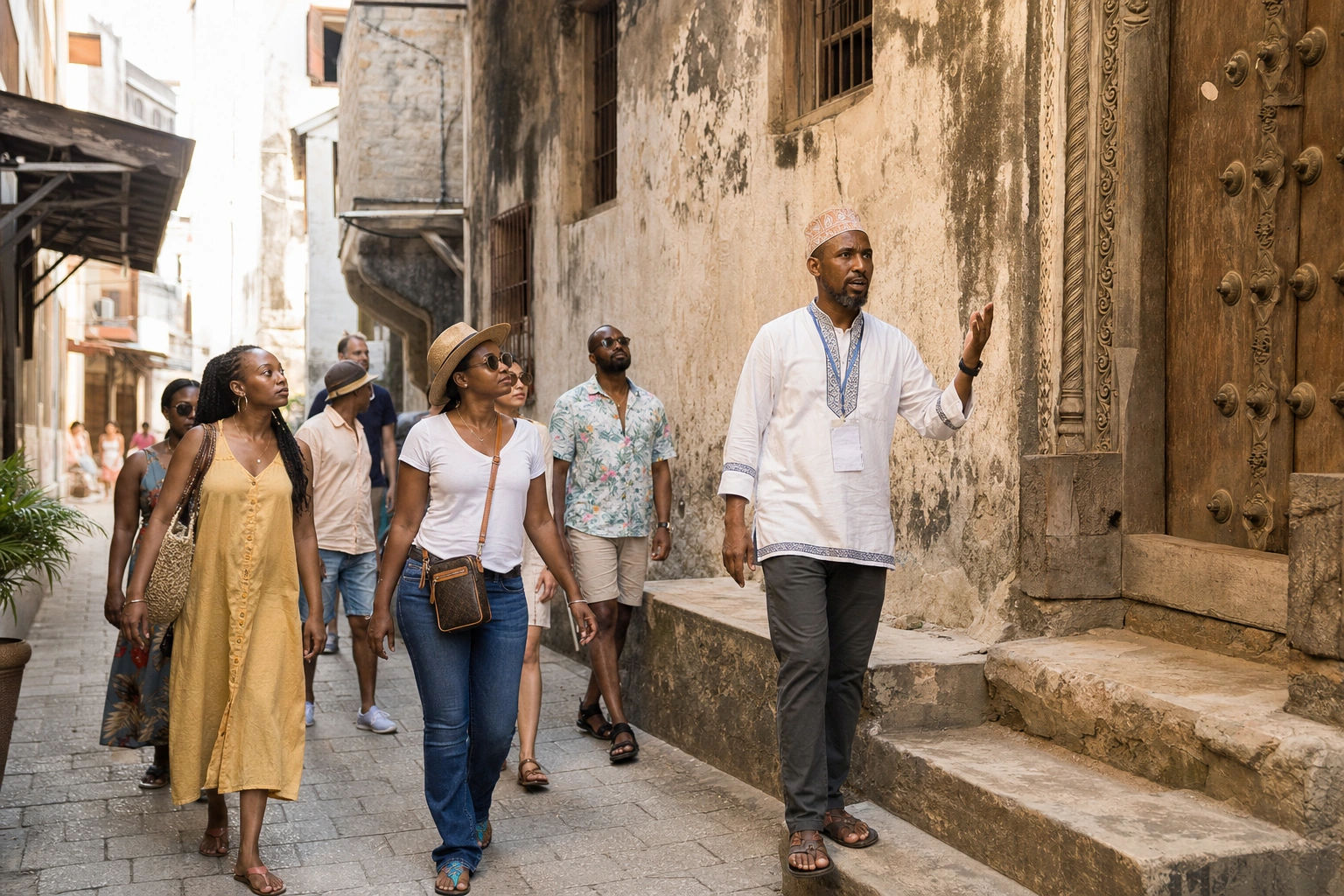
A tour guide is responsible for much more than delivering facts about a destination. Whether leading visitors through Nairobi National Park, the historic streets of Mombasa, a museum in London or a walking tour in a small town, the guide must help a group move safely, understand what it is seeing and enjoy the experience.
Group management is the practical skill that makes this possible. It combines planning, communication, observation, leadership, cultural awareness and calm decision-making. A knowledgeable guide can still deliver a poor tour if guests become lost, bored, uncomfortable or uncertain about what to do next. Effective group management turns individual visitors into a coordinated group without removing their sense of freedom and discovery.
What Group Management Means in Tour Guiding
Managing a tour group means guiding people, time, information and resources towards a shared experience. The group may contain families, older travellers, children, solo visitors, people with disabilities and guests from different cultural or language backgrounds. These visitors may also have different expectations: some want detailed history, while others prefer photography, wildlife observation, food or relaxed conversation.
The guide therefore has to balance several responsibilities at once:
- Movement: keeping the group together and helping it follow the planned route.
- Time: starting promptly, allowing worthwhile stops and maintaining the schedule.
- Safety: identifying hazards and giving clear instructions before risks arise.
- Information: presenting accurate and relevant explanations in an understandable way.
- Experience: creating an atmosphere in which guests feel welcomed, respected and involved.
These responsibilities are connected. For example, a long and complicated explanation at the wrong location can cause the group to block a busy walkway, fall behind schedule or miss an important activity. Good guides think about both the content of the tour and the conditions in which that content is delivered.
Preparing Before the Group Arrives
Strong group management begins before the welcome briefing. Preparation reduces avoidable problems and gives the guide more confidence when conditions change.
Know the itinerary and operating conditions
The guide should review the route, meeting points, opening hours, estimated walking times, toilet locations, rest areas, weather conditions and any access restrictions. If transport is involved, the guide should understand the boarding process, vehicle capacity, parking arrangements and likely delays. For a wildlife tour, preparation may also include checking the permitted routes, communication procedures and rules for observing animals safely.
The guide should distinguish between what is confirmed and what may change. A museum may close a gallery temporarily, a road may become congested, or rain may make a walking route unsuitable. A flexible plan should include alternatives rather than relying on one perfect sequence of events.
Understand the group
Available booking information can reveal the number of guests, languages spoken, age ranges, dietary requirements, mobility needs and special interests. This information should be treated respectfully and used to improve service, not to make assumptions about individuals.
Where possible, the guide should identify practical questions before departure: Does anyone need a slower pace? Is a child travelling without a separate adult in the group? Does anyone need regular access to medication, shade or seating? Are there guests who may not understand the main language easily? Asking these questions discreetly helps the guide plan without embarrassing anyone.
Prepare essential equipment
Depending on the activity, useful equipment may include a charged phone or radio, emergency contacts, a first-aid kit, water, a visible sign or flag, tickets, a route map and weather-appropriate clothing. The guide should also carry information that guests commonly need, such as the next meeting point, transport details and contact information for the tour operator.
Setting Expectations at the Start
The opening briefing establishes the tone of the tour. It should be warm and concise, but it must also provide the information guests need to make safe decisions.
A useful welcome normally includes:
- the guide’s name and role;
- the tour route and approximate duration;
- the planned stopping points and any scheduled breaks;
- meeting procedures if someone becomes separated;
- relevant safety instructions;
- ways guests can ask questions or raise concerns; and
- any cultural, environmental or site-specific rules.
Instructions should be specific. “Stay together” is less useful than “Please remain within sight of the guide and return to the entrance at 2.30 pm after the free time.” On a walking tour, the guide might explain how crossings will be handled and where guests should wait before the group moves on. In a national park, the guide may explain why guests must remain in the vehicle or follow an authorised path.
The guide should also check understanding without making the briefing feel like a formal test. Asking, “Is everyone clear about the meeting point?” and observing responses is helpful, especially when language differences or distractions are present.
Keeping the Group Together
Group separation is one of the most common operational problems in tour guiding. It can happen because a guest stops to take a photograph, enters a shop, uses a toilet, walks slowly or misunderstands the meeting point. Prevention is easier than searching for a missing person.
The guide should use visible landmarks and repeat meeting instructions before each free-time period. A place such as “the large gate beside the ticket office” is usually clearer than a vague direction such as “meet outside”. Time limits should include a specific clock time, and the guide should explain what happens if a guest is delayed.
At the front of a walking group, the guide can occasionally pause at junctions and look back to confirm that people are still following. A designated assistant, driver or responsible participant may help observe the rear of a larger group, but the guide remains responsible for coordinating the plan. In narrow or crowded areas, the guide should choose safe waiting points rather than stopping where the group obstructs other people.
When a guest is missing, the guide should remain calm and follow the agreed procedure. The group should be moved to a safe location if appropriate, the last known position should be established, and the operator or relevant site staff should be contacted. Guessing, blaming the guest or sending multiple people away without coordination can make the situation worse.
Communicating Clearly During the Tour
Good tour communication is structured, audible and adapted to the setting. A guide should avoid speaking while walking away from the group, talking beside loud traffic or delivering lengthy explanations in a place where guests cannot see the subject.
A practical interpretation pattern is:
- Orientate: tell guests where they are and what they are looking at.
- Explain: provide the essential history, meaning or context.
- Connect: relate the information to the destination, local life or the guests’ experience.
- Check: invite questions and confirm the next movement or activity.
For example, when introducing a historic building in Mombasa, a guide might first identify its location and function, then explain relevant historical context, connect it to the wider development of the old town and finally direct guests to the safest viewing point. The guide does not need to recite every available fact. Selection and timing are as important as knowledge.
Language should be accessible. Avoid unnecessary technical terms, unexplained acronyms and very long sentences. When interpreting for guests who speak different languages, the guide should deliver information in short sections and allow time for translation. Humour can build rapport, but it should not depend on stereotypes, embarrassing a guest or making light of sensitive history.
Managing Different Personalities and Needs
Groups contain different preferences and behaviours. One guest may ask frequent questions, another may remain quiet, and a third may repeatedly challenge the schedule. The guide should manage behaviour without labelling people or allowing one person to dominate the experience.
Frequent questions can be handled positively by answering briefly and offering to continue the discussion during a break. If one guest speaks constantly, the guide can invite contributions from others by asking, “Would anyone else like to add a question?” Quiet guests should not be forced to perform, but the guide can create inclusive opportunities for participation.
Guests who arrive late or repeatedly ignore instructions require clear, private communication. The guide should describe the practical effect of the behaviour and restate the expectation: for example, explain that delayed departures reduce time at the next attraction and ask the guest to return by the agreed time. Correcting someone publicly should be reserved for immediate safety concerns.
Inclusive management also involves physical access and comfort. The guide should avoid treating a slower pace as an inconvenience and should identify alternatives where a route contains stairs, steep ground or narrow passages. In a Kenyan cultural or nature experience, local customs and community spaces should be explained respectfully, including expectations about photography, dress, greetings and permission.
Balancing Time, Depth and Flexibility
Tour schedules often look precise on paper but are affected by traffic, queues, guest questions, weather and unexpected discoveries. The guide should protect essential parts of the itinerary while knowing which activities can be shortened or removed.
A useful approach is to divide the itinerary into fixed, flexible and optional elements. A pre-booked entry time or airport transfer may be fixed. A discussion at a viewpoint may be flexible. An additional photo stop may be optional. This structure allows the guide to make decisions without appearing disorganised.
Time announcements should be made before they become urgent. The guide might say, “We have ten minutes for photographs, then we will walk to the vehicle,” followed by a reminder near the end of the period. If a delay occurs, the guide should explain the adjustment honestly rather than silently rushing guests later.
Flexibility does not mean changing the plan for every request. It means evaluating the effect of a change on safety, access, cost, transport and the rest of the group. A request that benefits one guest but creates serious inconvenience or risk for everyone may need to be declined politely.
Safety and Risk Management
Safety is a continuous process rather than a single warning at the beginning. The guide should observe hazards such as traffic, slippery surfaces, heat, dehydration, steep paths, open water, aggressive animals, overcrowding and poor visibility. Risk controls should match the activity and location.
Instructions are most effective when delivered before the hazard is reached. On a coastal excursion, guests may need guidance about tides, rocks and appropriate footwear. On a city tour, the guide should position the group carefully near roads and avoid stopping in unsafe locations. During hot weather, rest, shade and water should be considered as part of the itinerary, not as signs that the tour has failed.
If an incident occurs, the guide should first protect people from further harm, assess what assistance is needed and contact the appropriate emergency or operational support. The guide should communicate calmly, avoid making promises beyond their authority and document the incident according to the operator’s procedures. Personal information about an injured or distressed guest should be handled discreetly.
Using Technology Without Losing Personal Attention
Technology can support group management through digital tickets, maps, translation tools, messaging groups, audio systems and location sharing. It can help a guide update guests about a changed meeting point or confirm transport arrangements.
However, technology should not replace observation and human communication. A phone battery can fail, network coverage may be limited and not every guest will check messages promptly. Important safety instructions should be spoken clearly, and the guide should offer alternatives for guests who do not have mobile data or smartphones. Devices should also be used in ways that respect privacy and the rules of the site.
Applying This in Practice
Before leading a group, a guide can use the following short routine:
- Review: confirm the route, timing, weather, access conditions and emergency contacts.
- Observe: understand the group’s pace, interests, language needs and mobility requirements.
- Brief: explain the plan, safety rules, meeting points and communication method.
- Lead: position yourself where guests can see or hear you and pause at useful locations.
- Check: count or visually confirm the group at transitions, before departures and after free time.
- Adapt: adjust the plan when conditions change, while protecting safety and the essential experience.
- Review: record incidents, guest feedback and improvements for the next tour.
After the tour, reflection should be specific. Instead of asking only whether guests enjoyed themselves, the guide can consider: Where did the group slow down? Which explanation generated interest? Did everyone hear the instructions? Was the meeting point easy to find? Did the itinerary allow enough rest? These questions turn experience into better future planning.
Key Takeaways
- Prepare the route, operating conditions, group needs and backup options before the tour begins.
- Give specific instructions about timing, meeting points, movement and safety.
- Keep the group together by using visible landmarks, regular checks and clear procedures for separation.
- Present information in short, relevant sections and adapt language to the group and surroundings.
- Balance different personalities, abilities and interests without allowing one guest to control the experience.
- Treat safety, time management and flexibility as connected responsibilities throughout the tour.
No comments yet.