
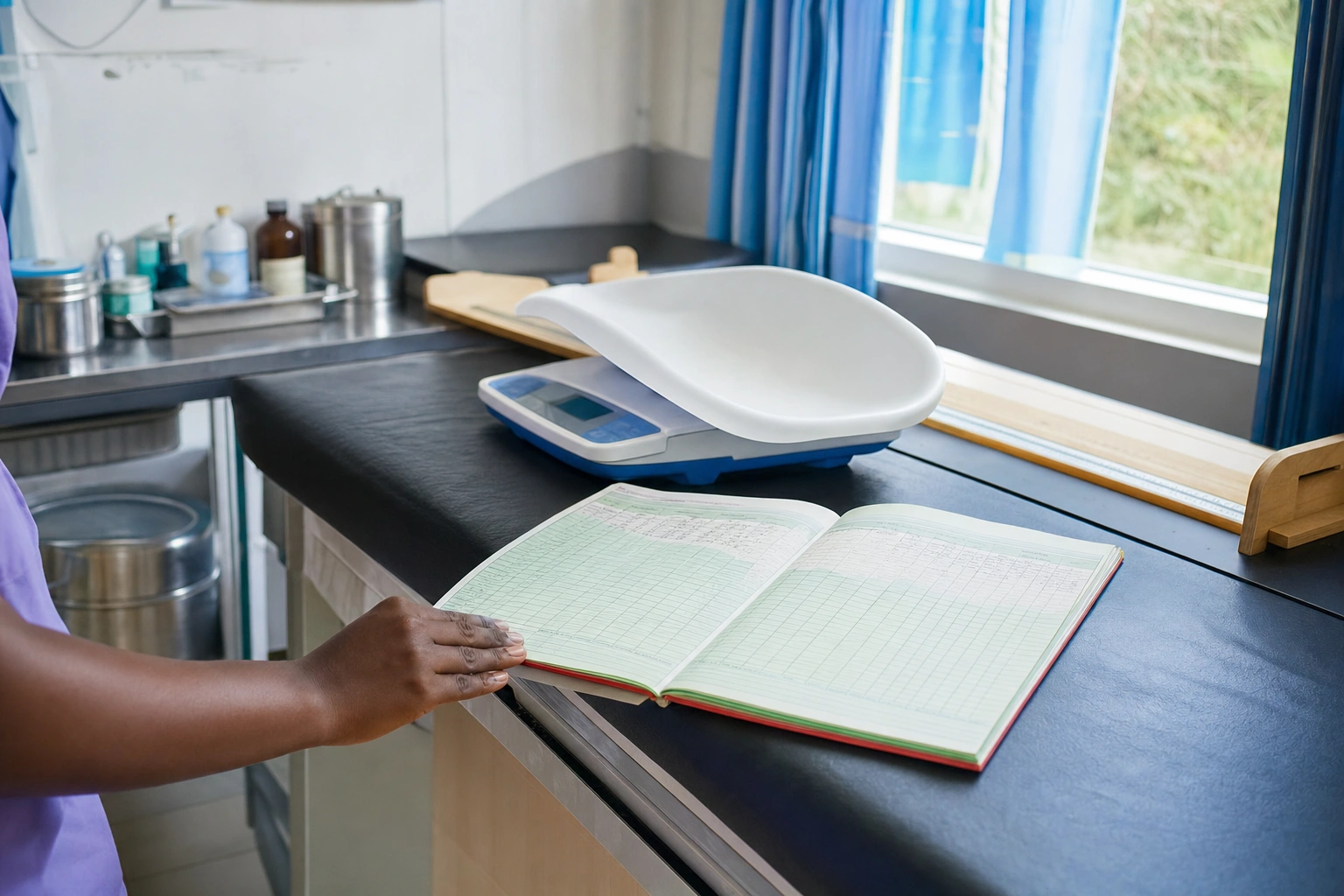
Monitoring child growth and development is a continuous process of observing how a child’s body, abilities and behaviour change over time. It is not limited to weighing a child during a clinic visit. Health workers combine measurements, developmental observations, caregiver information, physical examinations and the child’s health history to understand whether progress is broadly on track.
Regular monitoring helps identify concerns early, when support may be most effective. It can also reassure caregivers when a child is developing normally. Growth and development vary between individuals, so one measurement or one missed milestone should not automatically be treated as a diagnosis. What matters most is the overall pattern, the child’s circumstances and whether new skills are gradually emerging.
What Growth and Development Mean
Growth refers mainly to measurable physical changes, such as increases in weight, length or height and head circumference. It is influenced by nutrition, illness, genetics, sleep, the child’s environment and other health factors.
Development refers to the gradual acquisition of skills and abilities. These include movement, thinking, communication, emotional regulation and interaction with other people. A child’s development is shaped by both biology and experience, including responsive care, play, language exposure, safety and opportunities to explore.
Growth and development are related but not identical. A child may have normal physical growth but need support with language or movement. Another child may have an illness affecting weight gain while continuing to develop skills appropriately. This is why a complete assessment looks at both areas rather than using weight alone as a measure of wellbeing.
How Physical Growth Is Measured
At a routine health visit, a health worker may measure:
- Weight: This helps assess current body mass and changes over time.
- Length: Babies and young children who cannot stand safely are measured lying down.
- Height: Older children are usually measured standing upright with appropriate positioning.
- Head circumference: This is especially important during infancy and early childhood because it provides information about head growth.
- Mid-upper arm circumference: In some settings, this is used to help identify acute malnutrition in young children.
Accurate measurement requires suitable equipment, correct technique and minimal clothing where practical. The health worker should check the child’s age, use a properly maintained scale or measuring board and record the result clearly. Small errors can change how a result appears on a growth chart, so measurements should be taken carefully and repeated when the reading seems unusual.
How Growth Charts Are Used
Measurements become more useful when they are plotted on a growth chart alongside the child’s age and sex. Growth charts are based on reference standards that show how healthy children typically grow under suitable conditions. They are not pass-or-fail tests and do not predict a child’s future height or body shape.
Health workers may review several growth indicators, including weight-for-age, length- or height-for-age, weight-for-length or weight-for-height, and body mass index for age in older children. Each indicator answers a different question. For example, height-for-age can help identify a pattern of restricted linear growth, while weight-for-height can provide information about thinness in relation to stature.
The pattern across time is usually more informative than one point on the chart. A child who follows a broadly consistent path may be growing appropriately even if the child is smaller or larger than average. A sharp fall across growth lines, repeated poor weight gain or a persistent mismatch between measures deserves further assessment.
Growth charts should be interpreted with the child’s history. Recent diarrhoea, feeding difficulties, repeated infections, prematurity, food insecurity, allergies, chronic illness or an inaccurate age may affect the result. A chart can signal the need for questions and support; it cannot by itself explain the cause of a growth concern.
Monitoring Developmental Progress
Development is commonly considered in several overlapping areas:
- Gross motor skills: Using large muscles for activities such as holding the head steady, sitting, standing, walking, running and climbing.
- Fine motor and adaptive skills: Using hands and eyes together, reaching, grasping, transferring objects, feeding and managing simple tasks.
- Language and communication: Making sounds, responding to voices, understanding words, using gestures and speaking.
- Cognitive skills: Paying attention, exploring, remembering, solving simple problems and learning through play.
- Social and emotional development: Smiling responsively, forming relationships, expressing feelings, responding to others and gradually learning self-regulation.
Milestones are broad guides rather than rigid deadlines. Children often develop skills within a range, and skills may emerge unevenly. For example, one child may communicate early while another shows advanced physical coordination. Even so, a child who loses a skill already acquired, shows very limited progress or has several concerning signs should be assessed promptly.
What Happens During Developmental Surveillance
Developmental surveillance is the ongoing process of asking questions and observing a child during routine care. A health worker may ask a caregiver what the child can do at home, how the child communicates needs, whether feeding and sleep are manageable, and whether there have been changes in behaviour or abilities.
The health worker may observe how the child moves, responds to sounds, makes eye contact, handles an object, follows a simple interaction or engages with a caregiver. The setting matters: a tired, frightened or unwell child may not show usual abilities. Caregivers can explain what the child does in familiar surroundings, which is why their observations are an essential part of monitoring.
Some services also use structured developmental screening tools. These tools ask standard questions or include age-appropriate tasks to identify children who may need a more detailed assessment. Screening does not confirm a developmental condition. It indicates whether further evaluation, monitoring or referral would be helpful.
When Monitoring Usually Takes Place
Monitoring begins before birth. Antenatal care allows health professionals to support maternal health, review risks and prepare for the baby’s care. After birth, newborn assessments check basic wellbeing, feeding, temperature, breathing, physical signs and other indicators that may require attention.
During infancy and childhood, growth and development are reviewed during routine maternal and child health visits, immunisation contacts, treatment visits and other encounters with health services. The exact schedule differs between countries and health programmes. In Kenya, caregivers may encounter these services through a facility’s maternal and child health clinic, a child welfare clinic or community-based health support. The child’s health record or handbook should be kept safely because it helps different providers see previous measurements, treatments and concerns.
Monitoring should not wait for the next routine appointment when a caregiver is worried. A child can be assessed after a noticeable change in feeding, movement, communication, behaviour or general health. Caregivers should explain the concern clearly and, when possible, describe when it began and what has changed.
Understanding Possible Warning Signs
A warning sign does not always identify a specific condition, but it signals the need for professional advice. Examples include:
- Weight that remains unchanged or falls over repeated checks.
- Difficulty feeding, frequent vomiting, persistent diarrhoea or signs of dehydration.
- Marked loss of previously acquired skills.
- Very poor muscle control, unusual stiffness or unusual floppiness.
- Limited response to sounds, faces or social interaction.
- Concern about hearing, vision, movement, speech or understanding.
- Persistent lethargy, breathing difficulty, convulsions or severe illness.
Urgent medical care is needed when a child has danger signs such as difficulty breathing, unconsciousness, convulsions, severe dehydration or an inability to feed. For less urgent concerns, a health worker can decide whether the child needs repeat measurements, nutritional support, hearing or vision checks, a medical review or referral to a developmental specialist.
Why a Child May Grow or Develop Differently
Variation can be normal, but differences may also arise from several factors. Nutrition affects growth, while repeated infections can reduce appetite and increase the body’s demands. Feeding technique, oral problems, allergies, gastrointestinal conditions and difficulties swallowing may also affect intake.
Some children are born prematurely and may need their development interpreted using corrected age for a period determined by the health professional. Birth complications, genetic conditions, long-term illness, hearing or vision difficulties and limited opportunities for interaction can also influence development. Environmental factors such as poverty, unsafe housing, food insecurity and lack of access to healthcare may affect a child’s health without being the caregiver’s fault.
Assessment should therefore be respectful and practical. Health workers should ask what support the family can realistically provide and connect caregivers with available nutrition, medical, disability, social or community services. Blaming a caregiver can discourage future care and does not improve the child’s outcome.
How Caregivers Can Support Accurate Monitoring
Caregivers can make monitoring more useful by bringing the child’s health record to appointments and sharing honest information about feeding, illness, sleep, behaviour and skills. If a milestone is uncertain, it is better to describe what the child actually does than to give the answer the caregiver thinks is expected.
At home, caregivers can keep brief notes about new skills, changes in appetite, recurring illnesses and concerns. Short videos of a movement or behaviour may sometimes help a health professional, provided they are recorded safely and respectfully. Caregivers should never delay urgent treatment in order to collect a video.
Daily support for development includes talking, singing, reading, responsive play, safe movement and warm interaction. Babies and young children learn through ordinary routines: naming objects during bathing, responding to sounds, allowing safe floor play and offering age-appropriate opportunities to grasp and explore. Good nutrition, immunisation, hygiene, adequate sleep and protection from injury also support healthy development.
Applying This in Practice
- Prepare for the visit: Bring the child’s record and note recent illnesses, feeding changes, new abilities or concerns.
- Check that measurements are recorded: Ask whether weight, length or height and other appropriate measurements have been taken accurately.
- Look at the trend: Ask how the current result compares with earlier results rather than focusing only on whether the child is above or below average.
- Discuss development openly: Share what the child can do at home, including communication, movement, play and social interaction.
- Clarify the plan: Ask whether the child needs another review, feeding advice, treatment, screening or referral, and when to return.
- Act on changes: Seek care promptly if the child loses skills, becomes seriously unwell or develops a major change in feeding, breathing, alertness or hydration.
For example, if a toddler’s weight has dropped after several illnesses, the health worker may review the growth chart, ask about food and fluids, examine the child and treat or investigate illness. If a caregiver also reports that the child no longer uses words previously used, the clinician should consider that developmental concern separately rather than assuming it is explained by weight alone.
Key Takeaways
- Growth means physical change; development includes movement, communication, thinking and social-emotional skills.
- Growth charts are most useful for viewing a child’s pattern over time, not judging one measurement in isolation.
- Caregiver observations are essential because children may behave differently in a clinic than they do at home.
- Developmental screening identifies children who may need further assessment; it does not by itself provide a diagnosis.
- Loss of acquired skills, repeated poor growth or serious illness requires timely professional attention.
- Keep the child’s health record, share concerns honestly and follow the agreed review or referral plan.
No comments yet.