
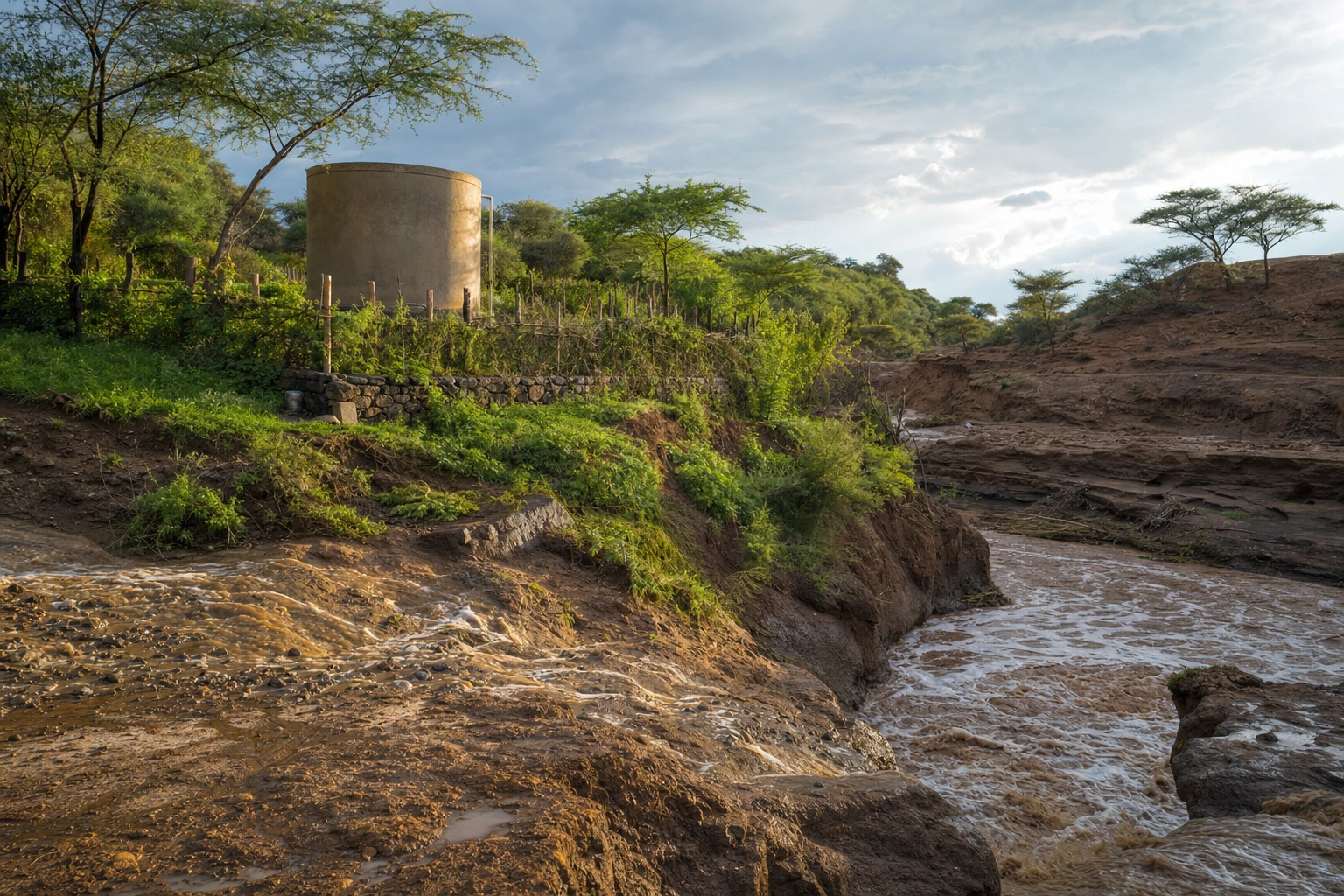
Water is one of the clearest ways in which climate change becomes part of everyday life. Changes in rainfall, temperature and extreme weather can affect whether a household has enough water to drink, whether a farmer can grow crops, whether a business can operate reliably and whether a town can maintain safe public services.
The relationship works in both directions. Climate change affects water resources, while the way societies collect, treat, pump, distribute and use water can contribute to greenhouse gas emissions. Understanding this relationship helps individuals, organisations and governments plan for water security rather than responding only after a drought, flood or water shortage has occurred.
How Climate Change Affects the Water Cycle
The water cycle describes the continuous movement of water between the atmosphere, land, rivers, lakes, oceans, soil and living organisms. Solar heat causes evaporation; water vapour forms clouds; precipitation returns water to the ground and surface water bodies; and water flows through rivers, soils and underground aquifers before reaching the sea or being used again.
Climate change influences this cycle mainly by raising temperatures and changing weather patterns. Warmer air can hold more water vapour, which may contribute to heavier rainfall when conditions produce storms. At other times, changing circulation patterns can lead to longer dry periods or rainfall arriving at the wrong time for crops and reservoirs.
These changes do not affect every place in the same way. One region may experience more intense rainfall and flooding, while another faces extended drought. Even in the same location, a year with high total rainfall may still create water shortages if rain falls in short, destructive bursts and runs off the land instead of soaking into soil and replenishing groundwater.
Major Effects on Water Resources
Drought and reduced reliability
Higher temperatures increase evaporation from soil, reservoirs, wetlands and vegetation. When rainfall is also irregular or below normal, rivers and shallow wells may decline more quickly. A water source does not need to disappear completely to create a serious problem. Lower flows can make abstraction more difficult, reduce the amount available for households and farms, and concentrate pollutants in the remaining water.
Drought also creates indirect pressure. Farmers may depend more heavily on groundwater or nearby rivers, increasing competition between domestic use, livestock, irrigation, industry and ecosystems. Households may spend more time and money collecting water, while businesses may face interruptions to production and higher operating costs.
Flooding and stormwater
Climate change can increase the risk of intense rainfall in some areas. Floodwater can damage roads, bridges, pumps, treatment facilities, homes and storage tanks. It can also carry sewage, chemicals, rubbish, soil and other contaminants into rivers and wells.
Urban areas are particularly exposed when roads, roofs and paved surfaces prevent water from soaking into the ground. Poor drainage, construction on floodplains and the loss of wetlands can make flooding more damaging. A flood is therefore not only a question of how much rain falls; it is also a question of land use, drainage design, maintenance and preparedness.
Water quality and public health
Water quality can deteriorate during both floods and droughts. Floods may overwhelm sanitation systems or wash contaminants into water sources. During dry periods, reduced river flow can limit the natural dilution of pollutants. Warmer conditions can also create more favourable conditions for some harmful organisms and algae in stagnant or nutrient-rich water.
Unsafe water increases the risk of waterborne illness. The effects are often greatest for young children, older people, people with weakened immune systems and communities without reliable treatment or storage facilities. Safe water therefore depends not only on the existence of a source, but also on protection, treatment, distribution and household handling.
Groundwater stress
Groundwater is water held below the surface in soil and rock formations. It can provide an important buffer during dry periods, but it is not automatically unlimited. Recharge depends on rainfall, soil conditions, vegetation, geology and the rate at which water is withdrawn.
If pumping continues faster than recharge, wells may become less productive, pumping costs may increase and conflicts between users may intensify. In coastal areas, excessive extraction can also allow salty water to move into freshwater aquifers. Careful monitoring and responsible abstraction are essential because groundwater changes can be difficult to see until the problem is advanced.
Changes in snow, ice and ecosystems
In regions that depend on mountain snow or glaciers, warming can alter the timing and quantity of water flowing into rivers. In the short term, faster melting may increase flows or flood risk; over time, the loss of stored ice can reduce dry-season water availability. Elsewhere, wetlands, forests, grasslands and freshwater habitats may be affected by changing rainfall, temperature and water levels.
Healthy ecosystems support water security by slowing runoff, reducing erosion, filtering water and helping groundwater recharge. When wetlands are drained or vegetation is removed, communities may lose these natural services and become more dependent on costly engineered infrastructure.
Who Is Most Vulnerable?
Climate-related water risks are not shared equally. A household with a piped connection, a storage tank and the ability to purchase treated water has more options than one that depends on a distant, seasonal source. Smallholder farmers may be more exposed to rainfall variability than large operations with irrigation, storage and insurance, although larger users can also face significant losses.
Vulnerability is shaped by income, location, health, gender, disability, infrastructure, land rights, information and access to decision-making. In parts of Kenya and other African countries, for example, pastoral and farming communities may need to manage changing grazing conditions, seasonal water points and competition among domestic, livestock and agricultural needs. In cities, informal settlements may face flooding and unreliable supply at the same time.
Recognising these differences is important. A technically impressive water project may still fail if it is unaffordable, inaccessible, poorly maintained or designed without the participation of the people who use it.
Climate Change, Water and Agriculture
Agriculture is closely connected to water availability and timing. Crops need sufficient moisture during particular stages of growth, so rainfall arriving too early, too late or in intense bursts may be less useful than a moderate, well-distributed pattern. Heat can also increase crop water requirements and reduce yields when plants lose water faster than they can replace it.
Farmers can reduce risk through a combination of measures rather than relying on one solution. These may include:
- Choosing crop varieties and planting periods suited to local conditions.
- Improving soil organic matter and ground cover to help retain moisture.
- Using mulching, contouring, terracing or other methods to reduce erosion and runoff.
- Applying water-efficient irrigation where it is appropriate and properly managed.
- Harvesting and storing rainwater safely for suitable agricultural uses.
- Diversifying crops, income sources and markets to reduce dependence on one harvest.
Adaptation measures should be matched to local water availability. Irrigation can help during dry periods, but uncontrolled expansion may deplete rivers or aquifers. Efficiency is valuable, yet saved water is not automatically available for another use if total abstraction remains unchanged. Water planning must therefore consider the whole catchment.
Adaptation: Preparing for Water Risks
Climate adaptation means adjusting decisions and systems to reduce harm from current or expected climate impacts. For water resources, effective adaptation usually combines infrastructure, ecosystem protection, information and good management.
Improve storage and diversify supplies
Storage can help communities manage seasonal differences between rainfall and demand. Options include reservoirs, tanks, managed aquifer recharge and protected household storage. However, storage must be designed for changing rainfall patterns and maintained over time. Diversification may include several sources, such as surface water, groundwater, rainwater and treated recycled water, provided each source is safe and properly regulated.
Protect catchments and natural systems
A catchment is the area from which water drains into a river, lake, reservoir or groundwater system. Protecting vegetation, wetlands, riverbanks and soils can reduce erosion, slow runoff and improve water quality. Restoration is not a substitute for every pipe, dam or treatment plant, but natural systems can reduce pressure on engineered infrastructure and provide benefits across a wider area.
Use early warnings and climate information
Rainfall forecasts, drought monitoring, river-level information and flood warnings can support better decisions. Farmers can adjust planting; water utilities can prepare for shortages; schools and workplaces can plan safe responses; and communities can move people and assets away from danger. Information is most useful when it is timely, understandable, locally relevant and connected to a clear action.
Strengthen water governance
Water governance includes the rules, institutions and processes used to allocate, protect and manage water. Strong governance requires clear responsibilities, reliable monitoring, fair enforcement and participation by affected users. It also requires plans for difficult choices when demand exceeds supply.
Good planning looks beyond administrative boundaries. A river basin may cross counties, regions or national borders, and decisions upstream can affect users downstream. Cooperation, transparent data and conflict-resolution mechanisms are therefore central to long-term water security.
Mitigation: Reducing Emissions from Water Systems
Water services also use energy. Water may need to be abstracted, pumped, treated, heated, transported and processed as wastewater. These activities can produce emissions when the energy comes from fossil fuels. Wastewater treatment and the decomposition of organic waste can also release greenhouse gases if systems are poorly managed.
Water-sector mitigation can include reducing leaks, improving pump efficiency, using renewable electricity where practical, treating wastewater effectively and reusing suitable water. Demand management is important too: using less water can reduce both pressure on sources and the energy required to supply it.
Mitigation should not reduce access to safe water. The aim is to provide reliable and affordable services with fewer emissions, while ensuring that efficiency gains benefit households and communities rather than only large users.
Practical Actions for Households and Organisations
Individuals cannot manage a whole watershed alone, but everyday decisions can reduce waste and improve preparedness. Households can repair leaking taps, use water-efficient fixtures, avoid contaminating drains, store water in clean covered containers and develop a plan for short interruptions. Rainwater harvesting may be useful where local conditions and safety requirements permit, but collected water should be kept separate from drinking supplies unless it has been appropriately treated.
Businesses, schools and community organisations can begin with a simple water assessment:
- Map use: Identify where water enters, how it is used and where wastewater leaves the premises.
- Measure the baseline: Review bills, meter readings, production records and visible losses.
- Assess risks: Consider drought, flooding, quality problems, supply interruptions and dependence on one source.
- Prioritise actions: Repair leaks, improve maintenance, protect storage and select measures with clear benefits.
- Prepare contingencies: Define what happens if supply falls, contamination is suspected or flooding threatens operations.
- Review and improve: Track results and update the plan as weather, demand and business activities change.
Applying This in Practice
Consider a small food-processing enterprise that depends on a single municipal connection. Its climate-related water risks may include supply interruptions during dry periods, contamination after heavy rainfall and rising costs caused by inefficient equipment. A practical response could combine a water audit, leak repairs, reserve storage, safe cleaning procedures, supplier communication and a documented emergency plan.
The enterprise should not assume that a private borehole is automatically a sustainable solution. Before investing, it would need to consider groundwater availability, licensing requirements, water quality, abstraction impacts, installation costs and what will happen during a prolonged dry period. It should also identify which uses require drinking-water quality and which may safely use an alternative source after suitable treatment.
Useful questions for any household, farm or organisation include:
- Which water sources do we depend on, and how reliable are they in dry and wet seasons?
- What would happen if supply stopped for one day, one week or longer?
- Where could floodwater or pollution enter the system?
- Which users may be affected first, and have they been included in planning?
- Can we reduce demand without compromising health, safety or livelihoods?
- How will we monitor water levels, quality, costs and progress?
Key Takeaways
- Climate change can produce both water scarcity and damaging floods, sometimes in the same region during different seasons.
- Water security depends on quality, timing, access and reliability, not simply on the existence of a river, lake or well.
- Healthy catchments, wetlands and soils help regulate flows, reduce pollution and support groundwater recharge.
- Adaptation works best when it combines safe storage, diversified supplies, early warnings, efficient use and strong governance.
- Businesses and households should assess their water sources, identify climate risks and prepare practical continuity measures.
- Reducing leaks, energy use and unnecessary consumption can lower pressure on water resources while reducing emissions.
No comments yet.