
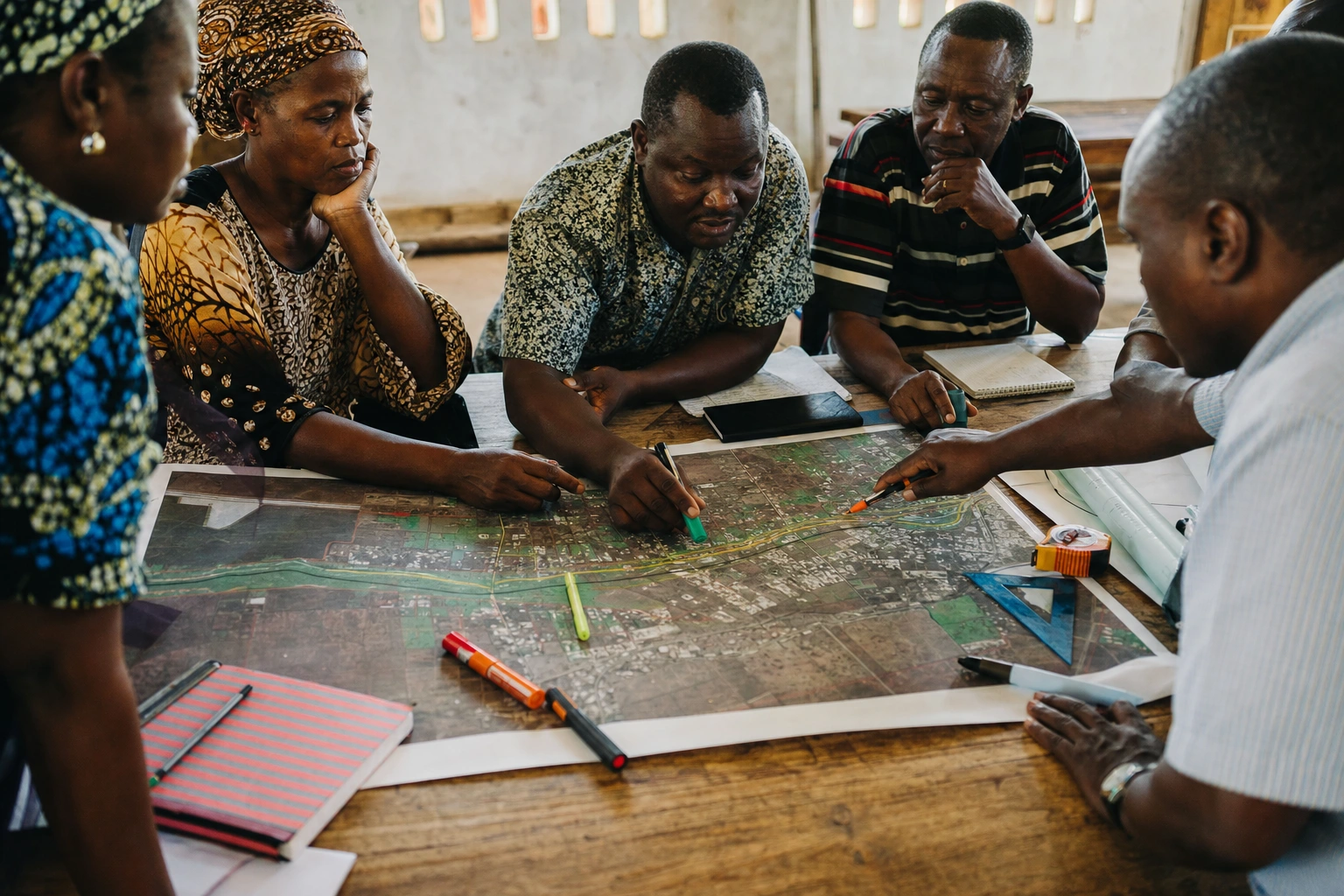
Community participation is the active involvement of people in decisions, activities and processes that affect their lives. It can take place in a village meeting, a neighbourhood planning forum, a school committee, a public budget consultation, a residents’ association or an online discussion. The central idea is simple: people should not be treated only as recipients of services or instructions. They should have meaningful opportunities to contribute knowledge, express priorities and influence outcomes.
Participation matters because communities understand their own circumstances in ways that outside institutions may not. Residents know which roads become impassable during heavy rain, which water points are reliable, which groups are often excluded and which proposed solutions are realistic in daily life. When this local knowledge is respected and combined with technical expertise, decisions are more relevant, accountable and sustainable.
What Community Participation Means
Community participation is more than informing people after a decision has already been made. It involves a relationship between communities and the institutions, organisations or leaders responsible for planning and action. The level of influence may vary, but meaningful participation gives people a genuine chance to shape priorities, question proposals, monitor implementation or help evaluate results.
Participation can occur at several levels:
- Information sharing: authorities or organisations explain a proposed project, policy or service and provide clear opportunities for questions.
- Consultation: community members give views, identify concerns and suggest alternatives before decisions are finalised.
- Collaboration: residents, professionals and institutions work together to design or implement a response.
- Community-led action: local people take a leading role in identifying needs, managing activities or evaluating outcomes.
These levels are not identical. A public notice about a new facility is information, not necessarily participation. A meeting where people are invited to speak but their views are ignored may be consultation in form but not in substance. The important question is whether the process gives people an appropriate degree of influence and whether decision-makers explain how public input affected the result.
Why Community Participation Matters
1. It improves the quality of decisions
Policies and projects are often designed with limited information. Technical reports, administrative records and professional experience are valuable, but they may not reveal the practical details of everyday life. Community members can identify problems that formal data misses and test whether a proposal fits local conditions.
For example, a plan to improve waste collection may focus on purchasing vehicles and setting collection routes. Residents may add important information: collection times conflict with market days, some lanes are inaccessible to trucks, tenants do not know where to dispose of waste, or the proposed collection point creates difficulties for people with disabilities. Considering these details early can prevent expensive changes later.
2. It builds accountability and trust
People are more able to hold institutions accountable when they understand how decisions are made, who is responsible and what resources are available. Open participation creates opportunities to ask questions about budgets, timelines, selection criteria and progress.
Trust does not mean that communities will agree with every decision. It grows when leaders communicate honestly, listen respectfully and explain constraints. If a proposal cannot be adopted, participants should be told why. A clear explanation is more credible than silence or the appearance that public meetings are merely symbolic.
3. It gives local knowledge a proper place
Communities hold practical, historical and cultural knowledge. Farmers understand seasonal conditions, traders understand local supply patterns, parents know the barriers children face in reaching school, and residents often recognise emerging safety or environmental problems before they appear in official reports.
Local knowledge should not be romanticised or treated as automatically complete. Communities can contain disagreement, misinformation and unequal power. However, excluding local experience creates its own risks. Good participation brings local knowledge into dialogue with evidence, professional skills and legal or administrative requirements.
4. It supports inclusion
Participation can make public decision-making more responsive to groups that are often overlooked. These may include women, young people, older adults, people with disabilities, informal workers, minority language groups, low-income households and residents of remote areas.
Inclusion does not happen simply because a meeting is open to everyone. Attendance may depend on transport costs, timing, safety, childcare, language, confidence or access to information. A process that is technically open but practically inaccessible may reproduce existing inequalities. Organisers need to identify who is missing and remove avoidable barriers.
5. It strengthens ownership and implementation
When people help shape a project, they are more likely to understand its purpose, identify problems early and support responsible use of the result. Ownership is not a substitute for proper funding or competent management, but it can improve cooperation and continuity.
Consider a community water project. Residents may help identify the most suitable location, agree on maintenance responsibilities, report faults and develop fair rules for access. If these arrangements are imposed without local discussion, the infrastructure may be poorly used, misunderstood or neglected even if the original construction is technically sound.
6. It develops civic skills and shared responsibility
Participation helps people practise listening, negotiation, evidence-based reasoning, public speaking and collective problem-solving. These skills are useful beyond a single project. They support responsible citizenship, stronger professional networks and more constructive relationships between residents and institutions.
It also clarifies that community development is a shared responsibility. Government, civil society, businesses, professionals and residents may have different roles, but sustainable progress rarely depends on one actor alone.
What Makes Participation Meaningful?
Meaningful participation has several connected features.
- Purpose: participants know what is being decided and which aspects are open to influence.
- Timeliness: engagement begins early enough for public input to affect the proposal, rather than after all important choices have been made.
- Accessibility: information, meeting spaces, language, technology and schedules are suitable for the people expected to participate.
- Representation: the process makes a serious effort to hear from different groups, not only the most visible or powerful participants.
- Respect: people can disagree without intimidation, ridicule or discrimination.
- Feedback: organisers report what they heard, what changed and what could not change.
- Continuity: participation continues through planning, implementation and review where the decision requires it.
These features help distinguish genuine engagement from tokenism. Tokenism occurs when participation is presented as a formality: people are invited to attend, but the process offers little real influence. Signs may include vague questions, rushed meetings, inaccessible documents, selective invitations or failure to record and respond to concerns.
Common Barriers to Community Participation
Understanding barriers is essential because low attendance does not automatically mean low interest. People may be willing to participate but unable to do so under the conditions provided.
Time and cost
Meetings held during working hours may exclude casual workers, traders, farmers and caregivers. Travel expenses, lost income and childcare responsibilities can also limit attendance. Practical adjustments might include choosing accessible venues, offering more than one meeting time and using brief follow-up channels.
Information gaps
People cannot contribute effectively if they receive late, incomplete or overly technical information. A long policy document may be appropriate for specialists but not sufficient for the wider public. Plain-language summaries, visual explanations and opportunities to ask questions can improve understanding.
Power imbalances
Local elites, officials or confident speakers may dominate discussions. Some participants may avoid challenging people who control jobs, services or resources. Skilled facilitation can establish ground rules, use smaller discussion groups and invite views from people who have not spoken.
Digital exclusion
Online surveys and messaging groups can extend participation, but they may exclude people without reliable internet access, suitable devices, digital skills or privacy. Digital tools should complement, not automatically replace, accessible in-person and offline methods.
Conflict and consultation fatigue
Communities may have genuine disagreements, especially where land, public funds, services or business interests are involved. Repeated meetings with no visible progress can also create fatigue. Participation should therefore have a clear purpose, realistic expectations and a transparent process for handling disagreement.
Practical Methods for Engaging Communities
No single method suits every decision. The choice should reflect the issue, the people affected and the level of influence available.
- Community forums: useful for sharing information, hearing broad concerns and building public visibility.
- Small-group discussions: helpful when people need a safer setting to explore sensitive issues or when large meetings are dominated by a few voices.
- Surveys and suggestion channels: suitable for collecting views from a wider group, provided questions are clear and responses are reviewed responsibly.
- Participatory mapping: residents identify assets, risks, service gaps or important locations on a map. This can be valuable in planning transport, drainage, markets or environmental protection.
- Focus groups: useful for understanding the experiences of particular groups, such as young people, caregivers or small-scale traders.
- Community monitoring: residents track agreed indicators, report problems or observe whether commitments are being implemented.
- Joint planning workshops: stakeholders compare priorities, develop options and agree on responsibilities.
Methods work best when combined. A local authority might publish a plain-language proposal, hold separate small-group discussions, collect written or digital feedback, and then present a revised plan at a public forum. This creates more than one route into the process.
A Step-by-Step Approach to Better Participation
- Define the decision. State what is being considered, who is responsible and what participants can influence.
- Identify affected groups. Go beyond formal leaders and list people who use, fund, deliver or may be excluded by the decision.
- Choose suitable methods. Match the approach to the size, sensitivity and complexity of the issue.
- Prepare accessible information. Explain the problem, available options, constraints and timetable in clear language.
- Create a respectful process. Set expectations for listening, equal speaking opportunities, confidentiality where appropriate and evidence-based discussion.
- Record contributions accurately. Capture different views rather than reporting only apparent agreement.
- Make decisions transparently. Explain which suggestions were accepted, adapted or declined, and give reasons.
- Follow up. Share progress, identify responsible people and provide a way to report concerns or assess results.
Applying This in Practice
Suppose a residents’ group, business association or county department wants to improve a busy public market. A weak approach would be to announce a design that has already been completed and ask traders to attend a single launch meeting. A stronger approach would begin by identifying all affected groups, including traders, customers, nearby residents, people with disabilities, transport operators, cleaners and local administrators.
The organisers could then walk through the market with participants, map congestion and drainage problems, and hold separate discussions about safety, working conditions and access. They would share several realistic options, including their costs and limitations, and ask participants to compare them. After reviewing the feedback, they would publish the selected priorities, explain compromises and agree on a monitoring arrangement.
The same logic applies to a professional or small business setting. Before introducing a new community service, an entrepreneur might speak with intended users, frontline staff and local partners. Rather than asking only whether people like the idea, the entrepreneur can explore when the service would be used, what price or access barriers exist, how trust is built and which unintended effects should be avoided. Participation then becomes part of responsible design, not a public-relations exercise.
When reviewing any participation process, ask: Who was able to take part? Who was absent? What changed because of the input? Were expectations clear? Did participants receive feedback? What evidence will show whether the decision worked? These questions encourage learning and help organisations improve future engagement.
Key Takeaways
- Community participation gives people a meaningful role in decisions that affect their lives.
- Local knowledge can reveal practical realities that formal plans and technical data may miss.
- Effective participation begins early, is accessible and includes clear feedback about decisions.
- Open meetings alone do not guarantee inclusion; organisers must address barriers such as cost, timing, language and power imbalances.
- Use different methods, including forums, small groups, mapping, surveys and monitoring, to reach different participants.
- Participation is strongest when communities help shape priorities and remain involved in implementation and review.
No comments yet.