
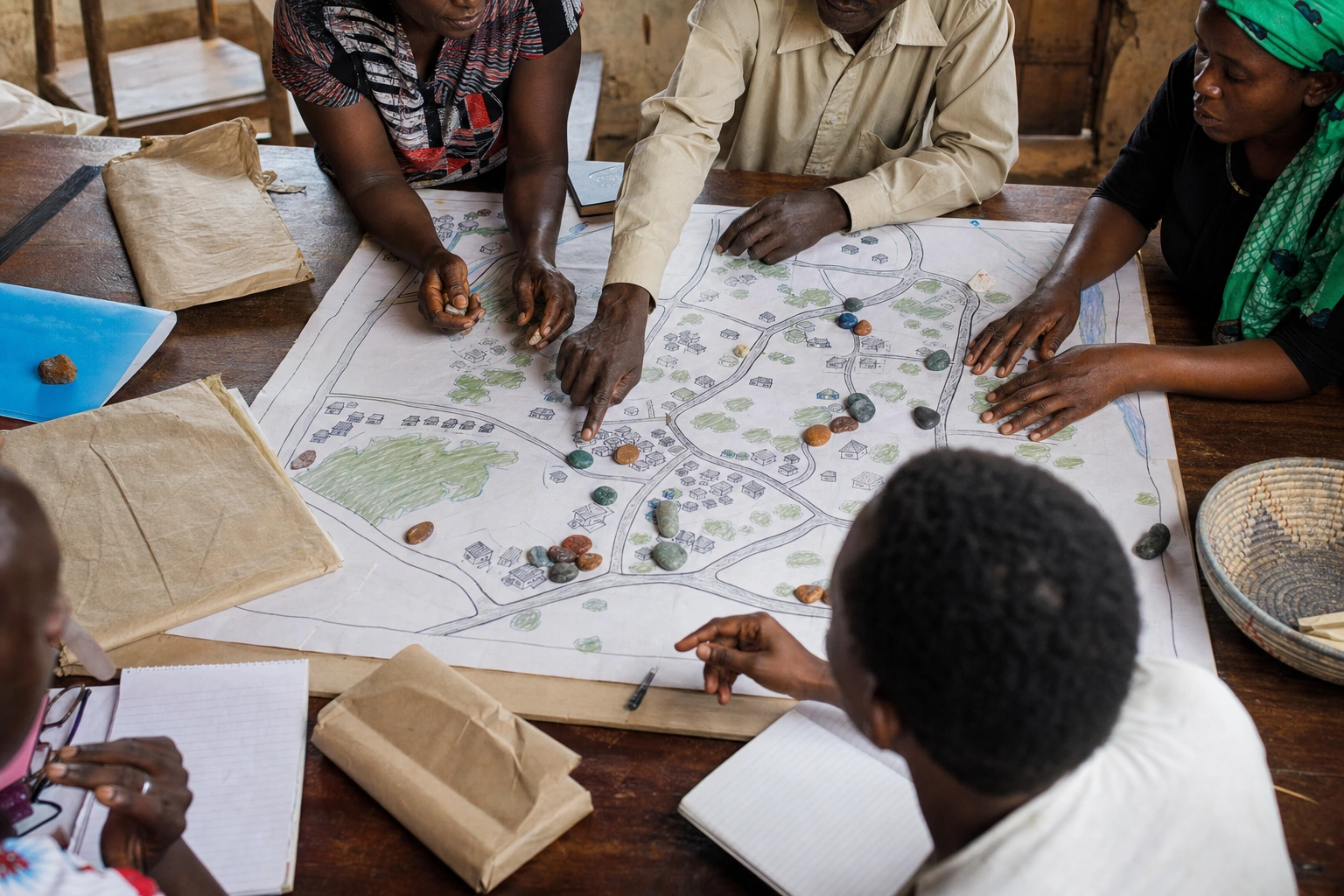
Development programmes are more likely to succeed when the people affected by them help shape, implement and assess them. Community participation is not simply the act of inviting residents to a meeting. It is a process through which people contribute their knowledge, priorities, decisions, labour, resources and feedback to actions intended to improve their lives.
Whether the initiative concerns water access, public health, education, livelihoods, roads or local environmental management, participation can improve development outcomes by making interventions more relevant and accountable. It can also reveal risks that outside organisations may miss. However, participation produces these benefits only when it is meaningful, inclusive and connected to real influence. A meeting held after all decisions have already been made may create the appearance of involvement without offering its substance.
What community participation means
Community participation involves people taking part in decisions and activities that affect their shared wellbeing. The community may be defined by geography, such as residents of a village or informal settlement, or by a shared identity or interest, such as smallholder farmers, persons with disabilities, youth groups or traders.
Participation can occur at several stages of a development initiative:
- Identifying needs: community members describe problems, priorities and existing strengths.
- Designing solutions: residents help determine what should be done, where, when and for whom.
- Making decisions: people influence the allocation of funds, selection of activities and setting of local rules.
- Implementing activities: community members contribute skills, labour, local knowledge, oversight or resources.
- Monitoring and learning: residents track progress, report problems and suggest improvements.
- Evaluating results: the community helps judge whether the intervention has made a useful and fair difference.
These forms of involvement are not equally powerful. Being informed is different from being consulted, and consultation is different from sharing decision-making authority. A strong participation process makes clear what the community can influence and how its views will affect the final decision.
How participation improves development outcomes
1. It makes interventions more relevant
Local people possess practical knowledge about their environment, routines, relationships and constraints. This knowledge can improve the fit between a development intervention and everyday life.
For example, an organisation planning a water point may identify a technically suitable location on a map. Residents may explain that the proposed site becomes inaccessible during heavy rains, is too far for older people, or creates safety concerns for children collecting water. They may also identify an existing community structure that could support maintenance. Incorporating this information can lead to a more useful and safer design.
Participation also helps distinguish symptoms from underlying problems. A project team may observe low school attendance and assume that families do not value education. Discussions with learners, parents and teachers might reveal transport difficulties, seasonal work, inadequate sanitation or fear of harassment on the journey to school. A more accurate diagnosis produces a more appropriate response.
2. It strengthens local ownership
People are more likely to support and protect an initiative when they have helped shape it and can see how it responds to shared priorities. Ownership does not mean that communities must finance an entire project or provide unpaid labour. It means that people recognise the initiative as relevant to them and have a meaningful stake in its success.
Local ownership can influence behaviour after external funding or technical support ends. A community health programme, for instance, is more likely to continue using referral systems, health information or peer support when local residents have helped design the approach and understand its purpose. Similarly, a farmers’ group that helps establish its own learning activities may be more willing to maintain records, share knowledge and adapt practices.
Ownership is built through respectful relationships, transparency and shared responsibility. It cannot be created by transferring tasks to residents without transferring information, authority or resources.
3. It improves accountability and trust
Participation creates opportunities for communities to ask questions, examine plans and monitor commitments. This can make development actors more accountable for the quality, timing and fairness of their work.
For instance, if residents help agree the criteria for selecting households for a livelihood programme, the process is easier to explain and scrutinise. If a local committee reviews progress against a public workplan, delays or missing activities can be raised before they become permanent failures. Feedback mechanisms, such as community meetings, suggestion channels or structured complaints processes, can also help identify problems that routine reporting may not reveal.
Accountability works best when feedback leads to a response. If community members repeatedly raise an issue and receive no explanation or action, participation can reduce trust rather than build it. Organisations should therefore record concerns, communicate decisions and explain honestly when a request cannot be accepted.
4. It uses local knowledge and resources
Development initiatives often become more effective when they combine professional expertise with community knowledge. Residents may understand local weather patterns, social networks, markets, languages, land use, informal support systems and previous attempts to address a problem.
In coastal communities, local fishers may provide useful knowledge about seasonal conditions and fishing areas. In dryland areas, pastoralists may understand movement patterns and water sources that are not visible in formal records. In urban neighbourhoods, traders, tenants and youth groups may know how people use public spaces at different times of day. Such knowledge can improve planning and reduce avoidable mistakes.
Communities may also contribute resources beyond money. These can include meeting spaces, volunteer time, local monitoring, technical skills, social influence and links to other institutions. Responsible development practice recognises these contributions without assuming that people can give unlimited time or absorb costs that should be covered by the programme.
5. It supports inclusion and equity
Participation can bring forward the experiences of groups that are often overlooked by formal planning systems. Women, young people, persons with disabilities, older residents, minority groups and people living in poverty may experience the same service differently from more powerful community members.
However, inviting these groups to a meeting does not automatically make the process inclusive. Barriers may include meeting times that conflict with care work, inaccessible venues, transport costs, language differences, fear of speaking publicly or social norms that give some people greater influence.
Inclusive participation requires deliberate design. Organisers may need to hold smaller discussions, provide accessible venues, use local languages, schedule activities at practical times and create safe ways to contribute privately. They should also examine who attends, who speaks, whose suggestions are adopted and who benefits from the final decision.
Equity means more than equal numbers in a room. It means paying attention to unequal power and making reasonable adjustments so that different groups can influence decisions fairly.
6. It improves implementation and sustainability
Many initiatives fail not because the original idea was unsound, but because implementation does not fit local conditions. Community participation can identify operational problems early and support timely adaptation.
Consider a waste-management project that distributes collection bins without consulting residents. The bins may be placed where vehicles cannot reach them, collection times may conflict with market activities, or households may not understand how waste should be separated. Involving residents in planning routes, schedules, responsibilities and communication can improve daily use.
Participation also supports sustainability by clarifying who will maintain an asset, fund recurring costs, manage records and resolve disputes. These questions should be addressed before construction or launch, not after external support has ended. A well-designed handover is not merely a ceremony; it includes capacity, authority, resources and realistic arrangements for ongoing management.
Participation is not automatically meaningful
Participation can be tokenistic when people are invited to approve decisions that have already been made. It can also be captured by local elites, meaning that influential individuals speak on behalf of everyone and direct benefits towards their own networks. Other risks include consultation fatigue, unrealistic promises, unpaid burdens and the exclusion of quieter groups.
There is also a difference between participation in an activity and participation in power. Community members may provide labour or attend training while having little influence over budgets, priorities or evaluation. Organisations should therefore ask not only whether people participated, but also what changed because they participated.
Meaningful participation usually has five characteristics:
- Early involvement: people contribute before major choices are fixed.
- Clear influence: participants understand which decisions are open to change.
- Accessible processes: practical, financial, social and physical barriers are addressed.
- Transparency: information about budgets, criteria, responsibilities and limitations is shared in understandable language.
- Feedback and response: suggestions and complaints are documented, answered and used to improve action.
A practical process for building participation into a project
Step 1: Understand the community and its power dynamics
Start by identifying different groups, institutions and interests rather than treating the community as a single voice. Map who is affected, who has knowledge, who makes decisions and who may be excluded. This may include elected representatives, traditional leaders, faith organisations, schools, businesses, civil society groups and informal networks.
Step 2: Agree the purpose and boundaries
Explain what the project seeks to achieve, what resources are available and what decisions the community can influence. Do not promise control where none exists. Clear boundaries help participants make realistic contributions and reduce later disappointment.
Step 3: Use more than one engagement method
A single public meeting often favours people who are confident, available and socially powerful. Combine community dialogues with household visits, focus discussions, mapping exercises, surveys, youth sessions or accessible feedback channels. Different methods reveal different perspectives.
Step 4: Turn information into decisions
Do not collect views merely to place them in a report. Group the issues raised, identify areas of agreement and disagreement, and explain how priorities will be selected. Where resources are limited, use transparent criteria and communicate the trade-offs.
Step 5: Share responsibilities realistically
Specify who will do what, by when and with which resources. If residents are expected to monitor a facility, provide the training, forms, authority and support needed. Avoid transferring risks to volunteers without safeguarding or recognition.
Step 6: Monitor both results and participation
Track development results such as service use, income, learning or access, but also monitor the quality of participation. Useful questions include: Which groups took part? Who made decisions? Were complaints resolved? Did the project change in response to local feedback? Were benefits distributed fairly?
Applying this in practice
Suppose a county-level partnership wants to improve a rural market facility. A conventional approach might focus on construction plans and contractor supervision. A participatory approach would begin by speaking with traders, farmers, transport providers, people with disabilities, customers, nearby residents and local authorities.
These groups might identify different priorities: drainage during rainy periods, secure storage, lighting, accessible walkways, waste collection, fair stall allocation and opening hours that match transport schedules. The partnership could then agree which improvements are affordable, publish the selection criteria, establish a representative management committee and create a simple process for reporting maintenance problems.
After opening, users could review the facility at agreed intervals. If women traders find that the layout creates safety concerns, or if waste collection is insufficient, managers can adjust operations. The result is not just a physical structure, but a service shaped and monitored by the people who depend on it.
For entrepreneurs and professionals, the same principle applies to business and organisational projects. Before launching a service, speak to users about their actual needs, test assumptions, involve staff who will deliver the service and create channels for feedback. Participation can reduce costly redesign, improve adoption and reveal opportunities that a top-down plan might overlook.
Key Takeaways
- Meaningful participation gives communities influence over decisions, not merely a place in a meeting.
- Local knowledge improves the relevance, safety and practicality of development interventions.
- Ownership, accountability and trust grow when responsibilities, budgets and limitations are transparent.
- Inclusive participation requires deliberate action to remove barriers faced by less powerful groups.
- Projects should monitor who participates, who benefits and whether feedback changes implementation.
- Sustainability depends on agreeing realistic arrangements for maintenance, authority, resources and ongoing learning.
No comments yet.