
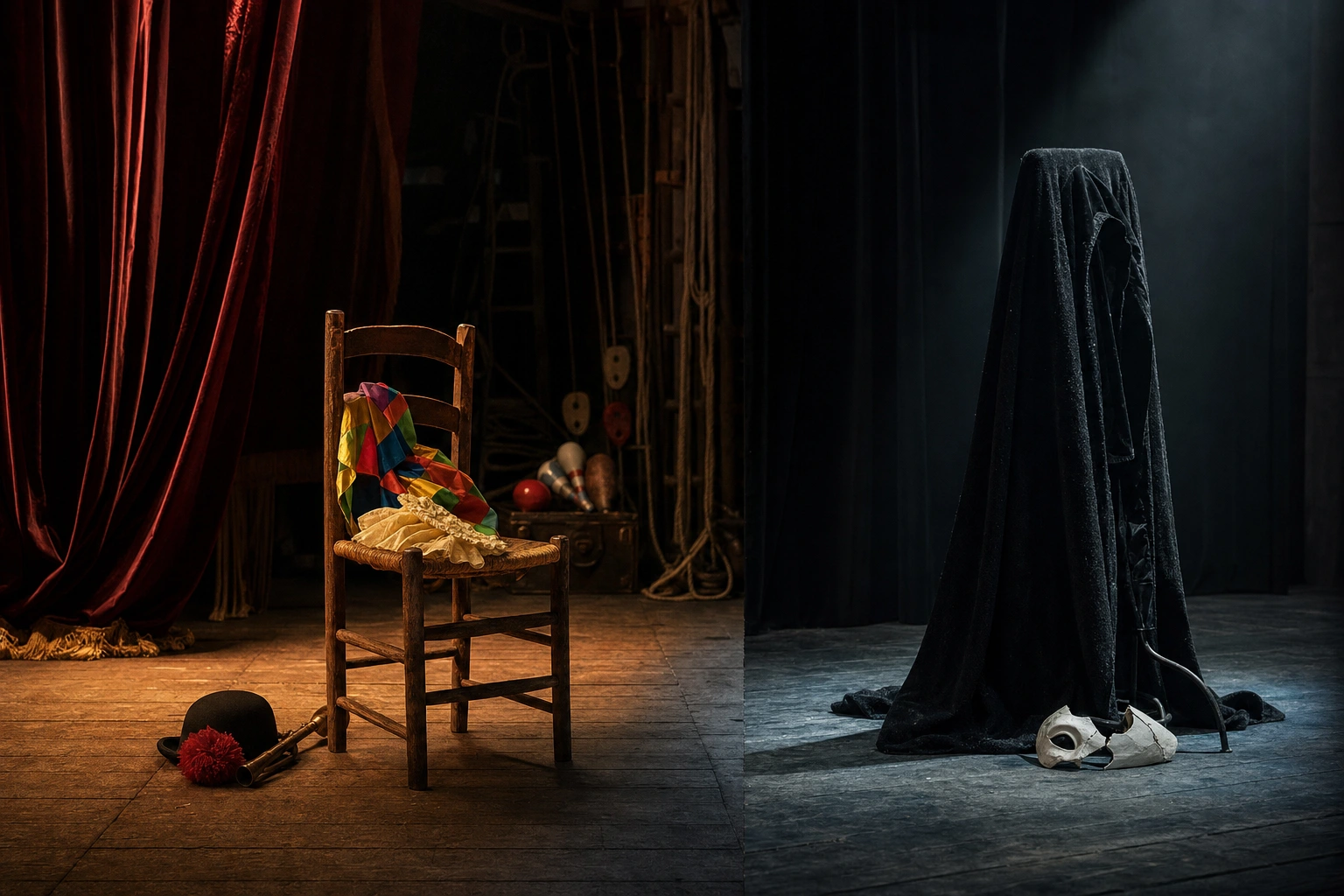
Tragedy and comedy are two of the oldest and most influential forms of drama. Although they are often treated as opposites—one serious and painful, the other humorous and enjoyable—both examine how people respond to pressure, desire, mistakes, relationships and social expectations. A play may make an audience laugh while exposing serious injustice, or create sympathy for a character while allowing moments of hope and humour.
Understanding tragedy and comedy therefore involves more than asking whether a play is sad or funny. It requires attention to the kind of conflict presented, the choices characters make, the way the plot develops, the ending the audience receives and the response the playwright wants to create. These ideas are useful not only for studying literature but also for writing scripts, interpreting performances and analysing stories in film and television.
What Is Drama?
Drama is literature designed for performance. Unlike a novel, which usually presents events through narration, drama communicates meaning through dialogue, action, character interaction, setting, staging and sometimes music or movement. The audience experiences the story as something enacted in the present, even when the events are fictional or set in the past.
Drama depends on conflict. Conflict may occur between individuals, within a character's mind, between a person and society, or between human beings and forces such as fate, nature or political power. Tragedy and comedy organise this conflict in different ways, but both depend on characters pursuing goals and encountering obstacles.
A useful analysis of any play asks five questions:
- What does each major character want?
- What prevents the character from achieving that desire?
- How do choices and misunderstandings change the situation?
- What does the audience know that the characters do not know?
- What does the ending suggest about individuals and society?
Understanding Tragedy
Tragedy is a dramatic form in which serious conflict leads to profound suffering, loss, moral crisis or destruction. Its purpose is not simply to make the audience unhappy. Tragedy invites audiences to examine difficult human experiences and to consider how personal choices, social systems, chance and responsibility interact.
In many classical tragedies, the central character has an important position or an unusual quality, but also possesses a weakness, limitation or error that contributes to the crisis. This character is often called a tragic protagonist or tragic hero. However, the term “hero” does not necessarily mean that the character is morally perfect. A tragic protagonist may be brave and intelligent yet proud, impulsive, jealous, indecisive or unable to recognise an uncomfortable truth.
Major features of tragedy
- Serious subject matter: Tragedy often deals with death, power, betrayal, injustice, family conflict, war, identity or the struggle between personal desire and public duty.
- A central moral or personal conflict: The protagonist usually faces a choice in which every available option carries a cost.
- Escalating consequences: A decision, discovery or mistake sets off further events. The situation becomes increasingly difficult to reverse.
- Recognition or realisation: The protagonist may eventually understand the truth about a person, situation or personal responsibility, although the discovery may come too late to prevent disaster.
- Reversal: A character's circumstances may change sharply from security to danger, authority to weakness or hope to despair.
- Loss or suffering: The ending often includes death, separation, political collapse, psychological damage or a permanent change in the community.
Aristotle's writing about Greek tragedy introduced ideas that have influenced later drama, including plot, character, recognition, reversal and catharsis. Catharsis is commonly understood as the emotional effect produced when audiences experience and process feelings such as pity and fear through the action of the play. It should not be reduced to the idea that audiences merely “feel better” after crying. The term relates to the way drama gives emotional and intellectual shape to disturbing human experiences.
Shakespeare's Macbeth illustrates several tragic patterns. Macbeth desires power, acts on that desire and gradually becomes trapped by fear, suspicion and violence. His choices damage both his private relationships and the wider political order. The play's tragedy does not arise from one isolated mistake; it develops through a chain of ambition, prediction, persuasion, murder and further attempts to protect acquired power.
Tragedy can also expose the pressure created by social or historical circumstances. In Antigone, the conflict is not simply between a good person and a bad person. Antigone defends family and religious duty, while Creon defends the authority of the state. Each position contains a recognisable principle, but the refusal of both characters to reconsider their certainty produces destructive consequences.
African drama also demonstrates that tragedy need not follow one narrow European pattern. In Wole Soyinka's Death and the King's Horseman, ritual duty, colonial interference, individual responsibility and communal expectations interact in a complex crisis. Studying such works encourages learners to ask how different cultures represent duty, leadership, death and social order rather than assuming that every tragedy follows exactly the same structure.
Understanding Comedy
Comedy is a dramatic form that uses humour, incongruity, misunderstanding and social observation to entertain audiences and often to question accepted behaviour. A comedy does not have to be shallow, and it does not need to avoid serious subjects. Its distinctive feature is usually the way conflict is managed: problems tend to be exposed, negotiated, reversed or resolved without the complete destruction associated with tragedy.
Comedy frequently presents ordinary people rather than rulers or warriors, although characters from every social class can appear. Comic figures may be vain, boastful, hypocritical, jealous, confused or excessively formal. By exaggerating these qualities, the playwright makes personal weaknesses visible and invites the audience to laugh at behaviour that may also deserve criticism.
Major features of comedy
- Humour: Comedy may use wordplay, satire, physical action, irony, parody, exaggeration or awkward situations.
- Misunderstanding: Characters may misread a message, disguise themselves, mistake identities or draw the wrong conclusion from incomplete information.
- Social disruption: Ordinary rules about marriage, class, gender, money or authority may be challenged, temporarily overturned or shown to be absurd.
- Flexible character types: Comic plots often include the clever outsider, the foolish authority figure, the boastful character, the strict parent, the young lover or the servant who sees through social pretence.
- Reconciliation or restoration: The ending often brings marriage, reunion, forgiveness, recognition or a renewed social balance, though modern comedies may end more ambiguously.
Shakespeare's A Midsummer Night's Dream combines romantic confusion, mistaken identity and theatrical self-parody. The audience understands more than many of the characters, so misunderstandings become a source of dramatic irony. In Oscar Wilde's The Importance of Being Earnest, witty dialogue and false identities expose the artificiality of social respectability. The audience laughs at the characters' elaborate deceptions, but the play also criticises a society that places excessive value on appearances and status.
Comedy can serve as social criticism because laughter creates distance. An audience may notice the absurdity of corruption, prejudice or bureaucracy more clearly when these behaviours are exaggerated on stage. Satire, in particular, uses humour to expose weaknesses in individuals, institutions or public beliefs. The presence of humour does not automatically make a work harmless; comedy can challenge powerful people and uncomfortable assumptions.
How Tragedy and Comedy Differ
The clearest difference between tragedy and comedy is the direction of the dramatic movement. Tragedy usually moves towards irreversible loss or a painful recognition, while comedy often moves towards discovery, reconciliation or a new arrangement. Yet the difference is not simply serious versus amusing.
- Conflict: Tragedy often presents conflicts that cannot be fully repaired. Comedy tends to create conflicts that can be resolved through communication, recognition or compromise.
- Character development: A tragic character may gain knowledge through suffering, while a comic character may escape a mistake, learn flexibility or expose the foolishness of others.
- Social order: Tragedy may end with the collapse or transformation of a family, kingdom or community. Comedy often restores social connections, although it may also reveal that the restored order is imperfect.
- Audience response: Tragedy commonly invites pity, fear, sorrow and reflection. Comedy invites laughter, surprise and pleasure, but may also produce embarrassment, criticism and social awareness.
- Time and possibility: In tragedy, opportunities are frequently missed until they cannot be recovered. In comedy, new information often arrives in time to change the outcome.
These are tendencies rather than absolute rules. A tragedy may contain comic scenes, and a comedy may include grief, exclusion or serious danger. Shakespeare's plays often mix tones, while modern drama frequently rejects neat categories. A work may be called a tragicomedy when it combines serious threats with humour or ends in a way that is neither wholly tragic nor conventionally comic.
Shared Dramatic Techniques
Tragedy and comedy use many of the same tools. The difference lies in how those tools shape meaning and audience response.
Foreshadowing
Foreshadowing gives the audience clues about what may happen later. In tragedy, it can create dread because viewers recognise danger before the characters do. In comedy, it may prepare the audience for an eventual misunderstanding or reveal while the characters remain unaware.
Dramatic irony
Dramatic irony occurs when the audience knows important information that one or more characters do not know. In a tragedy, this gap may make an innocent action painful to watch. In a comedy, it may make a character's confident mistake amusing. The same technique therefore produces different emotions depending on the consequences of the action.
Contrast and parallel characters
Playwrights often place characters with opposing qualities side by side. A cautious character may be contrasted with an impulsive one; a sincere character with a hypocrite; or a powerful public figure with a vulnerable private individual. These contrasts clarify the play's values and reveal different responses to the same pressure.
Language and performance
Language is central to both forms. Tragedy may use formal speeches, imagery, symbolism and pauses to express inner conflict. Comedy may rely on puns, repetition, understatement, rapid exchanges and double meanings. Performance adds another layer: tone, gesture, costume, movement, lighting and silence can change how a line is understood. A supposedly comic scene may become disturbing through slow pacing or sombre staging, while a serious line may generate laughter through timing.
How to Analyse a Tragedy or Comedy
- Identify the central conflict. State what the main character wants and what prevents that desire from being fulfilled.
- Track the turning points. Mark the events that change the direction of the plot, such as a revelation, betrayal, disguise, death or public decision.
- Examine character choices. Do not blame or praise a character without explaining the evidence. Consider personal weakness, social pressure, misinformation and available alternatives.
- Study the audience's knowledge. Ask what the audience understands before the characters do. This often reveals the role of irony and suspense.
- Analyse the ending. Decide whether the ending restores relationships, exposes a social problem, confirms a destructive pattern or leaves the audience uncertain.
- Connect form to meaning. Explain how humour, suffering, silence, repetition, symbolism or staging contributes to the play's ideas.
For example, when analysing a comic scene involving mistaken identity, do more than state that it is funny. Explain what information each character possesses, how the misunderstanding develops, which social rule is being tested and whether the final recognition changes the characters or merely restores the previous order.
Applying This in Practice
When writing or discussing a play, begin by deciding what kind of audience response you want. If the central action should create tragic pressure, give the protagonist a meaningful desire, a difficult choice and consequences that become increasingly hard to reverse. Avoid making the ending tragic through an unrelated accident; the audience should be able to trace how earlier decisions contributed to the outcome.
If you are developing a comedy, create a clear imbalance. This might be a rigid parent facing independent young people, a proud official confronted by an ordinary citizen or a business owner whose secret threatens the image of success. Let the humour arise from character and situation rather than from random jokes. Give the audience information that makes the characters' mistakes understandable, then use recognition or communication to move the plot towards change.
For an essay, a strong argument might claim that a play uses comedy to criticise social pretence, or that its tragedy results from the clash between personal responsibility and public duty. Support the argument with specific scenes, words, actions and structural turning points. Always explain how the evidence creates meaning; plot summary alone does not constitute analysis.
Key Takeaways
- Tragedy presents serious conflict that leads to suffering, loss, moral crisis or irreversible change.
- Comedy uses humour, misunderstanding and social observation to expose behaviour and often move towards reconciliation or restoration.
- A tragic protagonist is not necessarily morally perfect; personal weakness, social pressure and difficult choices may all shape the disaster.
- Dramatic irony, foreshadowing, contrast and performance techniques operate in both tragedy and comedy, but they create different audience responses.
- The ending, rather than the presence of sadness or jokes alone, is one of the strongest ways to distinguish tragic and comic dramatic movement.
- Good drama analysis connects character choices, turning points, language and staging to the play's wider ideas.
No comments yet.